
Industrial Property Due Diligence Checklist in Navi Mumbai
Industrial Property Due Diligence Checklist in Navi Mumbai means checking title, transfer rights, land-use fit, MPCB and CETP compliance, building approvals, dues, and actual site usability before paying token. That is the real answer. A factory unit can look perfectly saleable on paper and still become a bad purchase if the transfer is blocked, the consent is not valid for your activity, or the site simply cannot support your operations.
Buying an industrial property in Taloja, TTC, Rabale, Mahape, Turbhe, or the Panvel-side belt is not like buying a flat or even a normal shop. Here, a clean sale deed is only the starting point. The bigger risk is often hidden in authority-side permissions, environmental compliance, structural changes, tax arrears, or operational mismatch.
This guide is built for practical use. Not theory. Not generic property advice. The goal is simple: help you avoid paying money into a deal that later becomes legally messy, operationally weak, or financially painful.
What industrial property due diligence in Navi Mumbai actually means before you pay token
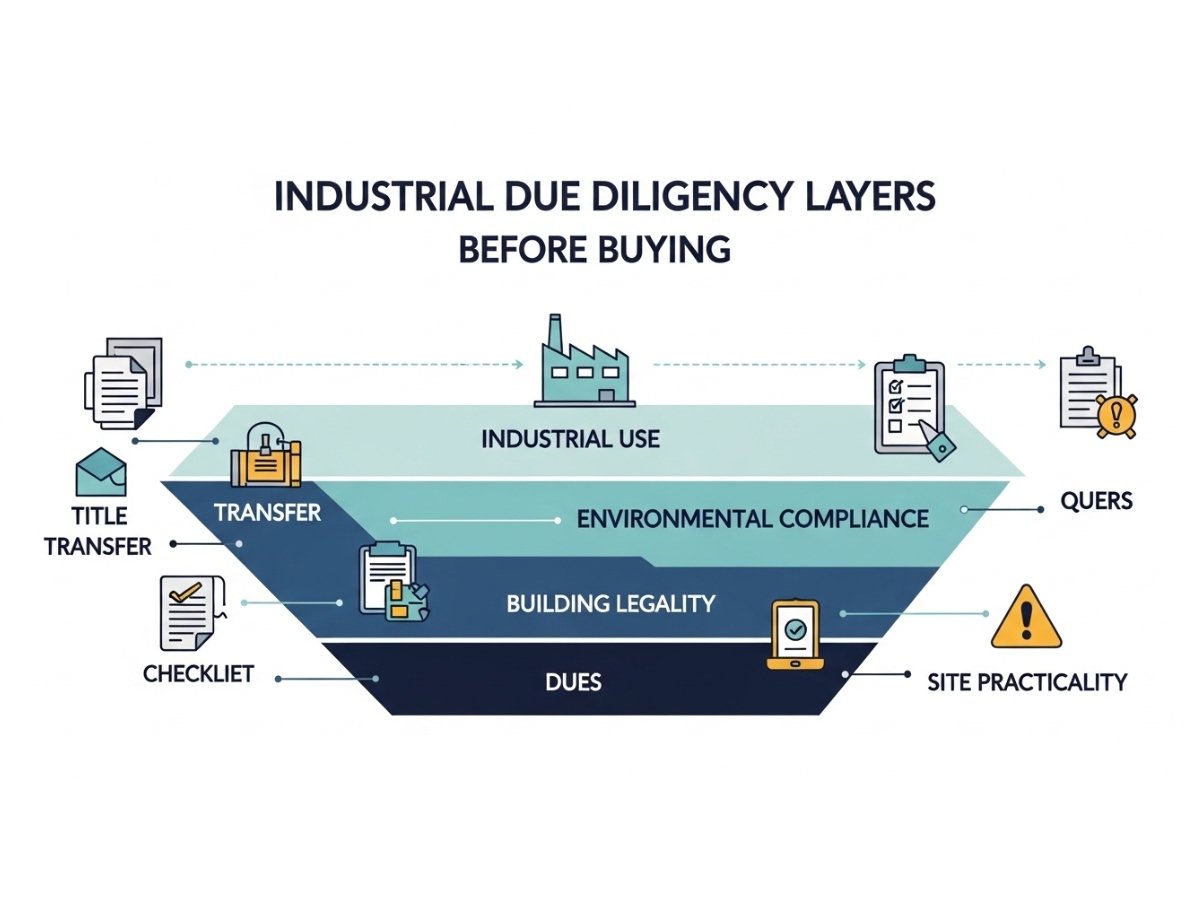
In simple words, due diligence means checking whether the property is actually safe to buy, legally transferable, and practically usable for your intended business. In Navi Mumbai industrial belts, those are three different questions, and buyers often wrongly treat them as one.
Here is the quickest way to understand it:
| Check layer | What you are really verifying | Why it matters |
|---|---|---|
| Ownership and title | Does the seller have the legal right to sell or assign the property? | Without this, the deal itself is weak |
| Authority-side transfer | Will MIDC or CIDCO allow the transfer, and are old dues or permissions pending? | A property can have possession but still face transfer trouble |
| Industrial-use legality | Is the property legally suitable for your exact activity? | Wrong activity fit can block operations |
| Environmental compliance | Does MPCB consent exist, and does effluent/waste handling match the use? | A unit can face closure risk even after purchase |
| Building legality | Does the actual structure match approved plans and usage permissions? | Illegal additions become your liability |
| Dues and cost exposure | Are tax, water, maintenance, premium, or transfer charges pending? | Hidden dues can change the whole deal |
| Site practicality | Can trucks move, machinery load, workers operate, and utilities support your use? | Paper-safe does not mean operationally safe |
That last line matters most: paper-safe does not equal operationally safe.
Why industrial property due diligence is stricter than a normal property check
A residential property buyer usually worries about title, loanability, society papers, and basic tax receipts. Industrial buyers have to go much further.
Title can be clear but industrial use can still fail
A seller may show a registered document and years of possession. But that still does not answer whether your proposed activity can legally run there. MPCB consent is activity-specific. Zoning fit matters. Effluent capacity matters. Waste disposal trail matters. A garment unit, a fabrication unit, a warehouse, and a chemical-processing unit do not carry the same compliance burden.
That is why industrial property legal checks in Navi Mumbai must go beyond “show me the sale deed.”
A transferable unit is not automatically a usable unit
Suppose you are buying an industrial gala because the rate looks attractive. On paper, transfer may be possible. But on site, you discover a low floor load capacity, weak truck access, illegal mezzanine, and no practical loading area. The property is transferable, yes. Useful for your actual business, maybe not.
That is the central mistake many first-time buyers make. They buy the asset first and test operational fit later.
Start with this 3-stage due diligence order so you do not waste money
The smartest industrial buyers do not do everything at once. They filter first, verify next, and confirm before final payment.
Stage 1: Early filter before token
This is the fast rejection stage. At this point, do not spend like the deal is already final.
Check:
- basic seller identity and present ownership claim
- property type: MIDC, CIDCO-linked, private layout, shared gala, old factory
- broad activity fit for your proposed use
- visible structural deviations from approved-looking layout
- any obvious environmental or site-level red flag
- whether the transfer story itself sounds clean or vague
If the seller cannot clearly explain title history, present use, or approval status even at this stage, slow down immediately.
Stage 2: Document and authority verification
This is where the real factory purchase checklist begins.
Check:
- 30-year title search report
- lease deed or assignment chain
- allotment trail and transfer approvals
- encumbrance or mortgage status
- MIDC or CIDCO transfer feasibility
- property tax, water dues, society dues, power dues
- sanctioned plans and usage permissions
- latest MPCB consent and waste handling papers
This stage usually decides whether the deal deserves an agreement.
Stage 3: Site, compliance, and final cost confirmation
Before final payment or registration, confirm what can still derail the transaction:
- lender NOC or charge release
- actual no-dues position
- final transfer premium or unearned income burden
- structural match with plans
- fire and occupancy-related usability
- utility sufficiency for your business
- whether your intended activity still fits the property without requiring a major regulatory reset
This three-step flow saves money. It prevents the common mistake of paying token first and asking serious questions later.
Which industrial property type are you buying, and why that changes the checklist
Not all industrial assets in Navi Mumbai should be checked the same way.
MIDC plot or shed
MIDC property due diligence usually involves stronger focus on allotment conditions, leasehold position, transfer classification, water dues, and authority-side premiums. Transfer charges are not one fixed universal number. They depend on the nature of the transfer and the asset profile.
CIDCO-linked or leasehold industrial asset
A CIDCO industrial property transfer check becomes more sensitive where the ownership story begins with allotment and later assignment. One of the biggest local mistakes is confusing an Agreement to Lease with a final Lease Deed. They are not the same. The final registered lease instrument is the stronger document for clear, mortgageable rights.
Private industrial layout or old standalone factory
Here the title chain, zoning status, building legality, and old approvals become critical. Buyers often assume older properties are simple because they have been in use for years. That assumption is dangerous.
Gala, tenanted unit, or part-building industrial space
Shared industrial buildings bring extra layers: society rules, maintenance dues, shared services, roof rights, common utility dependence, and internal alteration risk. A gala can be cheap to enter and expensive to regularize.
What title and authority-side documents must be checked first
This is the first serious layer. If this part is weak, later checks do not rescue the deal.
You need to verify the seller’s right to sell, the property’s right to be transferred, and whether old lapses are sitting in the background.
Key title and authority-side documents include:
- registered sale deed, lease deed, or assignment deed
- allotment documents where relevant
- 30-year title search report
- Index II and chain documents
- transfer approvals from the relevant authority where required
- mutation trail and present holding status
- mortgage papers, lender NOC, or closure proof if financed
A major local risk in Navi Mumbai is historical non-compliance in past transfers. For example, if a previous CIDCO-linked transfer should have cleared unearned income obligations and did not, the issue may not disappear. It can return when the next buyer tries to transfer or finance the asset.
So do not just ask, “Does the seller own it?” Also ask, “Was every previous transfer properly cleared by the relevant authority?”
What land-use and industrial-use legality must be confirmed before going further
This is where many industrial shed legal checks in Navi Mumbai fail quietly.
The main question is not whether the property is “industrial.” The real question is whether it is suitable for your exact industrial activity.
A warehouse-type or light industrial unit may not automatically work for a more pollution-heavy or process-heavy operation. A presently compliant unit can become non-compliant the moment the buyer changes machinery, output, water consumption, waste generation, or process category.
So verify:
- current sanctioned use
- actual present use
- your proposed use
- any activity restrictions
- whether expansion, chemical handling, or discharge needs create a mismatch
This is especially important for buyers moving from leasing to owning. Many businesses assume their current rented operations can be copied into a purchased unit without issue. That is not always true.
> Caution: Do not buy first and ask “Can we run our process here?” later. Ask that question before term-sheet comfort begins.
How to check MPCB, CETP, effluent, and waste risk before buying an industrial unit
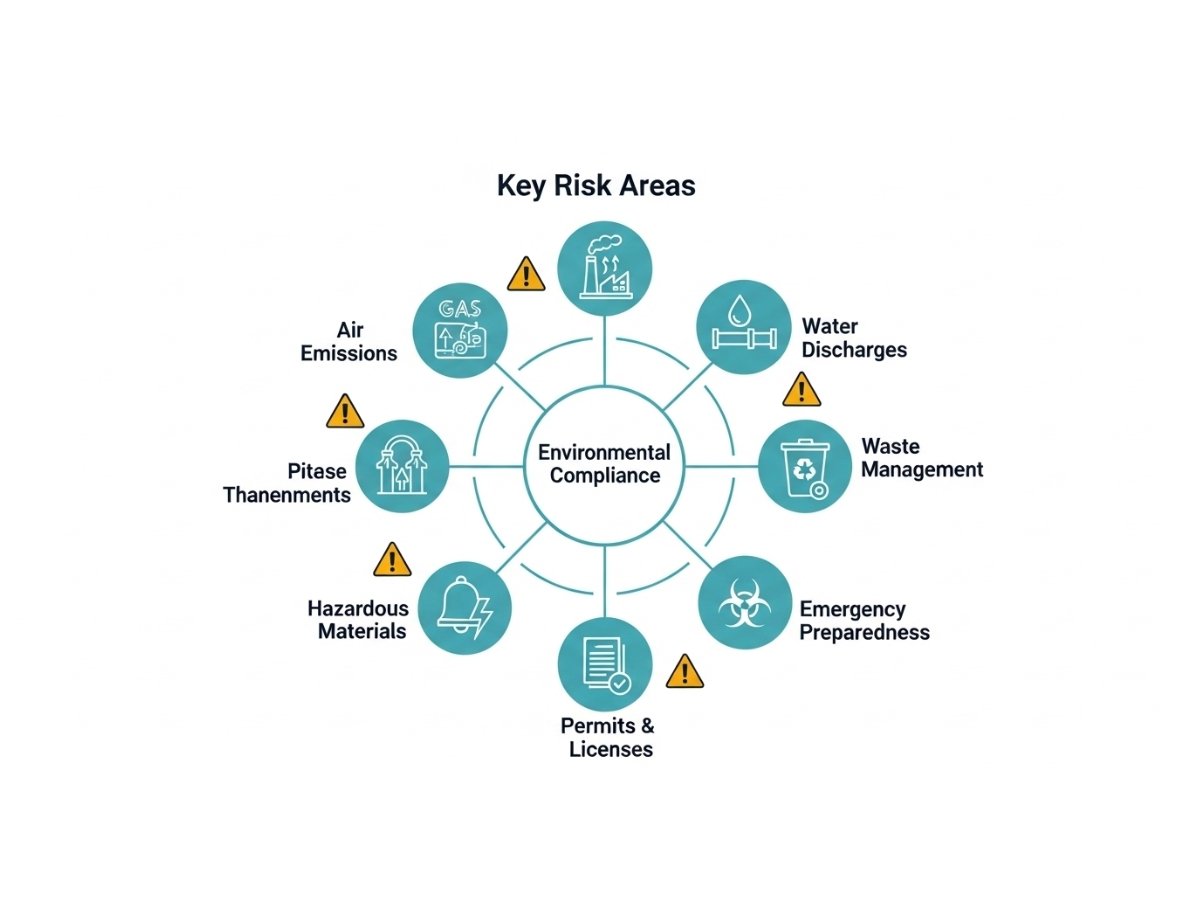
For many industrial deals in Navi Mumbai, this is the section that separates a smart buyer from a trapped buyer.
MPCB consent is not a decorative paper. It is an operating license tied to the nature of the activity. If the property has consent for one process and you plan another, the old consent may not protect you.
Whether MPCB consent exists, is valid, and matches the actual activity
Ask for the latest valid consent position, not just one old file. An expired or outdated approval copy proves very little. What matters is whether the consent is current and whether it matches real use on the ground.
How CETP linkage or ETP setup changes buyer risk
This matters heavily in belts like Taloja. Taloja has faced strong environmental scrutiny, and CETP capacity constraints are not theoretical. If your activity depends on effluent discharge support, you should verify the actual route and present linkage.
TTC has a different profile. It has stronger infrastructure in many parts, but monitoring is also serious. So the environmental comfort is not automatic there either.
Waste handling, hazardous waste trail, and occupier responsibility
Industrial buyers should also examine whether waste handling was lawful and properly documented. Hazardous waste issues do not become harmless just because ownership changes.
Here is a practical environmental document map:
| Document / proof | What it should prove | Risk if weak or missing |
|---|---|---|
| Valid CTO / consent papers | The present activity is legally allowed to operate | Closure risk, refusal of operational continuity |
| CETP linkage / discharge route proof | Effluent has a lawful disposal path | Consent refusal or future stoppage |
| ETP-related infrastructure evidence, if applicable | On-site treatment setup exists where needed | Non-compliance exposure |
| Waste disposal records / manifests | Hazardous or regulated waste was handled lawfully | Buyer may inherit serious compliance risk |
| Site inspection history / pending action clarity | No active closure-type crisis is hanging over the unit | High walk-away signal if active enforcement exists |
A practical way to think about it: when you buy an industrial unit, you may also be inheriting its environmental history.
What building approvals and occupancy checks are non-negotiable in industrial property
This is where buyers often get fooled by “extra usable area.”
Older industrial stock in Navi Mumbai, especially in some mature belts, can have unauthorized changes such as mezzanines, covered extensions, altered loading areas, side sheds, or structural adjustments made over time. These may look commercially useful. Legally, they can be a headache.
You should verify:
- sanctioned building plans
- actual built-up versus approved built-up
- whether the present structure matches the approved drawings
- occupancy or completion-related usage legality where applicable
- practical fire and structural safety logic
If a structure on site does not appear on the approved plan, do not casually treat it as bonus area. Treat it as a red flag until verified.
> Red flag: An “as-is” industrial purchase where visible built-up is materially larger than the approved layout should not be treated as a normal deal.
Which money-side checks buyers forget until the deal becomes expensive
Many industrial property deals look affordable until the money-side truth comes out.
In TTC-side NMMC zones such as Mahape and Rabale, buyers should pay attention to the higher industrial tax burden. Prevailing industrial property tax rates can be materially heavier than residential or commercial brackets, and this changes long-term operating cost. In pure MIDC-notified areas like Taloja, the recurring burden profile may differ, but environmental and authority-side checks become sharper.
Also check for:
- transfer charges
- unearned income-related liabilities in CIDCO-linked cases
- MIDC premium implications depending on transfer type
- property tax arrears
- water dues
- power dues
- society or maintenance arrears
- lender charge release
- tenant deposit or occupancy-related obligations
Do not rely only on the latest receipt shown by the seller. A recent payment receipt is not the same as a true no-dues position.
How to inspect the site like a serious buyer, not just a paper buyer
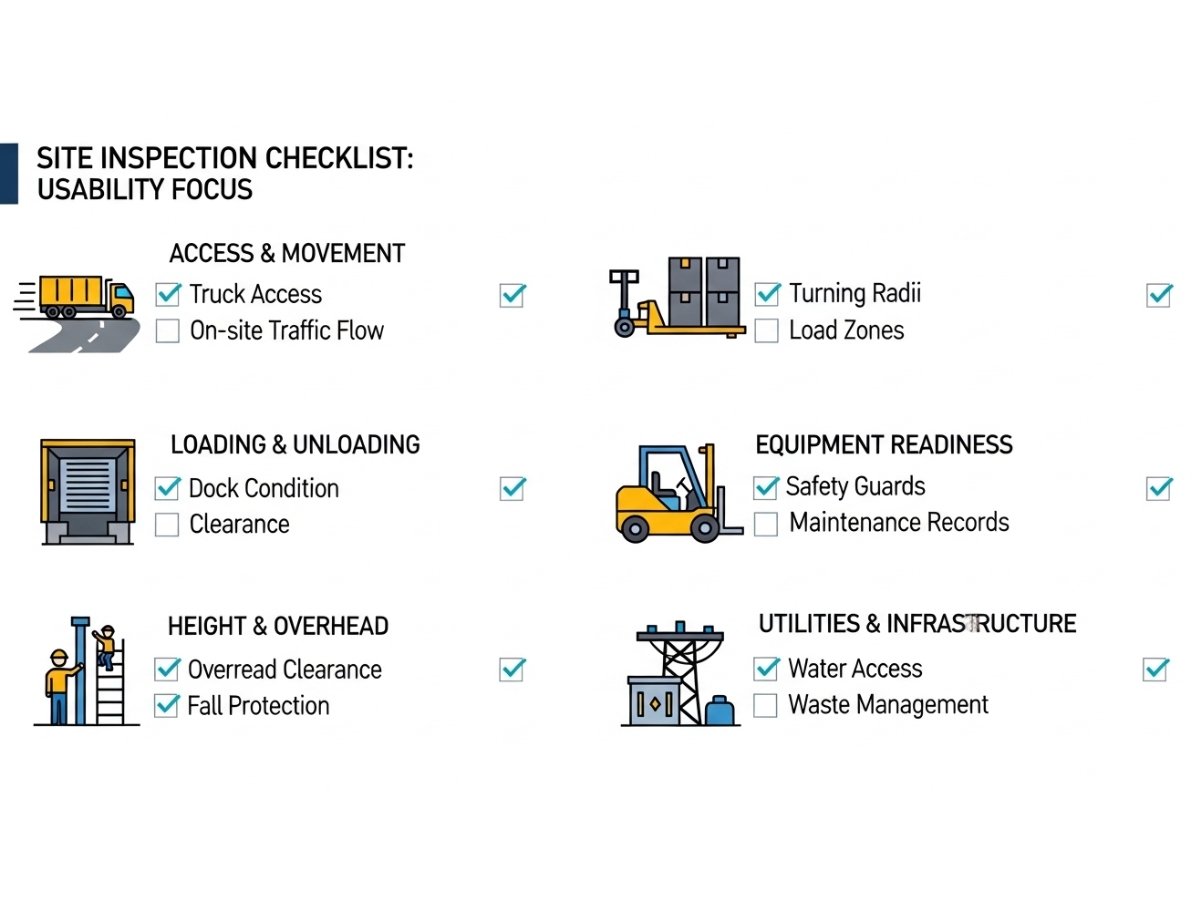
Industrial value is decided partly by paperwork and partly by function. Both matter.
When you visit the site, inspect like an operator:
- Can a heavy vehicle enter and turn properly?
- Is road width practical or only visually acceptable for a small vehicle?
- Is the loading point actually usable?
- Does the clear height suit your storage or machinery need?
- Is the floor likely suitable for heavy operations?
- Is drainage visible and sensible?
- Does water and power supply look realistic for your use?
- Are there obvious internal alterations that may have approval issues?
A logistics user, for example, can reject a legally clean property if truck movement fails. A manufacturing user can reject it if the slab, height, or utility setup is weak. A buyer should never let a clean title blind him to a bad site.
Navi Mumbai industrial belts do not carry the same due-diligence risk
This is where local understanding becomes important.
TTC-side assets: stronger infrastructure, but older stock and alteration risk
Mahape, Rabale, and Turbhe often benefit from established industrial infrastructure and better urban integration. But many assets are older, altered over time, and subject to municipal tax realities. That means structural regularity, tax dues, and approved-plan matching deserve extra attention.
Taloja-side assets: pollution and process-fit checks matter more
Taloja remains highly relevant for industrial buyers, but environmental scrutiny is not light. Here, MPCB logic, CETP capacity sensitivity, effluent handling, and process fit become central parts of due diligence. Buyers of chemical or wet-processing units should be especially careful.
Panvel or peripheral industrial belts: title, zoning, and access scrutiny can matter more
As you move into peripheral or mixed-transition belts, buyers should look harder at title continuity, land-use clarity, road practicality, and local development context. Do not assume all industrial-looking stock is equally clean from a transfer and usage standpoint.
15 walk-away signals in an industrial property deal
These are not small warning signs. These are serious reasons to pause or exit.
- Seller cannot clearly explain title chain or present authority status
- Only preliminary allotment-style papers are shown, but no final strong transfer instrument
- Previous transfers appear irregular or incomplete
- Major mortgage or lender release position is unclear
- Built structure visibly exceeds what approved papers appear to show
- Illegal mezzanine or extended shed is treated as normal saleable area
- Present use does not match sanctioned use
- Old MPCB papers are shown, but no clear current validity
- CETP or effluent route is vague for a process-dependent unit
- Hazardous waste handling trail is weak or missing
- Seller pushes token before document review
- Tax, water, or maintenance dues are not transparently disclosed
- Transfer charges or unearned income burden is left vague until later
- Truck access, loading, or utility reality does not suit your actual operations
- Broker says “everything can be managed later” without documentary support
A practical due diligence checklist you can use before booking any industrial property in Navi Mumbai
| Check | Why it matters | What to ask for | Walk-away signal |
|---|---|---|---|
| Seller authority | Confirms present right to sell/assign | Chain documents, ID, holding proof | Seller story keeps changing |
| Title chain | Shows ownership continuity | 30-year search report, Index II, prior deeds | Major gap or disputed link |
| Leasehold strength | Essential in MIDC/CIDCO-type cases | Lease deed, assignment papers, transfer approvals | Only preliminary allotment-level papers shown |
| Transfer feasibility | Prevents post-agreement blockage | MIDC/CIDCO transfer position, premium clarity | Authority-side transfer burden kept vague |
| Land-use and activity fit | Confirms your business can lawfully run | Sanctioned use, present use, proposed use review | Property is industrial, but not for your process |
| MPCB validity | Protects operational continuity | Latest valid consent and activity match | Old or mismatched consent papers |
| CETP / effluent route | Critical for process-heavy units | Linkage proof, route clarity, on-site treatment support | No clear disposal path |
| Waste compliance | Prevents inherited environmental risk | Manifest trail, disposal records | Hazardous waste history is unclear |
| Building legality | Protects against demolition or enforcement | Sanctioned plans, actual built-up match | Visible unauthorized additions |
| Occupancy / usage legality | Confirms structure is usable lawfully | Completion / occupancy-related records where relevant | No clear usage legality |
| Dues position | Stops inheritance of old liabilities | No-dues proof for tax, water, maintenance, power | Seller avoids formal no-dues proof |
| Mortgage release | Prevents finance and transfer trouble | Bank NOC / charge release | Existing charge unresolved |
| Site functionality | Ensures business practicality | Physical inspection and engineer review | Trucks, loading, slab, height, or utilities fail |
| Final cost realism | Avoids deal collapse later | Transfer cost, dues, premium, tax burden sheet | Hidden cost appears late in the deal |
Conclusion
The best industrial property due diligence checklist in Navi Mumbai is not a long paper list. It is a disciplined way of separating title safety, transfer safety, operational legality, and site practicality before money moves.
If you remember only one thing, remember this: an industrial property can be legally owned, physically standing, and still be the wrong asset to buy. That is why a serious buyer in Navi Mumbai should verify not just who owns the unit, but whether the unit can actually be transferred cleanly, operated lawfully, and used efficiently for the intended business.
That is the difference between buying an industrial property and buying a problem.
FAQs
Frquently Asked Questions