
Kharghar vs Panvel: Which Is Better for Buying Property?
Kharghar is usually the better place to buy property if your priority is present-day livability, planned surroundings, schools, parks, and a more polished residential environment. Panvel is usually the better choice if your priority is budget flexibility, wider supply, stronger railway and highway relevance, and long-term growth optionality linked to the airport belt. The right answer depends on whether you want a more finished lifestyle now or a broader value-and-growth play over time.
Quick guide
Before going deeper, this is the simplest practical answer.
| Buyer need | Better fit |
|---|---|
| Better daily livability right now | Kharghar |
| More budget options | Panvel |
| Easier market to understand | Kharghar |
| Better for long-hold growth optionality | Panvel |
| Stronger family lifestyle environment | Kharghar |
| Better regional rail and highway access | Panvel |
| Lower entry point for first-time buyers | Panvel |
| Less micro-location confusion | Kharghar |
That is why the Kharghar vs Panvel property decision is not really about which name is better. It is about what kind of buyer you are.
Kharghar feels more like a planned residential product that is already usable. Panvel feels more like a wider regional market with more upside paths, but also more variation, more filtering, and more room for buying mistakes.
Why buyers compare Kharghar and Panvel in the first place

These two places come on the same shortlist because they sit in the same southern Navi Mumbai growth belt and both benefit from the same large regional story. The Sion-Panvel corridor, Harbour line access, airport influence, metro expansion, and changing commute patterns have pushed both into the decision zone for buyers.
But the similarity is limited.
Kharghar is a more legible CIDCO-planned node. Its sector logic is easier to understand, the residential identity is clearer, and the buyer can usually judge it faster on the ground.
Panvel is broader and more mixed. When people say “Panvel,” they often mix together Old Panvel, New Panvel, Karanjade, peripheral growth pockets, and even NAINA-side speculative zones. That is exactly where many buyers get confused. Two projects can both be called “Panvel property,” but their civic reality, livability, and risk can be completely different.
So yes, many people search buy property in Kharghar or Panvel. But they are not comparing two identical market types. They are comparing a more mature node with a larger, more uneven regional catchment.
Kharghar vs Panvel at a glance: what changes for price, planning, commute, and daily life
This is where the difference becomes more practical.
Entry budget and configuration flexibility
Kharghar generally sits in the roughly ₹12,000 to ₹18,000+ per sq. ft. band, with stronger premium behaviour in better-known sectors and more central pockets. In practical terms, that means a buyer needs a much higher ticket size to enter well-located Kharghar.
Panvel is wider. Broadly, the market ranges from around ₹6,500 to ₹14,000 per sq. ft., but that range only becomes meaningful when broken down properly. Old Panvel and stronger established pockets can command much higher values than affordable zones like Karanjade or Palaspe-side catchments.
So when someone says Kharghar is expensive and Panvel is cheaper, that is true only at a broad level. The real difference is that Panvel offers far more flexibility across budget bands, while Kharghar offers fewer entry points but usually a more predictable residential product.
Daily livability and social infrastructure
Kharghar has the advantage here for most end users. It has the clearer planned-node feel, better-known educational institutions, stronger green-space identity, and a more visibly residential rhythm. Families understand it faster because the node reads more easily on the ground.
Panvel is improving, and some parts are already very practical, especially where station access and everyday markets are strong. But Panvel does not offer one single livability experience. Some parts feel established and usable. Others still feel transitional, infrastructure-led, or too dependent on future execution.
Rail, road, and regional access
Kharghar has strong day-to-day positioning within Navi Mumbai because of Metro Line 1 access, established road links, and its role in the Belapur-Kharghar-Taloja side of the urban system. For some buyers, that matters more than raw highway power.
Panvel is stronger as a regional transport gateway. Railway relevance, inter-city movement, expressway connection, and airport-belt logic all work in its favour. If your work, commute, or investment logic depends on railway junction value and wider movement across MMR, Pune corridor, or logistics-linked geographies, Panvel becomes very hard to ignore.
Market complexity and buying risk
Kharghar is easier to understand. Panvel is harder to decode.
That may sound simple, but it matters a lot. In Kharghar, sectors, price behaviour, and social infrastructure are more readable. In Panvel, the buyer has to ask tougher questions: exactly which Panvel pocket, under which authority context, with what civic support, and how far is the project from actual daily usability?
This is why Kharghar vs Panvel connectivity is not enough as a comparison. The real issue is also selection risk.
When Kharghar is the better place to buy property

Kharghar is the better choice when the buyer wants a more settled environment and is willing to pay more for it.
If Kharghar is looking more suitable for your needs, then Kharghar vs Ulwe is another practical comparison before you finalise the stronger growth-versus-stability fit.
For families who want a more settled residential environment
This is probably Kharghar’s strongest case. If a family wants a more polished everyday setting, better-known schools, broader roads, visible planning, and a more complete residential feel, Kharghar usually wins.
It is especially strong for buyers who do not want to spend the next few years waiting for a locality to become more coherent. The value in Kharghar is not just the flat. It is also the surrounding usability.
For buyers who value node planning and easier area selection
Kharghar is easier to shortlist sector by sector. That matters for buyers coming from Mumbai, Thane, or even other parts of Navi Mumbai who do not want a highly fragmented search process.
A buyer can usually understand the relative logic of central and upper sectors, metro access, social infrastructure, and price levels with fewer surprises than in the broader Panvel belt.
For buyers who can pay more for better everyday usability
This is the uncomfortable truth. Kharghar often asks you to pay a clear premium. But in many cases, that premium buys time, convenience, and confidence.
For example, a family buying a 3 BHK in a stronger Kharghar sector may be accepting a higher EMI and higher maintenance burden in exchange for easier schooling decisions, cleaner location logic, stronger neighbourhood identity, and better long-term resale comfort.
That does not mean every Kharghar purchase is smart. It means the premium can make sense when the buyer actually values the things Kharghar does better.
When Panvel is the better place to buy property
Panvel is the better choice when the buyer wants range, entry affordability, and a larger future-growth story.
If Panvel is still looking stronger for your budget and long-term logic, this Panvel vs Taloja comparison is the next useful step.
For buyers who want more budget options and supply depth
This is where Panvel wins clearly. First-time buyers, young salaried buyers, and families who feel stretched by Kharghar prices usually find more realistic options in New Panvel-side pockets, Karanjade, or other lower-entry locations.
That matters because budget is not only about affordability today. It is also about how much financial stress the buyer carries after possession. In many cases, Panvel gives buyers room to buy without overextending.
For buyers whose commute depends on rail and highway access
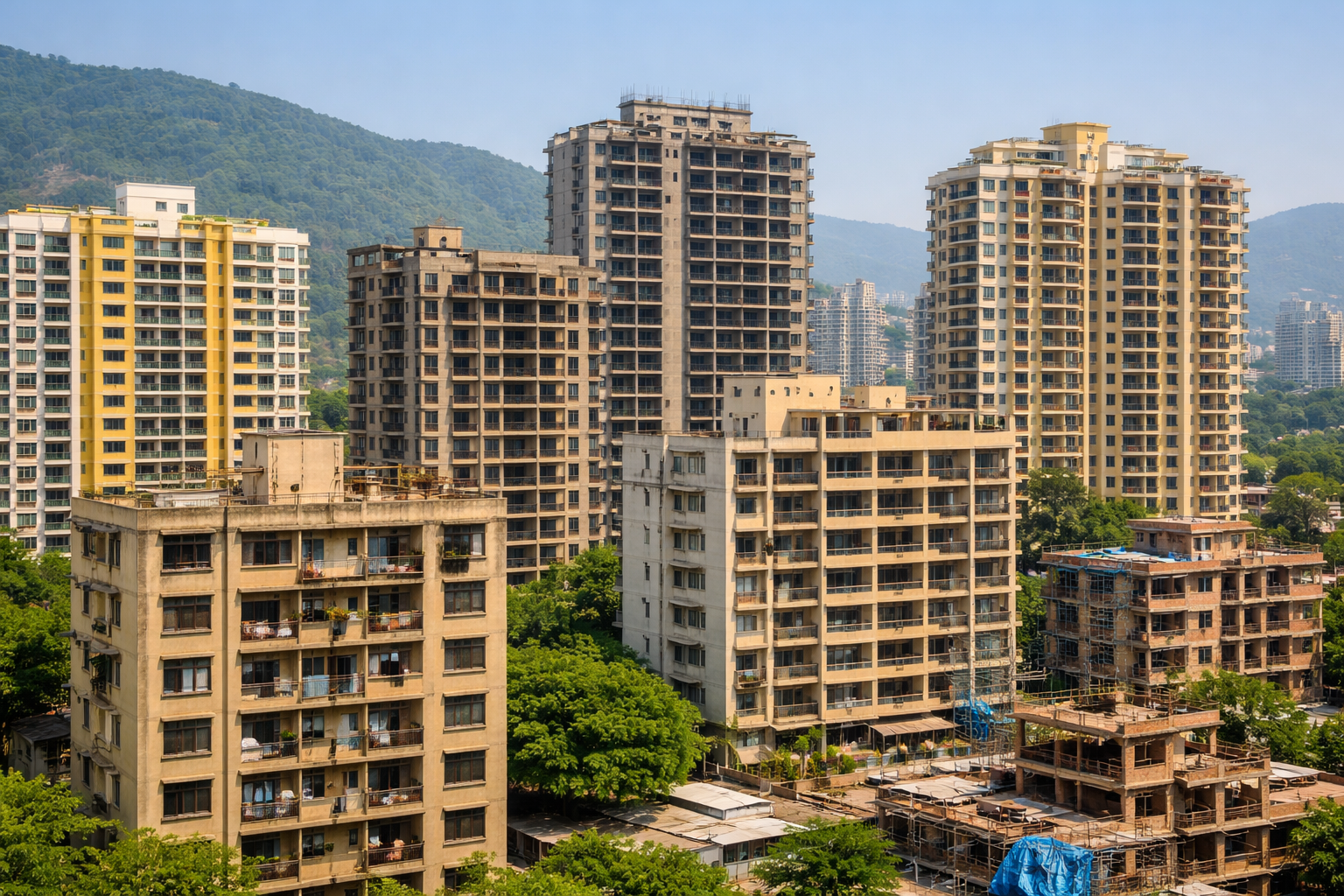
Panvel’s railway and highway logic is powerful. If your life depends on regional mobility rather than only internal Navi Mumbai convenience, Panvel can be a better fit.
This is especially true for professionals tied to inter-city movement, logistics, airport-related employment, Pune-side travel, or daily dependence on Panvel Junction-type connectivity logic.
For buyers comfortable doing more location filtering
Panvel rewards careful buyers. It punishes lazy selection.
A disciplined buyer who knows the difference between established Panvel pockets and long-gestation speculative zones can find strong value here. But this is not the kind of market where you should buy just because a brochure says “airport proximity.” You need to know exactly what you are buying into.
A realistic example would be a first-time buyer choosing a smaller but practical 2 BHK in an established Panvel-side micro-market instead of forcing a weakly located Kharghar purchase just for the brand name.
Kharghar vs Panvel for end users, investors, and first-time buyers
This is usually the real decision layer.
| Buyer type | Kharghar | Panvel |
|---|---|---|
| Family end user | Better for settled lifestyle, schools, parks, cleaner planning | Better only if budget is tighter and micro-location is practical |
| First-time buyer | Harder because entry price is higher | Usually better because of wider sub-₹70 lakh style options in many pockets |
| Investor | Lower yield but better liquidity in select formats | Better for yield and long-hold growth if pocket selection is correct |
| Student/young professional rental play | Select 1 or 2 BHKs can work well | Depends heavily on exact station and job-corridor relevance |
| Buyer wanting easy due diligence | Easier market to understand | Needs stricter legal and civic filtering |
| Budget-sensitive upgrader | Can feel financially stretched | Usually offers better upgrade room |
For end users, Kharghar is usually stronger because the lifestyle is more immediately usable.
For investors, Panvel often looks better on paper because rental yields are meaningfully higher, roughly in the 5.3% to 7.0% band in suitable pockets, compared with Kharghar’s lower broad yield range of around 2.2% to 3.2%. But that does not automatically make Panvel better for every investor. Higher yield often comes with more location risk, more uneven tenant behaviour by pocket, and more need for exact project selection.
For first-time buyers, Panvel has a real advantage. Kharghar is aspirational, but Panvel is often the place where the math actually works.
Which market is easier to judge correctly on the ground
Kharghar is usually easier to judge correctly. Panvel is usually harder.
That matters because most buyers do not lose money only by choosing the wrong city. They lose money by choosing the wrong micro-market inside the city.
Caution box: this is where many buyers go wrong
- In Kharghar, buyers often assume every premium-looking sector gives the same utility and long-term comfort.
- In Panvel, buyers often assume every project near the airport belt or highway corridor will benefit equally.
- In reality, Kharghar is more uniform but not flawless.
- Panvel offers more upside, but the gap between a practical buy and a weak buy is much larger.
A buyer can usually visit Kharghar, understand the sector logic, and get a fairly quick feel for whether the area matches the budget and purpose.
Panvel needs deeper filtering. You must distinguish Old Panvel, New Panvel, Karanjade-type affordable pockets, and NAINA-influenced long-gestation areas. If you do not, you may think you are buying in “Panvel growth,” while actually buying into delayed civic maturity.
The real mistake buyers make in Kharghar
The biggest mistake in Kharghar is paying for the brand without checking the friction behind it.
Many buyers assume that because Kharghar looks more polished, the purchase is automatically safer. But that is incomplete thinking. Some sectors face real water stress, especially parts of Sectors 11, 13, and 27 to 35, where supply cuts and tanker dependence can become practical problems. A premium home stops feeling premium very quickly when the society has to keep solving water shortages.
The second mistake is ignoring present-day disruption. The Kharghar-Turbhe Link Road is a strong long-term infrastructure project, but in the current phase it also creates traffic inconvenience and construction-side friction. Buyers need to judge the local reality of today, not just the brochure promise of tomorrow.
So yes, Kharghar buying mistakes are usually not about choosing a bad city. They are about overpaying for a polished image without checking water, traffic, building age, society quality, and exact sector value.
The real mistake buyers make in Panvel
The biggest Panvel mistake is treating Panvel as one single market.
This is where marketing creates the most confusion. Buyers hear airport, growth, rail, highway, and future Aerocity language, then assume every Panvel project has the same quality of upside. That is not true.
Established New Panvel and practical connected pockets are very different from speculative NAINA-side or weaker civic-support zones. Some places can work well for actual living or rental demand. Others may take many years before the promised infrastructure catches up.
Panvel property buying risks usually come from poor filtering, not from Panvel itself. If you buy a well-selected project in a practical micro-market, Panvel can be a very strong value play. If you buy vague “future growth” without civic clarity, you may be stuck for a long time.
What to check before buying in either Kharghar or Panvel

No matter which side you choose, do not skip the due-diligence layer. In Navi Mumbai, this part is not optional.
Project registration and delivery track record
Check the project on MahaRERA. Do not stop at seeing that the project is registered. Also check whether the registration is active, whether possession timelines were extended multiple times, and whether the developer has a pattern of delays.
Repeated extensions are not always fatal, but they are a warning sign. For under-construction projects, this step is basic capital protection.
Ready reckoner, agreement value, and cost realism
Use IGR Maharashtra eASR to understand the ready reckoner baseline. This helps in two ways. First, it gives you the official valuation base used for stamp duty. Second, it helps you judge whether a quoted market price is only strong demand, or partly broker-led inflation.
This is especially useful when comparing Kharghar property rates and Panvel property rates. The headline number means very little unless you also understand how far above the official base rate the market is trading, and why.
Local authority and documentation context
This part matters more than many buyers realise.
Some Navi Mumbai and Panvel-side properties sit in CIDCO leasehold contexts, not standard freehold assumptions. That can affect transfer charges, documentation flow, and future legal processes. There is also ongoing citizen sensitivity around CIDCO charges and PMC-side tax issues, so buyers should understand what financial obligations actually apply to the exact property being purchased.
Buyer checklist before token payment
- Check MahaRERA registration and extension history
- Verify exact micro-location, not just the “Panvel” or “Kharghar” label
- Understand whether the project is in CIDCO leasehold or another land title context
- Check water reliability and society maintenance burden
- Compare quoted rate with local market reality and eASR baseline
- Ask about possession status, OC, and completion stage where relevant
- Verify daily access to station, highway, school, market, and office routes
- In Panvel, confirm whether the project is in an established pocket or long-gestation development belt
So, which is better for buying property: Kharghar or Panvel?

Here is the most honest final answer.
Choose Kharghar if:
- you are a family prioritising present-day livability
- you want a more planned and easier-to-understand node
- you can comfortably afford the premium
- you care more about daily quality than lowest entry price
- you want a safer-feeling end-user market, with proper sector-level checks
Choose Panvel if:
- your budget is limited and Kharghar feels stretched
- you are a first-time buyer needing more supply options
- your commute depends on rail junction and highway relevance
- you are an investor looking for better rental yield and long-term growth optionality
- you are comfortable doing deeper micro-location filtering
Shortlist both only if:
- your budget can stretch into lower or edge Kharghar options and stronger Panvel options
- you are still deciding between end use and investment
- you are willing to compare actual projects, not just area names
The cleanest way to say it is this: Kharghar is the better buy for comfort-led certainty. Panvel is the better buy for value-led optionality.
Final verdict
Kharghar vs Panvel is not a battle of which place is more famous. It is a choice between two very different buying outcomes.
Kharghar is usually the better property buy for families, stable end users, and buyers who want a more complete residential environment from day one. Panvel is usually the better property buy for first-time buyers, budget-sensitive upgraders, and investors who want a wider price band, better yield potential, and stronger long-term growth optionality.
If you want less confusion and better present-day living, Kharghar usually wins. If you want more room in the budget and a larger long-term opportunity set, Panvel usually wins. The best decision comes when you stop asking “which area is better?” and start asking “better for what kind of buyer?”
FAQs
Frequently Asked Questions