

Kharghar vs Vashi for Small Business Owners: Which Node Fits Better?
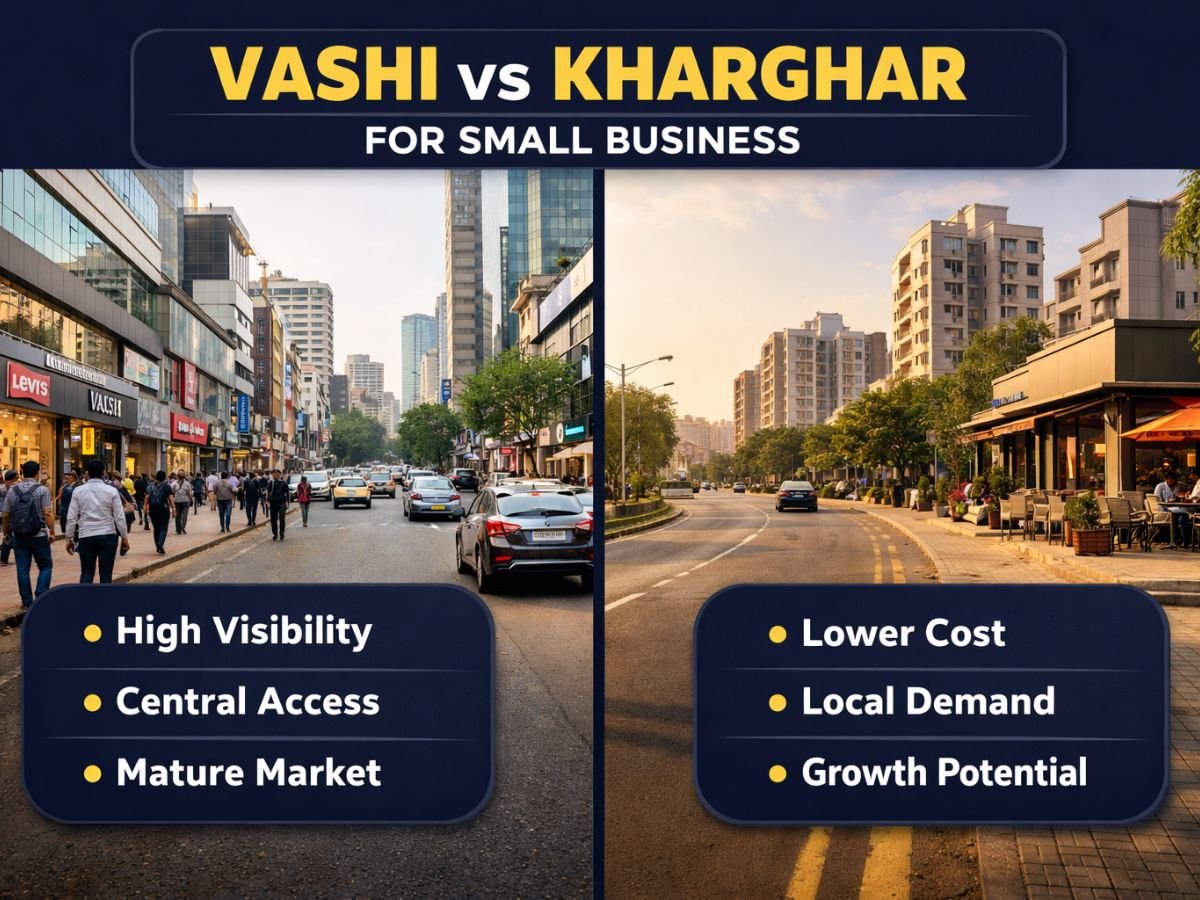
Vashi usually works better for small business owners who need central access, stronger commercial familiarity, faster client movement, and an already mature business environment. Kharghar usually works better for owners who need lower occupancy pressure, a family-and-student catchment, and a business model built on repeat local demand. The right answer is not about brand value. It depends on your business type, customer pattern, and the exact pocket you choose.
If you want stronger context on Kharghar before comparing both nodes, Kharghar Commercial Property Guide is worth reading first.
Quick Summary: Kharghar or Vashi for a Small Business?
Vashi vs Kharghar: Commercial Decision Comparison (2026)
| Decision Factor | Vashi | Kharghar |
|---|---|---|
| Best for | Established or well-funded businesses, B2B offices, premium retail, branded F&B | Clinics, coaching, neighbourhood services, cafés, early-stage offices |
| Market character | Mature, central, commercially proven | Expanding, residential-demand driven, lower entry pressure |
| Shop capital value | ₹45,000 to ₹65,000/sq ft | ₹25,000 to ₹35,000/sq ft |
| Office capital value | ₹38,000 to ₹50,000/sq ft | ₹18,000 to ₹28,000/sq ft |
| Average ticket size | ₹70 lakh to ₹2.5 crore | ₹45 lakh to ₹1.2 crore |
| Rental yield | 6% to 7% | 7% to 8% |
| Working capital stress | Higher | Lower |
| Best customer pattern | Walk-ins, brand visibility, citywide access | Repeat local demand, student & family catchment |
| Safer for first-time owner | Only if business is already validated | Usually yes |
Kharghar or Vashi: Which node usually works better for a small business owner?
For most small business owners, the question is not which node looks better on paper. The real question is which node helps the business survive long enough to grow.
Vashi is Navi Mumbai’s more mature commercial environment. It already has legacy business behaviour, stronger transit familiarity, and a wider city-level recall. That matters when your customers are not just local residents but office-goers, passing shoppers, visiting clients, or people travelling across the Mumbai Metropolitan Region. It also matters if your business needs staff coming from Mumbai, Thane, or Kalyan side.
Kharghar works very differently. It is more residential, more demographic-driven, and more forgiving for businesses that rely on local trust and repeat usage. It gives many small operators what Vashi often does not: breathing room. Lower asking rates, smaller average ticket sizes, and a family-student ecosystem make a big difference when the business is still proving itself.
So which node usually works better? Vashi works better for visibility-heavy, access-sensitive, established business models. Kharghar works better for service-led, neighbourhood-dependent, and lower-burn businesses.
What kind of small business fits Kharghar better, and what kind fits Vashi better?
This is the section most generic comparison pages fail to handle properly. A clinic, a café, a coaching class, and a consulting office do not need the same commercial environment.
Businesses that usually fit Kharghar better
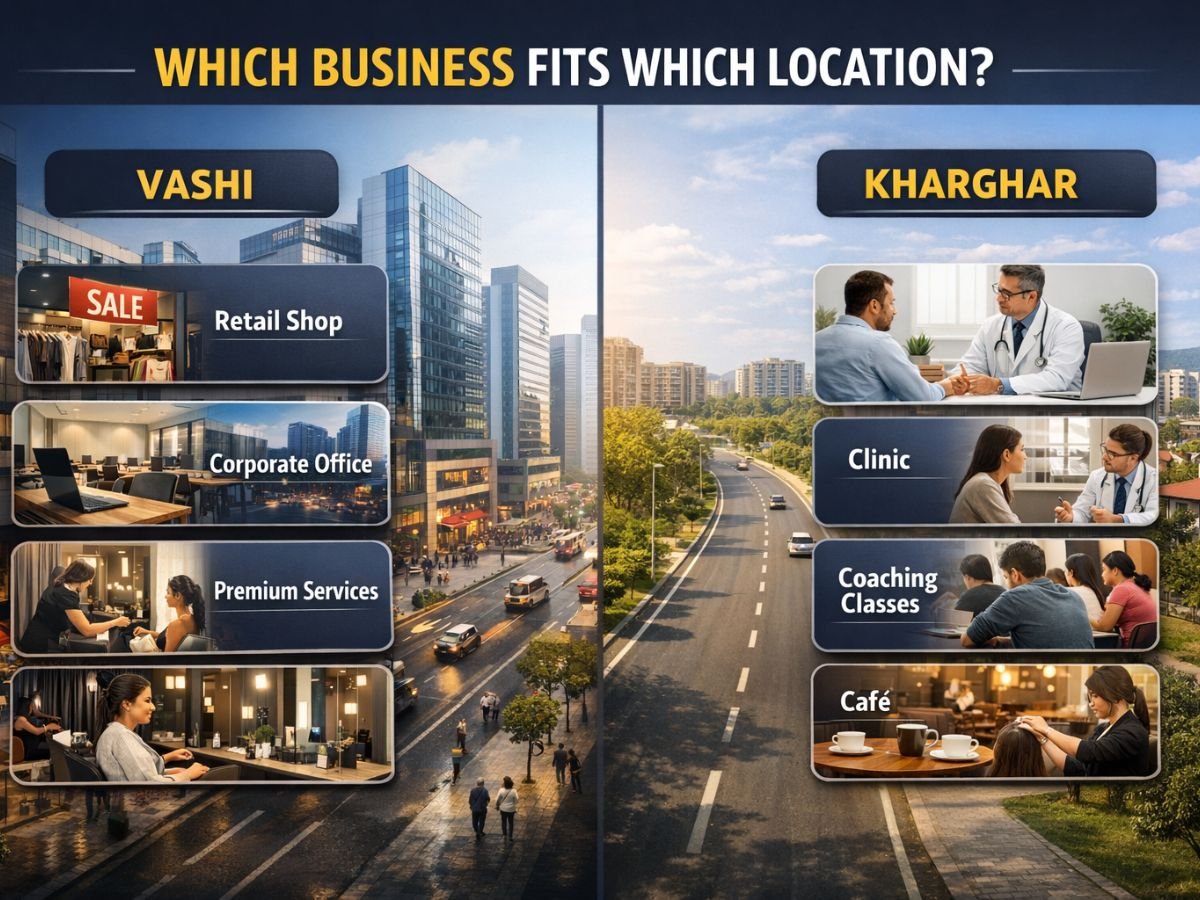
Kharghar usually suits businesses that build around repeat local demand. That includes coaching classes, polyclinics, dental clinics, diagnostic support centres, neighbourhood cafés, salons, wellness studios, and certain small agencies serving local businesses or residents.
Why? Because Kharghar has a strong residential and student base. A student will travel to a coaching class if the faculty is trusted. A parent will travel to a good pediatrician if the service is reliable. These businesses do not always need expensive high-street visibility. They need affordability, comfort, and access to the right local catchment.
Businesses that usually fit Vashi better
Vashi usually suits businesses that depend on wider access, stronger market familiarity, and commercial trust at first glance. Think premium retail, branded food chains, wealth advisors, corporate-facing consultants, branch offices, medical aesthetics, and certain fast-moving service outlets.
In Vashi, the commercial behaviour is more established. Customers already expect to transact, browse, compare, and spend in many of its active sectors. That makes a difference if your business needs immediate credibility or impulse-led movement.
Businesses where the answer depends on the exact pocket
Some businesses can work in either node, but only in the right micro-market. These include:
- boutique gyms and fitness studios
- boutique salons
- digital marketing or consulting offices
- cafés
- training centres
- speciality clinics
In these cases, the node alone is not enough. A salon in a strong Kharghar residential-service belt may do better than a badly placed Vashi shop. A small office in Vashi Sector 30 may outperform a random Kharghar office because the client profile is completely different.
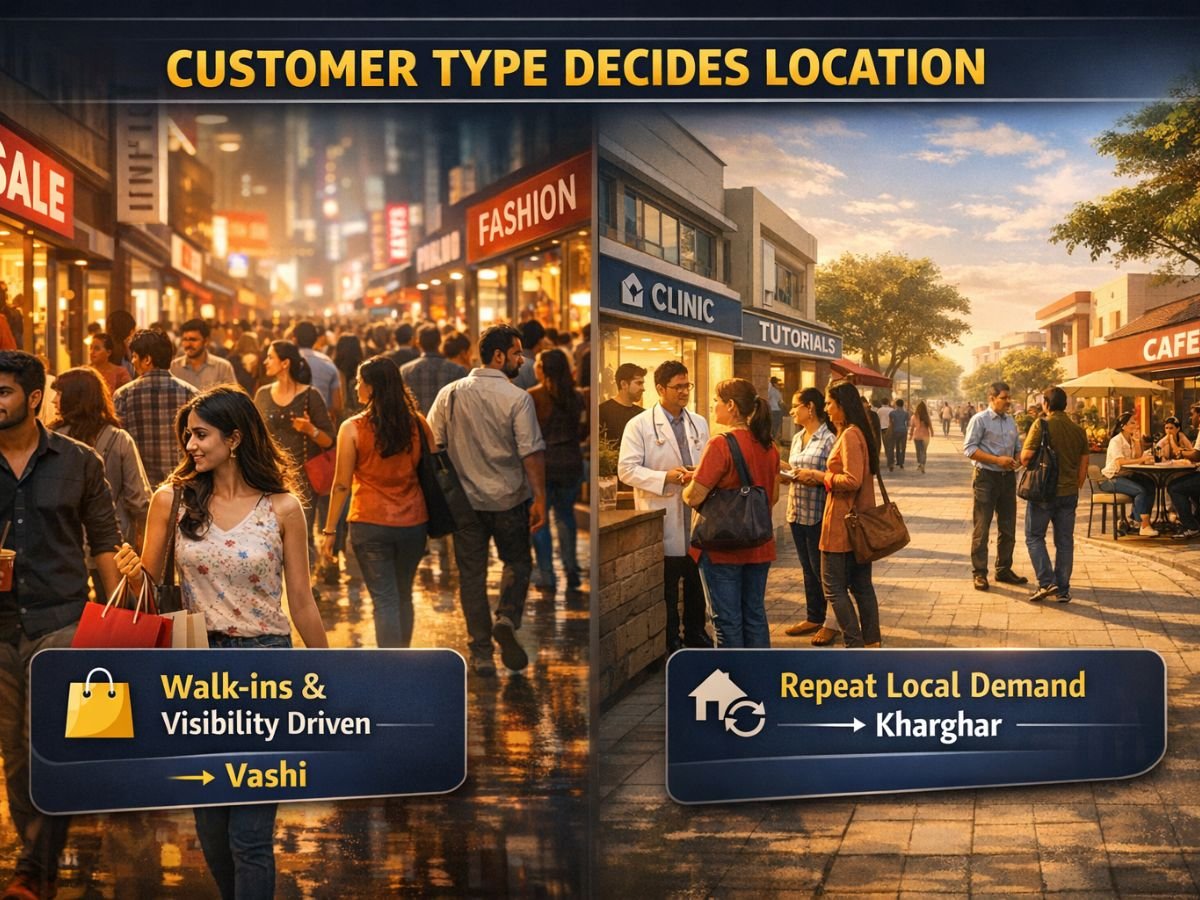
Do you need walk-in customers, destination visits, or mostly repeat local demand?
This is where many small business owners make expensive mistakes.
Walk-in and impulse-led business
If your business depends on people noticing you, entering casually, and making a purchase or enquiry without much planning, Vashi generally has the stronger case. Sector 17 is the classic example. It carries legacy retail behaviour, stronger high-street familiarity, and better impulse visibility.
That does not mean every Vashi shop works. It means the node is better suited to models where physical visibility is part of the conversion engine.
Appointment-led and destination-led business
If people come to you because they already decided to come, Kharghar becomes much more attractive. A coaching institute, dentist, skin clinic, CA office, or therapy studio often does not need the most expensive frontage. It needs a trustworthy location, manageable rent, and easy access for repeat visitors.
For such businesses, paying Vashi-level rents only for visibility can become a costly mismatch.
Repeat neighbourhood demand and service catchment
Kharghar is especially strong when the business becomes part of daily or monthly local life. Families, students, and residents tend to stay within their operating comfort zones. Wide roads, sector-based movement, and local catchment behaviour matter here.
That is why many service-led businesses in Kharghar can survive and scale even without classic high-street positioning. Their strength comes from relevance, not show.
Which node is easier on budget without becoming a false economy?
Kharghar is easier on budget. But that is only half the truth.
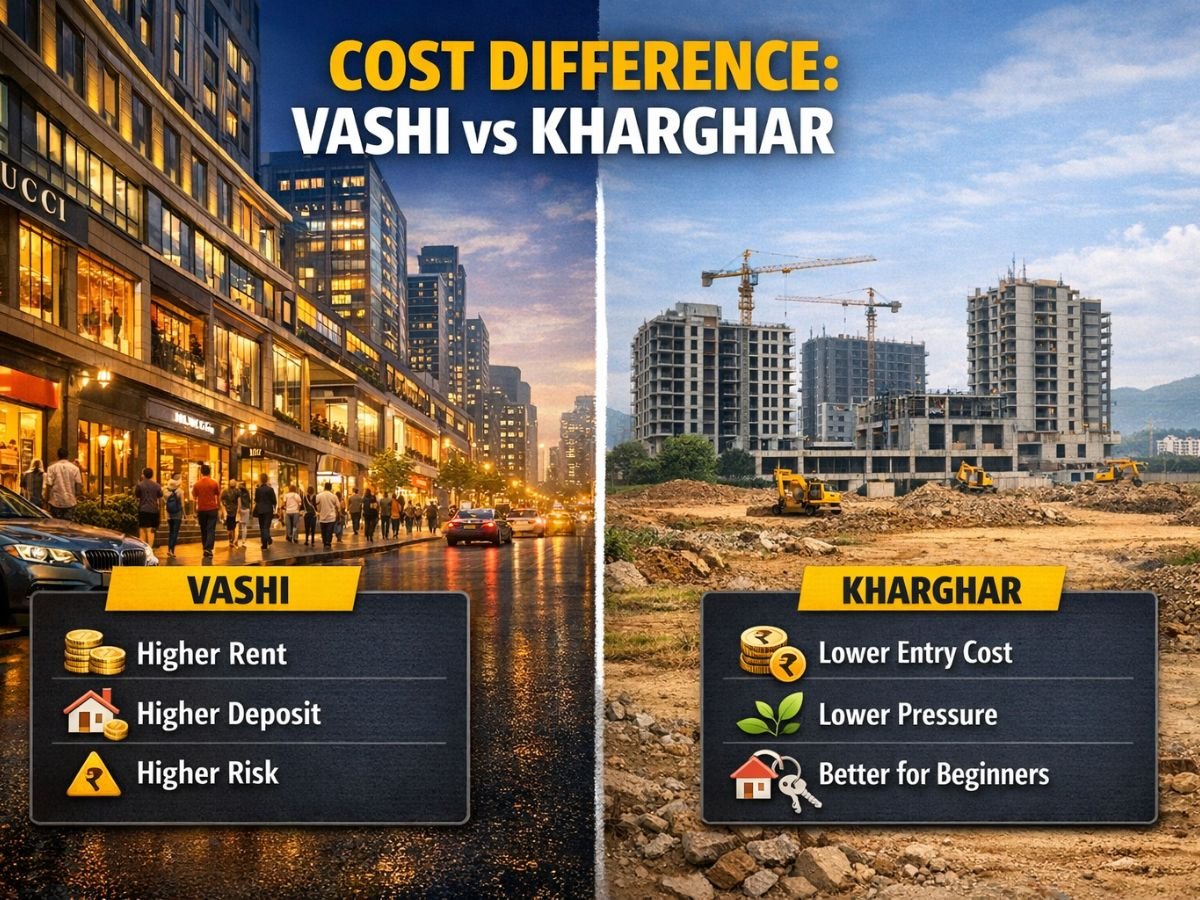
On current asking ranges from 2025-2026 market listings, commercial capital values in Vashi are materially higher than Kharghar. Offices in Vashi are generally quoted around ₹38,000 to ₹50,000 per sq ft, while Kharghar office stock is often seen around ₹18,000 to ₹28,000 per sq ft. For shops, Vashi’s asking band is usually around ₹45,000 to ₹65,000 per sq ft versus Kharghar’s roughly ₹25,000 to ₹35,000 per sq ft.
That lower entry cost is exactly why Kharghar looks attractive to bootstrapped operators. But cheaper is not always smarter.
A cheap shop in an underactive Kharghar pocket is a false economy if your business needs visibility and spontaneous visits. In the same way, a costly Vashi shop is also a false economy if the monthly burn destroys working capital before the business stabilises.
The second major issue is deposit lock-in. In both nodes, the usual commercial lease pattern is around six months of rental value as security deposit. This matters a lot. A ₹2 lakh monthly space means ₹12 lakh gets blocked immediately. For a small business, that is not just a lease term. That is lost liquidity for interiors, staffing, equipment, and launch marketing.
So the better budget question is not “Which is cheaper?” It is: Which location gives the best chance of conversion without suffocating the business in month one?
Is customer convenience more important here, or owner convenience?
Sometimes Vashi wins because the customer needs centrality. Sometimes Kharghar wins because the customer needs ease and comfort close to home.
Vashi has stronger citywide convenience. Railway access, highway access, and overall commercial familiarity make it easier for clients, staff, and vendors coming from multiple parts of the region. If your business needs employees from outside Navi Mumbai or clients who value central access, Vashi has a natural operational edge.
Kharghar works better when the business is serving the local ecosystem itself. The internal grid, wide roads, metro connectivity, and easier ground-level access in many sectors can make daily usage more comfortable for families and repeat visitors.
A pediatric clinic does not need a citywide transit reputation as much as it needs easy repeat access for nearby families. A B2B consultancy office may need exactly the opposite.
So ask one practical question: Is your business being chosen for convenience across the region, or for trust inside a local catchment?
Does the answer change if you need a shop, office, clinic, studio, or coaching space?
Yes, completely. Commercial property is not one category.
Shop logic
For high-street retail and visibility-led shopping, Vashi generally holds the stronger position, especially in older, proven retail belts. Established buyer behaviour matters more in retail than people realise.
Kharghar shops work better for daily-needs retail, neighbourhood services, select cafés, and lifestyle-led local concepts near active residential and leisure-driven pockets.
Office logic
If you need a client-facing office, a corporate image, or easier citywide staff access, Vashi usually works better. Certain sectors there support a more formal business environment.
Kharghar offices are often better for back-end operations, smaller agencies, IT startups, or businesses that do not need premium address value on day one.
Clinic and professional services logic
Kharghar is usually stronger for polyclinics, pediatricians, dentists, and general practice setups because the residential demand base is very important here. Repeat usage, local referrals, and family trust matter more than flashy frontage.
Coaching, studio, salon, and class-based logic
Kharghar is the clearer fit for coaching and education-led businesses because the student ecosystem is already strong. For salons, studios, and boutique classes, the answer depends on positioning. A local repeat-use model may work very well in Kharghar. A premium brand-led concept may still do better in the right Vashi pocket.
| Business Type | Usually Better Node | Why |
|---|---|---|
| Premium high-street retail | Vashi | Stronger impulse visibility and established buying behaviour. |
| Coaching classes / institutes | Kharghar | Student density and education ecosystem support repeat demand. |
| Corporate / B2B office | Vashi | Better transit reach and easier staff movement. |
| Polyclinic / diagnostic / dental | Kharghar | Local trust model works better with lower overhead. |
| Local café / boutique service | Kharghar | Better rent-to-revenue balance in residential pockets. |
| Wealth advisory / consultancy | Vashi | Stronger citywide access and premium address value. |
| Startup / digital agency | Either (depends on client type) | Vashi for access, Kharghar for lower cost. |
Which pockets inside Kharghar and Vashi can change the answer completely?
This is where real local understanding begins. Neither node should be treated as one uniform market.
In Vashi, Sector 17 behaves very differently from Sector 19 or Sector 30. Sector 17 is older, busier, more retail-led, and more dependent on visibility and walk-ins. Sector 19 and Sector 30 are more office-led or mixed-use in character. A consultancy or agency may work in one and struggle in the other even within the same node.
In Kharghar, the answer also changes sector by sector. Sectors 15 and 20 are more commercially active and better aligned to business demand. On the other hand, residential-service pockets, including emerging areas like Sector 34, Sector 35, and Upper Kharghar, are more affordable but need careful matching with the business model. Low rent alone is not enough.
That is why the right sentence is not “Choose Vashi” or “Choose Kharghar.” The right sentence is: Choose the right pocket inside the right node for your exact business behaviour.
What local authority and approval checks matter before you rent or buy in either node?
This part is not glamorous, but it can save a business from serious trouble.
Vashi falls under NMMC, while Kharghar comes under PMC. That matters because the civic framework is not identical. Commercial property tax methodology is one major difference. Under historically applied structures, NMMC commercial taxation works through a rateable value system, while PMC has used a carpet-area-based approach that has seen resistance and disputes in some cases. So if you are buying, do not compare only purchase price. Compare long-term civic burden too.
CIDCO also matters, especially in resale commercial property. Many older Navi Mumbai properties were originally leasehold. Under current CIDCO policy, transfer charges on commercial leasehold assets can materially affect acquisition cost, and commercial transfer fees have seen hikes. If the property has been converted to freehold, future transfer burden changes. If it is still leasehold, you need to know exactly who is paying what.
For under-construction commercial units, do not stop at “RERA registered.” On the MahaRERA system, the more useful check is the Quarterly Progress Report, because that helps you understand actual completion progress and possible project issues more honestly.
And for tenants, two checks are basic but non-negotiable:
- valid Occupancy Certificate
- landlord or society NOC, where required for license or use compliance
Without these, business opening can get stuck at the documentation stage itself.
Quick Verification Checklist Before You Commit
- Confirm whether the property is under NMMC or PMC
- Check long-term tax impact, not just rent or sale price
- Verify whether the property is CIDCO leasehold or freehold
- If under construction, review MahaRERA project details and QPR
- Confirm the building has a valid Occupancy Certificate
- Ensure the landlord can provide documents needed for Shop Act or trade use compliance
- Treat IGR Maharashtra eASR only as a stamp duty benchmark, not as actual market value
- Model six months’ deposit, fit-out cost, and maintenance before signing
Should a small business owner rent first or buy first in Kharghar or Vashi?
For most first-time small business owners, rent first is the safer answer.
Buying commercial space too early can trap capital in the wrong location before the business model is proven. This is especially risky in Vashi, where ticket size and capital burden are much higher. If the business has not yet validated demand, buying in Vashi is often an unnecessary risk.
Kharghar creates a more interesting buy-case, but only for the right operator. If the business is stable, long-term, and locally anchored, owning early in the right Kharghar pocket may make strategic sense because the entry point is lower and the long-term upside story is stronger. But even here, that does not mean buy blindly.
A simple practical rule works well:
- Rent first if the business is new, untested, or still learning customer behaviour
- Consider buying only if the business model is already stable and location dependence is clear
What mistakes do small business owners make when comparing Kharghar and Vashi?
The biggest mistake is choosing based on image instead of operating reality.
One common error is the footfall fallacy. Owners assume that a busy Vashi location automatically means business success. But if the business is appointment-led or niche, that visibility may be expensive and unnecessary.
The second mistake is ignoring hidden cost structure. Monthly rent gets attention, but blocked deposit, fit-out, maintenance, and civic burden often hurt more.
The third mistake is treating Kharghar as a low-risk default just because it is cheaper. Some sectors are still more residential-service oriented and may not suit every concept immediately.
The fourth mistake is document negligence. Lease signed, token paid, and only later the owner discovers issues around OC, NOC, or compliance.
And finally, many buyers misuse ready reckoner logic. IGR eASR is useful for stamp duty planning. It is not a real-time substitute for actual market pricing.
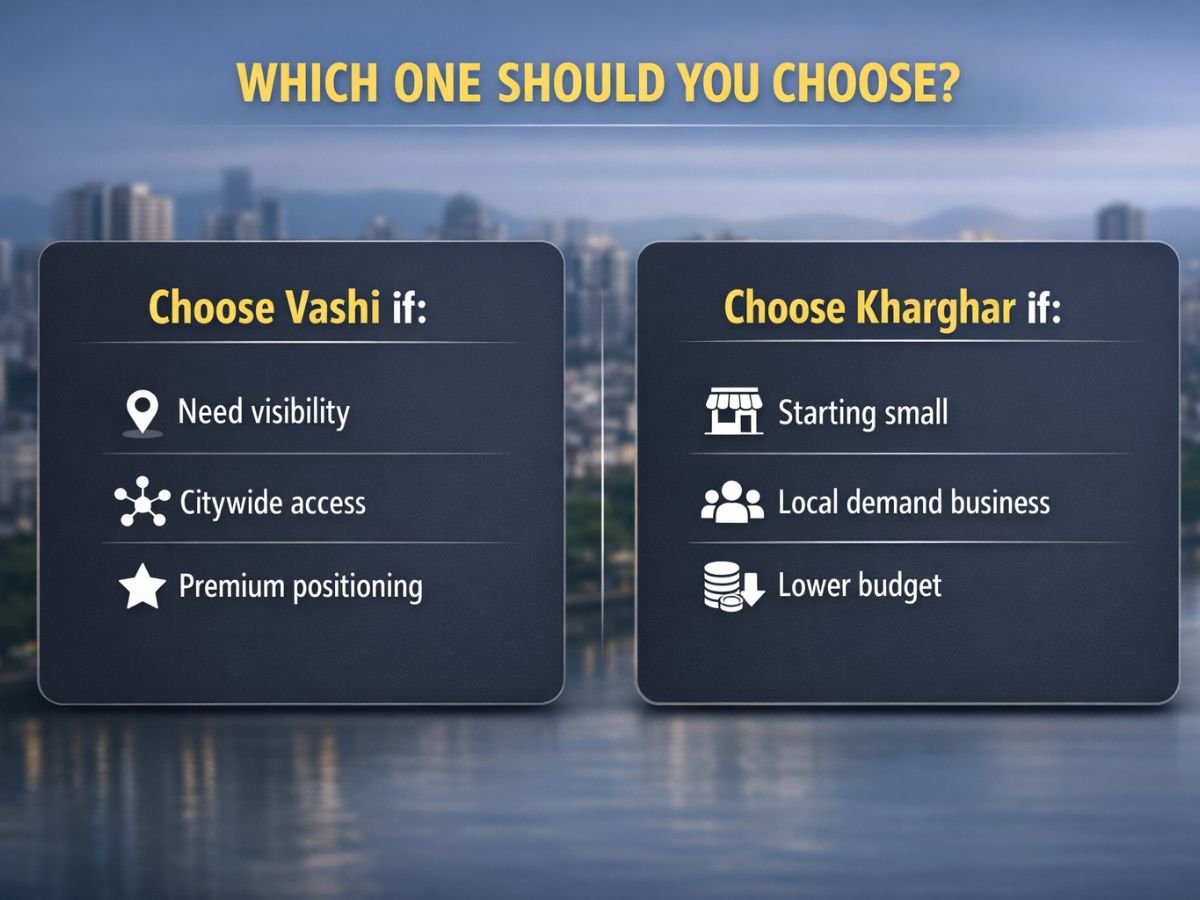
So who should choose Kharghar, and who should choose Vashi?
Choose Vashi if:
- your business depends on central access
- you need stronger commercial familiarity from day one
- your team or clients travel from multiple parts of the region
- you run a premium retail, B2B, or brand-led model
- your working capital is strong enough to absorb higher occupancy burden
Choose Kharghar if:
- your business depends on local trust and repeat visits
- you are starting with limited capital
- you run a clinic, coaching class, salon, studio, local café, or neighbourhood service
- you want lower entry friction and better survival runway
- your business does not need costly high-street visibility to convert
The best area in Navi Mumbai for small business is not one fixed answer. For many first-time owners, Kharghar is the safer starting node. For businesses that truly need centrality and stronger commercial behaviour, Vashi justifies its premium.
You should also read Vashi Commercial Property Guide so the Vashi side of the decision feels clearer.
Conclusion
If you want one clean answer, here it is: Vashi is usually the better commercial node for businesses that need visibility, city-level access, and an already proven market. Kharghar is usually the better node for small business owners who need affordability, local demand, and room to grow without getting crushed by monthly burn.
For a first-time entrepreneur, Kharghar often makes more practical sense. For an established operator who can pay for centrality and needs it operationally, Vashi can be the stronger move.
But the smartest decision is not “pick the better city.” It is: pick the better business fit, in the better pocket, under the better cost structure. That is what actually decides survival in Navi Mumbai.
FAQs
Frequently Asked Questions