
Letter of Allotment in Navi Mumbai: Meaning, Home Loan Use, & Risks
A Letter of Allotment in Navi Mumbai is usually an early-stage document that confirms a specific flat, plot, or unit has been earmarked for you by a builder or authority. It can help with booking confirmation, payment tracking, and the early stage of a home loan process, but it usually does not make you the final legal owner by itself. In most cases, the real legal security starts only when the Agreement for Sale is executed and registered.
Quick summary
| Question | Practical answer |
|---|---|
| What is a Letter of Allotment? | A written confirmation that a particular unit has been allotted to a buyer |
| Who usually issues it? | A private builder, CIDCO, or another housing authority depending on the transaction |
| Does it prove full ownership? | Usually no |
| Can it help with a home loan? | Yes, often for initial processing and file opening |
| Is it enough for registration or final transfer? | No, not by itself |
| Biggest risk | Treating it like a final title document when it is only an early-stage document |
What exactly does a Letter of Allotment mean in a Navi Mumbai property deal?

In practical terms, this is the paper that says, “This unit is reserved for you under these basic terms.” It usually comes after token payment or early booking. The letter may mention the flat number, wing, floor, carpet area, price, payment schedule, and sometimes parking details.
That is why many buyers feel relieved when they receive it. But relief and legal finality are not the same thing. A Letter of Allotment is usually a reservation and commercial confirmation document, not the final document that transfers full title in your name. That distinction matters a lot in Navi Mumbai, especially in under-construction projects, CIDCO-linked properties, and older resale transactions.
Who issues an allotment letter in Navi Mumbai, and why does that change the answer?
Builder-issued allotment letter
In private developer projects, the allotment letter is usually a booking-stage document governed by the MahaRERA framework. Since September 4, 2024, MahaRERA has a formal proforma of allotment letter, which makes this document more standardized than older builder-created versions.
For a buyer in Kharghar, Ulwe, Taloja, Dronagiri, or Pushpak Nagar, this usually means the letter is part of the path between booking and the registered Agreement for Sale.
CIDCO or authority-issued allotment letter
In Navi Mumbai, CIDCO is not a minor background authority. It is central to how much of the city was planned and allotted. So when the allotment letter comes from CIDCO or a CIDCO-linked scheme, it can carry a more foundational administrative value in the document chain, especially in leasehold contexts.
But even here, buyers should be careful. A CIDCO allotment letter may be the start of the title chain, not the end of it. Later documents like lease deed, assignment records, transfer permissions, society records, and mutation trail still matter.
Why old resale allotment papers confuse buyers
This is where many people get trapped. In older nodes such as Vashi, Nerul, CBD Belapur, and Sanpada, a seller may show an old allotment letter and present it as full proof of ownership. That is risky. A historical allotment letter may be important, but a resale buyer must still verify what happened after that paper was issued.
What a proper allotment letter should normally contain
A proper allotment letter should not be vague. If it is vague, that itself is a signal to slow down.
The following details are usually important:
- Name of the promoter or issuing authority
- Project name
- MahaRERA registration number, where applicable
- Flat or plot number
- Wing, floor, and unit identification
- Carpet area, not just inflated marketing area
- Total consideration and payment schedule
- GST, stamp duty, and registration treatment if separately shown
- Parking details, if promised
- Cancellation terms
- Date of issue
- Buyer name and identification details
MahaRERA’s updated framework has made this more important. The regulator’s updated forms specifically reflect the move toward a clearer proforma, including the allotment letter dated 04-09-2024.
What can you actually do with an allotment letter?
This is the question most people really care about. The answer is: quite a few useful things, but not everything.
1. Confirm that a specific unit has been earmarked for you
If the letter clearly identifies the unit, it acts as written confirmation that the builder or authority has allotted that particular unit to you. That gives practical comfort at booking stage.
2. Track price and payment terms
If the letter records the agreed consideration and payment schedule, it becomes an important reference point. This matters when there is later confusion over pricing, floor-rise charges, parking, or commercial terms.
3. Start the home loan process
Many banks accept an allotment letter as part of the initial home loan documentation set. Axis Bank’s public guidance lists allotment letter from builder, housing board, or co-operative society among important documents for availing a home loan.
That does not mean the bank will disburse the entire loan just because you have an allotment letter. It usually means the document can help in file opening, preliminary scrutiny, valuation, and sanction-stage processing.
4. Use it as early evidence if a dispute starts
If the builder changes unit details, delays moving to agreement stage, or creates confusion after taking booking money, the allotment letter becomes an important starting document in your case record.
What an allotment letter usually cannot do on its own
This is the part buyers should read carefully.
It usually does not complete ownership transfer
A Letter of Allotment is usually not the same as a registered Agreement for Sale, sale deed, conveyance, or final title instrument. So saying “I have the allotment letter, so I am now the owner” is usually too loose and legally unsafe.
It is not the same as a registered Agreement for Sale
This difference is huge. The Agreement for Sale is the registered contract that formally records key terms and strengthens the buyer’s legal position. Maharashtra’s registration ecosystem separately recognizes and processes such registered documents.
It is not enough for blind resale trust
If a seller says, “All documents later ho jayenge, allotment letter enough hai,” treat that as a caution signal, not comfort. In a resale deal, you need to see the later documents in the chain.
Allotment letter vs Agreement for Sale vs Sale Deed vs Possession Letter
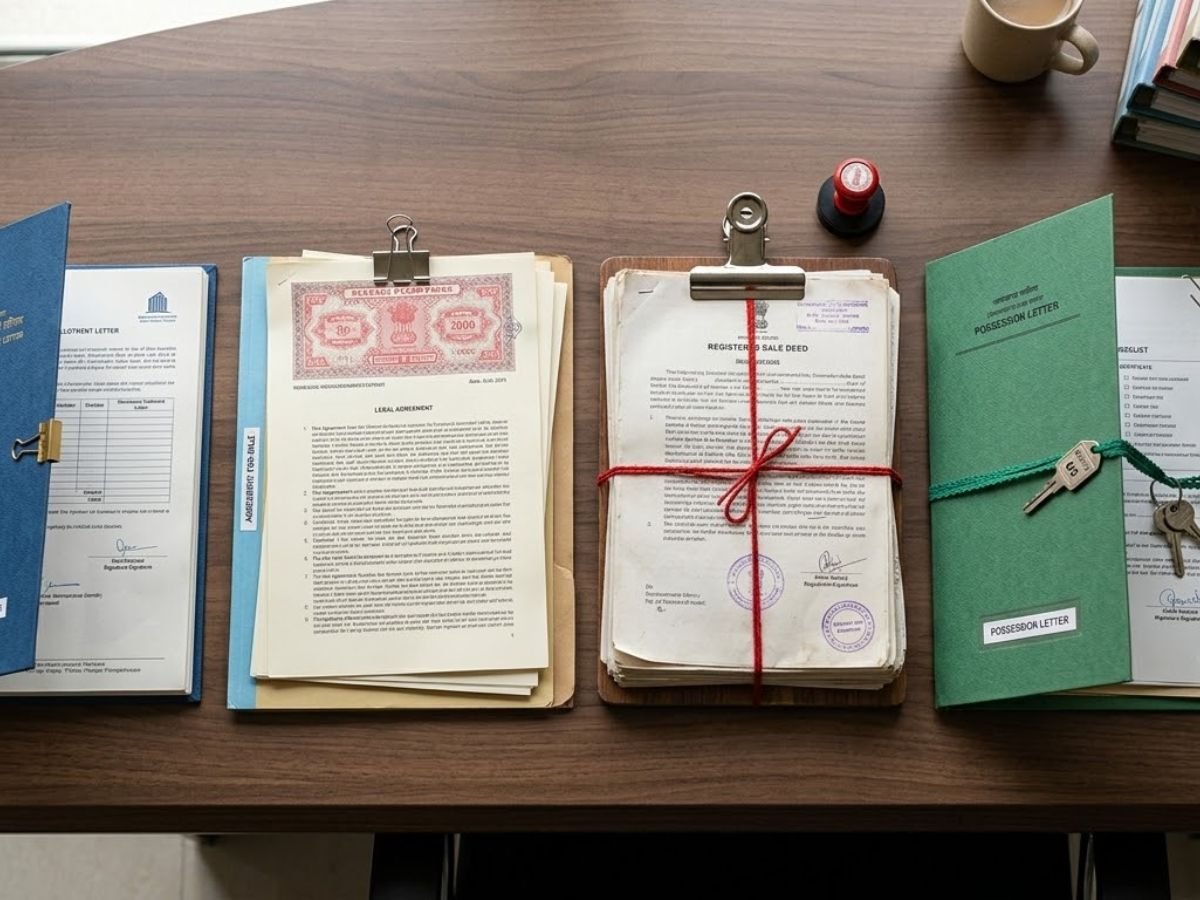
| Document | Stage | What it really does | Is it usually registered? |
|---|---|---|---|
| Letter of Allotment | Early booking stage | Confirms unit allotment and basic commercial terms | Usually no |
| Agreement for Sale | Mid-transaction stage | Creates stronger contractual rights and records detailed legal-commercial terms | Yes |
| Sale Deed / Conveyance / relevant final transfer deed | Final transfer stage | Transfers ownership rights as per the transaction structure | Yes |
| Possession Letter | Handover stage | Confirms physical possession or handover status | Usually not the title document |
If you remember only one thing, remember this: allotment letter is an early-stage paper, not the finish line.
Is an allotment letter enough for a home loan, registration, resale, or possession?
For home loan file opening or initial sanction
Often yes, at the preliminary stage. Banks may use it to start processing. Axis Bank’s document guidance supports this broad position. :contentReference
For actual disbursement
Usually not by itself. The registered Agreement for Sale and other lender-required papers usually become important before actual major disbursement.
For registration
No. The allotment letter is not the substitute for the registrable agreement or final transfer document. Maharashtra’s system clearly distinguishes formal registration workflows for agreements and deeds. :contentReference
For resale due diligence
Definitely no. In resale, the allotment letter is only one part of a larger verification exercise.
For possession and society-side comfort
Again, no. You will usually need later documents such as possession-related records, registered documents, and in older society contexts, share certificate and transfer trail.
The most important buyer protection: the 10% rule
This is the practical legal anchor of the whole topic.
Under Section 13(1), a promoter cannot take more than 10% of the cost of the apartment, plot, or building as advance or application money without first entering into a written Agreement for Sale and getting it registered. MahaRERA’s FAQ also clarifies that even if a buyer is “ready” to pay more, that does not override the rule.
So if a builder in Navi Mumbai is asking for 20%, 25%, or 30% while keeping you only on an allotment letter, that is not a small technical issue. It is a serious red flag.
What changes when the allotment letter is from CIDCO instead of a private builder?
This is where Navi Mumbai becomes different from a generic real estate blog.
Many Navi Mumbai properties sit within a CIDCO-shaped land and title history. CIDCO-linked property is often leasehold by default, not automatically freehold. That means the allotment letter may be part of a longer authority-based chain involving lease deed, transfer permission, NOC, and later conversion possibilities.
CIDCO has also publicly moved on the issue of leasehold-to-freehold conversion for certain residential plots, with conversion linked to ready reckoner-based charges. That is important, but it does not mean every old allotment letter magically becomes freehold ownership on its own. The later document chain still matters.
In simple terms:
- A builder allotment letter usually sits inside a private project booking process.
- A CIDCO allotment letter may sit inside a planning-authority and leasehold framework.
- The second type usually needs even more continuity checking.
If a seller or broker shows only an allotment letter, what should you ask for next?
Use this checklist.
Buyer checklist: what to demand next
- Payment receipts
- Registered Agreement for Sale, if executed
- Sale deed, lease deed, or assignment deed as applicable
- Possession records
- Society share certificate, where relevant
- CIDCO transfer NOC, where relevant
- Chain of past transfers
- Loan closure proof or encumbrance clarity, if mortgaged
- Identity match between seller and records
- Property tax and society dues status, where applicable
If these documents are missing, do not assume the allotment letter “covers everything.” It usually does not.
What is the normal document chain after an allotment letter?
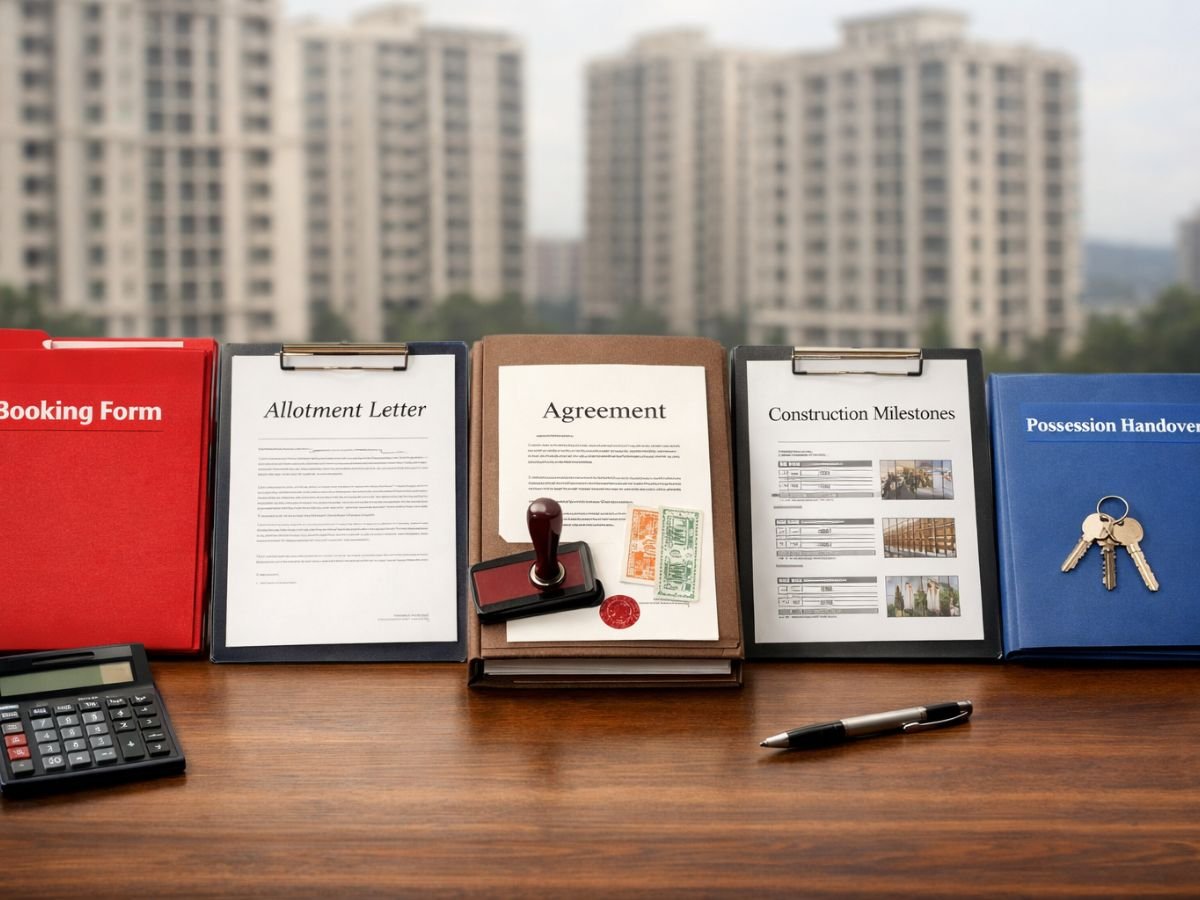
A normal buyer journey often looks like this:
1. Token or application stage 2. Allotment letter stage 3. Registered Agreement for Sale 4. Construction progress and payment milestones 5. Occupancy and possession stage 6. Final transfer, conveyance, lease-completion, or society/title continuation depending on property type
This sequence is especially useful for first-time buyers because it tells you one simple truth: there are later milestones after allotment, and they matter more.
Practical Navi Mumbai examples
Example 1: Under-construction flat in Ulwe or Kharghar
A buyer books a flat in an under-construction project and receives an allotment letter after paying a token amount. That letter helps the buyer begin the home loan process. But once the payment demand crosses the 10% mark, the developer should move to the registered Agreement for Sale stage. If the developer delays that step but still keeps demanding higher payments, the buyer should become cautious.
Example 2: CIDCO-linked allotment case
An allottee in a CIDCO housing or authority-linked context may receive a digital or formal allotment document that starts a longer administrative and leasehold chain. Missing a payment deadline or later documentation step in such cases can create very different consequences compared to a normal private builder booking.
Example 3: Older resale flat in Nerul or Vashi
A seller shows an old allotment letter from many years ago and says that is the core ownership proof. A careful buyer should immediately ask for the later registered deed, society papers, transfer permissions, and continuity trail. In older Navi Mumbai stock, this is not over-caution. It is basic due diligence.
conclusion
A Letter of Allotment in Navi Mumbai is an important document, but it is not a magic document. It can confirm your unit, support early payment and loan processing, and give you a written basis for the next stage. But in most cases, it is not the document that completes ownership.
That is the safest way to read it: useful, serious, and worth checking carefully, but not the finish line. If you are buying in a private builder project, watch the 10% rule closely. If you are dealing with a CIDCO-linked or older resale property, check the full title chain even more carefully. That one difference can save a buyer from a very expensive mistake.
FAQs
Frequently Asked Questions