
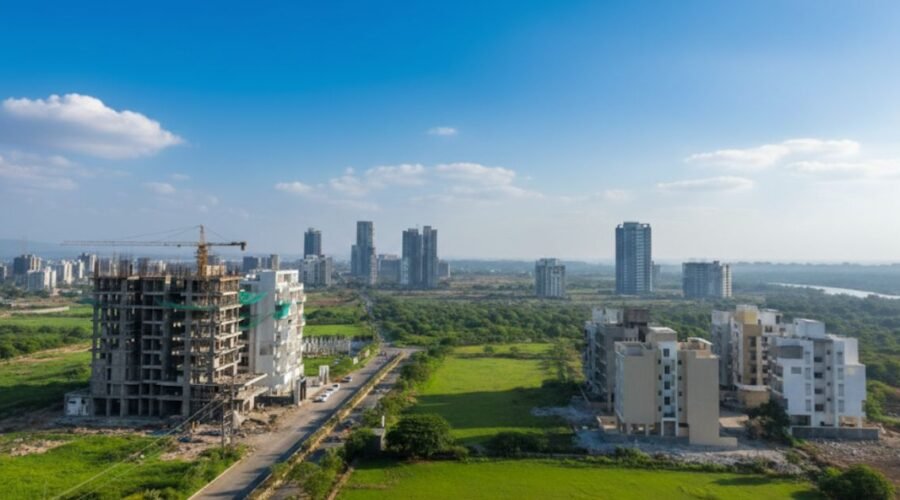
Dronagiri is becoming the next Kharghar, But Have We Learned Anything from Ulwe’s Mistakes?
Published 11 Sep 2025, 4:22 PM IST
Key Points
- Rapid Growth: Dronagiri is seeing a massive real estate boom, attracting thousands of families due to its proximity to the new NMIA airport and the MTHL sea link.
- Services Deficit: There is a critical shortage of essential social infrastructure. The node currently lacks any major multi-specialty hospitals and has very few reputed schools.
- Daily Hardship: Residents face significant daily challenges, including children travelling 1-2 hours each way to schools in Panvel or Vashi, and a lack of immediate medical care during emergencies.
- Planning Flaws: The current situation mirrors the exact planning mistakes made in Ulwe, where residential development happened years before basic amenities were provided.
- Investment vs. Livability: The focus on rapid housing construction has outpaced the development of a supportive ecosystem, creating a livability crisis for its early inhabitants.
What it means for Navi Mumbai
For homebuyers, Dronagiri presents a classic high-risk, high-reward scenario. While property values are expected to appreciate significantly, the “first-mover” residents are paying a heavy price in terms of quality of life. Families must budget for high transportation costs for education and live with constant anxiety about the absence of emergency medical facilities. The dream of a convenient lifestyle remains distant, as residents must travel to older, developed nodes for healthcare, quality education, and even basic shopping and recreation.
Promise vs. Reality in Dronagiri
The skyline of Dronagiri is rising fast, promising a modern, well-connected future for Navi Mumbai. Marketed as the region’s next megalopolis, its proximity to the Navi Mumbai International Airport (NMIA) and other key infrastructure has ignited a construction frenzy. However, for the families who have already moved in, the reality on the ground is far from the dream sold to them.
The School Run Nightmare
The most significant challenge for parents in Dronagiri is education. With a severe lack of established schools within the node, families are forced into a grueling daily routine. Children as young as six wake up before dawn to catch buses for schools located in distant nodes like Panvel, Ulwe, and even Vashi. This daily commute, often lasting over an hour each way, leaves students exhausted with little time for homework or play, while parents bear high transportation costs and constant stress.
Anxiety Over Healthcare
An even more critical issue is the absence of a single multi-specialty hospital. While small clinics can handle minor ailments, any serious illness or accident becomes a logistical nightmare. In a medical emergency, residents have to rush to hospitals in Panvel or beyond, a journey that can take a crucial 30-45 minutes. This lack of immediate, reliable healthcare is a major source of anxiety, especially for families with young children or elderly members.
A Lesson Not Learned from Ulwe
This situation is not new; it is a direct repeat of the planning failures witnessed in Ulwe. For years, Ulwe residents struggled with the very same issues, living in a residential hub that lacked the “social” in social infrastructure. Experts are concerned that planning authorities like CIDCO have not learned from this precedent, prioritizing revenue from land sales for housing projects while letting the development of schools, hospitals, and parks lag by several years. For Dronagiri to thrive as a community, and not just a cluster of buildings, a radical shift in planning priorities is urgently needed.
What it means for Navi Mumbai
For homebuyers, Dronagiri presents a classic high-risk, high-reward scenario. While property values are expected to appreciate significantly, the “first-mover” residents are paying a heavy price in terms of quality of life. Families must budget for high transportation costs for education and live with constant anxiety about the absence of emergency medical facilities. The dream of a convenient lifestyle remains distant, as residents must travel to older, developed nodes for healthcare, quality education, and even basic shopping and recreation.
Sources
We have seen Dronagiri and Ulwe, closely. The mistakes which were made in building Ulwe are being repeated in Dronagiri, the major source of this article is our on-ground experiences in Dronagiri.