

Risks of Buying Property Without Conveyance in Navi Mumbai
Buying property without conveyance is risky because the society or buyer may not have clear legal control over the land or building. It can affect resale, redevelopment, bank comfort, mutation, property-card updates and future disputes. Before paying token money, verify the registered document chain, society conveyance status, IGR records, 7/12 or property card, OC/CC, MahaRERA, CIDCO or NAINA approvals where applicable.
For broader safety checks, also read Navi Mumbai property fraud and buyer protection guide.
What Conveyance Means in Maharashtra
Conveyance means transfer of right, title and interest in land and building from the promoter, builder or landowner to the society, company, association or buyer, depending on the property structure.
For a flat buyer, there are two different documents to understand.
| Document | Simple meaning | Why it matters |
|---|---|---|
| Sale deed / agreement for sale | Your transaction document with the seller or builder | Shows your flat purchase transaction |
| Society conveyance deed | Transfer of land/building rights to the society | Helps the society control land, redevelopment and common areas |
A registered flat agreement does not always mean the society has received conveyance of the land and building.
In Maharashtra, “deemed conveyance” is a legal route used when the promoter does not execute conveyance in favour of the society or association. But deemed conveyance is not automatic. It requires proper application, scrutiny, order and registration.
Is It Safe to Buy Property Without Conveyance?
Not automatically.
Some old societies in Navi Mumbai, Thane and Maharashtra still operate without completed conveyance. Some may later obtain deemed conveyance. But that does not make every such property safe.
The practical answer is this:
Do not pay non-refundable token money until the conveyance risk is verified by documents.
Use this risk table.
| Situation | Risk level | Buyer action |
|---|---|---|
| Society has registered conveyance | Lower | Still verify IGR, land records and society records |
| Society has deemed conveyance order but registration is pending | Medium | Check order, registration status and objections |
| Society has applied for deemed conveyance | Medium to high | Check application status and reason for delay |
| No conveyance, no application, builder uncooperative | High | Avoid non-refundable token |
| Plot, gaothan or NAINA land has unclear title/mutation | Very high | Verify with lawyer/revenue office before payment |
Main Risks of Buying Property Without Conveyance
1. Society may not fully control the land
The biggest risk is simple. The building may exist. Flats may be registered. People may be living there.
But the land and building title may still not be properly transferred to the society.
This can create problems when the society wants to repair, redevelop, sell development rights, update records or defend its title.
2. Redevelopment can become difficult
In older buildings across Vashi, Nerul, Kopar Khairane, Airoli, Kharghar, Panvel and other Navi Mumbai nodes, redevelopment is a major future issue.
If the society has no conveyance, disputes can arise over:
- who controls redevelopment rights;
- who can use balance FSI or TDR;
- whether builder or landowner claims rights;
- whether common areas are properly transferred;
- whether the society can sign a clean development agreement.
For redevelopment-related risk, read redevelopment risks for society members.
3. Property card or 7/12 may not match
In Maharashtra, land records may include 7/12 extract, 8A extract, mutation entry and property card, depending on whether the property is agricultural, village, city survey or urban land.
Plain meaning:
- 7/12 extract: village land record showing land details, holder names and related entries.
- 8A extract: account-style landholding record.
- Mutation entry / फेरफार नोंद: record update after sale, inheritance, partition or other change.
- Property card: urban land/property record used in city survey areas.
If the old landowner, builder or wrong name still appears in records, it does not automatically prove fraud. But it is a serious mismatch that must be checked before transaction.
For deeper checks, read 7/12 extract, 8A, property card and mutation guide.
4. Resale and bank comfort may reduce
A bank loan approval is not the same as clean title.
Some banks may approve loans in old societies even if conveyance is pending. Another bank or future buyer may take a stricter view.
This can affect:
- resale speed;
- buyer confidence;
- NRI buyer comfort;
- redevelopment negotiations;
- future loan or mortgage processing.
5. Builder or landowner disputes may continue
If conveyance is not done, the builder, original landowner, heirs or third parties may still appear in the document chain.
This can create issues around:
- open spaces;
- parking;
- terrace rights;
- additional construction rights;
- unsold flats;
- development potential;
- society handover documents.
For builder-side warning signs, read builder fraud in Navi Mumbai.
6. CIDCO, leasehold and NAINA issues can increase the risk
In Navi Mumbai, many properties are linked to CIDCO allotment, leasehold title, transfer permissions or planning approvals.
For CIDCO-origin properties, buyers should verify allotment, lease deed, transfer permission, pending dues, society handover and development permission.
For NAINA, Panvel, Ulwe, Dronagiri, Uran, Taloja or nearby village areas, the buyer should also check:
- NAINA zone certificate;
- development plan status;
- approved layout;
- commencement certificate;
- occupancy certificate;
- road access;
- reservation;
- land-use permissions;
- mutation status.
For local plot risks, read NAINA plot verification and fake CIDCO plot fraud.
7. CRZ, green zone or gaothan risk may combine with title risk
If the property is near creek, coast, mangroves or village land, conveyance is only one part of due diligence.
In areas such as Uran, Dronagiri, Ulwe, Panvel creek belt, Raigad and Thane-side locations, check whether CRZ, CZMP, green zone, no-development zone or reservation restrictions apply.
For village property, read gaothan property verification guide.
What to Check Before Paying Token Money
Use this checklist before paying token money.
| Document | Where to check | What to watch |
|---|---|---|
| Registered conveyance deed | Society file + IGR search | Society name, land details, registration |
| Deemed conveyance order | Society file / competent authority records | Whether order is final and registered |
| Society registration certificate | Society office / registrar record | Confirms society exists, not land title |
| Share certificate | Society file | Confirms membership, not complete title |
| Sale deed / agreement chain | Seller + IGR | Missing or unregistered links |
| Index II | IGR Maharashtra | Buyer, seller, property details, document number |
| 7/12, 8A or property card | Mahabhumi / land records | Name mismatch or pending mutation |
| Mutation entries | Mahabhumi / Talathi / City Survey office | Pending or disputed changes |
| OC / CC / approved plans | Planning authority / CIDCO / NAINA | Construction approval risk |
| MahaRERA details | MahaRERA portal | Project registration, promoter and status |
| CIDCO documents | CIDCO | Lease, transfer, dues, allotment |
| CRZ / CZMP map | MCZMA / authority | Coastal or creek-side restriction |
Token rule: if the seller refuses document verification, do not pay non-refundable token.
For token safety, read token amount fraud in property deals.
How to Verify Conveyance and Title
Step 1: Ask the society directly
Ask the society secretary or managing committee for:
- conveyance deed copy;
- deemed conveyance order, if any;
- registration receipt;
- property card update status;
- correspondence with builder or landowner;
- OC and approved plan copy;
- society handover documents.
Step 2: Search IGR records
Use IGR Maharashtra to check registered documents. Search by document number or property details where available.
Look for:
- registered agreement;
- conveyance deed;
- chain documents;
- Index II details;
- old owner and new owner names.
Step 3: Check land records
Use Mahabhumi / Mahabhulekh for 7/12, 8A, property card, mutation status and related records.
Do not treat these records as a standalone ownership certificate. They support verification. A lawyer must compare them with registered documents and actual authority records.
Step 4: Check MahaRERA if applicable
For RERA-registered projects, check project details, promoter information, sanctioned plans, approvals, extensions and complaint status on MahaRERA.
Step 5: Check CIDCO or NAINA records
For CIDCO or NAINA-linked areas, verify development permission, CC, OC, zone certificate, leasehold or allotment papers.
This is especially important in Ulwe, Pushpak Nagar, Panvel, Taloja, Dronagiri, Uran and NAINA villages.
Step 6: Check CRZ or CZMP if near coast or creek
If the property is near creek, mangroves, coast or low-lying village land, verify CRZ/CZMP status through the relevant authority.
Do not rely only on broker statements for CRZ, green zone or no-development-zone risk.
Example: Ulwe or Panvel Buyer
A buyer is considering a resale flat in Ulwe. The society is old enough for conveyance, but the seller says, “Conveyance is pending. Everyone buys like this.”
The buyer has a registered agreement and share certificate. The broker says bank loan is possible.
The buyer should not stop at that.
They should ask for society conveyance status, search IGR, check property card or land record updates, verify OC/CC, check CIDCO or NAINA records if applicable, and insert a refund clause in the token receipt if title or conveyance verification fails.
If the society has no conveyance, no deemed conveyance application and unclear builder handover, the risk is high.
Red Flags
Stop and verify deeper if you see these signs:
- Seller says conveyance is “not required.”
- Broker says bank loan approval is enough.
- Society has no conveyance and no deemed conveyance process.
- Builder or old landowner still controls documents.
- Property card or 7/12 does not match the transaction story.
- Seller refuses IGR document numbers.
- Only photocopies or WhatsApp PDFs are shared.
- OC, CC or approved plan is missing.
- CIDCO transfer, lease or dues are unclear.
- NAINA plot has no clear zoning or mutation trail.
- Property is near creek, mangroves, CRZ or green zone.
- Token is demanded urgently before document review.
Common Mistakes Buyers Make
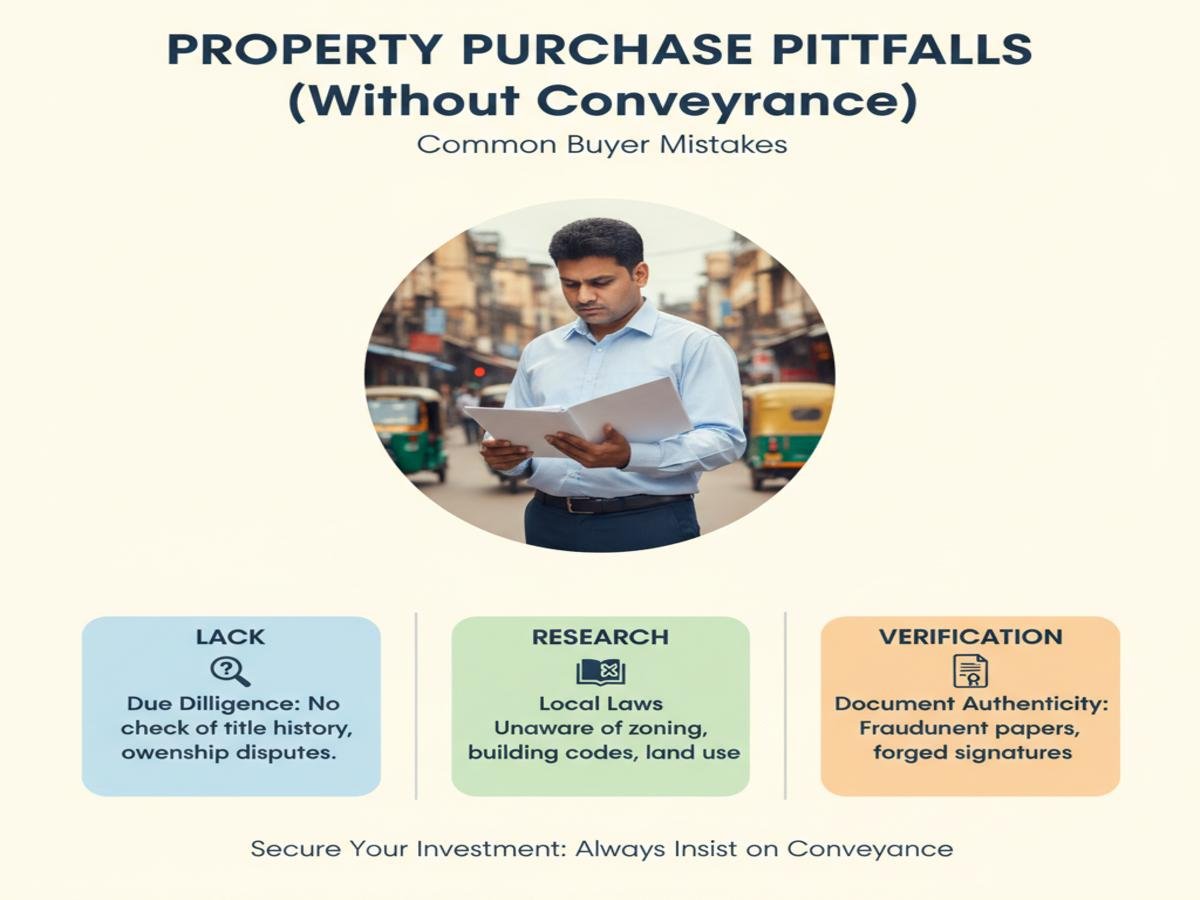
Many buyers make the same mistake.
They check the flat agreement but ignore the society’s land title.
They check the share certificate but ignore conveyance.
They trust bank loan approval but do not do title search.
They check the seller’s name but not the full document chain.
They ignore mutation, property card and 7/12 mismatch.
They pay token first and verify later.
That is backwards.
Verify first. Pay later.
For complete document review, read property title search in Navi Mumbai.
When to Consult a Professional
Consult a property lawyer or title-search professional before paying token if:
- society conveyance is missing;
- deemed conveyance is pending;
- builder is uncooperative;
- property is old and redevelopment is likely;
- property is CIDCO leasehold;
- property is linked to 12.5% scheme;
- property is in NAINA, gaothan, CRZ, green zone or no-development zone;
- seller is NRI, POA holder, heir, company or trust;
- mutation is pending or disputed;
- token amount is large or non-refundable.
This is not a formality. It can save lakhs or crores.
conclusion
Before paying token money for a flat, plot, gaothan property, CIDCO property or NAINA-linked property, get the document chain checked. Start with property title search in Navi Mumbai and verify conveyance, IGR records, land records, approvals and authority status before committing money.
FAQs
Frequently Asked Questions