
Risks of Buying Property with Unpaid Dues in Navi Mumbai
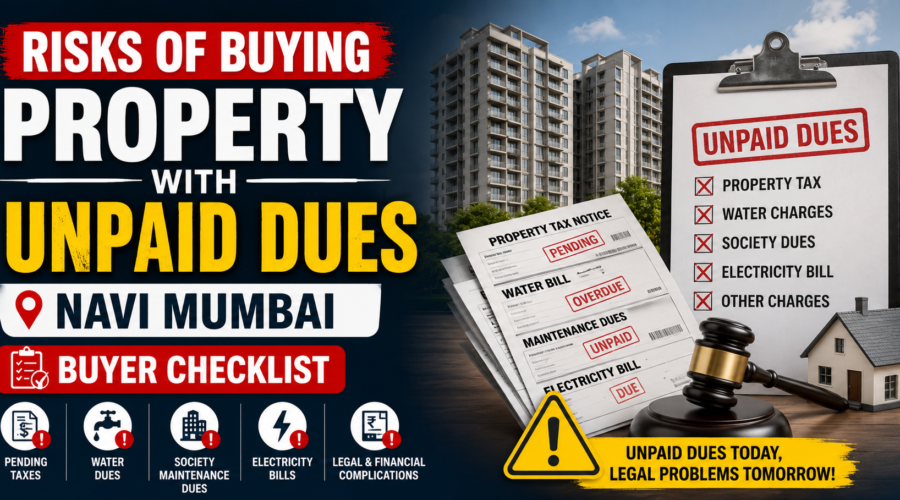
Buying property with unpaid dues is risky unless each liability is verified and settled before registration. In Navi Mumbai, check property tax, society maintenance dues, CIDCO service or water charges, electricity bills, bank loan dues, land records, and NAINA-related permissions. Do not pay token money unless the seller gives written no-dues proof or the unpaid amount is clearly adjusted in the agreement.
What Are Unpaid Dues in a Property Deal?
Unpaid dues are pending payments connected to the flat, shop, plot, land, building, society, authority, bank, or utility provider.
Many buyers think unpaid dues only mean electricity or maintenance bills. That is a mistake.
In Navi Mumbai and nearby areas like Panvel, Ulwe, Kharghar, Taloja, Dronagiri, Uran, Raigad and Thane, unpaid dues may include:
| Type of due | Why it matters | What to ask for |
|---|---|---|
| Property tax | Can delay transfer and create penalties | Latest paid receipt and demand notice |
| Society maintenance | May affect NOC, membership transfer and share certificate | Society no-dues certificate |
| CIDCO dues | Important for leasehold, service, water or transfer-related properties | CIDCO payment receipts and transfer status |
| Utility bills | Can delay meter transfer or possession | Latest paid electricity, water and gas bills |
| Bank loan dues | Can mean mortgage, original documents with bank, or CERSAI charge | Bank NOC, loan closure letter, original document release proof |
| Land revenue / NA charges | Important for plots, gaothan, agricultural or converted land | 7/12, 8A, property card, mutation entries and authority confirmation |
| NAINA / planning dues | May affect development permission or plot usability | ZCS, CC, OC, DCPR and planning authority records |
| RERA project issues | Can show project-level delay, complaints or compliance problems | MahaRERA project and promoter details |
This is an educational guide. Verify the latest position with the relevant authority or a property lawyer before making a transaction.
Should You Buy a Property with Unpaid Dues?

You can consider buying only if the dues are fully disclosed, verified and handled in writing.
The safest options are:
1. The seller clears all dues before agreement or registration. 2. The buyer pays verified dues directly to the authority and deducts the amount from the sale price. 3. A holdback amount is kept until all no-dues certificates are received.
Do not proceed only because the broker says, “This is normal.”
For a safer buying process, start with Navi Mumbai Property Buyer Due Diligence Guide before moving ahead.
Main Risks of Buying Property with Unpaid Dues

1. Society Transfer Can Get Delayed
In resale flats, pending society maintenance, repair fund, sinking fund, interest or penalties can delay the society NOC.
The society may also delay membership transfer or share certificate update until dues are settled.
2. Property Tax Arrears Can Create Problems
Municipal tax dues can create penalties and transfer complications.
For flats or shops under NMMC, Panvel Municipal Corporation or another local body, verify the latest tax demand and paid receipt before signing.
3. CIDCO Transfer or Service Issues Can Come Up
Many Navi Mumbai properties have a CIDCO angle.
For CIDCO leasehold properties, check service charges, water charges, estate receipts, transfer permissions and lease conditions. Do not assume a normal sale deed is enough.
If the property is linked to allotment, lease transfer or 12.5% scheme claims, also read CIDCO 12.5% Scheme Fraud Guide and Fake CIDCO Plot Fraud Guide.
4. Hidden Loan Dues Can Block the Deal
If the seller has an active home loan, the original documents may be with the bank.
Ask for:
- Loan statement
- Bank NOC
- Closure letter, if loan is closed
- Original document release proof
- CERSAI charge search, where applicable
A seller saying “loan is almost closed” is not enough.
5. Land Records May Not Match the Seller’s Claim
For plots, gaothan property, NAINA land or village land, check land records carefully.
Important Marathi / land-record terms:
- 7/12 extract / Satbara: A rural land record showing survey number, area, holder details and land-related entries.
- 8A extract: A landholding summary.
- Ferfar / mutation entry: A record change after sale, inheritance, partition or other transaction.
- Property card: Urban land/property record used in many city areas.
These records support verification. They should not be treated as complete ownership proof by themselves.
For title-risk checks, connect this article with Title Fraud Property Guide.
6. NAINA or CRZ Issues Can Create Bigger Risk
If the property is in NAINA, check Zone Confirmation Statement, development permission, commencement certificate, occupancy certificate and applicable DCPR.
If the land is near creek, mangroves, coast or CRZ-sensitive areas such as parts of Uran, Dronagiri, Kharghar creek-side belts or Raigad coastal areas, check CZMP / CRZ applicability.
For NAINA plot risk, use NAINA Plot Fraud Guide as the next reading step.
What to Check Before Paying Token Money
Do not pay token money first and verify later.
Use this checklist before any token, booking amount or written commitment.
| Check | Document / proof needed | Where to verify |
|---|---|---|
| Property tax | Latest bill and paid receipt | NMMC / Panvel MC / relevant local body |
| Society dues | No-dues certificate, ledger, NOC | Society office |
| CIDCO dues | Service charge, water charge, transfer-related receipts | CIDCO portal or office |
| Electricity / water / gas | Latest paid bills | Utility provider |
| Bank loan | Bank NOC, closure letter, original document release proof | Bank and CERSAI |
| Registered history | Sale deed, Index II, eSearch result | IGR Maharashtra |
| Land record | 7/12, 8A, property card, mutation entries | Mahabhulekh / Mahabhumi / revenue office |
| RERA project | Project status, promoter details, complaints | MahaRERA |
| NAINA property | ZCS, CC, OC, DCPR, TPS status | CIDCO / NAINA records |
| CRZ-sensitive property | CZMP map and clearance position | MCZMA / authority check |
If the seller refuses these documents, treat it as a warning.
For token-money protection, also read Token Amount Fraud Guide.
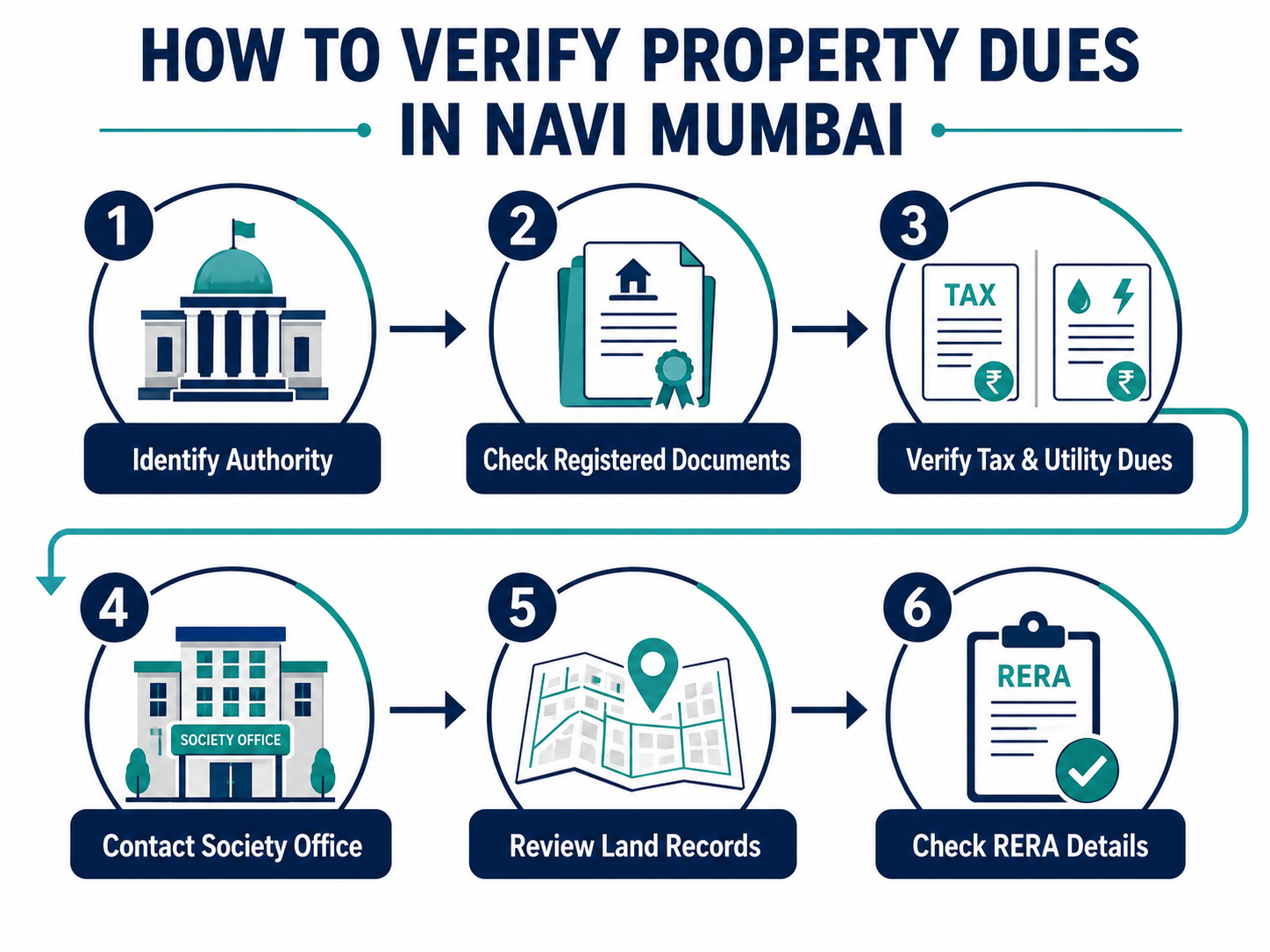
How to Verify Dues in Navi Mumbai

Step 1: Identify the Correct Authority
First identify where the property falls.
A Vashi or Nerul flat may involve NMMC.
A Panvel property may involve Panvel Municipal Corporation.
A CIDCO leasehold property may involve CIDCO.
A NAINA plot may involve CIDCO NAINA and revenue records.
A village or gaothan property may involve the revenue office and gram-level records.
Do not use the wrong authority’s receipt as proof.
Step 2: Check Registered Documents
Use IGR Maharashtra records for Index II, eSearch and registered document history.
This helps you check whether the seller’s document chain is logical. It does not replace legal title verification.
Step 3: Check Local Tax and Utility Dues
Ask for the latest property tax receipt, water bill and electricity bill.
If the tax record is still in an old owner’s name, ask why.
Step 4: Contact the Society Directly
Do not depend only on the seller’s copy.
Ask the society office about:
- Maintenance arrears
- Repair fund dues
- Sinking fund dues
- Non-occupancy charges, if applicable
- Dispute notices
- Transfer process
- Share certificate status
Step 5: Check Land Records for Plots
For land or plot deals, check 7/12, 8A, property card and mutation entries.
If the land is shown as agricultural, Class-II, gaothan, NAINA, green zone, CRZ-sensitive or conversion-related, verify with a property lawyer and revenue office before transaction.
Maharashtra’s NA and land-conversion framework has seen post-2025 changes. Do not rely on old assumptions. Verify before transaction.
Step 6: Check RERA for Project Property
For under-construction or recently completed projects, check MahaRERA registration, project status, promoter details, complaints and any adverse project status.
MahaRERA registration helps verification, but it does not mean the buyer can skip document checks.
Red Flags
Stop or slow down if you see these signs:
- Seller asks for token money before showing no-dues proof.
- Broker says, “Dues can be cleared later.”
- Society refuses to issue no-dues certificate.
- Property tax bill is in someone else’s name.
- CIDCO transfer papers are missing.
- Seller has a loan but cannot show bank NOC.
- Original documents are not available.
- 7/12 or property card does not match the seller’s claim.
- NAINA approval documents are unclear.
- Property is near creek, mangrove or coastal land but CRZ is not checked.
- Seller gives a large discount for immediate payment.
- Power of Attorney seller avoids direct owner verification.
If the pressure is coming mainly from the broker, read Broker Fraud Guide Navi Mumbai before paying.
Common Mistakes Buyers Make

Mistake 1: Checking Only the Sale Deed
A sale deed is important, but it does not show all dues.
You still need tax receipts, society no-dues, loan clearance, utility bills and authority records.
Mistake 2: Accepting WhatsApp Proof
A screenshot is not enough.
Ask for official receipts, certified records, digitally signed records where available, and written confirmation.
Mistake 3: Ignoring Society Dues
In resale flats, society dues can become a practical transfer problem.
Always meet or contact the society office.
Mistake 4: Treating Online Records as Final
Online records are useful for screening. For purchase decisions, verify certified records and legal position.
Mistake 5: Not Adding Protection in the Agreement
If dues are discovered after registration, the buyer may have to fight to recover money.
Put dues responsibility clearly in writing before final payment.
Agreement Clauses to Protect Yourself
Ask your property lawyer to include:
- Seller is responsible for all dues up to possession or registration date.
- Seller must provide no-dues proof before final payment.
- Buyer can deduct verified unpaid dues from sale consideration.
- A fixed holdback amount will remain unpaid until clearance.
- Seller indemnifies buyer against hidden dues, penalties, claims, loans or authority demands.
- Token is refundable if hidden dues, title defects, loan charges, litigation or approval issues are found.
Do not copy clauses blindly. Get them drafted for your exact property.
Example: Panvel / NAINA Plot Buyer
A buyer is shown a plot near Panvel in the NAINA influence area.
The broker says the title is clear and asks for token money.
Before paying, the buyer checks 7/12, mutation entries, IGR eSearch, NAINA ZCS, development permission, local tax dues, CIDCO-related dues and CRZ risk.
The buyer finds pending local dues and unclear development permission.
Correct action: do not pay token. Ask the seller to clear dues, produce written proof and add a refund / holdback clause.
Conclusion
Before paying token money, verify every due in writing. Check tax, society, CIDCO, bank, utility, land record, RERA and NAINA-related risks first.
Next step: read Navi Mumbai Property Buyer Due Diligence Guide and then check Token Amount Fraud Guide before making any payment.
FAQs
Frequently Asked Questions