
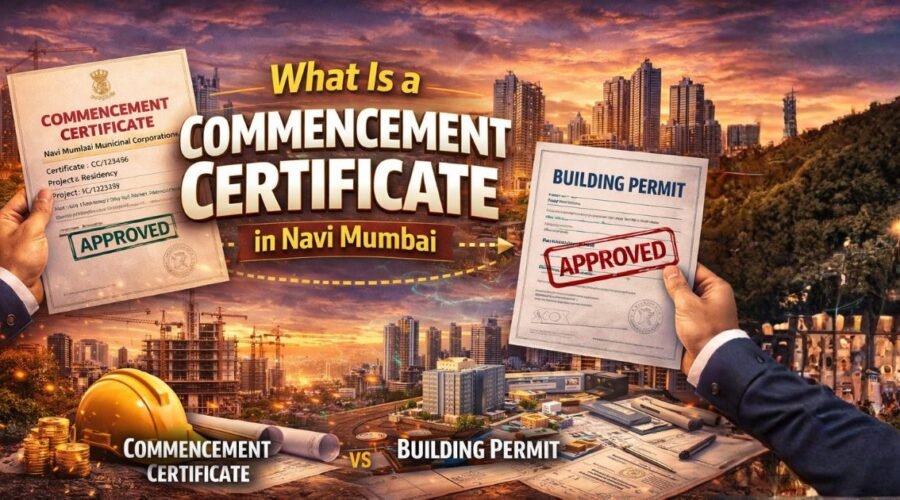
Commencement Certificate vs Building Permit in Navi Mumbai: Key Difference for Buyers
A Commencement Certificate in Navi Mumbai is the authority-issued permission that allows actual construction to begin. A building permit, by contrast, is the broader approval language around the sanctioned building proposal. In practice, the two are related, and sometimes even appear on the same paperwork, but they are not the same thing for a buyer. If you are checking a project before booking, the Commencement Certificate is the more important document for construction-stage legality.
That difference matters more than many buyers realise. In sales conversations, people often say “all approvals are done” or “building permission is received” as if that alone proves the project is fully ready for construction. In Navi Mumbai, that can be misleading.
A project may have approved plans and still not be at a stage where physical construction is lawfully cleared in the way a buyer assumes. That is why this topic is not just about definitions. It is about risk, timing, and document clarity.
A commencement certificate should not be confused with an occupancy certificate, because the first allows construction to start while the second relates to legal occupation after completion.
Commencement Certificate vs Building Permit in Navi Mumbai
| Point | Commencement Certificate | Building Permit |
|---|---|---|
| What it basically means | Permission to actually start construction | Approval of the building proposal, plans, and development framework |
| What it tells a buyer | Construction can begin, subject to the stage and conditions mentioned | The design and development proposal has been sanctioned |
| Is it the same thing in practice? | No | No |
| Why confusion happens | In Navi Mumbai, both can appear within the same official approval format | Sales teams often use “building permit” as a loose umbrella term |
| What matters more before booking an under-construction flat | Very important | Important, but not enough by itself |
| Does the stage matter? | Yes. It may be only up to plinth level at first | Yes, but it does not by itself prove full construction readiness |
| Should buyers ask to see it? | Absolutely | Yes, but along with the CC, not instead of it |
Understanding the difference between these approvals is important, but buyers should also review the full property buying checklist documents in Navi Mumbai before moving ahead.
What a Commencement Certificate means in Navi Mumbai in simple terms
A Commencement Certificate, often called a CC, is the legal green signal for construction to start. It is the point at which the authority says the developer can move from paper approval to actual site work.
This matters because an approved drawing and a legally active construction site are not the same thing. A fenced plot with a big project hoarding may look like a launched development, but unless the required commencement permission has actually been granted, the buyer should treat the project with caution.
In plain terms, a Commencement Certificate tells you that the authority has allowed the project to cross an important threshold. It does not mean every later stage is automatically clear forever. It simply means the project has reached a legally meaningful construction stage, subject to the conditions and scope mentioned in that approval.
For a normal buyer, this is the practical takeaway: if you are being asked for a token amount, Expression of Interest, or booking amount in an under-construction project, do not stop at hearing “plans are approved.” Ask whether the Commencement Certificate has been issued, for which tower or phase, and for what construction stage.
Is a Commencement Certificate the same as a building permit?
No, they are not the same in the way buyers should understand them.
A building permit usually refers to the sanctioned building proposal. It is the approval of the project’s architectural and planning side: height, layout, FSI logic, setbacks, and other planning compliance under the applicable development control rules.
A Commencement Certificate is the operational permission that allows physical construction to start.
That sounds straightforward, but Navi Mumbai adds a real-world complication. Under the current regulatory format used by local authorities, these permissions are often combined into one document format. So a buyer may see a paper that carries language around both building permission and commencement. That is the root of the confusion.
For many under-construction buyers, the letter of allotment appears early in the purchase journey, well before later approvals like Occupancy Certificate become relevant.
Why buyers, brokers, and builders often use the words loosely
In market language, “building permit,” “sanctioned plan,” “approval,” “CC,” and even “all approvals” are often thrown around as if they mean the same thing. They do not.
This happens for two reasons. First, many sales teams simplify legal language because they want the buyer to feel the project is moving smoothly. Second, the paperwork itself may combine the sanction of building permission and the commencement element in a single official format. When that happens, people stop reading the details and assume the headline means everything is fully clear.
That is where mistakes happen.
What “building permit” usually refers to in practical project talk
In practical Navi Mumbai project talk, “building permit” usually points to the approval of the building scheme or sanctioned plan. It tells you the authority has accepted the proposal from a planning and design compliance angle.
But that does not automatically answer the buyer’s bigger question: can the builder legally begin the actual construction of the building I am being shown in the brochure?
That second question is where the Commencement Certificate becomes more important.
What the CC specifically indicates on the ground
The CC is what turns the project from approved-on-paper to allowed-on-site. It is the working permission for construction.
Even here, buyers need to be careful. In many projects, the first CC is not a blanket clearance for the entire structure. It may be restricted to the plinth level or another specified stage. That means you should not read one valid-looking certificate and assume the entire tower has already been cleared for full superstructure construction.
Where this difference matters most in Navi Mumbai project approvals

This topic becomes much more practical when you look at how Navi Mumbai is actually administered. The city is not one single approval environment. Different areas can involve different authority pathways, and that changes how a buyer should verify documents.
When the project falls under CIDCO-side control
In several developing and planned belts of Navi Mumbai, especially places with strong CIDCO land history such as Kharghar, Ulwe, and Dronagiri, the land and project logic can be closely tied to CIDCO’s own development and lease structure.
In such cases, document verification is not just about seeing a pretty brochure or a builder presentation. The buyer should be alert to whether the project is in a CIDCO-linked zone, whether leasehold conditions are relevant, and whether the permission trail matches that local reality.
In practical terms, CIDCO-side projects can involve a more specialised approval and compliance path. So if the project is in a CIDCO-heavy node, the buyer should be especially careful not to treat generic sales statements as enough.
When the project falls under NMMC limits
In established Navi Mumbai nodes such as Vashi, Nerul, Belapur, and nearby NMMC-controlled areas, the project is operating in a different local regulatory environment.
Here, the buyer’s job is still the same at the core: verify the actual approval status and do not confuse sanctioned plan language with commencement-stage legality. But the local authority path, conditions, and digital verification route can differ from CIDCO-side projects.
This is why a good due diligence conversation should start with one question: under which authority or local planning setup is this project actually being processed?
When the project is in Panvel or PMC-side growth areas
Panvel-side areas and the wider growth corridors connected to the airport-influence expansion belt often carry another layer of complexity. Land conversion history, expanding urban control, and changing development intensity can make these projects especially vulnerable to early marketing hype.
This is where many buyers get drawn into “pre-launch” conversations. The project may sound attractive because of future growth, airport influence, or lower entry pricing, but that is exactly the stage where a buyer must insist on checking whether the commencement-stage permission is actually in place.
Local authority matrix: where buyers should be more alert
| Area context | Why the CC issue matters here | Buyer’s practical focus |
|---|---|---|
| CIDCO-linked nodes | Leasehold and authority-specific compliance can shape approval readiness | Verify authority path and do not rely on generic sales wording |
| NMMC nodes | Projects may look mature and urban, but document-stage clarity still matters | Check the approval stage, not just the market reputation of the area |
| Panvel / PMC-side growth belts | Early-stage launches and future-growth selling are more common | Be extra careful with pre-launch claims and partial approvals |
What comes first in the approval chain, and where the Commencement Certificate fits
The cleanest way to understand this topic is to see it as a sequence, not as one isolated paper.
A project normally moves through a chain of legal and practical milestones. The builder first needs the right to develop the land in the way claimed. Then the building plans are processed and sanctioned. After that come multiple compliance steps, conditions, charges, and supporting clearances. Only then does the project reach the point where a Commencement Certificate can become meaningful for physical construction.
That sequence matters because many buyers jump from “the plan is approved” to “the building is legally underway.” That jump is exactly where confusion lives.
A simple way to think about the approval chain
1. Land status and development rights 2. Sanctioned building plan or development permission 3. Conditions, charges, and required clearances 4. Initial Commencement Certificate 5. Site work and inspection-based progression 6. Later completion and occupancy-side approvals
The most important thing to understand here is that the CC sits after the project has crossed more than just a design-approval stage. That is why it carries so much weight.
Why plinth-level language matters
One of the most overlooked details in Navi Mumbai project approvals is that the initial commencement permission can be stage-based.
In practical terms, the first permission may allow only work up to plinth level. After site inspection and compliance at that stage, the project may move further. So if a buyer sees a Commencement Certificate, the next question should not be only “Is there a CC?” It should also be “Up to what level, for which tower, and under what conditions?”
That one follow-up question can save a buyer from making a wrong assumption.
What a buyer should ask for before booking an under-construction project

Before paying anything meaningful, the buyer should ask for the exact project documents that prove the project is legally at the stage being claimed.
The minimum goal is not to become a lawyer. It is to avoid basic preventable mistakes.
Buyer document checklist before booking
- Ask for the exact document titled Commencement Certificate, or the combined approval document that includes the commencement portion
- Check which authority issued it: CIDCO, NMMC, PMC-side authority, or another relevant planning authority depending on the project
- Match the plot details, sector details, survey or CTS references, and project identity with the actual project being sold
- Check whether the certificate is for the same wing, tower, or phase in which you are buying
- Check whether the permission is limited to plinth level or extends beyond that stage
- Check whether the certificate is still within validity and not stale or expired
- Cross-check the project details on the MahaRERA page if the project is one that requires registration
- Do not accept verbal assurance, brochure lines, or WhatsApp screenshots as final proof
What to match against MahaRERA disclosures
If the project is a standard project that falls under MahaRERA registration rules, the buyer should cross-check the project page and uploaded documents. That does not replace reading the approval document itself, but it gives an additional verification layer.
This matters because MahaRERA is not just a name to drop in conversation. It is one of the places where the buyer can test whether the project’s legal story matches its sales story.
What not to rely on
Do not assume the following are enough on their own:
- A sanctioned plan shown in a sales cabin
- A non-agricultural order shown as if it proves full project readiness
- A fire or other departmental NOC shown out of context
- A claim that “RERA is in process”
- A line that says “all approvals received”
- A CC belonging to a different phase, wing, or tower
These may be relevant papers, but they are not substitutes for checking the correct commencement-stage permission.
Can a project be marketed before full construction permissions are in place?
For normal projects, this is the area where buyers should be most cautious.
A standard-scale project is not supposed to be casually marketed and sold in the way many “pre-launch” campaigns suggest if the core registration and permission position is not in order. For most mainstream Navi Mumbai buyers looking at towers, high-rises, and large residential projects, the absence of a proper registration trail and valid commencement-stage permission should be treated as a serious warning sign.
At the same time, this topic needs careful wording. Not every project falls under the exact same regulatory treatment. Smaller micro-projects may be exempt from MahaRERA registration if they fall within the specific size and unit-count thresholds. That means the buyer should not use a blanket one-line rule for every small project, plot-based build, or tiny development.
Still, for the typical Navi Mumbai apartment buyer looking at a regular builder project, the safe approach is simple: if the developer is asking for money but cannot show a valid commencement-linked approval position and the matching MahaRERA trail where applicable, assume the risk is high.
Caution box: what the builder says vs what the document actually proves
| What the sales team may say | What the buyer should actually verify |
|---|---|
| All approvals are in place | Ask for the actual Commencement Certificate or the combined building permission and commencement document |
| Project is under construction | Check whether the CC has truly been issued and for what stage |
| RERA is coming soon | Do not treat this as safety |
| Tower launch is open | Ask whether that specific tower or phase is covered |
| Building permission is approved | Check whether commencement clauses are active and relevant to your unit |
How to read a Commencement Certificate without being a technical expert
A buyer does not need to be a town planner to read a CC properly. A few practical checks are enough to catch many common problems.
1) Check the issuing authority
Start with the official authority details. In Navi Mumbai, the project context may involve CIDCO, NMMC, PMC-side systems, or another planning setup depending on the exact geography. The document should clearly show who issued it.
If the authority is unclear, the buyer should slow down immediately.
2) Match the land and project identity
The plot details matter. Sector, survey number, CTS details, plot reference, or project identification should match the project being sold.
If the brochure name is glamorous but the legal reference does not match, do not assume it is fine. Legal identity matters more than branding.
3) Check the tower, wing, or phase
This is a very common blind spot. In larger Navi Mumbai projects, approvals can be tower-wise or phase-wise. A certificate for Tower A does not protect a buyer who is paying for Tower C.
If the project is a township or multi-wing development, phase matching becomes non-negotiable.
4) Read the stage wording carefully
This is one of the most important practical checks. The permission may be limited. If it is only up to plinth level, do not read it as if the full vertical construction is already cleared.
A buyer who ignores this line can completely misunderstand the project’s true stage.
5) Check validity and conditions
A Commencement Certificate is not something to treat as timeless. If the approval has an initial validity period and construction has not progressed in time, the buyer should ask whether the permission remains active or has been revalidated as required.
Also read the conditions. Some buyers look only at the heading. The real meaning often sits in the conditions, stage limits, endorsements, and scope wording.
Example: how a normal buyer should think about it
Suppose you visit a project in Kharghar or Panvel-side growth areas. The sales team shows a stamped approval paper and says, “See, building permission is done.” That is not the end of the check.
You should ask:
- Is this the same as the Commencement Certificate or does it include the commencement portion?
- Is it valid for this exact tower or phase?
- Is it only up to plinth level?
- Is the same approval reflected in the project’s regulatory disclosure trail where applicable?
That small pause can protect a buyer from a very expensive assumption.
Common buyer mistakes in Navi Mumbai when checking CC and building approval documents
This is where theory becomes ground reality. Most buyer mistakes are not dramatic legal mistakes. They are simple trust mistakes.
1: accepting one official-looking page without reading the scope
Many buyers see a stamp, signature, and technical language and assume the entire project is fully clear. But the important part is not that the paper looks official. The important part is what exactly it authorises.
2: confusing sanctioned plan with live construction clearance
This is probably the biggest mistake. A sanctioned plan can look impressive. It may show the full vision of the project. But a sanctioned plan is not the same as construction-stage permission.
3: ignoring phase and tower mismatch
Large projects in Navi Mumbai often unfold in stages. A document for one phase may be shown to create confidence for another phase. If the buyer does not match the unit being purchased to the exact approval coverage, that is a serious due diligence failure.
4: falling into the pre-launch trap
Future-growth locations can create excitement. Buyers hear airport, metro, or new corridor stories and rush into early entry. But if the commencement-stage document position is weak, the lower price may simply reflect higher legal and execution risk.
5: relying only on screenshots or verbal claims
A screenshot on WhatsApp, a marketing deck, or a one-line broker assurance is not document verification. Buyers should verify through proper project documents and official portal logic where available.
So what is the safer takeaway for buyers, investors, and families?
The safest takeaway is simple: treat the Commencement Certificate as the practical construction-start checkpoint, and treat “building permit” as a broader approval phrase that still needs deeper reading.
If you are a conservative homebuyer, especially someone buying with family money or depending on a home loan, it is smarter to wait until the project has a clearly valid commencement-stage approval and the matching regulatory trail is visible where applicable. That reduces avoidable uncertainty.
If you are a higher-risk investor looking at earlier entry for price advantage, you may consciously study projects at an earlier stage. But that should be a calculated risk, not a confused one. You should know exactly what the project has, what it still lacks, and how that gap could affect timeline, finance, and resale comfort.
In other words, the question is not just “Does the project have approval?” The real question is: “What kind of approval, for which stage, under which authority, and for my exact tower or phase?”
That is the difference between informed buying and brochure-driven buying.
conclusion
If you remember only one thing, remember this: in Navi Mumbai, “building permit” and “Commencement Certificate” may appear close together in project paperwork and sales language, but they do not answer the same buyer question.
The building permit side tells you the project proposal has planning approval. The Commencement Certificate side tells you whether the project has reached the stage where actual construction is lawfully allowed to begin, and even then, you still need to check the exact stage, validity, tower, and authority details.
For most buyers, that makes the Commencement Certificate the more practical document to focus on before trusting an under-construction project. Read the paper, match the phase, verify the authority, and never let a generic “all approvals done” line replace real due diligence.
FAQs
Frequently Asked Questions