

Vashi vs CBD Belapur for Office Visibility and Business Use: Which Node Works Better?
If the question is simple, the practical answer is this: Vashi usually works better for stronger everyday commercial visibility, wider brand recall, and high-energy business presence, while CBD Belapur usually works better for formal office use, cleaner client experience, structured business functioning, and institutional credibility. The better choice depends on what your office actually needs: daily visibility, client comfort, staff commute ease, quieter operations, or stronger long-term yield logic.
A lot of buyers and renters make one basic mistake here. They compare Vashi and CBD Belapur as if both are just “prime commercial nodes” and the rest will somehow work out. That is not how office property works in Navi Mumbai. An office is not a shop. Heavy movement outside a building does not always help. Sometimes it helps brand recall. Sometimes it only creates parking stress, entry friction, and noise.
This is why the real comparison is not just Vashi vs CBD Belapur. It is visibility vs usability, prestige vs practicality, and commercial energy vs structured business comfort.
For a better understanding of Vashi before comparing both nodes, Vashi Commercial Property Guide is worth reading first.
Vashi or CBD Belapur for office visibility and business use: what is the practical answer?
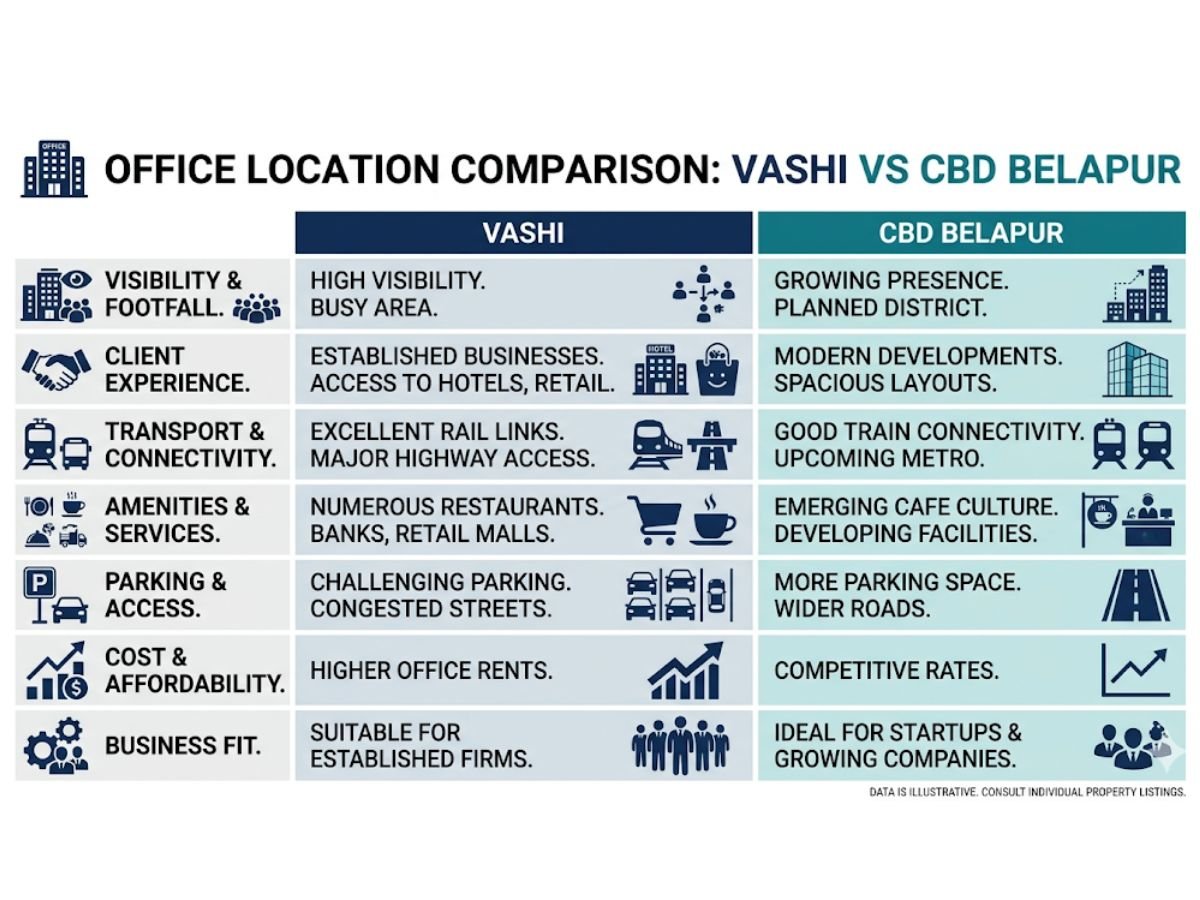
| Comparison Point | Vashi | CBD Belapur |
|---|---|---|
| Everyday commercial visibility | Usually stronger | More selective, less loud |
| Brand recall across Navi Mumbai and Mumbai-side audience | Stronger | Good, but more formal than mass-visible |
| Client-facing office feel | Familiar, active, convenient | Structured, polished, calmer |
| Suitability for formal B2B and institutional work | Good in the right building | Usually stronger |
| Retail-style movement around office | Higher | Lower |
| Parking and entry stress risk | Often higher in busy mixed-use pockets | Usually better managed in stronger office pockets |
| Office investment entry cost | Higher on average | Lower on average |
| Rental yield logic | Lower yield, stronger capital safety pattern | Better yield pattern in many cases |
| Best fit | Agencies, branches, visible service businesses, startups | Legal, finance, consulting, B2B, backend teams |
What does “office visibility” actually mean in Vashi and CBD Belapur?
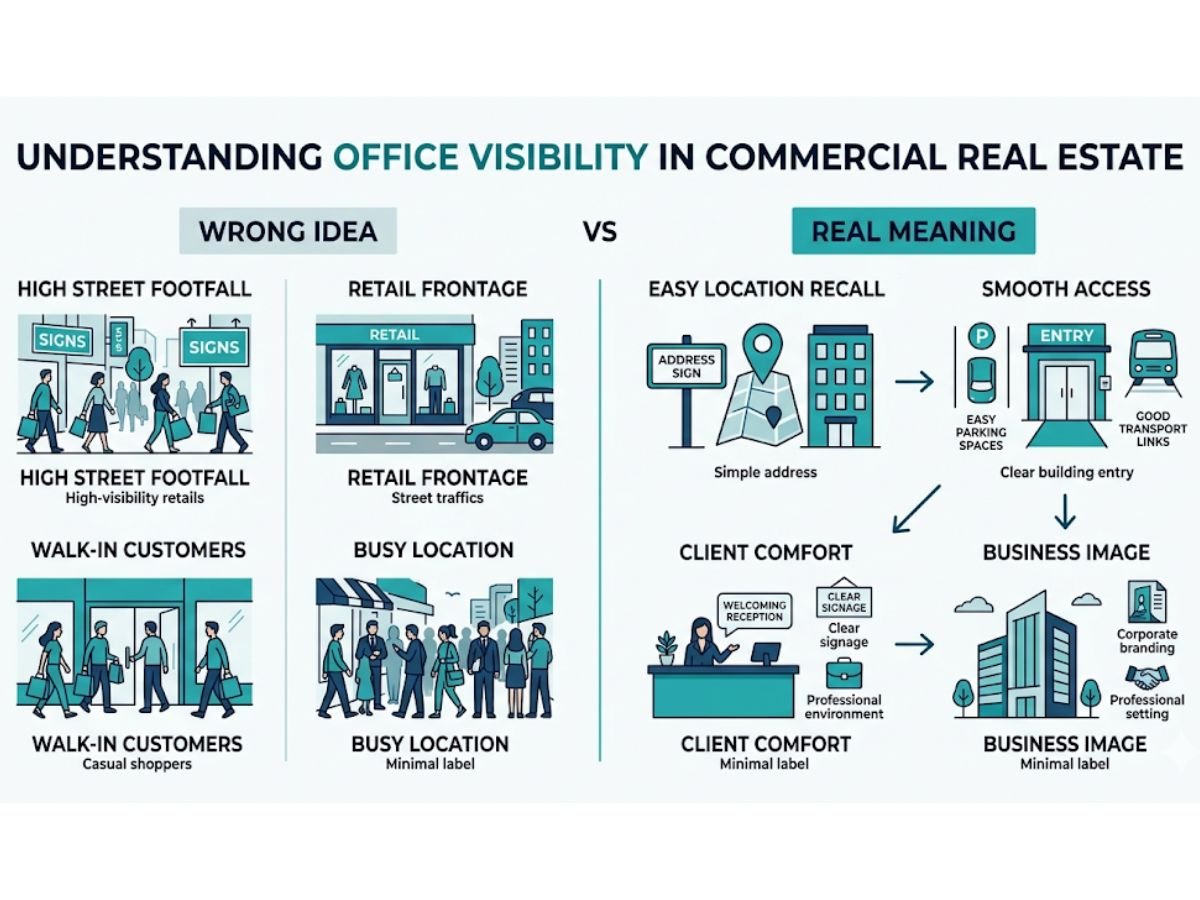
Office visibility is one of the most misunderstood ideas in commercial property. People often borrow shop logic and apply it to offices. That causes expensive mistakes.
Why office visibility is not the same as shop visibility
A shop may benefit directly from passing footfall, frontage, and spontaneous stopping. An office usually does not work that way. A legal office, consulting office, agency office, tax office, design studio, or back office does not need hundreds of random pedestrians. It needs the right people to find it without friction.
For an office, visibility usually means four things:
- easy location recall
- easy building approach
- comfortable client entry
- the right business image
That is why a highly visible main-road office can still be a bad office. If the client cannot park, cannot enter smoothly, or feels irritated before the meeting begins, the address has failed even if thousands of people saw the building from the road.
When visibility helps office business and when it barely matters
Visibility helps more in Vashi when the office benefits from broad commercial familiarity. This is true for branches, agencies, certain service businesses, client-facing sales teams, and offices that gain from being in a node people instantly recognize.
Visibility matters much less when business comes through referrals, appointments, compliance work, legal routines, backend operations, or repeat clients. In those cases, approachability beats exposure. CBD Belapur often performs better there because its office environment can feel more structured and less distracting.
A useful rule is this: if your office needs eyeballs, Vashi matters more; if your office needs trust and ease, Belapur may matter more.
Why Vashi usually feels more commercially visible in everyday business life
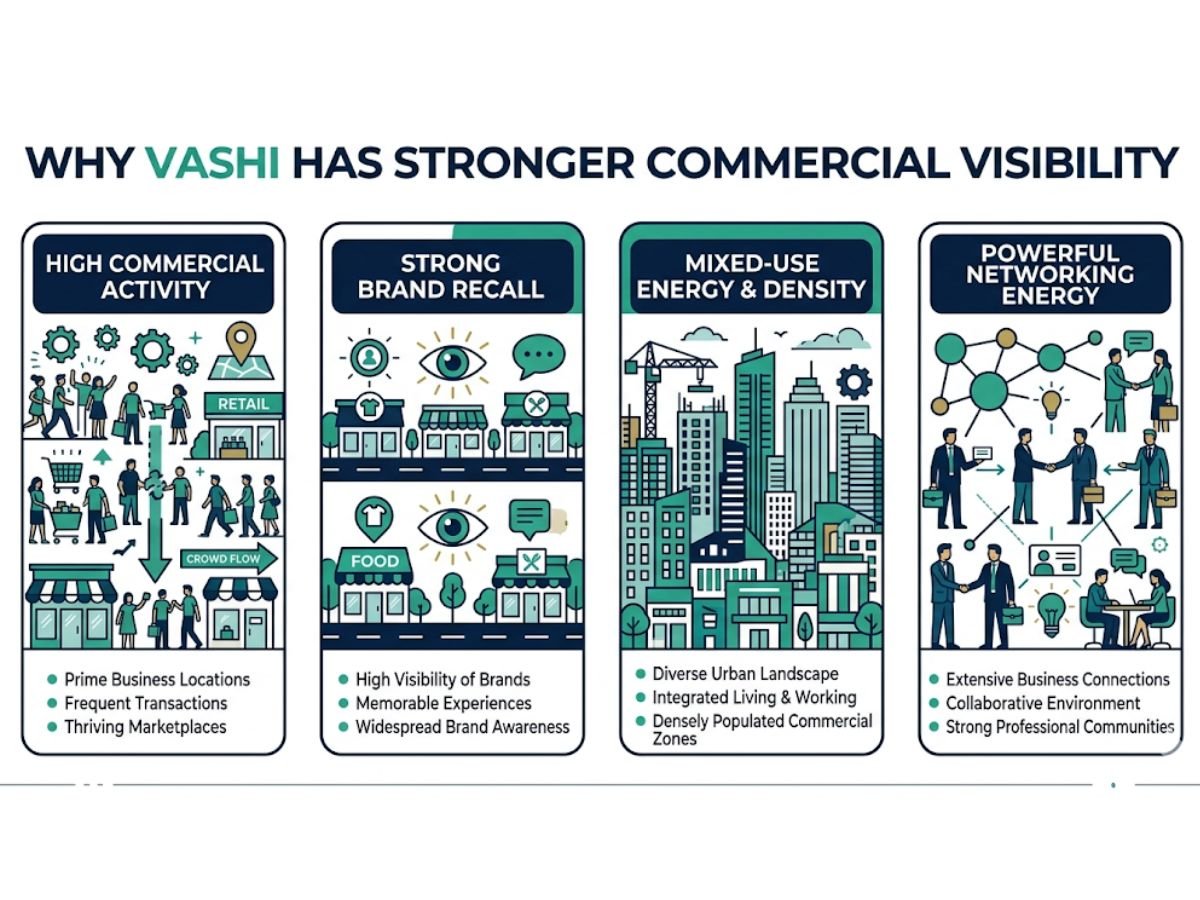
Vashi has something that is difficult to manufacture: commercial memory. It has long been one of Navi Mumbai’s strongest gateway nodes, and that history still affects business behavior today. People know Vashi. They refer to it easily. They understand its commercial identity quickly.
That wider recall matters in office use more than many people admit. A business that says “our office is in Vashi” often gets immediate recognition from clients, vendors, recruits, and Mumbai-side contacts. That familiarity reduces explanation. It creates a built-in commercial shorthand.
Vashi’s mixed-use intensity also adds to this. Commercial buildings, retail lines, dining, services, and transit movement all exist close together in many pockets. That creates a constant feeling of activity. For some businesses, this is a real advantage.
A marketing agency, a startup, a premium service office, or a visible branch setup may benefit from being in a node that feels commercially alive throughout the day. Coworking presence and lifestyle support also strengthen that appeal. This is one reason Vashi continues to attract businesses that care about energy, connectivity, and networking comfort.
But there is a price for that energy.
The same mixed-use strength can become operational friction. In some Vashi pockets, especially highly active sectors, visibility comes with noise, parking stress, crowding, delivery churn, and a more tiring daily business atmosphere. A place like Satra Plaza shows this duality well. By day, it can feel premium and active. By evening, dining and nightlife movement can change the whole usability mood around the office. That is not automatically bad, but it is not neutral either.
So yes, Vashi often feels more visible. But that visibility is not free. It comes bundled with a heavier sensory and operational load.
Why CBD Belapur often works better for formal office use than people first assume
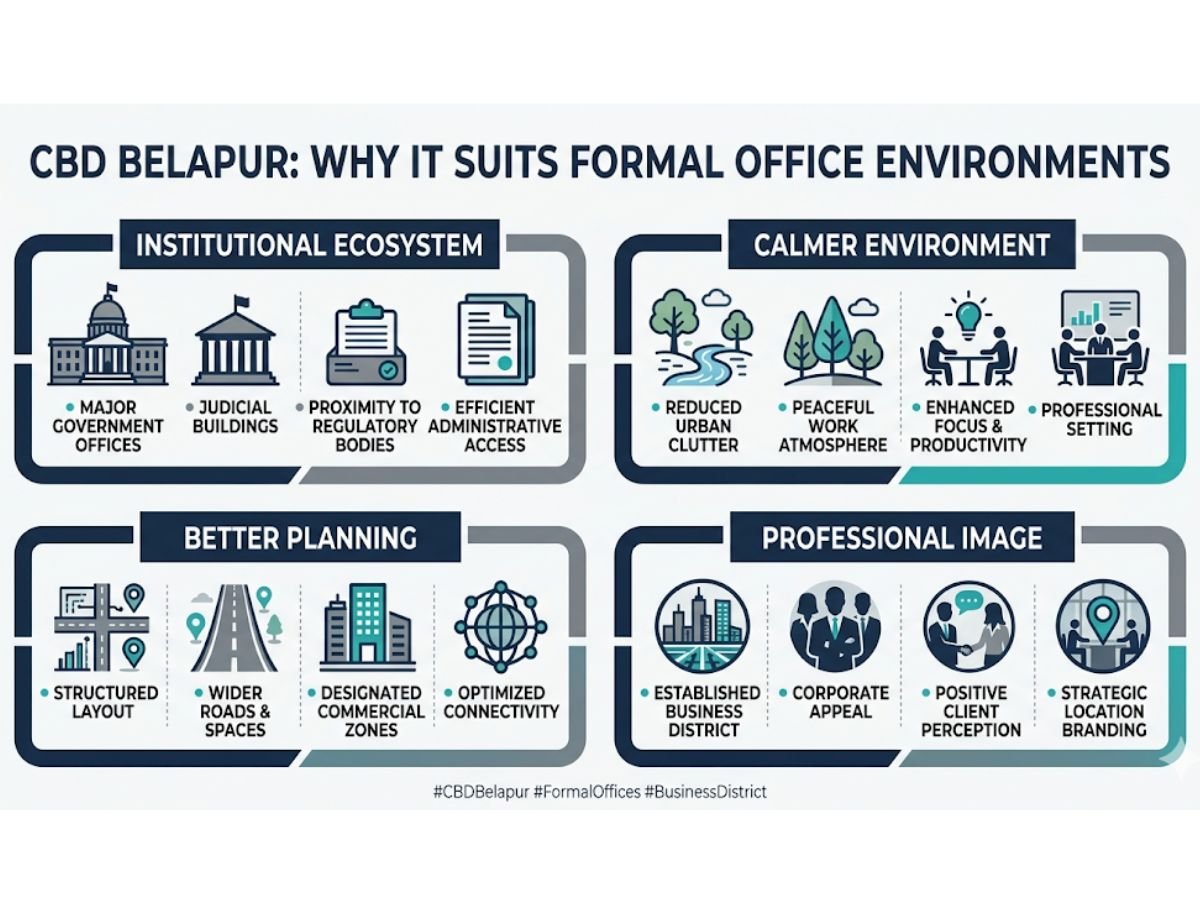
CBD Belapur is often underestimated by people who look only for obvious commercial noise. It may feel quieter than Vashi in some parts, but for many office users that is exactly the point.
Belapur was shaped as a central business district, and that still shows in how the node feels. Wider roads, more formal sector behavior, stronger administrative identity, and institutional anchors create a different kind of business value. It does not scream for attention. It signals seriousness.
That matters a lot for legal offices, chartered accountants, architects, consultants, finance-linked businesses, and firms that work through appointments rather than spontaneous walk-ins. The presence of institutions such as CIDCO Bhavan, Belapur Court, RBI, and SBI influences the tenant profile and the business culture around the node. Clients coming for formal work often read that environment positively.
There is another advantage that people call “quiet” too casually. For office work, lower-chaos surroundings can improve the entire experience: easier entry, less distraction, smoother meetings, and better staff focus. A quieter node is not a weaker node if the office model is appointment-led and professional.
This is where CBD Belapur often becomes the more mature choice. It may not give the same broad mass-market commercial buzz as Vashi, but it often gives something more useful: a cleaner setting for serious work.
You may also want to read CBD Belapur Commercial Property Guide to see how Belapur compares on business use and positioning.
For client visits, which node usually creates a better first impression?
| Client Experience Factor | Vashi | CBD Belapur |
|---|---|---|
| Immediate recognition of location | Usually stronger | Good, but more formal than widely familiar |
| Arrival mood | Active, busy, commercial | Calmer, structured, office-oriented |
| Risk of parking frustration | Often higher in mixed-use pockets | Improving, especially in stronger office sectors |
| Suitability for formal meetings | Good in the right building | Usually stronger overall |
| Shared retail-office conflict | More common | Usually lower |
| Best first impression for | Sales, brand-facing, energetic business setups | Legal, consulting, finance, institutional meetings |
For staff commute and daily usability, which node is easier to run from?
For daily business operations, commute is not a side topic. It directly affects hiring, retention, punctuality, and fatigue.
Vashi remains strong because of its major road linkage and its gateway role toward Mumbai. The Vashi Creek Bridge expansion is also important because it is expected to reduce peak congestion pressure significantly once fully realized. For businesses with frequent Mumbai movement, that matters.
But CBD Belapur has gained a serious operational advantage through Metro Line 1, which connects Belapur to Kharghar, Taloja, and Pendhar. This is not just a transport improvement. It changes workforce access. It makes Belapur more practical for businesses that want to tap residential talent pools from the Kharghar-Taloja-Pendhar belt without forcing long, messy commutes.
That is especially relevant for:
- back-office teams
- mid-sized corporate support functions
- fintech or consulting satellite teams
- businesses planning to scale headcount gradually
A founder may focus on their own commute. A smarter office decision also considers how 20, 30, or 50 employees will reach the location daily. On that question, Belapur’s metro linkage can be a real edge.
Which node suits different business types better?
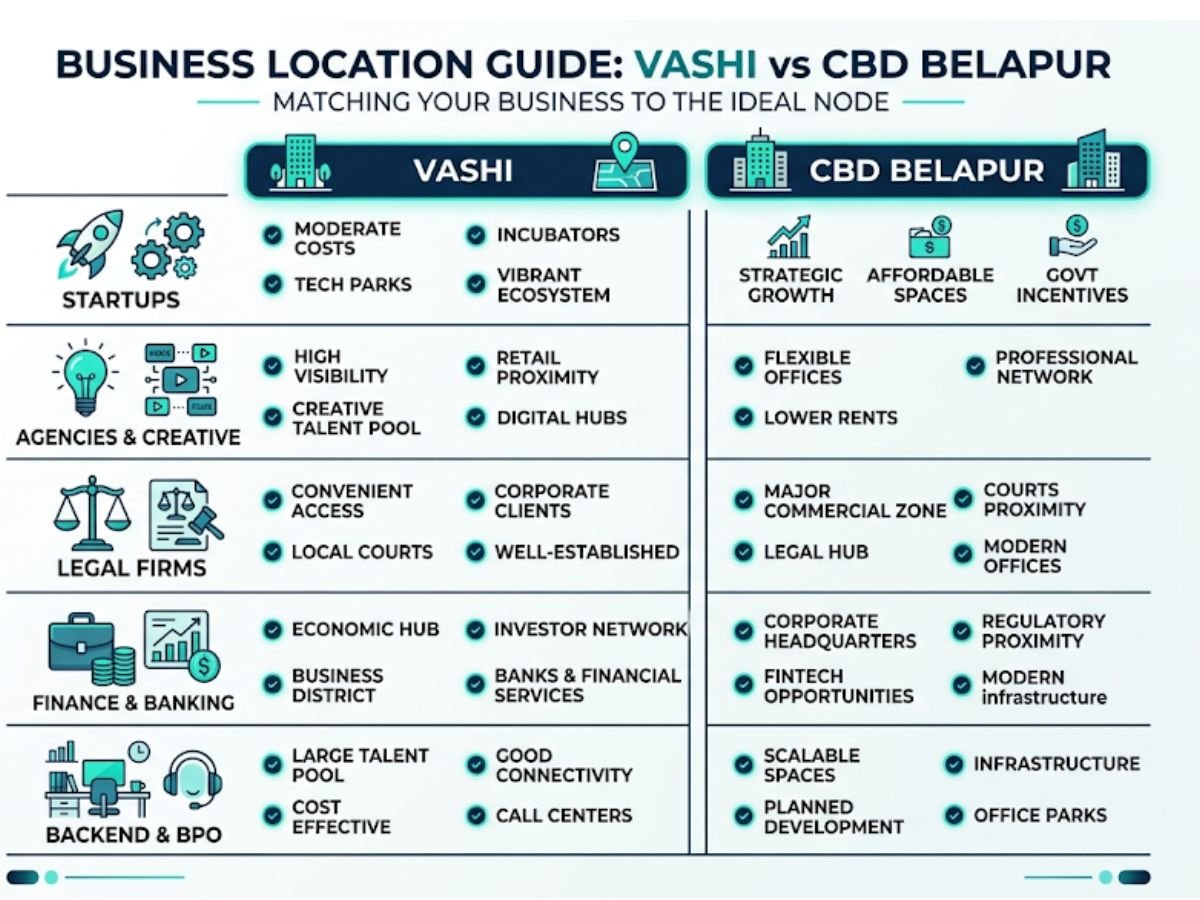
| Business Type | Usually Better Fit | Why |
|---|---|---|
| Marketing agency / creative studio | Vashi | Better commercial buzz, stronger recall, networking energy |
| Startup / coworking-led team | Vashi | Lifestyle ecosystem and startup-friendly environment |
| Branch office for visible brand presence | Vashi | Stronger mass recognition and gateway value |
| Walk-in clinic or visible service office | Vashi | Better benefit from everyday movement and familiarity |
| Lawyer / litigation office | CBD Belapur | Court and institutional proximity matter directly |
| Chartered accountant / tax consultant | CBD Belapur | Formal, appointment-led, trust-oriented environment |
| Finance / compliance / regulatory consulting | CBD Belapur | Strong institutional ecosystem fit |
| B2B backend office | CBD Belapur | Better for structured operations and staff commute scaling |
| Supply chain / logistics coordination office | CBD Belapur | Practical ecosystem fit can be stronger than high-footfall Vashi |
| Investor-owned office seeking better yield math | CBD Belapur | Lower capital entry often supports better rental yield |
Does Vashi’s stronger visibility also mean better office investment potential?
Not automatically. In fact, this is where the comparison becomes more interesting.
Vashi generally commands higher commercial capital values, roughly in the band of ₹25,000 to ₹50,000 per sq. ft., depending on building, age, floor, and exact pocket. CBD Belapur typically sits lower, around ₹18,000 to ₹35,000 per sq. ft., again depending on micro-location and asset quality. These are approximate market-dependent bands, not fixed truths.
The result is that Vashi often gives stronger capital safety and lower vacancy comfort, but not always better yield. Typical local brokerage patterns suggest Vashi office yields may often sit around 6% to 7%, while CBD Belapur may often offer 7% to 9% because the entry cost is lower and B2B tenant demand remains steady.
That creates a useful distinction:
- Vashi often suits capital-preservation-minded buyers
- CBD Belapur often suits yield-focused investors better
This does not mean Belapur is automatically the better investment. A poor building in Belapur is still a poor building. But it does mean visibility alone should not drive the investment decision. A famous node can still underperform in yield if the entry price has already baked in too much premium.
Caution: visibility premium can become a trap
Some buyers overpay for a visible Vashi address assuming it guarantees strong returns. But office investment performance depends on more than visibility. It depends on:
- unit efficiency
- tenant type
- parking practicality
- building management
- leasehold or freehold status
- long-term usability of the asset
A well-managed office in the right Belapur sector can outperform a weaker but more famous Vashi office in rental logic.
Where do buyers and renters get misled in this comparison?
The biggest trap is the main-road illusion. A building facing a major road may look commercially powerful, but that does not mean it works well as an office.
If vehicle entry is awkward, legal parking is weak, and client approach is stressful, the office becomes less usable despite high visual exposure. This has become more important after the NMMC parking policy gazetted in December 2024, which tightened parking expectations for commercial properties and penalized severe deficits through ASR-linked charges. In simple words, older parking-deficient stock is now a bigger risk than many buyers realize.
Another trap is assuming “street parking ho jayega somehow.” That thinking is dangerous now. In both Vashi and Belapur, dedicated parking and compliant building planning matter much more than before.
A third trap is ignoring land tenure. In Navi Mumbai, CIDCO leasehold and freehold status can materially affect resale ease, financing smoothness, and future transfer burden. Where freehold conversion is available and completed under CIDCO schemes, the asset may become easier to hold and transfer. But that is not automatic for every property and must be checked carefully.
How building type and micro-location can change the Vashi vs CBD Belapur answer completely
This comparison breaks down completely if you ignore micro-location.
A tired old building near a station is not automatically better than a well-managed modern office building a little deeper inside a cleaner commercial pocket. This matters in both nodes.
In Vashi, Sector 17 and Sector 19 can behave very differently. One may feel more retail-commercial and saturated. Another may feel more premium but also carry after-hours congestion from dining and nightlife patterns. In Belapur, a better-quality standalone office asset in Sectors 11 or 15 can be a very different proposition from older station-complex stock.
This is where the ongoing ₹103.27 crore CIDCO revamp of station business complexes in Vashi and Belapur becomes a serious caution signal. The fact that structural upgrades are needed tells you something important: not all station-linked office stock is healthy stock. Issues like falling plaster, weak ceilings, poor lifts, and tired common areas are not minor cosmetic details in office property. They shape client trust and daily functioning.
A professionally managed Class-A style building in Belapur can easily outperform an unmanaged, deteriorating office building in Vashi, even if the Vashi address sounds more commercially powerful on paper.
Who should choose Vashi and who should choose CBD Belapur?
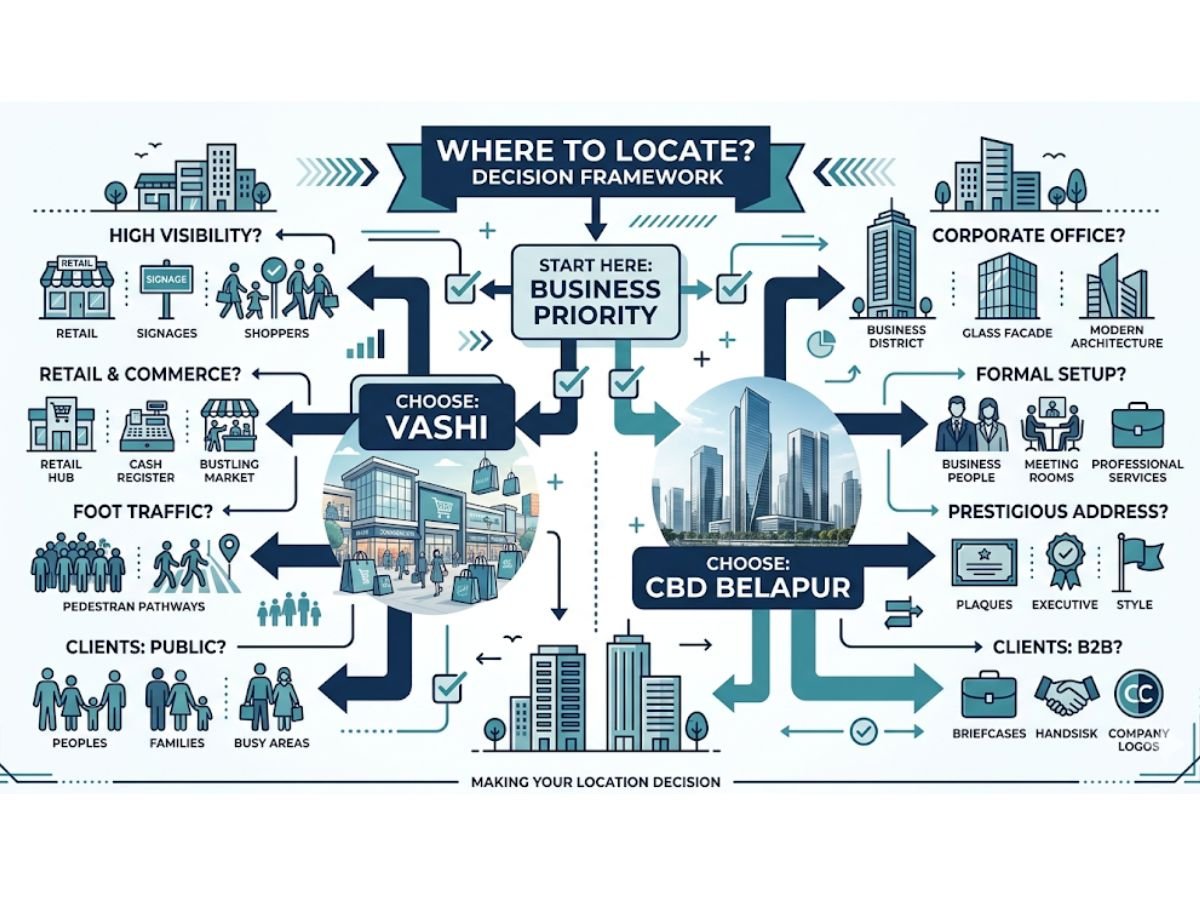
| Choose Vashi if… | Choose CBD Belapur if… |
|---|---|
| your office needs stronger everyday brand recall | your office runs mostly on appointments and formal meetings |
| you benefit from a busier commercial environment | you want a calmer, more structured office district feel |
| networking energy and visible presence matter | legal, finance, consulting, or regulatory linkage matters |
| you are okay paying more for node prestige and familiarity | you want better entry-value-to-yield logic |
| your business is startup-friendly, agency-led, service-visible, or branch-facing | your business is B2B, backend, compliance-heavy, or professionally formal |
| the address must feel commercially active to outsiders | the office must feel organized and easier to operate daily |
Before choosing either node, what should you physically check on the ground?
Before buying or leasing, do not stop at the brochure, map pin, or broker pitch. Visit the building properly.
Use this on-ground checklist:
- Visit once in working hours and once around evening, ideally an “8 PM reality check”
- Check actual parking behavior, not just promised parking
- Ask whether the building aligns with current NMMC parking norms
- Inspect lift condition, common lobby quality, and maintenance standard
- Check whether retail spillover or dining traffic affects office entry
- Observe how a first-time client would actually enter the building
- Ask clearly whether the property is CIDCO leasehold or freehold
- If freehold conversion is claimed, ask for supporting papers
- For newer commercial assets, check MahaRERA position where applicable
- Understand whether the surrounding business mix helps or hurts your office type
That last point is important. The wrong ecosystem can quietly damage a good office.
Conclusion
If your business needs stronger visibility, broader commercial recall, more everyday energy, and a location that people instantly recognize, Vashi usually makes more sense. If your business needs formal office use, smoother appointments, quieter operations, stronger institutional fit, and better yield logic, CBD Belapur usually makes more sense.
That is the real answer.
Not Vashi because it is famous. Not Belapur because it is “CBD.” Choose based on what the office is supposed to do every single day. In Navi Mumbai commercial property, the better address is not the louder one. It is the one that fits your business model, your clients, your team, and your long-term risk properly.
FAQs
Frequently Asked Questions