

Best Commercial Node in Navi Mumbai for First-Time Investors: Belapur, Vashi or Nerul?
For most first-time commercial investors in Navi Mumbai, CBD Belapur is usually the safest all-round starting node. It is the clearest choice for office-led investment, stable professional tenants, and lower regret. Vashi can beat Belapur for high-visibility retail, but it is more expensive, more chaotic, and far less forgiving if you choose the wrong pocket. Nerul is a good selective option, not the automatic answer.
That is the short answer. The longer and more important answer is this: the best commercial node changes depending on whether you are buying an office, a shop, a pre-leased unit, or a long-term appreciation play.
That is where many first-time investors go wrong.
They search for the “best commercial area in Navi Mumbai” and end up reading generic lists. But commercial property does not work like that. A node that is excellent for a law firm office can be weak for a retail shop. A corridor that looks exciting because of airport hype can become financially painful if you need immediate rent to support your EMI.
And that is exactly why this topic matters now. Residential property in Navi Mumbai usually gives only modest rental yields, often in the 2.5% to 4% range, while commercial property historically operates in a much higher band, often around 6% to 9% in functioning markets. That yield gap is real. But so is the risk gap. If you buy the wrong commercial unit in the wrong node, the extra yield story disappears very fast.
Before narrowing down the best node, Best Commercial Areas in Navi Mumbai is worth reading for the broader market view.
Best Commercial Node in Navi Mumbai for First-Time Investors: Quick Verdict
If the goal is a safe first step, not an adventurous one, here is the practical ranking.
Best Commercial Nodes in Navi Mumbai (2026)
| Node | Beginner Fit | Better Asset | Rent Stability | Entry Difficulty | Who Should Avoid |
|---|---|---|---|---|---|
| CBD Belapur | Strongest | Office | High | Moderate | Retail-only buyers |
| Vashi | Selective | Shop | Moderate–High | High | Low-budget beginners |
| Nerul | Selective | Mixed | Moderate | Moderate | No micro-location knowledge |
| Kharghar | Watchlist | Future play | Evolving | Moderate | Immediate return seekers |
| Panvel / Ulwe | Growth only | Future commercial | Low | Moderate | Rent-dependent buyers |
| TTC Belt | Avoid | Industrial | Complex | High | Retail investors |
Stronger conviction, more patience, or more specialised knowledge can change the order, but for most first-time buyers, this is the safer practical hierarchy.
What Kind of First-Time Commercial Investor Are You?
Before choosing a node, choose your actual strategy. Most beginners think they are buying “commercial property.” In reality, they are usually buying one of four very different outcomes.
Income-first investor
This buyer wants steady rent, lower vacancy stress, and reasonable tenant stability. They are usually using personal savings, a business surplus, or a loan. They do not want to spend six months chasing tenants.
For this person, mature nodes matter more than future stories. CBD Belapur is usually the best fit. Vashi can also work, but only if the asset is chosen very carefully and the pricing still makes sense after all costs.
Self-use-later investor
This buyer may use the unit for their own CA office, studio, training centre, consultancy, or SME in a few years. Yield matters, but usability matters more. Commute, parking, visitor comfort, and professional credibility become important.
For this person, Belapur and selective parts of Nerul often make more sense than a flashy retail-heavy market.
Appreciation-first investor
This buyer can sit through vacancy, incomplete ecosystem development, and delayed demand. They are not buying mainly for today’s rent. They are buying for tomorrow’s price rise.
For this person, Panvel, Ulwe, and some emerging mixed-use corridors can be logical. But this is not the safe default first move.
Low-ticket cautious investor
This buyer sees cheaper rates and feels tempted. That temptation is dangerous. Cheap entry can hide poor leasing, industrial restrictions, transfer issues, or dead frontage.
This is why many first-timers should stay away from industrial belts and confusing low-ticket commercial products that look affordable only on paper.
Why CBD Belapur Is Usually the Safest All-Round Starting Node
If you force a single answer to this topic, CBD Belapur is it.
The reason is simple. Belapur was not built as a random commercial spillover. It was planned as Navi Mumbai’s administrative and financial core. That matters. Planned business districts usually create more structured tenant demand than mixed, noisy, accidental commercial pockets.
In Belapur, the office logic is clearer. Government-linked activity, banking, legal services, consulting, and professional firms create a real ecosystem for small and mid-sized offices. That gives first-time investors something very valuable: predictability.
This is especially relevant for buyers looking at smaller office sizes, roughly in the 300 to 800 sq.ft. band. In active commercial pockets such as Sector 11 and Sector 15, an office unit can make practical sense because the tenant profile is easier to understand. It is not just about “footfall.” It is about whether someone can run a stable professional business from that address.
Another big advantage is that Belapur is usually calmer and easier to read than Vashi. Road width, business zoning, office identity, and the general work environment are more orderly. For a beginner, that lowers selection risk.
Belapur also tends to be slightly more manageable than prime Vashi when you compare capital intensity. Approximate current pricing in Belapur may sit broadly around ₹9,500 to ₹12,000 per sq.ft. in some bands, while stronger premium micro-markets can go much higher, sometimes into the ₹18,000 to ₹30,000 range depending on building, frontage, and asset type. That spread is exactly why beginners must not treat “Belapur rate” as one number.
Where Belapur is not the winner is casual consumer retail. If you are buying a shop that depends on weekend shopping energy, impulse buying, or mass retail visibility, Belapur is not the automatic first choice. It is stronger as an office node than as a broad retail node.
When Vashi Is the Better First Buy, and When It Is Not
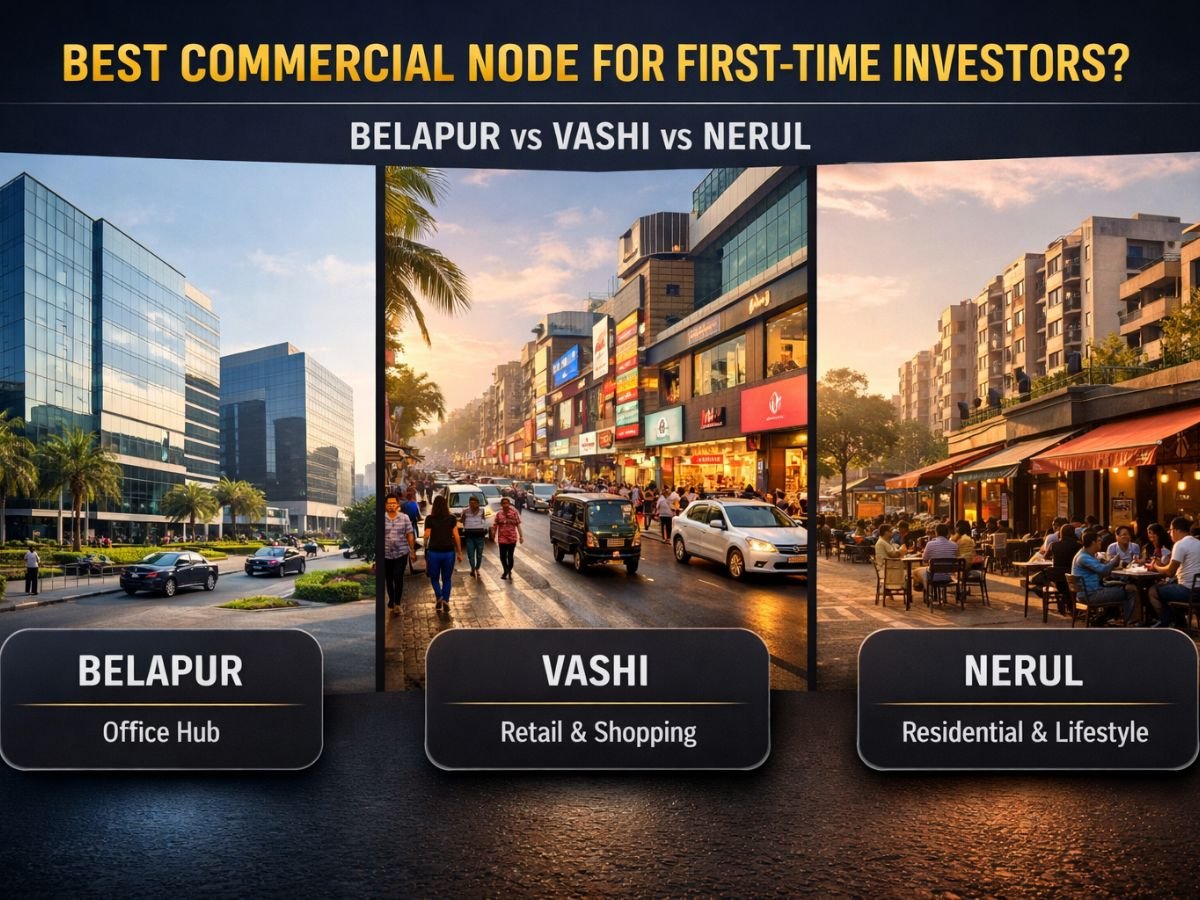
Vashi is the node many people think of first, and that instinct is not wrong. It has strong commercial recall. It feels busy. It feels proven. It has long-established retail gravity. That is why Vashi often becomes the best retail answer in Navi Mumbai.
If you want a high-visibility shop, a branded retail outlet, a strong frontage-driven asset, or something that benefits from known commercial behaviour, Vashi is powerful. Sectors like 17 and 30A matter far more than simply saying “Vashi.” Inorbit Mall influence, Raghuleela recall, and legacy shopping behaviour all support its retail case.
That also makes Vashi strong for resale liquidity. More people understand Vashi. More businesses want a Vashi address. More buyers are willing to evaluate it quickly.
But Vashi punishes beginners in three ways.
First, the entry cost can be brutal. Broad pricing may sit around ₹12,000 to ₹15,000 per sq.ft. in some bands, but prime retail can move far higher, often around ₹25,000 to ₹40,000 per sq.ft. That compresses yield if the tenant or rent does not justify the premium.
Second, Vashi has mixed-use friction. Parking stress, traffic congestion, noise, and uneven commercial quality from one lane to another are real issues. A first-time investor can overpay simply because the area “looks active,” without checking whether the exact unit has lasting tenant logic.
Third, Vashi is not equally strong for every commercial format. A premium retail unit with real frontage is one thing. A badly placed office inside a noisy mixed-use environment is another.
So yes, Vashi can be the better first buy. But only for the buyer who is well-capitalised, understands pocket-level selection, and is intentionally buying retail, not blindly buying “commercial.”
Is Nerul Actually a Smart First Commercial Node, or Only in Selective Pockets?
Nerul sits in an interesting middle ground.
It is not as institutionally office-led as Belapur. It is not as overwhelming or aggressively commercial as Vashi. But in the right places, that is exactly why it works.
Nerul benefits from a strong residential base, service demand, better lifestyle perception in certain belts, and good pockets around Palm Beach Road influence, transit points, and major intersections. It can work very well for service retail, healthcare formats, clinics, coaching setups, premium neighbourhood businesses, and some selective office uses.
That is why Nerul often suits a first-time investor who wants a commercially usable location without jumping into the most expensive or most chaotic retail battle.
But Nerul is selective. Very selective.
A good unit in the right Nerul sector can lease. A poor unit in a dead internal lane can stay vacant for a long time. This is why Nerul should never be sold as a blanket recommendation. Sectors with stronger traction, such as Sector 19 or Sector 28 style commercial environments, are not the same as quiet residential stretches that happen to have one shop below a building.
If Belapur is the safest office-led default and Vashi is the strongest retail-led bet, Nerul is the selective lifestyle-and-service-market option. That is a useful role, but it is not the automatic beginner answer.
Which Attractive Navi Mumbai Nodes Are Usually Not the Safest First Commercial Buy?
This is where many first-time investors lose discipline.
Airport-led growth belts
Panvel, Ulwe, Pushpak Nagar, Dronagiri and similar airport-linked stories sound exciting. And to be fair, some of these areas have seen strong capital appreciation over a five-year period. But appreciation and beginner safety are not the same thing.
A first-time investor who needs immediate rent should be very careful here. These are still ecosystem-building markets. Commercial demand can lag far behind brochure language. Basic infrastructure, internal roads, water reliability, and last-mile business activity matter more than the airport headline.
If your commercial EMI depends on rent starting quickly, airport-led nodes are usually not the safest first move.
Industrial and TTC-side corridors
Turbhe, Pawane, Mahape and the wider TTC belt can look attractive because rates may seem more accessible and the business activity looks real. But many assets here belong to a different game. Industrial galas, B2B warehousing, and MIDC-regulated transactions are not beginner-friendly retail investments.
The transfer side can itself become painful. MIDC transfer charges can materially hurt your exit, especially with steep charges on the differential premium. This is one of those traps that small investors notice too late.
Cheap-entry commercial products
If a commercial unit looks surprisingly cheap, ask why. Is it a dead lane? Is the building weak? Is there no parking? Is there poor vertical access? Is the tenant profile unclear? Is it a bare-shell space in a building with no leasing traction?
Cheap does not mean beginner-safe. Sometimes it means vacancy waiting to happen.
Shop or Office? This Changes the Answer More Than Most First-Time Investors Realise
Office vs Retail: Practical Investment Difference (2026)
| Investment Metric | Corporate Office Space | Retail Shop / Showroom |
|---|---|---|
| Best beginner node | CBD Belapur | Vashi or selective Nerul |
| Typical lease nature | Longer, more stable | Shorter, more turnover-heavy |
| Main value driver | Connectivity, parking, professional ecosystem | Frontage, visibility, conversion-quality footfall |
| Maintenance stress | Usually moderate | Often higher |
| Big beginner mistake | Ignoring visitor parking and lift access | Confusing traffic with actual retail demand |
- For safer office-led investment, Belapur usually wins.
- For visibility-led shop investment, Vashi usually wins.
- For selective service retail or neighbourhood premium activity, Nerul can work very well.
What Should Matter More to a First-Time Investor Than the Node Name Itself?
The node matters. But deal structure matters more than most people realise.
A first-time investor often calculates yield on the base price and stops there. That is a mistake. Commercial acquisition cost can hit hard.
Take a ₹1 crore commercial purchase. The real outlay can rise materially once you add 5% stamp duty, around 0.3% registration, legal diligence, 12% GST if the unit is under construction, and another 5% to 10% for interior fit-outs in a bare-shell unit. Very quickly, the “₹1 crore” story can become a ₹1.22 crore to ₹1.27 crore story, sometimes more depending on fit-out and transaction structure.
And that is before monthly CAM pain begins.
So before finalising any node, check these five things carefully:
1. Entry budget vs full acquisition cost Do not buy a unit if you only have money for the agreement value.
2. Rentability vs brochure promise Ask who the likely tenant is. Be specific. Not “any business.” Which business?
3. Parking, access, and usability An office without parking or reliable vertical movement is harder to lease than people think.
4. Exit ease Who will buy this asset from you after five to seven years? Another investor? A self-user? No one?
5. Building quality and operational friction Lifts, loading, frontage, CAM, maintenance quality, and service condition all matter.
A bad unit inside a good node is still a bad commercial investment.
Which Local Authority and Approval Checks Matter in Navi Mumbai Commercial Deals?

This is where Navi Mumbai becomes very different from generic property advice.
What to verify on MahaRERA
If the commercial project is under construction, the MahaRERA check is non-negotiable. Verify project registration, proposed completion status, layout approvals, and whether there are visible disputes or serious red flags.
A lapsed or expired registration is not something to ignore casually. It is not just a small paperwork issue. For a first-time investor, it should be treated as a serious warning sign.
Where CIDCO matters more than buyers expect
Many Navi Mumbai properties sit on CIDCO-controlled planning history, leasehold logic, or land structures influenced by CIDCO processes. In some cases, a registered sale deed alone is not the full story. Transfer formalities, Estate CFC processes, 12.5% land history, and backend record alignment can matter.
This is especially important in resale cases and any property where title structure is not plain vanilla. Buyers should verify current lease status, transfer requirements, and whether any pending charges or permissions remain unresolved.
How IGR Maharashtra helps, and where it does not
The Ready Reckoner is useful as a valuation and stamp-duty reference point. It is not the same as live market truth. Do not use it as your only pricing guide for a commercial asset.
Why OC, usage clarity, and title chain matter
Commercial property creates more damage when legal clarity is weak. If the occupancy certificate is unclear, the use permission is mismatched, or the title chain is weak, the leasing story can collapse later. A professional tenant will often check more than a casual residential tenant.
In short, local authority checks are not paperwork for the lawyer alone. They directly affect leasing, transfer, resale, and peace of mind.
Three Real First-Time Investor Scenarios and the Node That Fits Each Best
Scenario 1: The lower-regret office investor
A salaried professional has ₹60 lakh to ₹80 lakh and wants stable rent with minimum drama. They do not want to manage frequent tenant turnover. They want a practical office asset.
The best fit is usually a smaller office in CBD Belapur, ideally in an active office-oriented pocket. This is the cleanest first commercial move for many beginners.
Scenario 2: The daily business logic investor
A local businessman wants a shop that works for self-use today and remains a valuable commercial asset later. Walk-ins, visibility, and local brand recall matter.
This buyer should look at Vashi first, especially the right retail corridors, and then at highly selective Nerul pockets. This is not a passive choice. It needs sharper location judgment.
Scenario 3: The growth-seeking investor
An investor has patience, surplus holding power, and no need for immediate rent. They are willing to wait for infrastructure-led appreciation.
This buyer can study Panvel or Ulwe. But that is a growth strategy, not a beginner safety strategy. It should be entered with eyes open.
You should also read Navi Mumbai Commercial Property Rates, Rents and Yields because pricing and return logic matter a lot here.
A Simple Decision Matrix: Choose Belapur, Choose Vashi, Choose Nerul, or Wait
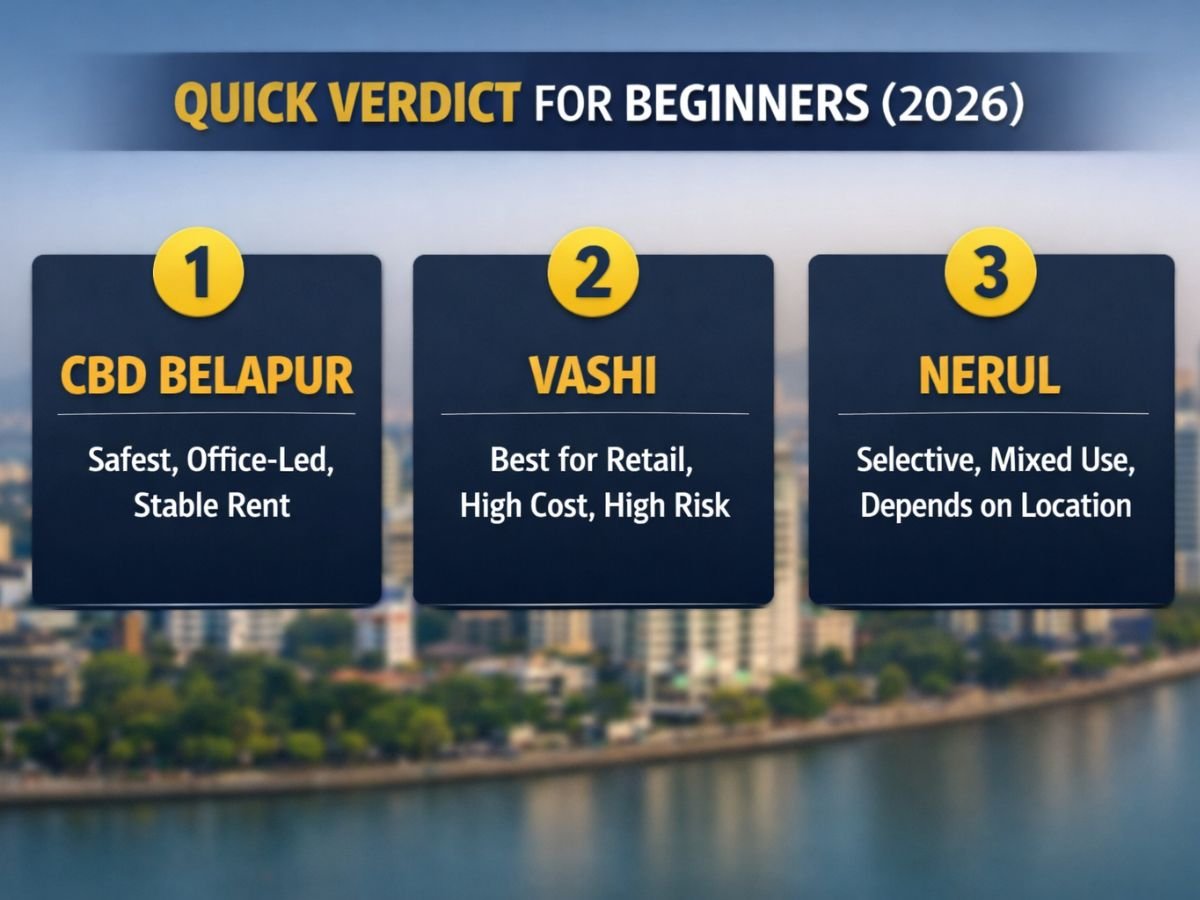
If you want stable office rent and lower tenant stress, choose CBD Belapur.
If you want high-visibility retail and you can afford premium entry with tighter selection discipline, choose Vashi.
If you want service-led, lifestyle-linked, selective commercial exposure in a better residential ecosystem, choose Nerul, but only after studying the exact pocket.
If you mainly want future appreciation from airport-led development and can tolerate vacancy, choose Panvel or Ulwe, but do not pretend it is a low-risk first rent strategy.
If you are tempted by cheap industrial or TTC-side property without understanding MIDC complexity, do not buy yet. Wait and learn more first.
Conclusion
If this is your first commercial investment in Navi Mumbai and you want the safest place to start, choose CBD Belapur first, especially for office-led investing.
Choose Vashi only when your thesis is clearly retail, visibility, and resale liquidity, and when you can handle higher pricing and sharper selection risk.
Choose Nerul only when the exact micro-location supports the asset type you are buying.
And if your heart is pulling you toward airport stories, industrial bargains, or brochure-driven future promises, pause. Those may become good investments later. They are just not the most forgiving first commercial move for someone learning the market with real money on the line.
FAQs
Frequently Asked Questions