
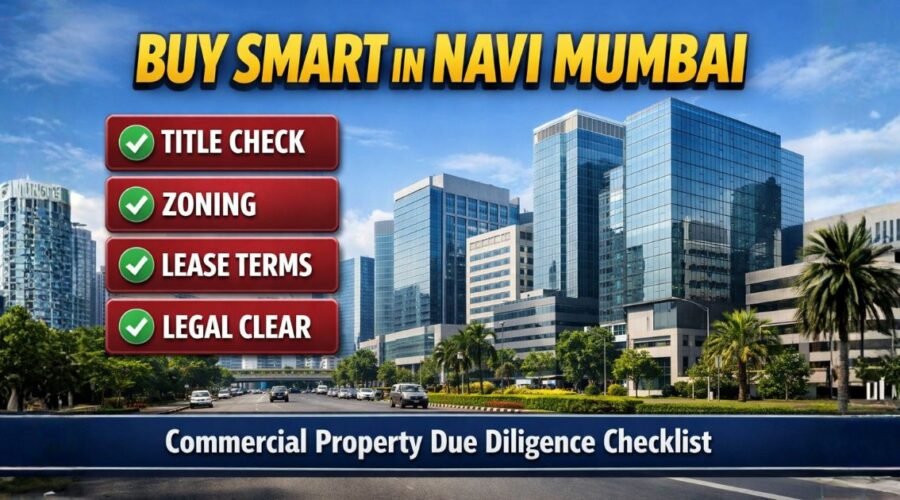
Commercial Property Due Diligence Checklist in Navi Mumbai
If you are buying commercial property in Navi Mumbai, start with five checks before you pay token money: land and title structure, the correct authority, occupancy and permitted use, hidden dues and transfer exposure, and whether the unit actually works for business on the ground. That is the practical answer. In this market, a registered document alone is not enough, because CIDCO-side transfer issues, MahaRERA disclosures, municipal ledgers, Part OC, or wrong-use problems can still damage the deal later.
This is why a commercial property due diligence checklist in Navi Mumbai cannot be a generic document list copied from a national real estate blog. A shop in Vashi, an office in CBD Belapur, and a gala in TTC or Mahape do not sit inside the same legal and operational reality. The first filter changes by asset type, by authority, and by how the property will actually be used after purchase.
Commercial property due diligence in Navi Mumbai: the 7 checks that matter before token money
| Check | What you must verify before token | What can go wrong if you ignore it |
|---|---|---|
| Land and title structure | Whether the unit is CIDCO-linked, MIDC-linked, society-held, company-held, or another structure | Mortgage, transfer, and approval problems appear later |
| Correct authority | Whether MahaRERA, CIDCO, NMMC, PMC, MIDC, or the Sub-Registrar matters first | You waste time checking the wrong place and miss the real risk |
| Occupancy status | Full OC, Part OC, completion stage, usable services | A physically ready unit may still carry operational or compliance risk |
| Permitted use | Whether the intended business use matches the approved use | Business can get blocked even after purchase |
| Dues and transfer costs | Property tax, maintenance, sinking fund, transfer charges, premium exposure | A cheap deal becomes an expensive deal |
| Tenant quality | Registered rent paperwork, deposit, lock-in, escalation, vacancy risk | Paper yield can fool you |
| Ground usability | Parking, frontage, signage, loading, lift, staff and visitor movement | Title-clean does not always mean commercially workable |
What exactly are you buying: office, shop, showroom, gala, floor, or tenanted asset?
This is the first serious due diligence decision. Commercial buyers often make the mistake of using the same checklist for every asset type. That is where trouble begins.
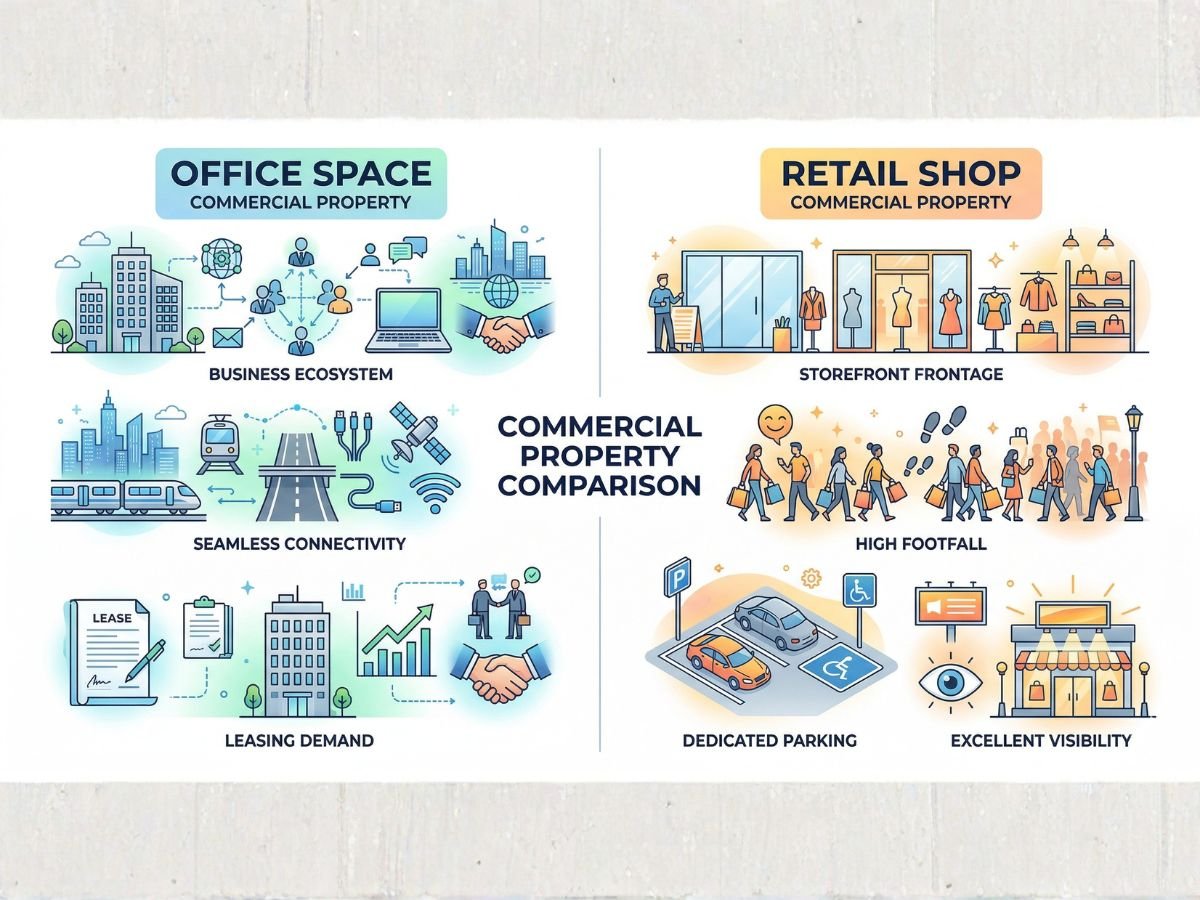
Office space due diligence checks
Office units need a stronger usability check than many buyers realise. Beyond title and approvals, you need to assess sanctioned parking, visitor movement, lift performance, common-area maintenance, access for staff, and whether the building genuinely functions as an office ecosystem. In places like CBD Belapur, Vashi, Airoli, or certain pockets of Nerul, office demand is tied to day-to-day practicality, not only address value.
Do not ignore parking and circulation. Recent NMMC-side policy tightening on parking has shown that Navi Mumbai authorities are taking parking allocation more seriously, so buyers of larger-format office stock should not casually assume that historical parking arrangements are enough. Even when the exact requirement varies by property type and approval date, parking scrutiny should be part of due diligence, not an afterthought.
Shop and showroom due diligence checks
Retail due diligence is more physical. Frontage, visibility, signage scope, loading convenience, internal height, and legal alterations matter more here than buyers expect. A shop that looks “bigger” because of an internal loft or mezzanine can be a trap if that structure is not legally supportable.
Planning documents used in CIDCO-style development control frameworks clearly separate loft and mezzanine. Loft depth is limited, mezzanine area counts toward FSI, and the minimum height of a mezzanine floor is 2.2 metres, with headroom below it not less than 2.10 metres. So if a seller is charging premium rates for an upper internal platform, do not treat it as automatically legal or permanent just because it exists physically.
Gala or industrial-commercial due diligence checks
A gala in TTC, Mahape, Rabale, or other MIDC-influenced belts needs a different lens altogether. MIDC separately handles transfer, subletting, change in activity, and change in land use through its land post-operations system. That means a gala purchase is not just a resale deal with one more sale deed in the file. It is a property sitting inside a separate industrial land-management framework.
If you are buying a gala for warehouse use, fabrication, light industrial activity, or commercial support use, check whether the current use, proposed use, and permissions actually match. Do not assume that a unit inside an industrial belt can smoothly become ordinary retail stock just because the inside can be renovated.
Tenanted commercial property checks
A tenanted asset is not automatically safer. Sometimes it is more dangerous, because buyers get blinded by “yield” and stop checking quality.
Focus on the actual rent paperwork, not just the headline return. Ask for the registered lease or leave-and-license document, rent payment proof, lock-in clause, escalation clause, deposit terms, termination rights, and vacancy history. A tenanted unit is worth paying extra for only if the income is legally documented, commercially sensible, and realistically transferable.
Is the land and title structure actually clean: freehold, CIDCO leasehold, society-held, company-held, or MIDC-linked?
In Navi Mumbai, this question comes before almost everything else.
CIDCO’s Town Services department itself explains that it handles plots and built properties given on leasehold terms after sale, including compliance with agreement conditions, recoveries connected to transferable tax and additional premium, and transfer and NOC-related matters across nodes. That is the local reality commercial buyers must understand. In many Navi Mumbai-origin properties, the land side and transfer side continue to matter after the first sale.
So do not stop at the current seller’s sale deed. Ask what sits underneath the unit. Is it a CIDCO-origin leasehold property? Is it inside a society? Is it company-owned? Is it an MIDC-controlled property? Is there any pending approval, transfer, or compliance issue that still sits with the authority?
If the seller is a company, LLP, partnership, or society-linked entity, verify seller authority properly. The right signatory, board or partner authorisation, share certificate where relevant, and authority to transfer all matter. A weak seller-authority chain can delay or collapse the deal even if the unit looks clean on the surface.
A simple rule helps here: if the seller cannot clearly explain who holds the underlying right, who can sign, and which authority still has to clear transfer or mortgage, you are not ready to pay token money.
Which authority should you check first in Navi Mumbai: MahaRERA, CIDCO, NMMC, PMC, MIDC, or Sub-Registrar?
Many buyers lose time because they start at the wrong office.
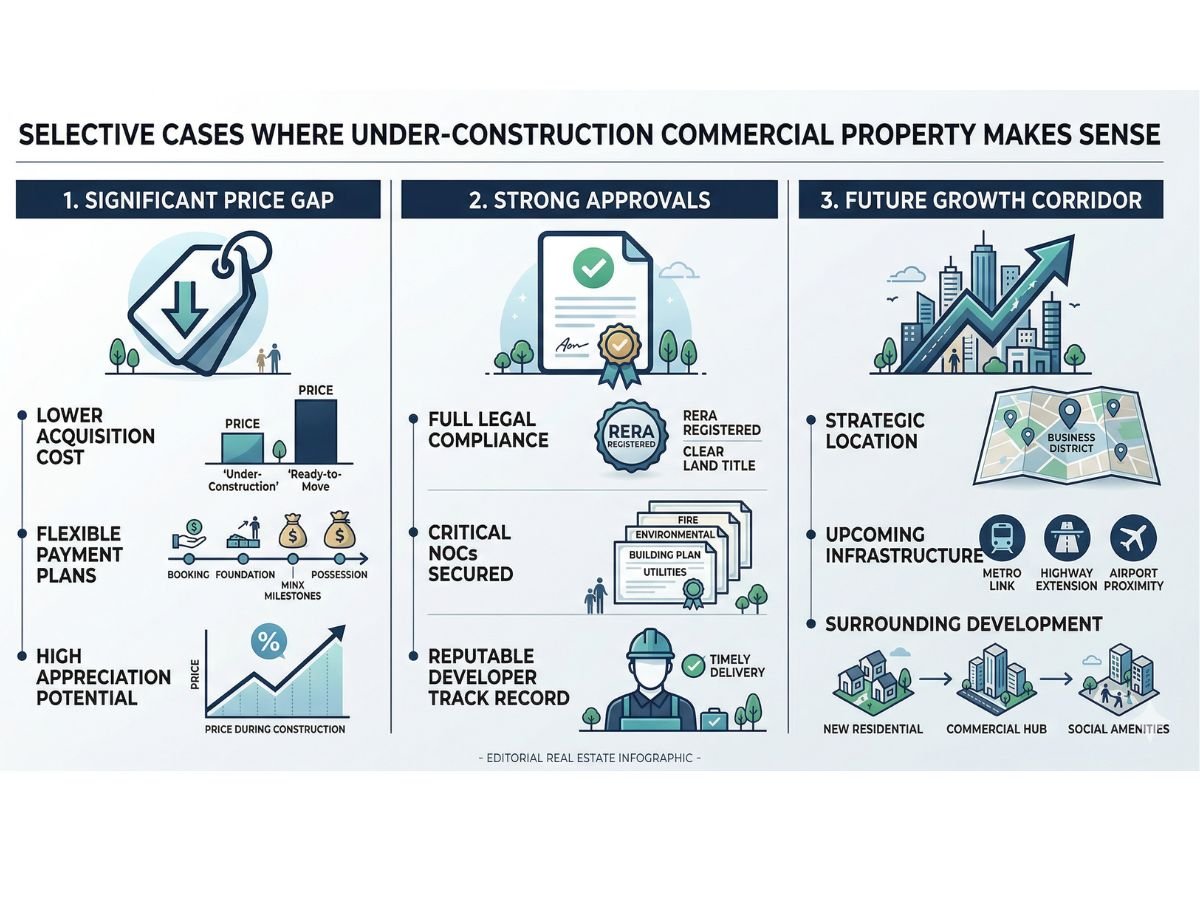
If the project is under construction, recently completed, or being sold directly by a developer in a registered project, start with MahaRERA. Its public resources include Form 4, Form 5, Form 2A, sold or booked inventory disclosure, commencement-certificate declarations, and CERSAI-related public information. That makes MahaRERA more than a registration-number portal. It is a buyer-side audit tool if you know where to look.
If the issue is transfer, leasehold conditions, additional premium, transferable tax, or node-level estate administration, start with CIDCO. Its Town Services department openly states that these are part of its role for leasehold plots and built properties in Navi Mumbai.
If the issue is property-tax dues for a property inside NMMC limits, go to the NMMC property-tax portal and search using the property number or property details. Do not rely only on one receipt shown by the seller. You need the live dues picture, not only a convenient paper copy.
If the property falls on the Panvel side, then the civic side needs to be checked through PMC systems, not only through Navi Mumbai assumptions. If the property sits in MIDC-controlled territory, then transfer, subletting, activity, and land-use questions move into the MIDC framework. And if you only want to understand stamp-duty valuation guidance, eASR is useful, but even the IGR Maharashtra portal clearly says it gives only approximate rate information and that inputs must be accurate. So use it as a baseline, not as the final truth of market value.
If the unit is under construction, what should you verify on MahaRERA before trusting the builder?
Do not stop at “RERA number available.” That is shallow due diligence.
Go to the project’s public record and inspect the disclosures that actually help a buyer. MahaRERA’s public forms section lists Form 4, which is the architect’s completion certificate of the registered project, Form 5, which is the annual report of withdrawal from the designated bank account, and Form 2A, the engineer’s annual quality assurance certificate. It also separately places sold or booked inventory disclosure into the public domain, and the MahaRERA FAQ section links that disclosure to Circular 29 of 2021.
For a commercial buyer, that means three practical checks.
First, read Form 5 because it helps you judge whether fund withdrawal discipline looks reasonable. Second, compare sold or booked inventory disclosure with the sales team’s “almost sold out” pitch. Third, look for complaints, orders, delays, or extension patterns before believing possession promises.
In simple terms, brochure claims should never outrank public filings.
If the unit is ready or resale, which documents should you insist on seeing before you negotiate price?
Ready commercial property is where buyers become casual. They see a building, maybe even a running business, and feel safe too early.
Before price negotiation gets serious, insist on seeing the title chain, the seller’s authority documents, the underlying allotment or transfer trail where relevant, the share certificate if the property sits in a society structure, the current property-tax status, maintenance and sinking-fund position, occupancy papers, and if the property is tenanted, the actual registered rent document.
Also understand one common confusion properly. Maharashtra’s model housing-society bye-laws say that a society’s No Objection Certificate is not required to transfer shares and interest from transferor to transferee. The housing manual also states that there is no necessity of NOC for transfer of flat. But real transactions still move more smoothly when the society side is cooperative and clear, especially where records, dues, or share transfer paperwork are involved. So do not reduce this to a slogan. Understand both the legal position and the practical transaction position.
Does the building have legal occupancy and permitted commercial use?
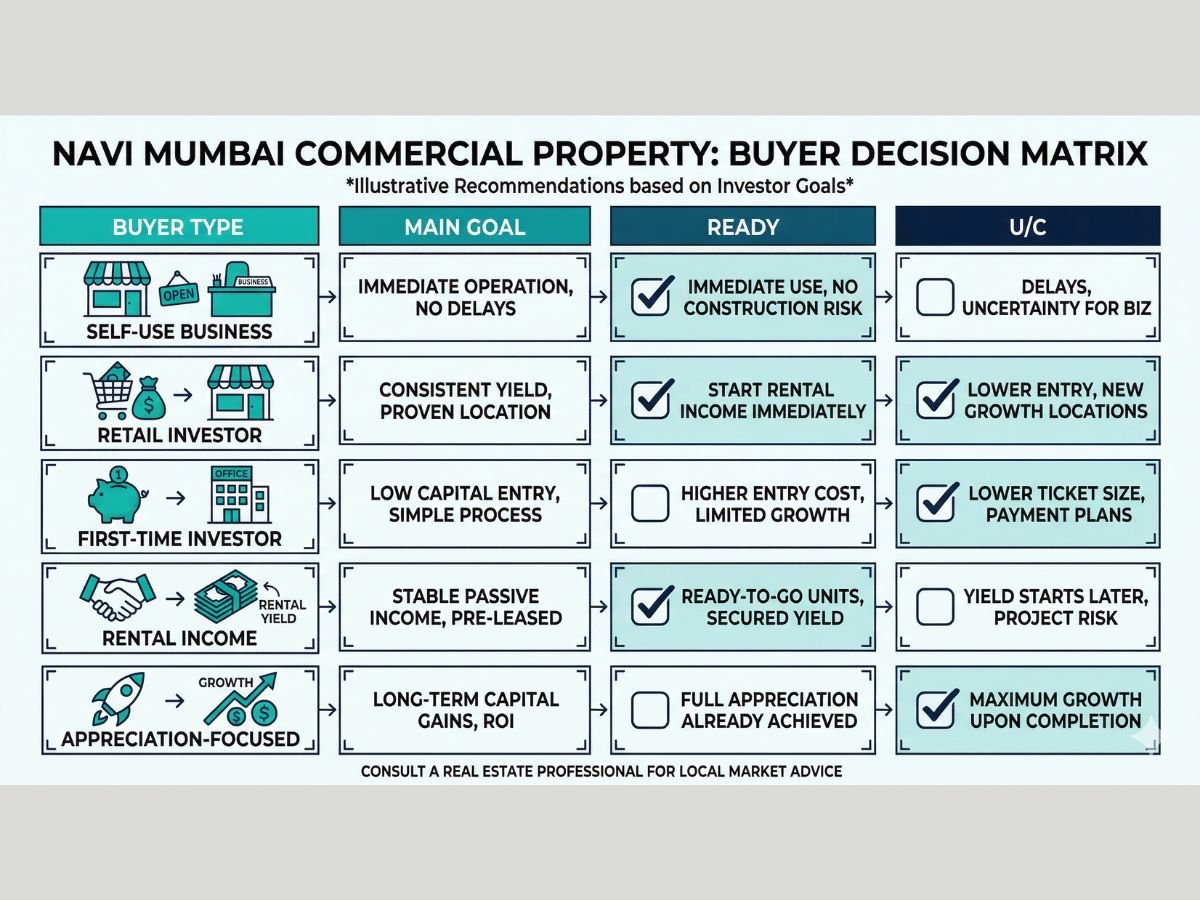
This is one of the most ignored commercial checks in Navi Mumbai.
CIDCO’s development-control rules booklet shows that Part Occupancy can be granted in several situations, including one or more buildings in a multiple-building layout, part of a multi-storey building with more than 50 percent construction completed and structurally complete, or the residential or commercial part of a mixed-use plot, provided the portion covered by Part OC has the required services like water supply, sewerage, drainage, parking, and firefighting completed.
What does that mean for a buyer? It means Part OC is not the same thing as a fully settled end state. A unit with Part OC may still depend on pending larger project completion, shared infrastructure, or future compliance. That does not mean every Part OC deal must be rejected. It does mean the burden of questioning becomes much higher.
Use the same caution on permitted use. In Navi Mumbai, use assumptions can destroy a business plan. If the property sits in an industrial or service-industry style approval structure, do not assume it can become open retail or another use just because the inside looks adaptable. MIDC itself separately treats change in activity and change in land use as approval matters. So intended business use must be checked before token, not after registration.
Are there hidden dues, transfer costs, restrictions, or pending compliance issues attached to this unit?
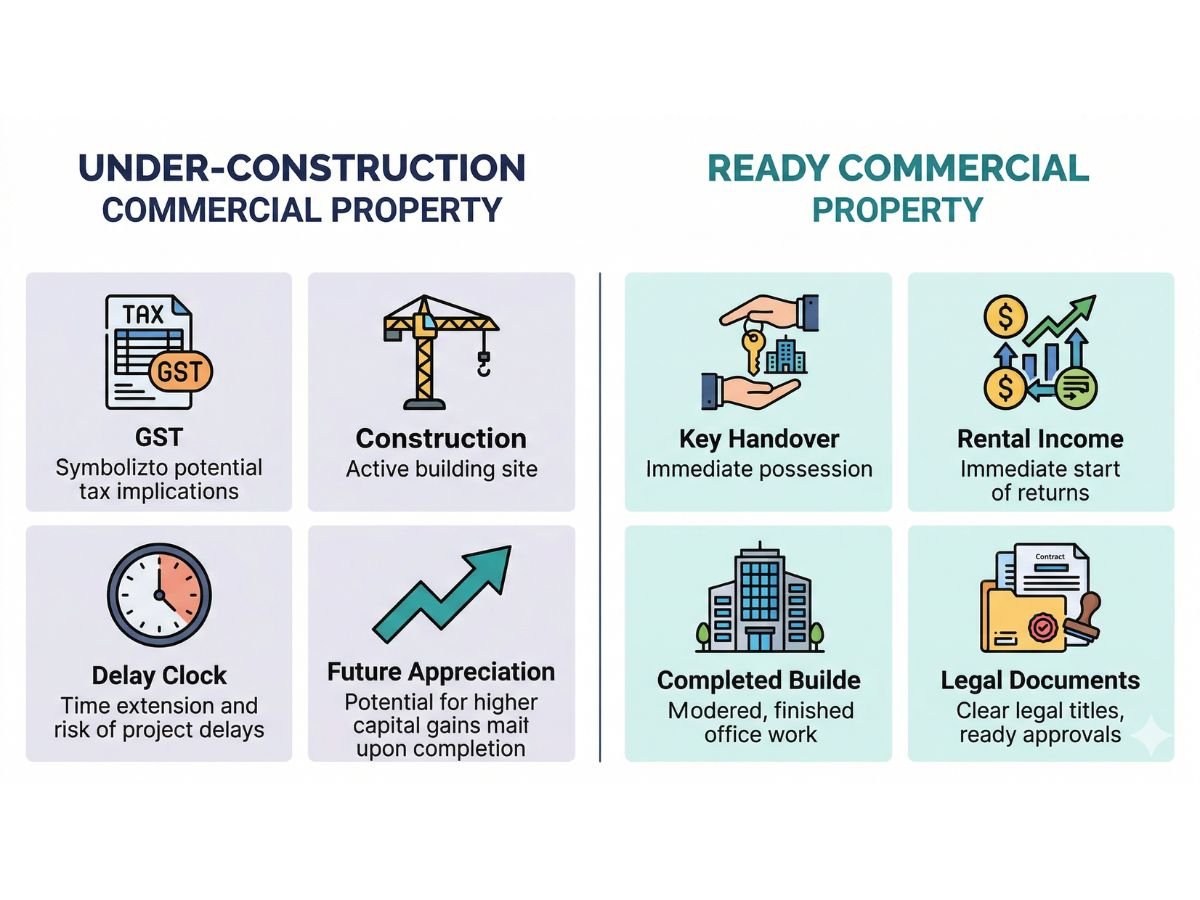
This is where an apparently cheap commercial deal becomes expensive.
Start with the municipal side. If the property sits inside NMMC limits, check the live property-tax record through the official portal. Commercial buyers should not inherit arrears blindly. Then go to the building side: maintenance dues, sinking fund strength, pending repair burden, electricity or utility arrears, and any special levy exposure. NMMC gives the public search tool. The society side gives you the internal financial health picture.
The sinking fund is especially important in older commercial buildings. Maharashtra housing-society rules and model bye-laws describe a sinking fund with a minimum contribution benchmark of 0.25 percent per annum of construction cost, certified by the architect, for heavy repairs. For a buyer, the meaning is simple: if the building is aging and the reserve is weak, future repair contributions can hit you harder than expected.
Then check the authority side. CIDCO Town Services openly states that transferable tax, additional premium, transfer, and NOC-related matters remain part of its work for leasehold properties. So if the seller says “everything is simple, only registration remains,” do not accept that casually. Simple for whom? The file may still be hiding transfer-side exposure.
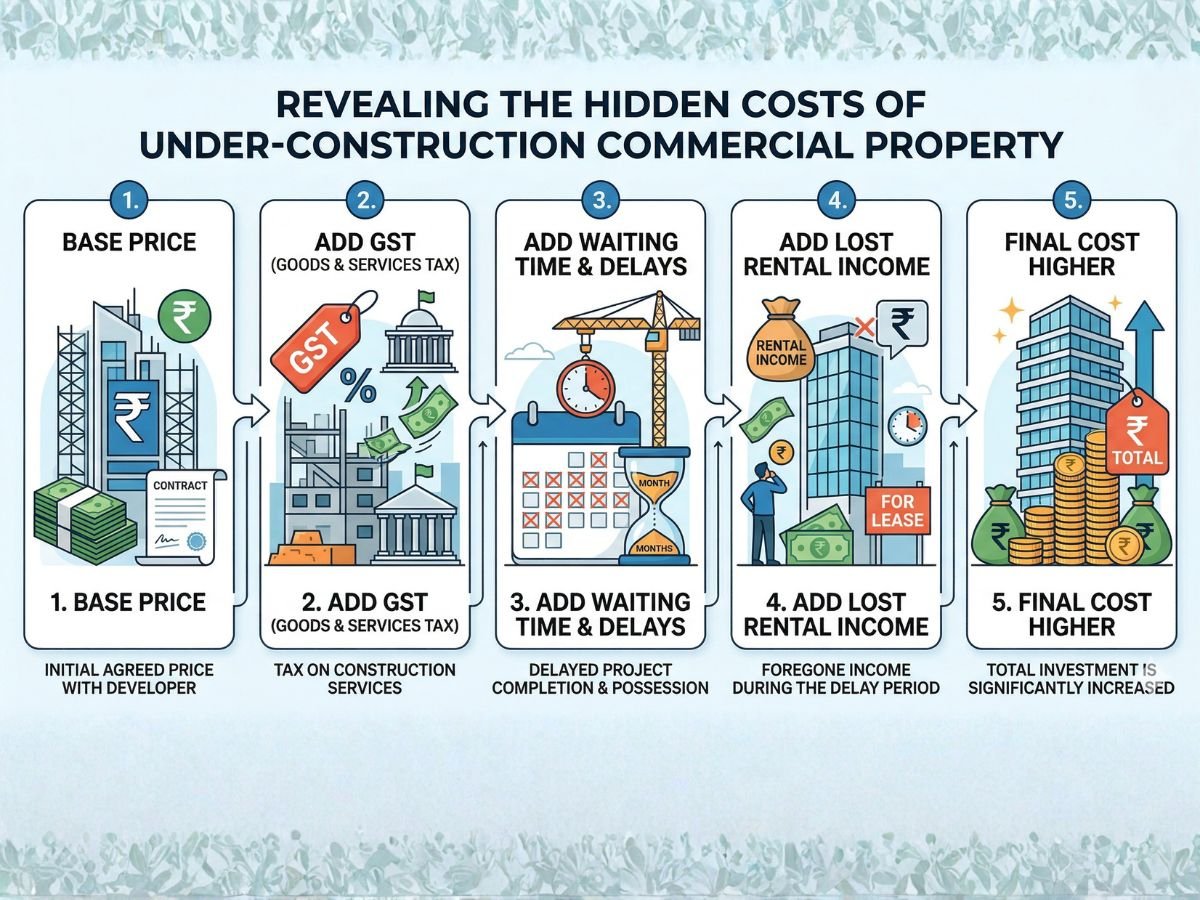
If the property is already rented, is the income real, transferable, and worth the risk?
A pre-leased commercial property can be a good investment, but only if the income story is real.
Do not pay a premium only because the broker says the unit is “earning from day one.” Verify the actual agreement, the registration status, the lock-in, the deposit, the notice period, escalation terms, and proof of rent receipts. Also assess whether the current tenant suits the location. A fragile tenant in a weak building is not safety. It is only temporary occupancy.
In practice, the quality of the paper matters almost as much as the amount of the rent. Your goal is not to buy yield on paper. Your goal is to buy durable, transferable income.
Can this unit actually work on the ground for your business or your future tenant?
This is the check generic articles usually miss.
A legally documented commercial unit can still be a bad business asset. Ask basic questions that serious buyers sometimes forget. Can customers park? Can staff reach it comfortably? Is loading possible? Is signage practical? Are the internal dimensions honestly usable? Do lifts and common areas match the promised tenant profile? Is the building actually known for office use, or is it only being marketed that way?
For shops and showrooms, internal height and alteration legality matter a lot. For offices, parking, access, and visitor experience matter. For galas, handling movement, activity permissions, and industrial compatibility matter more than cosmetic fit-out.
This is why commercial due diligence is not just legal due diligence. It is legal plus operational due diligence.
How does the checklist change across Navi Mumbai’s commercial ecosystems?
Navi Mumbai is not one commercial market.
In office-led nodes like CBD Belapur, Vashi, Airoli, and certain structured business pockets, your due diligence should lean harder into office usability, parking, building ecosystem, maintenance, and transfer-side clarity. In retail-heavy belts like Vashi, Nerul, Seawoods-linked frontage, Kharghar sectors, or local market stretches, the stress should shift toward frontage, signage, mezzanine legality, loading practicality, and daily conversion logic.
In TTC, Mahape, Rabale, and similar industrial-commercial corridors, the emphasis changes again. There, MIDC-side transfer, subletting, activity, and land-use checks become much more important. MIDC itself lists these as separate processes, so gala buyers should stop using office-space checklists for industrial stock.
On the Panvel side and in newer growth corridors, the local civic and planning context can become more fragmented. So buyers should be more careful about jurisdiction, property records, and the exact authority that governs the site rather than assuming every Panvel-side commercial opportunity works like established Navi Mumbai stock.
Which red flags should make you stop the deal immediately?
Some risks are serious enough to justify walking away unless they are cured first.
- The seller cannot clearly explain the land and transfer structure
- The file depends on unresolved CIDCO or MIDC approvals
- The building is operating on Part OC but the seller speaks as if everything is fully settled
- The intended business use does not clearly match the permitted use
- The unit’s “extra area” is mainly an internal structure of doubtful legality
- Live property-tax or maintenance dues are unclear
- The seller avoids giving full rent paperwork for a tenanted asset
- The seller pushes for token money before authority-side verification starts
- The transaction story sounds simpler than the paperwork actually looks
In Navi Mumbai commercial property, confusion is not a small issue. Confusion is often the first visible sign of hidden risk.
What should be cleared before token, before agreement, and before registration?
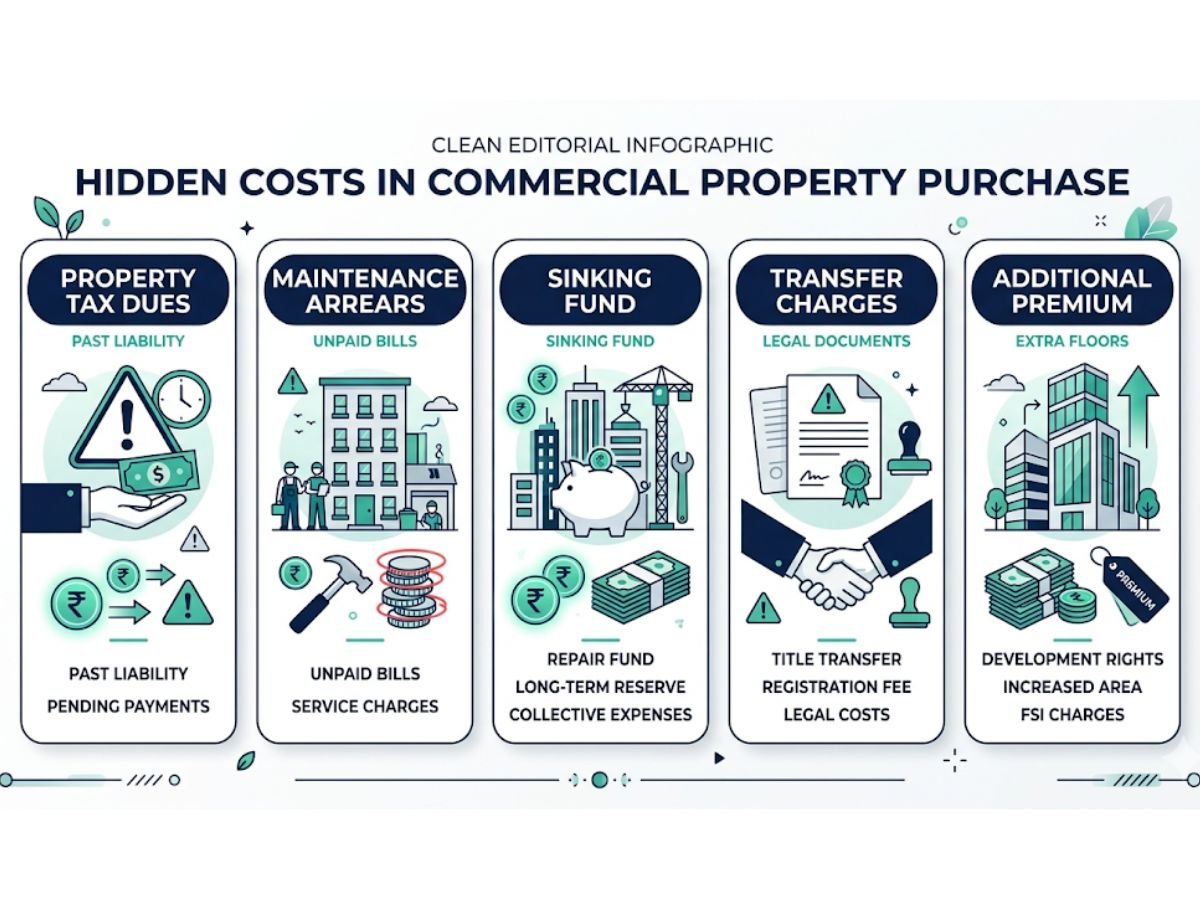
Property Buying Checklist: Stage-wise Due Diligence (2026)
|
|---|
Conclusion
A strong commercial property due diligence checklist in Navi Mumbai is not just a document list. It is a local risk filter.
You are not only checking whether the seller owns something. You are checking whether the title structure is workable, whether the correct authority is clear, whether the occupancy and use position are safe enough for business continuity, whether hidden dues or transfer exposure are sitting in the file, and whether the unit is actually usable for your business or your future tenant.
That is the real standard.
So do not pay token money just because the unit looks ready, the seller sounds confident, or the broker says the file is clean. In Navi Mumbai commercial property, the smart buyer is the one who verifies land structure, authority, occupancy, dues, and ground usability before emotion enters the deal.
FAQs
Frequently Asked Questions