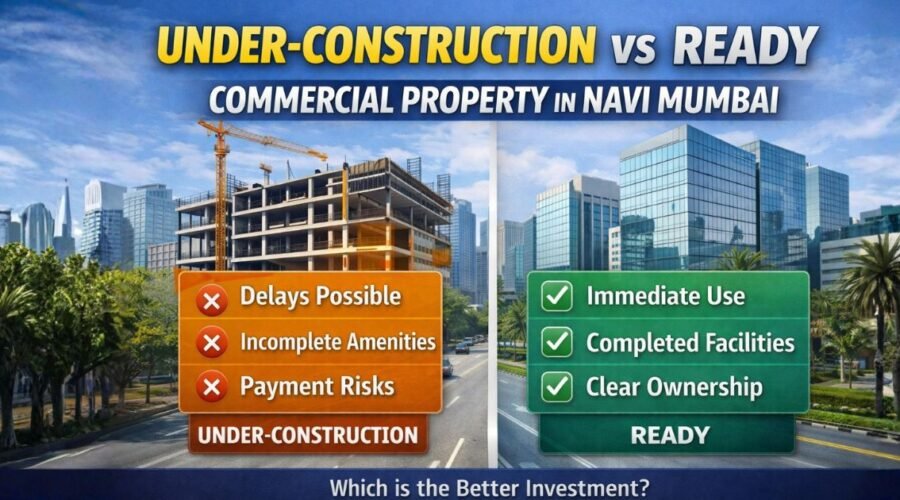
Under-Construction vs Ready Commercial Property in Navi Mumbai: Which Makes More Sense?
For most buyers in Navi Mumbai, ready commercial property is usually the safer and more practical choice. It lets you avoid the GST burden that applies to under-construction commercial units, removes a large part of completion and OC-related risk, and gives you a chance to start using the property or earning rent sooner. Under-construction commercial property can still make sense, but only in selective cases where the price gap is genuinely attractive, the project is well-documented, and the buyer can absorb delay risk.
This is also not one single answer for every buyer. A ready office in Airoli or CBD Belapur is a very different decision from an under-construction shop in Ulwe, Taloja, or Kharghar. Office space depends more on ecosystem, access, and leasing depth. Retail depends much more on real frontage, actual footfall, parking, and surrounding business activity that often cannot be judged properly until the building is operational.
Before comparing both options too closely, How to Buy Commercial Property in Navi Mumbai is worth reading first.
Under-Construction or Ready Commercial Property in Navi Mumbai: Which Is Usually Better?
| Buyer Type | Usually Better Option | Why |
|---|---|---|
| Self-use office buyer | Ready | Business cannot wait for delays, GST, and uncertain handover timing |
| First-time commercial investor | Ready | Easier to judge usability, rentability, and legal readiness |
| Cash-flow-focused investor | Ready | Rent can start earlier, which matters more than brochure discounts |
| Retail shop buyer | Ready | Real footfall and visibility must be verified on ground |
| High-capital appreciation-first investor | Selective Under-Construction | Works only when price gap, location story, and compliance quality are strong |
When Does Ready Commercial Property Clearly Make More Sense in Navi Mumbai?
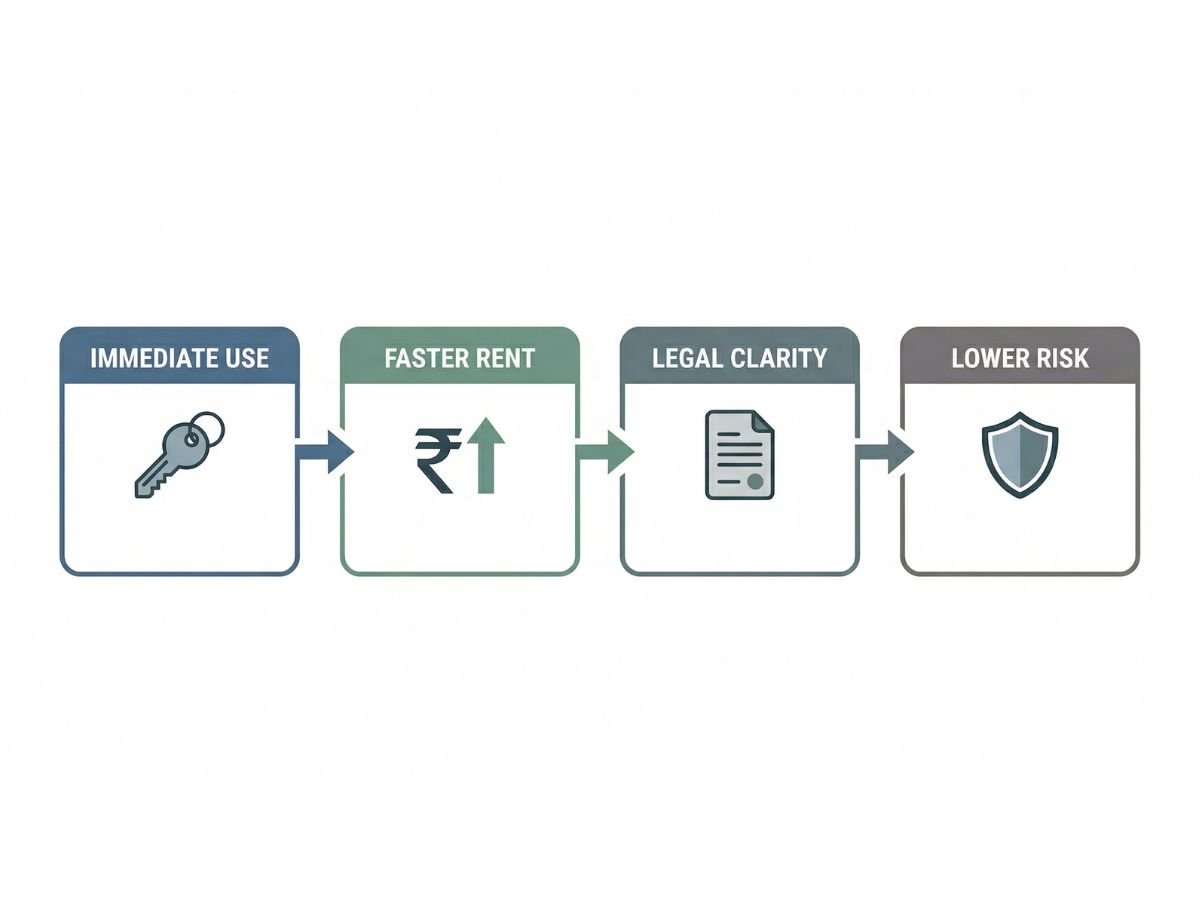
Ready stock makes more sense when the buyer values certainty more than brochure upside. In commercial real estate, certainty is not a small thing. It affects taxation, cash flow, business continuity, tenanting, and even exit ease.
For self-use businesses that cannot wait
If you are a doctor, consultant, SME owner, clinic operator, coaching brand, or service business planning to shift into your own commercial premises, ready property usually makes far more sense. Your business cannot keep paying current rent, staff overheads, and EMI together while waiting for a project that may slip.
This matters even more because under-construction commercial property generally attracts GST, while completed commercial units sold after the completion or occupancy stage are not liable to GST in the same way. That changes the real entry cost from day one.
For buyers who want rent to start sooner
Commercial property is not usually bought for emotional comfort. It is bought for use, rent, future upside, or some mix of the three. If rent matters to you, delay matters more than people admit.
Navi Mumbai’s office market has been benefiting from cost competitiveness, and recent market reporting says office rents here are about 21 percent lower than the average of Tier-1 city rents, which is one reason GCC and multinational demand has been tracking this belt more seriously. On the leasing side too, Thane-Belapur Road was one of the strongest contributors in 2025 office absorption data. That is exactly why a ready office in a proven ecosystem can start working for you much sooner than a glossy under-construction promise.
For buyers who want lower execution risk, not future storytelling
A ready commercial asset is not automatically safe. But it is easier to verify. You can inspect the actual floorplate, real access, parking pain, loading convenience, footfall quality, neighbouring tenants, and maintenance condition.
You also avoid one major local risk: municipal compliance surprises. In 2025, NMMC publicly identified 2,111 buildings in its jurisdiction that were occupied without mandatory occupancy certificates. That is a serious reminder that a building looking complete and a building being legally ready are not the same thing.
When Can Under-Construction Commercial Property Still Be the Smarter Buy?
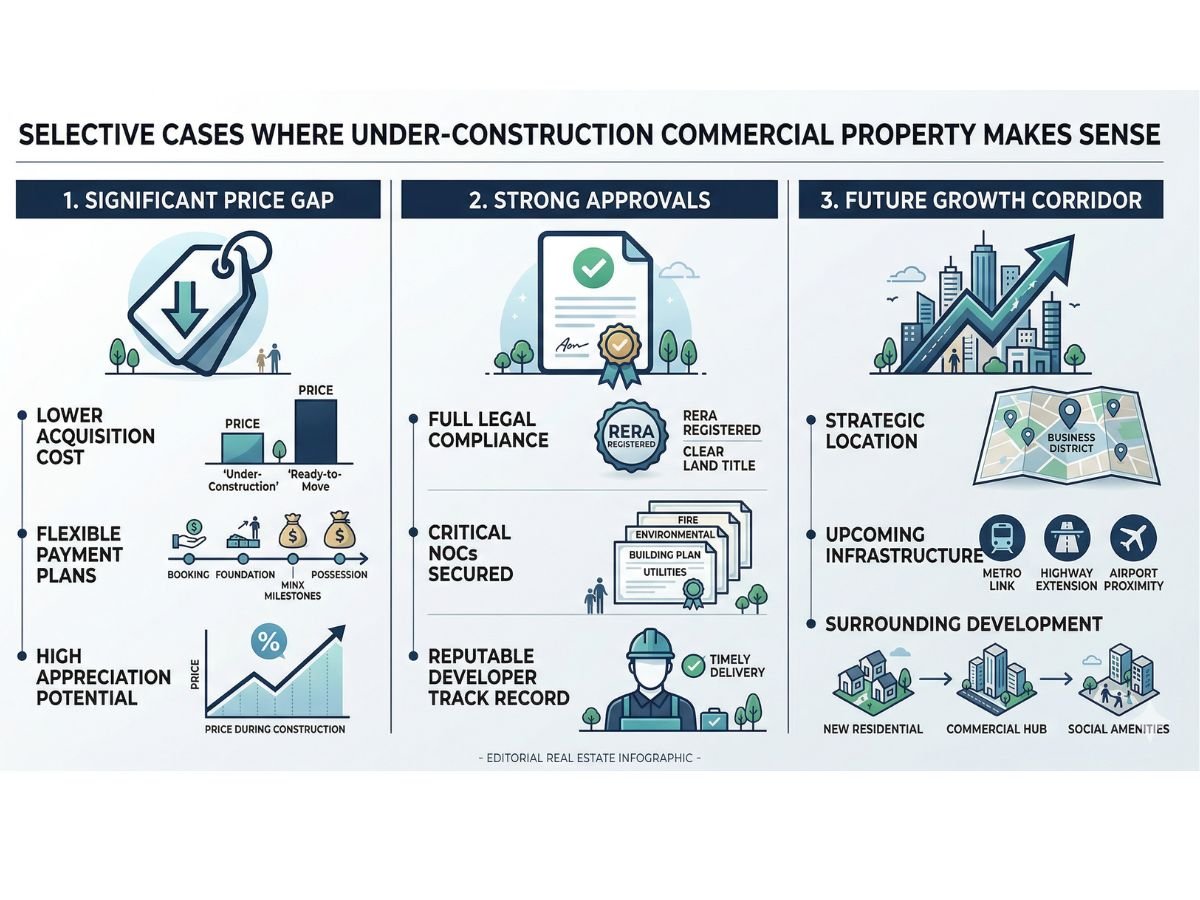
Under-construction commercial property is not always a bad idea. But it is not the safer default either. It only makes sense in a narrow set of conditions.
First, the price gap must be real after adding GST and after counting the cost of waiting. Second, the project should have a clean MahaRERA trail, realistic timelines, and a developer with a stronger-than-average completion record. Third, the micro-market should still have room to deepen because of real infrastructure, not just launch marketing.
This is why under-construction commercial bets are more logical for buyers chasing future appreciation in nodes like Panvel-side growth corridors, selected Ulwe belts, or certain emerging markets where the business ecosystem is still being built out. But even here, the risk is not theoretical. MahaRERA may grant project extensions, yet allottees’ rights remain intact and delay-related rights under Section 18 do not simply disappear because an extension was allowed.
A simple way to think about it is this: under-construction commercial property is a capital strategy, not a bargain strategy.
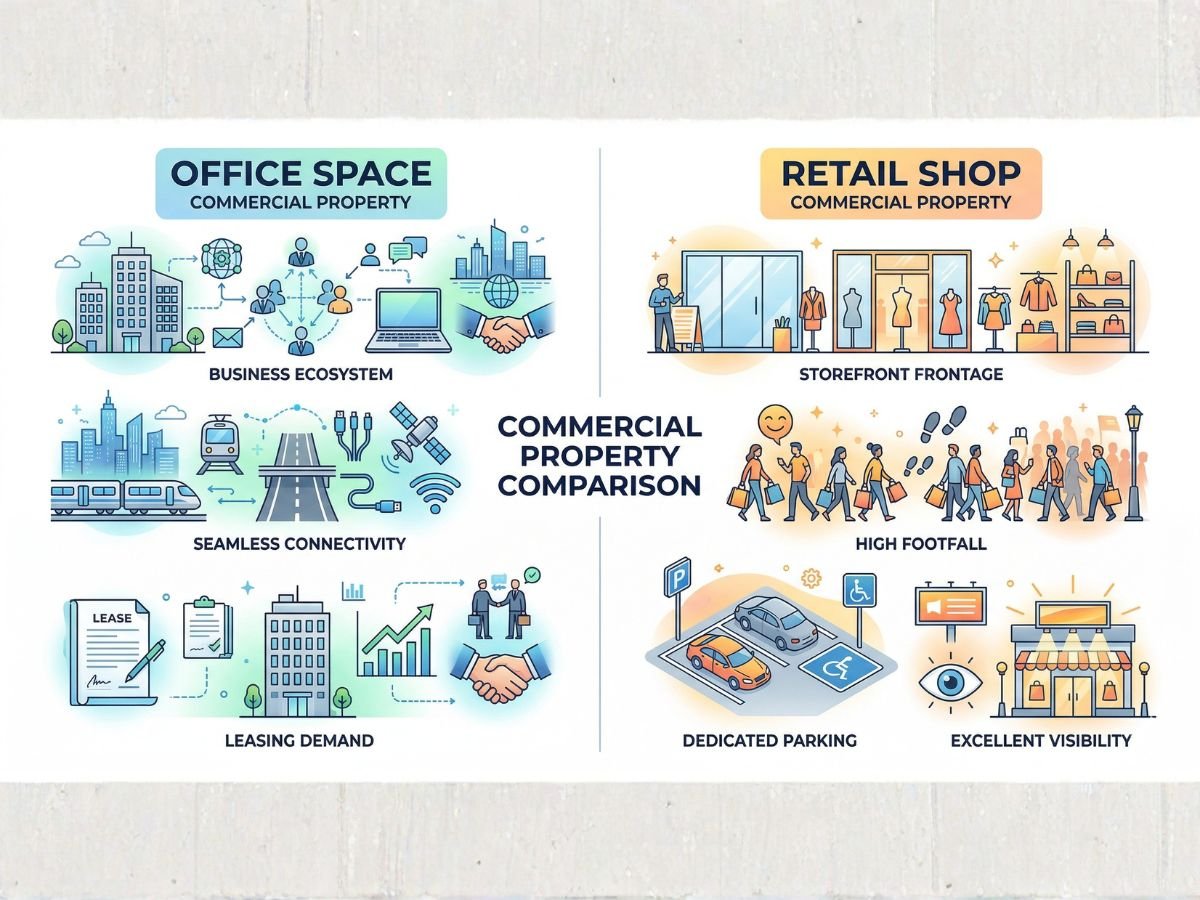
Why the Answer Changes Completely Between Office Space and Shop Space
This is where many weak articles fail. They treat office and shop as if both are just “commercial.”
They are not.
An office can sometimes justify under-construction risk because office demand is often tied to broader ecosystems. In Navi Mumbai, that means access to staff catchments, highway connectivity, the Thane-Belapur corridor, nearby business clusters, and the quality of the building itself. If the ecosystem is already working, an under-construction office in a sensible location may still have a believable future leasing case.
Retail is much harsher. A shop does not survive on brochures. It survives on real frontage, actual pedestrian behaviour, parking practicality, road edge visibility, neighbouring tenant mix, and how people move through that exact lane or podium. An under-construction retail shop can look excellent on plan and still become a dead pocket after handover.
That is why ready retail is usually much safer than under-construction retail in Navi Mumbai, especially for first-time investors.
Which Navi Mumbai Nodes Usually Favour Ready Stock, and Which Can Still Reward an Under-Construction Bet?
Node logic matters because Navi Mumbai is not one uniform commercial market.
Airoli and Mahape are office-led ecosystems. Here, the office story is easier to read because the business base already exists. Ready offices are still safer, but a strong late-stage under-construction office can sometimes be justified because the demand ecosystem is legible.
CBD Belapur, Vashi, Nerul, and Seawoods are more mature commercial locations. In these nodes, ready stock usually makes more sense because you are paying for an already functioning market. The value here is not just the building. It is the ecosystem that already exists.
Kharghar, Panvel, Ulwe, Kalamboli, and Taloja need stricter filtering. Some pockets here may genuinely benefit from airport-led, metro-led, or corridor-led growth. But future upside is not evenly distributed. One building may benefit from real movement and occupier demand. Another may sit inside a corridor where the promised commercial energy still does not translate into daily business.
What Makes Under-Construction Commercial Property Look Cheaper Than It Really Is?
The biggest trap is the brochure discount.
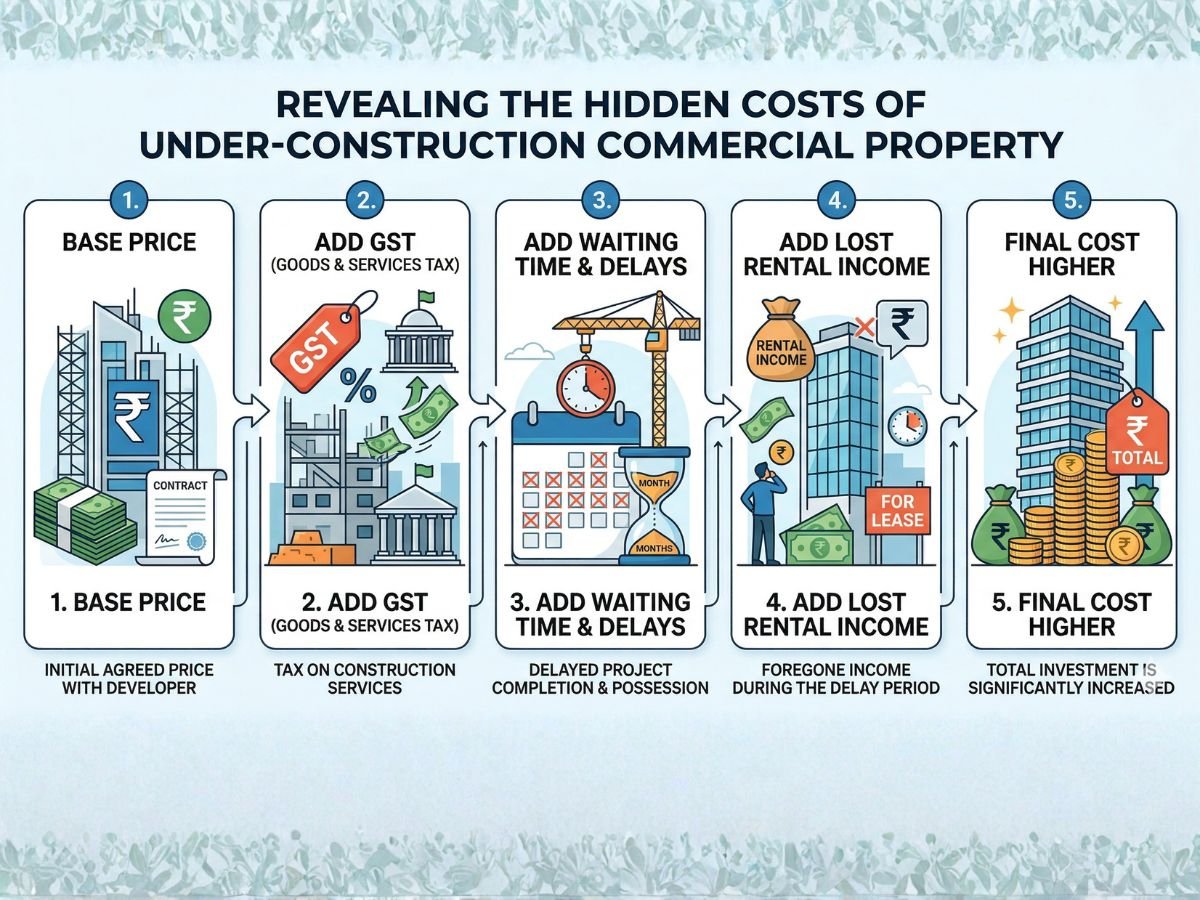
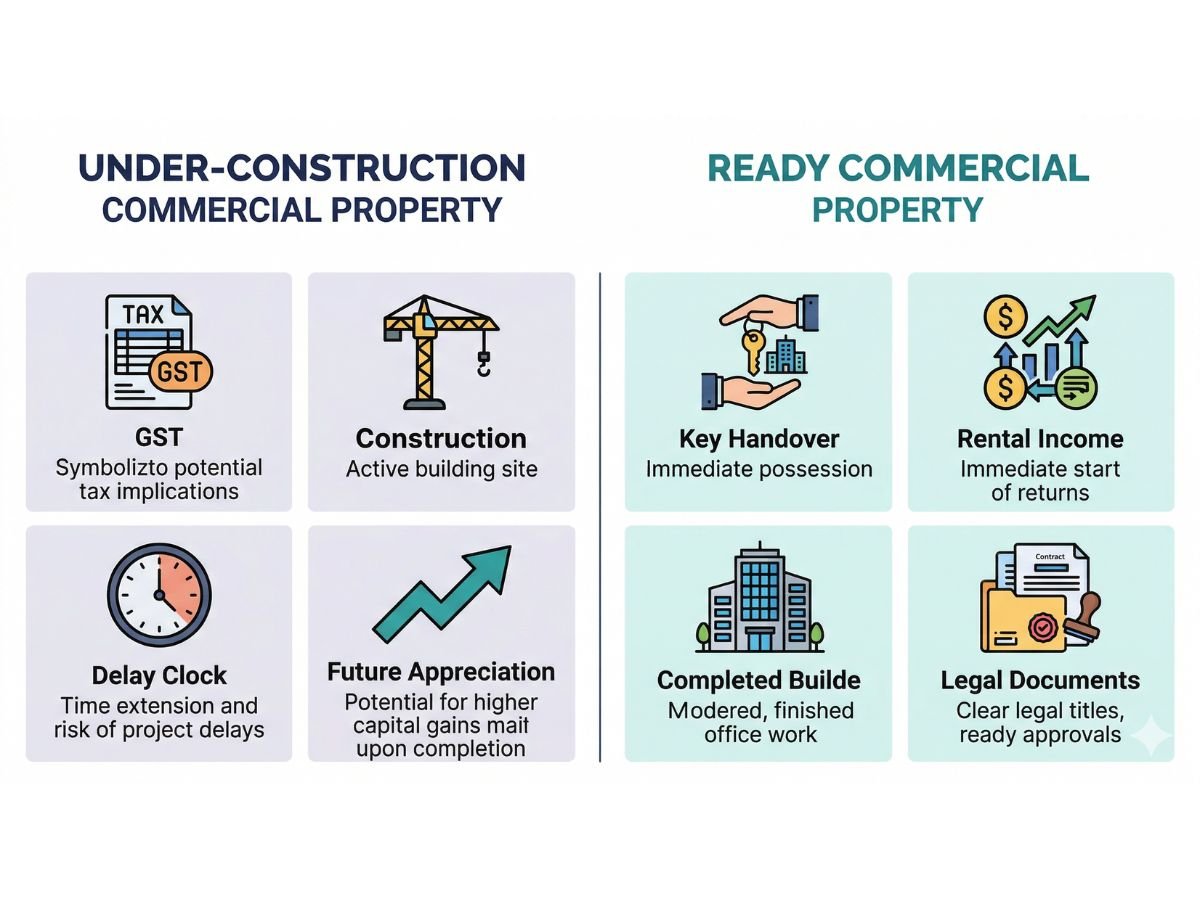
A buyer sees a ₹1 crore under-construction office and compares it with a ₹1.2 crore ready office. At first look, the under-construction option seems cheaper by ₹20 lakh. But now add 12 percent GST on the under-construction asset. Your ₹1 crore entry becomes ₹1.12 crore before you even begin comparing operational reality. The GST framework for real estate continues to preserve the broad distinction that completed commercial units sold after completion or occupancy are not taxed the same way as under-construction supply.
Now add the cost of waiting. If the project takes three years, that is three years of no rent, no business use, and in many cases continuing EMI outflow. Even without pretending to calculate one fixed rent for every building, that holding cost can wipe out the supposed price advantage very fast.
Then there is the exit problem. CIDCO increased transfer fees across Navi Mumbai from 1 April 2025, with reported hikes of 5 to 10 percent depending on category and size, and a 50 percent hike for flats in registered housing societies and commercial shops. That makes speculative flipping less attractive and, in some deals, significantly hurts exit math.
So the right question is not, “Which one has lower base price?” It is, “Which one is actually cheaper after tax, delay, and lost income?”
What Must You Verify Before Calling a Ready Commercial Unit Safe?
A ready building is only useful when it is also legally and operationally ready.
Check these points before getting comfortable:
1. Verify the Occupancy Certificate or the relevant completion clearance for the exact commercial portion, not just the tower name. 2. Confirm the sanctioned use is genuinely commercial. 3. Check whether access, parking, loading, frontage, and lift/core design suit the business or tenant category you are targeting. 4. For Panvel-side locations, use PMC-side records and published town-planning outputs. PMC publicly publishes OC and CC related town planning records and lists, which is useful for due diligence. :contentReference[oaicite:8]{index=8} 5. For older NMMC-side locations, do not rely on “building is complete” logic alone. The local OC issue is serious enough that thousands of non-compliant buildings were publicly flagged in 2025. :contentReference[oaicite:9]{index=9} 6. If the property sits on CIDCO leasehold land, verify transfer conditions, outstanding premiums, and NOC position properly.
What Must You Verify Before Booking an Under-Construction Commercial Property?
For under-construction commercial property, your first layer of safety is the MahaRERA trail.
Check the project registration. Then go beyond registration. See the proposed completion date, whether extensions were granted, whether the documents uploaded make sense, and whether the marketed phase matches the approved phase.
Also read the agreement carefully. Pay attention to possession wording. “Fit-out possession” is not the same as full legal readiness. In practice, the safer commercial rule is very simple: do not treat interior-access handover as equivalent to a business-ready handover unless the relevant occupancy approval is in place.
How MahaRERA, CIDCO, NMMC, PMC, and IGR Maharashtra Actually Matter in This Decision
These names matter only because they affect your money, legality, and exit.
MahaRERA matters because it gives you a public record for under-construction projects and a legal path on delay issues. Its orders and FAQ position make it clear that allottee rights remain alive even where extensions are granted.
NMMC and PMC matter because they sit on the operational legality side. A Commencement Certificate lets construction happen. It does not mean the property is ready for lawful business use. PMC’s own public records show separate publication of commencement and occupancy outputs, which is exactly why buyers should not confuse the two.
CIDCO matters because many Navi Mumbai properties still involve leasehold and transfer mechanics that can affect resale, mortgage processing, and transaction cost. The 2025 fee hike is enough reason to stop treating transfer cost as a side issue.IGR Maharashtra matters because its eASR system gives a government valuation reference, but the portal itself says it provides only a general indication of rates and that final confirmation should be checked properly. So use ready reckoner as an anchor, not as proof of real deal value or true achievable rent.
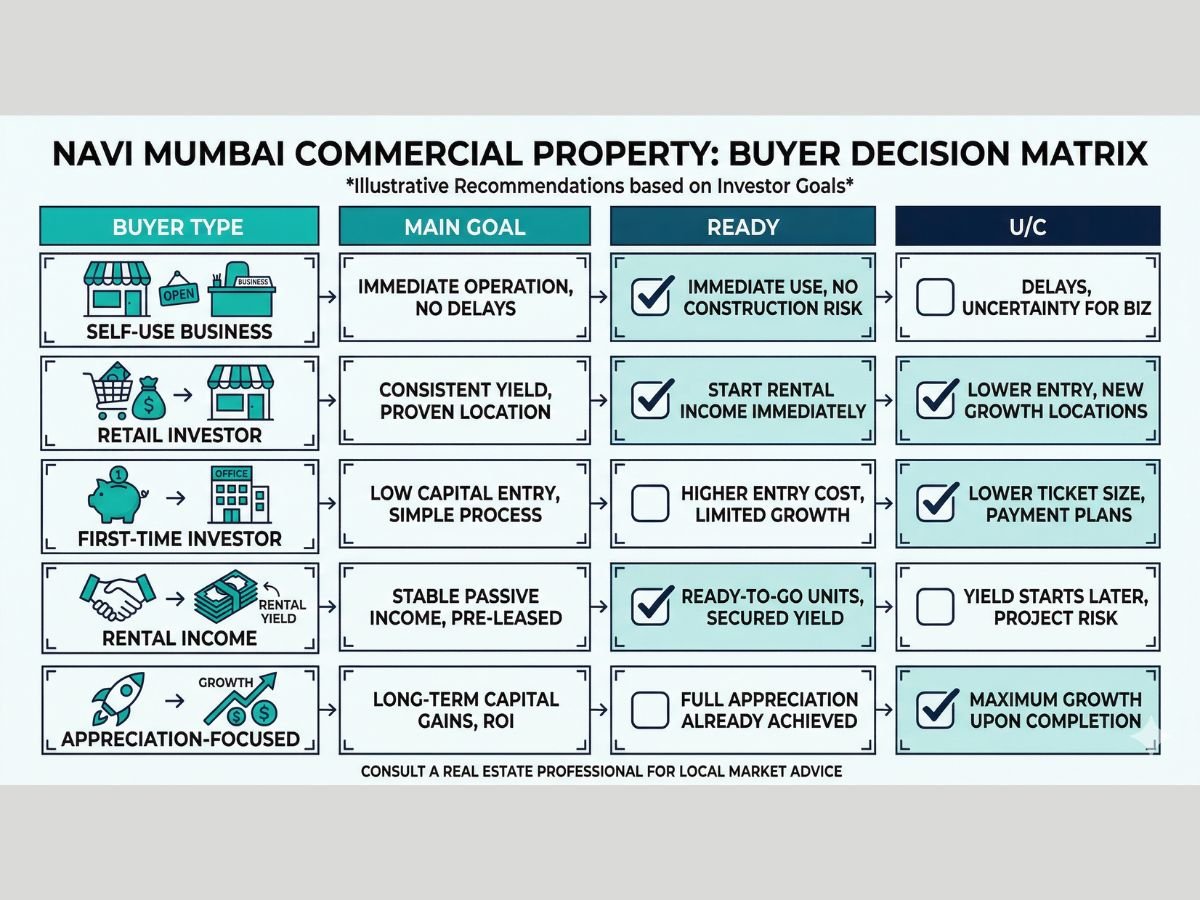
Which Option Fits You Better: Buyer-Type Matrix for Navi Mumbai Commercial Buyers
Ready vs Under-Construction: Which Buyer Should Choose What (2026)
| Buyer Profile | Main Goal | Better Fit | Practical Reason |
|---|---|---|---|
| Self-use office buyer | Start operations quickly | Ready | Waiting hurts business more than brochure discounts help |
| Retail shop investor | Real visibility and conversion | Ready | Footfall quality must be verified on ground |
| First-time commercial investor | Lower regret | Ready | Easier to inspect legality, usability, and leasing reality |
| Cash-flow-focused investor | Immediate rental yield | Ready | Faster rent start matters more than launch pricing |
| Appreciation-first investor | Future upside | Selective under-construction | Works only when node, builder, approvals, and price gap are strong |
| Conservative buyer | Legal clarity and exit comfort | Ready | Fewer risks and easier due diligence |
What Mistakes Cause the Biggest Regret in This Comparison?
The first big mistake is buying future demand that never becomes daily demand. This happens most in retail.
The second is treating fit-out possession like legal readiness. That shortcut can create serious trouble.
The third is confusing visible location with rentable location. A main road address alone does not create leasing success. Internal circulation, approach, parking, and how the building actually works matter more than many buyers realise.
The fourth is buying only because the launch discount looks attractive. If the price advantage disappears after GST, waiting cost, and transfer friction, it was never really a bargain.
Conclusion
If you are a self-use buyer, first-time investor, retail buyer, or someone who values faster rent and lower regret, ready commercial property is usually the better choice in Navi Mumbai today.
Under-construction commercial property should be treated as a specialised strategy, not the default smart buy. It works only when the location story is believable, the compliance trail is strong, the price gap survives GST and waiting cost, and you have the patience and capital to hold through uncertainty.
In simple words, most buyers should choose ready. Under-construction is for selective, well-capitalised, well-documented bets, not for blind discount chasing.
FAQs
Frequently Asked Questions