

Who Should Buy Commercial Space in CBD Belapur? Practical Buyer Guide
CBD Belapur is a strong buy mainly for people who need business stability, institutional proximity, and long-term office utility, not for everyone chasing fast appreciation or generic “prime location” branding. It suits self-use professional offices, government-facing businesses, legal and compliance firms, and selective long-hold investors far more than speculative buyers, mass-footfall retail bets, or companies that need large modern campus-style office environments.
For stronger market clarity before taking that call, CBD Belapur Commercial Property Guide is worth reading as well.
Quick Summary:

| Buyer type | Fit level | Why CBD Belapur does or does not fit |
|---|---|---|
| Lawyers, CAs, tax consultants, company secretaries | Strong fit | Daily work often depends on court, compliance, document, and client movement within Belapur’s administrative belt. |
| Government-facing SMEs and liaison businesses | Strong fit | Proximity saves time, improves business legitimacy, and supports repeat operational visits. |
| Self-use small office buyers | Strong fit | Ownership can make sense if the business wants long-term stability and will stay for years. |
| Branch offices for stable service businesses | Good fit | Belapur works well for mature, predictable office use rather than experimental expansion. |
| Long-hold investors buying small office units | Selective fit | Can work if the unit is in the right building with good access, parking, and tenantability. |
| Large IT occupiers or campus-style office users | Weak fit | Belapur is not naturally built for giant contiguous office plates like Airoli-Ghansoli ecosystems. |
| Generic retail investors buying internal shops | Weak fit | Belapur footfall is purpose-led, not relaxed browsing footfall. |
| Short-term speculative investors | Weak fit | This is a mature administrative market, not the cleanest quick-flip story. |
Why does CBD Belapur attract a different kind of commercial buyer than other Navi Mumbai nodes?
CBD Belapur does not behave like every other commercial node in Navi Mumbai. That is the entire point. Its value comes less from glamour and more from function.
Belapur’s commercial identity is built around three things: institutional presence, commuter access, and established weekday office demand. CIDCO headquarters, NMMC headquarters, Konkan Bhavan, the district court belt, and other government-linked offices create a daily ecosystem that is very different from a mall-driven or pure IT-driven location.
That changes the answer to who should buy here.
A buyer in Vashi may be buying into broader market vibrancy. A buyer in Seawoods may be buying into premium transit-linked visibility and newer mixed-use appeal. A buyer in Airoli may be buying into a much larger office ecosystem shaped by tech and corporate campuses. But a buyer in CBD Belapur is usually buying into administrative relevance, professional credibility, and predictable weekday business movement.
That is why Belapur works especially well for office users whose work depends on physical presence, trust, documentation, meetings, filings, and repeat visits.
It also explains why many retail assumptions fail here. Footfall exists, yes. But Belapur footfall is usually fast, transactional, and purpose-driven. People come to finish work. They do not always linger, browse, or spend like leisure shoppers.
Which buyer profiles are the best fit for CBD Belapur?

The best buyers in Belapur are not random. They usually belong to a narrow set of profiles that gain direct operational value from the location.
Self-use professional offices
This is one of the strongest buyer categories in CBD Belapur.
If you are a lawyer, CA, architect, tax consultant, corporate compliance advisor, insurance consultant, or documentation-heavy professional, Belapur can justify ownership far more easily than many other nodes. A stable office address here carries functional value, not just image value.
For such buyers, the office is not only a real estate asset. It becomes part of daily operations. Client meetings are easier. Nearby authority access matters. Staff can commute by rail, metro, or road. And over a long holding period, ownership can reduce the pain of periodic rental escalation.
A lawyer working around the district court ecosystem is a clear example. For that buyer, a properly chosen office in Sector 15 can be far more practical than a cheaper but poorly located office elsewhere in Navi Mumbai.
Government-facing and document-heavy businesses
This is where CBD Belapur becomes very different from generic office markets.
Businesses that regularly deal with CIDCO, NMMC, court-related movement, government departments, approvals, tax matters, land records, documentation, or recurring compliance visits are usually well suited to Belapur. The time saved on travel and follow-up is real. So is the credibility of operating from the same ecosystem your work revolves around.
This includes liaison firms, permit consultants, project management consultants, planning-related professionals, small legal-process teams, certain finance and back-office support businesses, and firms that serve clients whose work touches public authorities.
Here, location is not decoration. It is part of business productivity.
Consultants, finance, legal, and compliance firms
These are some of Belapur’s natural users.
Belapur’s court belt, civic offices, institutional surroundings, and weekday office culture make it especially suitable for firms that depend on trust, paperwork, repeat appointments, and a credible business address. These users generally do not need huge fancy campuses. They need reliable access, practical layouts, and buildings that clients can reach without too much confusion.
Sector 15 often fits such users better because it has stronger civic and court-side relevance. Sector 11, on the other hand, often works better for teams that value immediate public transport access and station convenience.
That Sector 11 versus Sector 15 split matters. Belapur is not one flat market.
Long-hold investors seeking stable office demand

Belapur can work for investors, but only selectively.
This is not the cleanest market for passive buyers who want effortless high yields and quick exits. Holding costs, maintenance drag, building quality variation, and local statutory realities can reduce the neatness of the investment thesis. But a disciplined investor buying a smaller office in a good building with strong professional tenant demand can still make a reasonable long-hold case.
The better investor thesis here is stability, not excitement.
If the unit is in a well-maintained building, has functional parking, sits in a strong micro-location, and attracts sticky tenants like legal, finance, or professional users, then Belapur can deliver a steady commercial holding story. But the investor has to buy the right unit, not just the right pin code.
Business owners upgrading from rented office to owned office
This is another strong-fit profile.
If a business is already operating in Belapur, knows it wants to stay, and expects a 5-to-10-year horizon, then buying may start making practical sense. This is especially true when the business has already tested the location and understands its staff commute, client movement, building quality preferences, and actual space requirement.
There is another practical layer here. Fit-outs are expensive. If a business is going to spend heavily on interiors anyway, doing that in a long-term owned office can be more rational than repeatedly spending on rented spaces and facing relocation risk later.
Still, the math only works when the business is stable enough. If growth is uncertain, renting can still be the smarter move.
Which buyers usually overestimate CBD Belapur and should be careful before buying?
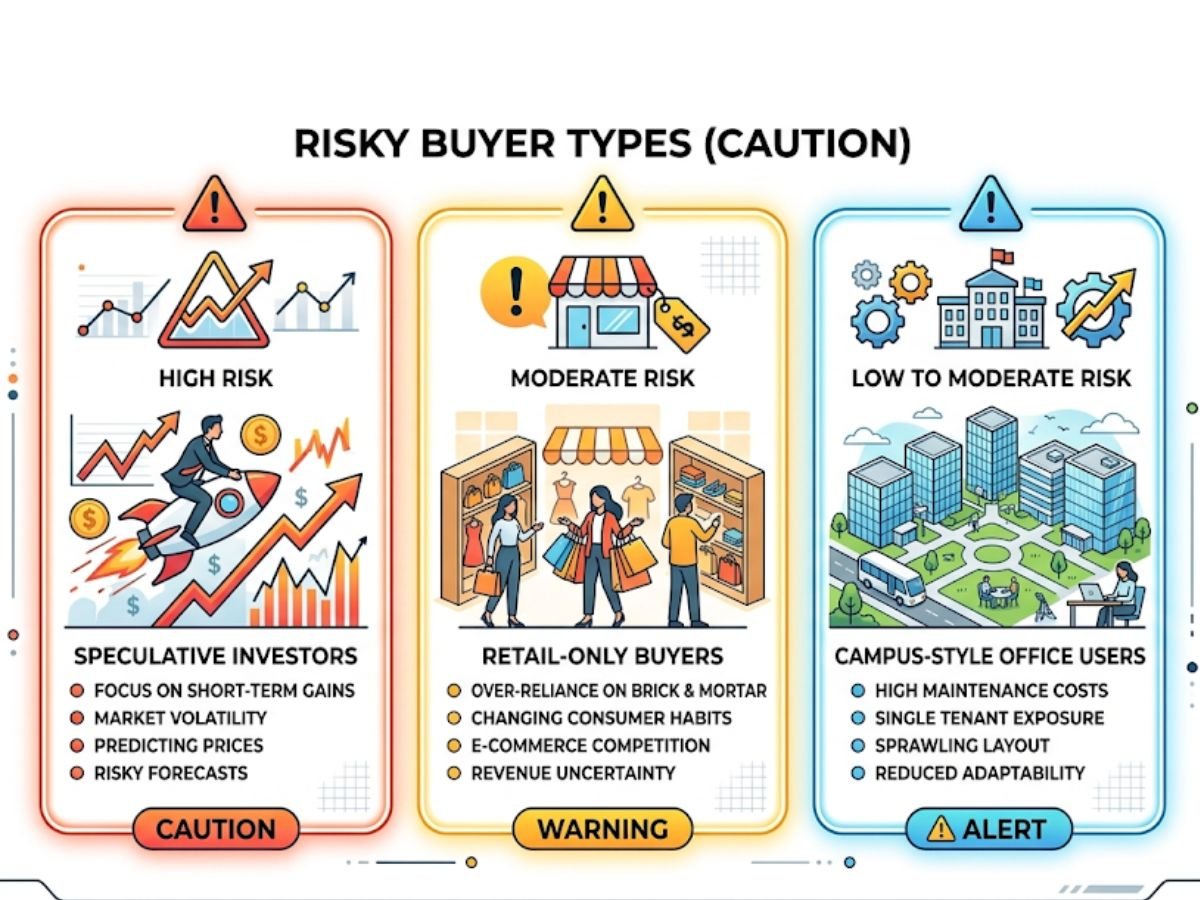
CBD Belapur is easy to misunderstand. A lot of buyers see the words “CBD” and “Belapur” and assume that every commercial unit here is automatically a strong investment. That is exactly how money gets trapped.
Pure hype-driven investors
If your main goal is fast capital appreciation because the location sounds elite, Belapur is not automatically the right fit.
This is a mature node. Its strength is institutional stability, not speculative drama. There may still be upside in the right building and the right cycle, but buying here only because the address sounds strong is a weak thesis.
A mature market can preserve value well, but it can also punish lazy buying.
Buyers expecting high-street retail style footfall from every property
This is one of the most common mistakes.
Not all footfall is commercial footfall. Not all crowd movement converts into retail sales. In Belapur, much of the daily movement is administrative, professional, or commute-related. That does not automatically support every ground-floor shop, internal arcade unit, or hidden commercial corner.
A shop with poor visibility inside an older complex can remain vacant for long periods even if the broader location is active. Buyers who assume “busy area means good retail” often misread Belapur badly.
Businesses that need large campus-style modern office ecosystems
Belapur is not the best answer for every office user.
If your company needs large contiguous floor plates, modern campus infrastructure, expansion flexibility, integrated amenities, and a more institutional Grade A corporate environment, Airoli or certain other office corridors may fit better. Trying to stitch together large office space through multiple small strata units in an older Belapur building can become messy very quickly.
Layout mismatch, parking limitations, multiple ownership layers, older building cores, and inefficient common areas can all create operational friction.
Buyers who want quick-flip liquidity in average buildings
This is another weak-fit profile.
A mediocre old office in a tired building does not become liquid just because it is in Belapur. In fact, older strata stock with weak common areas, poor light, awkward layouts, no real parking comfort, and maintenance issues can become difficult to exit cleanly.
A Belapur address cannot fix a weak product.
What type of commercial space makes the most sense to buy in CBD Belapur?
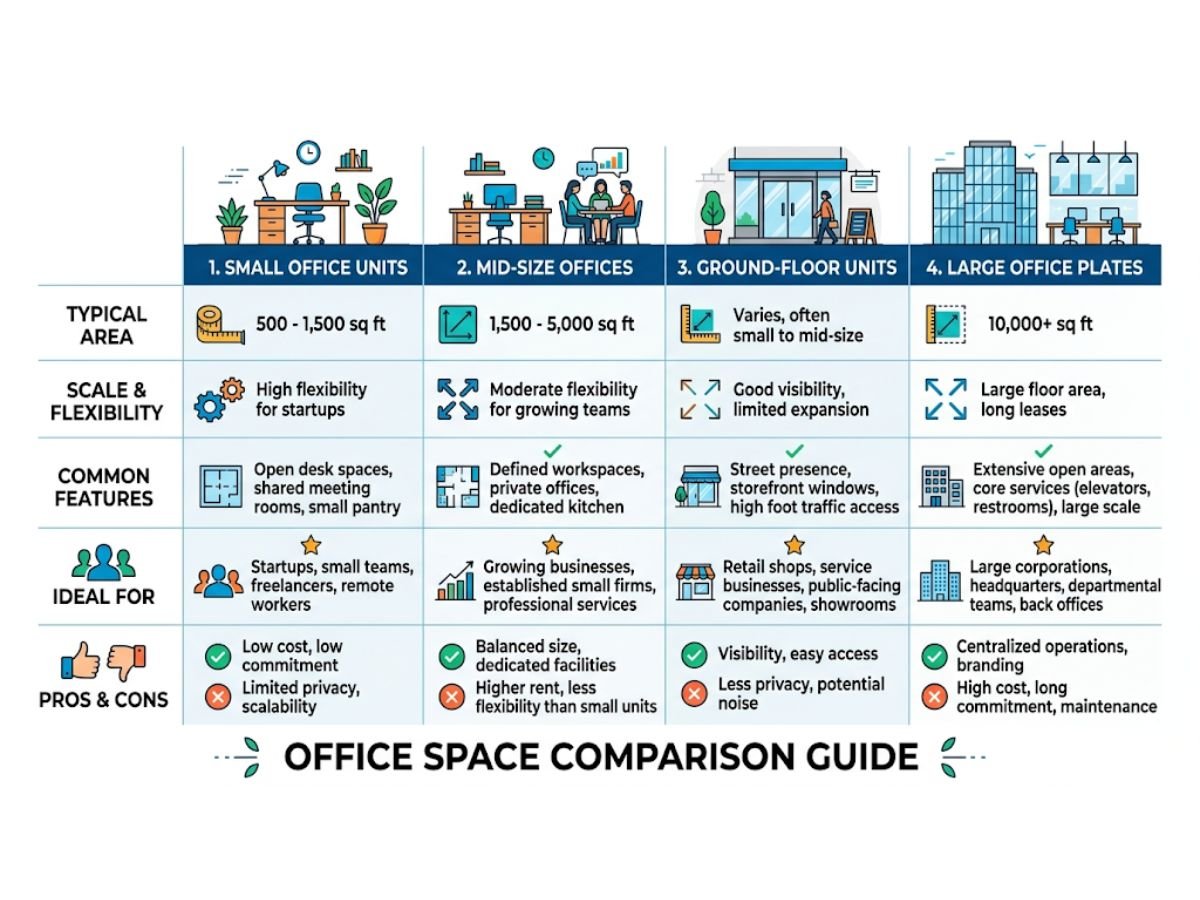
Belapur is a market where unit type matters as much as location. A buyer can be correct about Belapur and still be wrong about the actual asset.
You may also want to read Small Office vs Full Floor Office in CBD Belapur if you are still comparing scale, use, and investment fit.
Small strata office
This is usually the best fit in Belapur.
Small office units, especially in the roughly 300 to 800 sq ft range, are often the easiest to understand, lease, and resell. They match the natural demand pool of lawyers, consultants, CAs, boutique service firms, compliance teams, and small branch offices. Ticket size is more manageable, and leasing demand is broader.
But building quality matters a lot. A good small unit in a tired building can still underperform.
Mid-size office for self-use
This can make strong sense for established SMEs, legal groups, consulting firms, and service businesses that need more than a cabin-style office but do not need a giant corporate plate.
This format works best when the buyer has already validated Belapur as a long-term business base. For self-use buyers, a properly planned mid-size office in the right building can create daily efficiency and long-term occupancy stability.
The caution is simple: do not underestimate interior cost, parking needs, or building management quality.
Ground-floor commercial unit
This is highly selective, not universally good.
A main-road, high-visibility, accessible ground-floor unit can work. A hidden internal shop in an aging commercial complex may not. Ground-floor buying in Belapur only makes sense when the unit clearly benefits from actual visibility, easy approach, and the right customer profile.
Retail, food, convenience, service counters, and document-related walk-in uses may work in select pockets. But many buyers overgeneralise this category.
Larger office plate in established buildings
This can work only in selective cases.
For a serious professional practice, a larger self-use unit in a good modern or well-kept building may still make sense. But the buyer has to evaluate transfer costs, parking, expansion flexibility, common area quality, and future resale comfort carefully.
For pure investment, this category becomes much more difficult. The buyer pool is narrower, the capital lock-in is heavier, and building-level risk becomes more important.
Is CBD Belapur better for self-use buyers or pure investors?
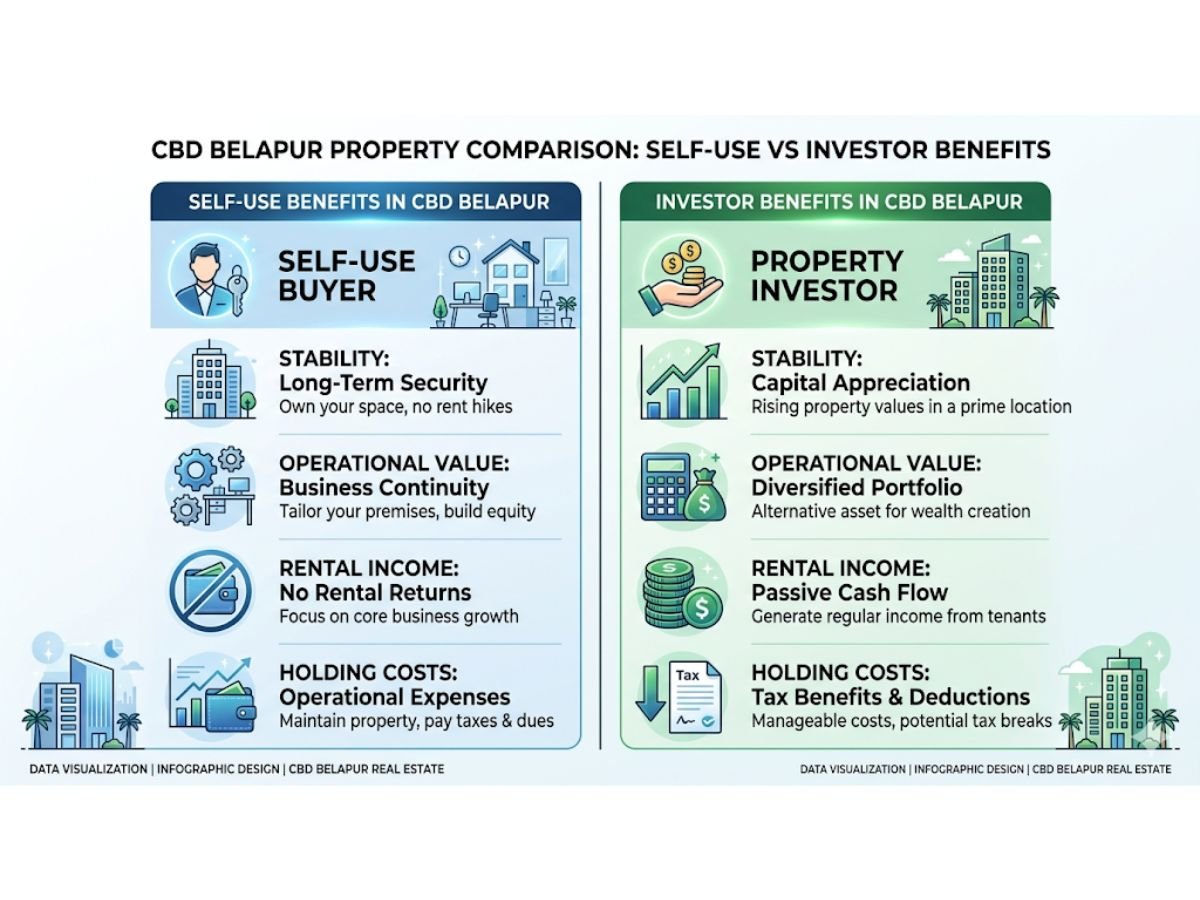
The stronger thesis in Belapur is self-use. That is the honest answer.
For self-use buyers, ownership can convert rent into equity, give business continuity, strengthen local credibility, and reduce relocation friction. This becomes even more relevant when the business wants to stay in Belapur for years and depends on the surrounding institutional ecosystem.
For pure investors, the picture is more mixed.
Yes, Belapur can offer stable office demand in the right asset. But the investor must deal with commercial maintenance burdens, local tax realities, vacancy periods, fit-out sensitivity, and resale selectivity. Gross yields can look decent on paper, but net yield can compress once real holding costs and downtime are considered.
So the node is not anti-investor. It is just not lazy-investor friendly.
A disciplined investor may still buy a small professional-office unit in a good building with parking comfort and a sticky tenant profile. But a buyer expecting easy passive income from any random Belapur office should slow down.
What makes a Belapur commercial building worth buying into and what makes one risky?
This is where most real mistakes happen. Many buyers evaluate the node but do not evaluate the building hard enough.
Access and station convenience
Belapur station connectivity matters, but only where it improves actual usability.
If staff, clients, and daily visitors depend on train and metro access, then station-side convenience can materially improve tenantability. That is why Sector 11 often works well for commuter-heavy office users and SMEs.
But station proximity alone is not enough. A unit that is “near station” but sits inside a poorly maintained or confusing commercial building may still disappoint.
Parking and daily usability
Parking is one of the most important filters in Belapur today.
This is especially critical in the court and Konkan Bhavan side of the market, where on-ground parking friction can turn into a daily business problem. A unit with proper deeded or dependable in-building parking is not a luxury here. For many users, it is a core value driver.
If your clients visit in person, parking should be checked before price.
Building age, maintenance, and occupancy quality
A large share of Belapur’s commercial stock is older. That does not automatically make it bad, but it does raise the due-diligence bar.
Check the lobby, lifts, common washrooms, facade condition, leak history, electrical load comfort, and overall professionalism of the occupant mix. A building full of serious office users behaves differently from one with patchy occupancy, weak maintenance, and constant disputes.
A nicely furnished office inside a badly run building is still a risky buy.
Authority, title, and documentation comfort
This part must not be treated casually.
Belapur buyers need comfort on title chain, local authority documentation, society or building records, tax dues, parking allocation, and where relevant, CIDCO-related permissions or transfer requirements. For under-construction or newer regulated stock, MahaRERA can be useful. For the large resale market, document verification becomes even more important.
Use IGR Maharashtra as a record-checking and valuation-reference support tool, not as a substitute for legal due diligence. And if the transaction involves leasehold complications, old commercial society issues, or unclear transfer obligations, use a Navi Mumbai property lawyer before committing.
Tenantability and resale depth
Ask one hard question: if you had to lease this unit or exit it later, who would actually want it?
That one question filters out a lot of bad purchases.
If the answer is vague, the asset is risky. If the unit clearly suits lawyers, consultants, compliance teams, professional firms, or small office users, then the tenant base is easier to understand. If the layout is awkward, the floor plate is inefficient, the light is weak, or the building reputation is poor, resale depth shrinks quickly.
How does CBD Belapur compare with Vashi, Seawoods, and Airoli for different commercial buyers?
| Node | Best known for | Best suited buyers | Where it beats Belapur | Where Belapur still wins |
|---|---|---|---|---|
| CBD Belapur | Administrative, legal, civic-office ecosystem | Lawyers, CAs, consultants, liaison firms, self-use SMEs | Not the strongest for broad retail or giant office campuses | Stronger for government-facing and professional-office utility |
| Vashi | Broader commercial vibrancy and stronger mixed-use energy | Retailers, traders, broad service businesses, commercial investors | Better for wider market activity and stronger high-street logic | Belapur can feel more credible for legal-compliance-office use |
| Seawoods | Premium transit-led mixed-use environment | Select retail, premium services, boutique agencies | Better for premium retail and some destination appeal | Belapur is often stronger for institutional and court-linked office use |
| Airoli | Larger office and IT-led ecosystem | Corporate occupiers, tech teams, bigger office users | Much better for campus-style office demand and large floor plates | Belapur suits smaller professional and authority-linked users better |
When does renting in CBD Belapur make more sense than buying?
Renting makes more sense when the business is still testing itself, testing Belapur, or protecting capital.
Do not buy just because the rent feels painful. Buy only when the business is stable enough to justify the lock-in.
Renting is usually the better option when:
- the company is early-stage or uncertain about team size
- the business may shift to another node within a few years
- capital is better used in inventory, hiring, sales, or growth
- the buyer has not yet tested whether Belapur actually improves operations
- the ideal building is available on lease but not as a sensible purchase
- the total entry cost, including interiors and transaction burden, stretches the business too hard
A simple example helps here.
A small consulting firm with 6 staff, unclear growth visibility, and strong business expansion opportunities may be better off renting a 500 sq ft office in Belapur rather than locking a large amount of capital into ownership. But a stable CA firm already working in Belapur for years may find buying much smarter, especially if it expects to remain there long term.
A practical checklist: should you buy commercial space in CBD Belapur or not?
Use this as a final go or no-go filter.
Buy in CBD Belapur if:
- your work depends on courts, CIDCO, NMMC, Konkan Bhavan, or recurring regulatory movement
- you are a self-use buyer with a 5-to-10-year business horizon
- you have identified the correct micro-market, such as Sector 11 for transit convenience or Sector 15 for civic-legal relevance
- the building has strong daily usability, not just a strong address
- parking is dependable and clearly allocated
- the unit layout, light, and floor efficiency support real office use
- documentation comfort is high and legal review is clean
- the asset would still lease reasonably well if your own use changes later
Rent instead if:
- your business is still experimenting
- you need flexibility more than ownership
- your headcount may change sharply
- the building is weak but the location is tempting
- the deal only works if prices rise quickly
- you are buying for prestige rather than operational logic
- you need weekend retail demand or destination-style footfall
- you are stretching capital too hard after including interiors and transaction costs
Conclusion
CBD Belapur is worth buying into when the buyer is purchasing business utility, not fantasy. It is one of the better commercial nodes in Navi Mumbai for self-use professional offices, legal and compliance firms, government-facing businesses, and selective buyers who value long-term stability over hype.
It is not the automatic answer for every investor, every retail user, or every office format.
If your business needs institutional proximity, weekday office credibility, and a mature administrative ecosystem, Belapur can be a very smart commercial buy. If you are chasing fast appreciation, leisure-style footfall, or large modern corporate floor plates, you should probably rent first or look at another node.
The cleanest way to think about CBD Belapur is this: buy here when the location makes your business work better every week. Do not buy here just because the address sounds important.
FAQs
Frequently Asked Questions