

What Makes an Office Grade A in Navi Mumbai? A Practical Buyer and Investor Guide
A Grade A office in Navi Mumbai is not just a new glass building with a polished lobby. It is an office that works better in daily business life because it combines strong location access, reliable lifts, proper parking, full power backup, better floor efficiency, professional management, and cleaner legal and operational comfort. Just as important, not every expensive office is Grade A, and not every Grade A office is worth paying for in every case.
If you are buying, leasing, or investing in commercial office space here, that difference matters a lot. In Navi Mumbai, the real test of Grade A is not brochure language. It is whether the building performs like a serious business asset.
What actually makes an office Grade A in Navi Mumbai?
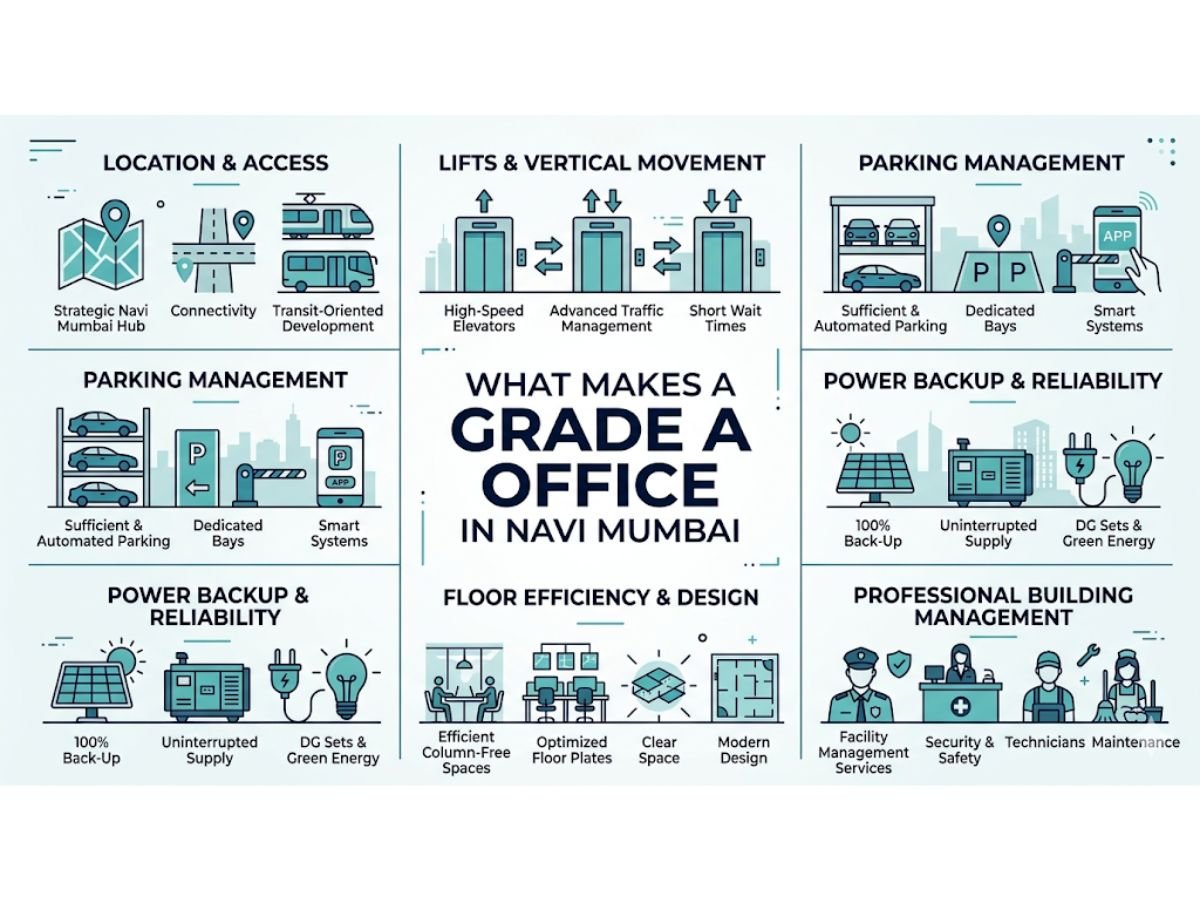
In practical Navi Mumbai terms, a Grade A office is a high-performance office building that delivers three things together: strong usability, strong operations, and strong market credibility.
That means the building should be in a business-friendly location, ideally with easy access to station networks or major roads, but location alone is not enough. It must also have solid building systems, professional upkeep, strong common-area management, reliable vertical movement, proper parking logic, and a floor design that actually works for modern offices.
A true Grade A office in Navi Mumbai usually attracts better tenants because it reduces day-to-day friction. Employees reach more easily. Clients find the building without confusion. Lifts do not become a daily headache. Power backup is not partial or symbolic. Washrooms and common areas do not deteriorate within two years. Management responds before problems become visible.
Quick summary: what usually separates real Grade A stock from average office stock?
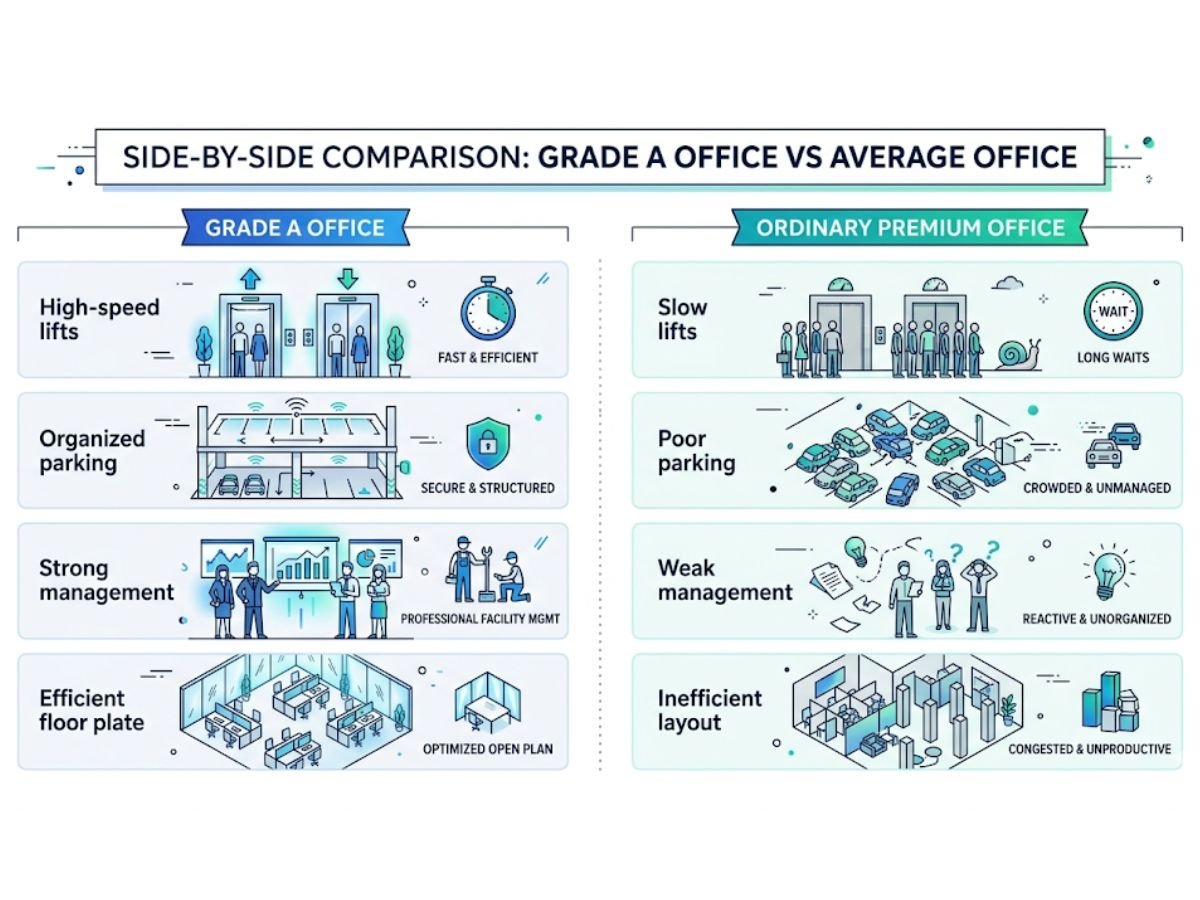
| Factor | Real Grade A Office Navi Mumbai | Ordinary or weak “premium” office stock |
|---|---|---|
| Location | Strong business catchment, better station or arterial road access | Good address on paper, but weak daily convenience |
| Building management | Professional, preventive, centralized | Reactive, fragmented, inconsistent |
| Lifts and movement | High-speed lifts, better peak-hour handling, service lift | Slow lifts, crowding, operational delays |
| Power backup | 100% backup expected for serious usage | Partial backup or backup only for basics |
| Parking | Organized owner and visitor handling | Tight, confusing, inadequate |
| Floor usability | Better floor plate efficiency, fewer layout compromises | Awkward columns, wasted pockets, poor fit-out logic |
| Legal and authority comfort | Better documentation comfort, stronger occupier confidence | Unclear records, incomplete comfort, avoidable risk |
| Tenant profile | Better-quality occupiers, stronger leaseability | Shallower demand, weaker tenant stickiness |
Is Grade A only about a new building, or does operations quality matter more?
Operations quality matters more than most first-time buyers think.
A new commercial building may look superior on day one, but if it has poor lift handling, inconsistent facility management, weak parking control, and downtime in core systems, it does not behave like Grade A for very long. On the other hand, an older office building in a stronger business pocket can still outperform a newer project if it has been maintained properly and continues to run smoothly.
Building age vs building performance
In Navi Mumbai, this difference becomes visible quickly. Humidity, coastal wear, heavy usage, and inconsistent maintenance can age a building faster than buyers expect. So the better question is not, “How old is this building?” but “How well does this building still function?”
An older commercial asset in a mature pocket of Vashi or CBD Belapur may still hold stronger Grade A characteristics if it has better management, better tenant mix, better access, and periodic upgrading. A newer building on a weaker internal stretch may look fresher but fail on real business convenience.
That is why office building amenities Navi Mumbai should never be judged only by brochure features. The performance of those amenities matters more than the list.
Why maintenance, management, and uptime matter
In a real office environment, uptime is value. A well-managed building protects working hours, employee comfort, client experience, and brand perception.
A serious Grade A office usually shows these patterns:
- common areas stay clean and consistent, not just at launch
- security is professional and controlled
- lifts, power systems, and technical services are maintained before failure
- vendor accountability is centralized
- the building does not visibly “slip” after initial possession
This is also why higher maintenance charges do not automatically mean a bad deal. In many cases, better managed buildings cost more to maintain because they are actually being maintained.
Reality check
A building with a designer lobby but poor lift performance is not truly Grade A. A building with impressive facade lighting but weak power redundancy is not truly Grade A. A building with premium pricing but messy common-area management is not truly Grade A.
Which features are non-negotiable before a building can seriously be called Grade A?
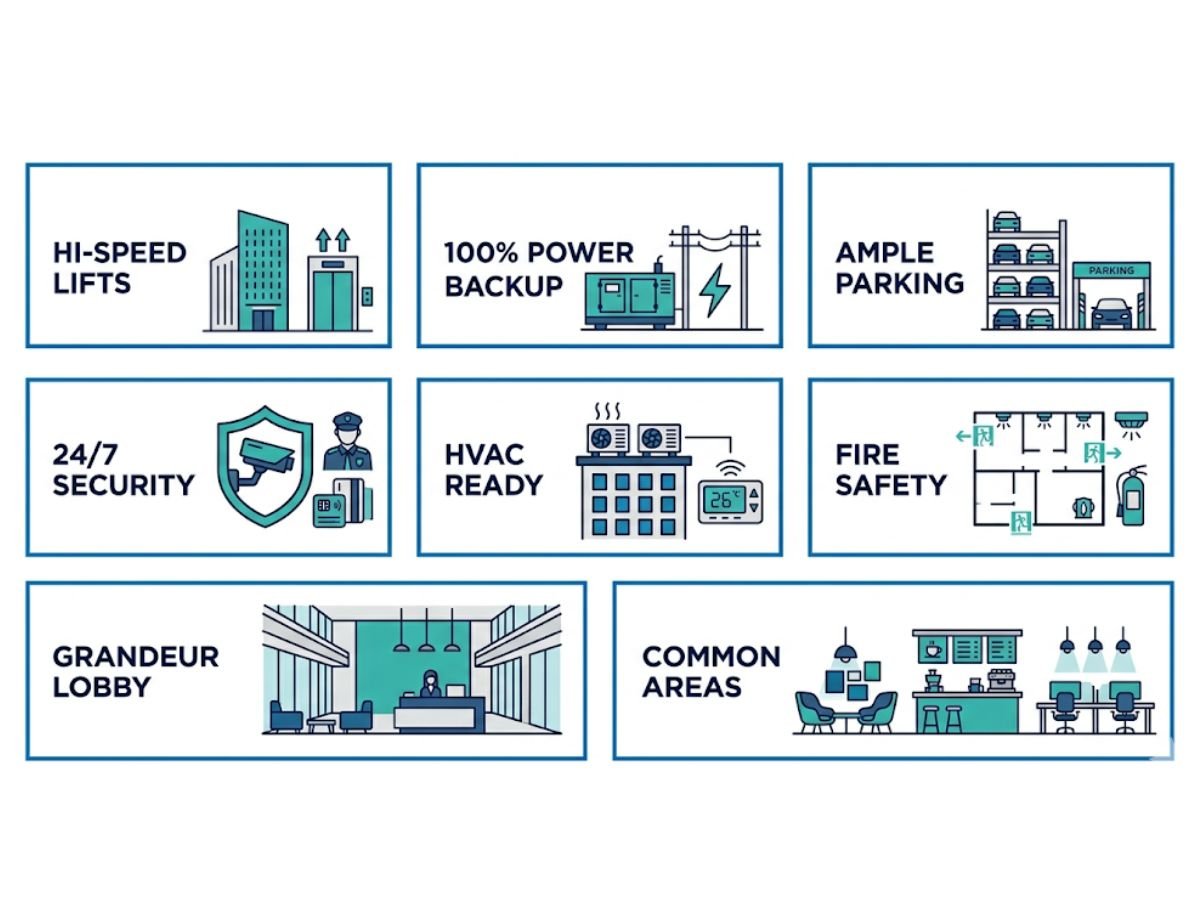
Some features are optional luxuries. Some are branding extras. But a few are core filters. Without them, the Grade A claim becomes weak very quickly.
Access, lobby, lifts, parking, security, and common areas
The office experience starts before the office unit begins. A Grade A building should have a proper drop-off, good arrival handling, and a lobby that feels professionally run rather than just decorated.
Lifts are one of the biggest reality tests. In a commercial building, poor lift handling can spoil the user experience every single day. Real Grade A stock should have enough passenger lifts to support peak-hour traffic, and serious buildings should also have a separate service lift.
Parking matters much more in Navi Mumbai than many sellers admit. Owner parking, staff parking, and visitor parking all shape how the building functions. A premium address with no sensible parking handling often becomes frustrating in actual use.
Power backup, fire systems, HVAC readiness, washrooms, and building efficiency
A Grade A commercial property in Navi Mumbai should offer serious power backup. Not token backup. Not lift-only comfort. Businesses paying a premium expect reliability.
Fire systems and life safety also matter. Buyers may not see them as glamorous, but occupiers and serious investors do. Strong fire compliance, refuge planning, and building safety systems improve both confidence and long-term leaseability.
HVAC readiness is another practical issue. Some buildings look premium but create trouble when tenants try to fit out proper office cooling systems. That makes the office costlier to occupy than it first appears.
Washrooms and common areas are often ignored during site visits, but they tell the truth. If these spaces are already aging badly, the building’s long-term quality is questionable.
Floor plate quality, natural light, and practical office usability
This is where many buyers make mistakes. Floor plate quality directly affects usable space, workstation planning, circulation, cabin placement, and meeting-room logic.
A Grade A office should not force too many compromises. Large columns, inefficient core placement, dark internal pockets, or awkward floor geometry increase fit-out waste and reduce practical efficiency.
Good natural light, better clear height, and more usable planning all make the office easier to occupy, easier to lease, and easier to value properly.
How much does location decide whether an office feels truly Grade A?
A lot. In Navi Mumbai, location is not only about prestige. It is about commute logic, business convenience, and daily employee experience.
A technically good building in a weak or inconvenient commercial pocket may still struggle to feel truly Grade A to serious occupiers. At the same time, a well-run building in a strong node benefits from the ecosystem around it.
Station-linked convenience vs highway-facing visibility
For office users across the Mumbai Metropolitan Region, rail access remains a major value driver. A station-linked or near-station office reduces commute friction. That helps occupancy, retention, and tenant appeal.
Highway-facing or major-road visibility creates a different kind of premium. It improves brand presence, visitor access by car, and a landmark effect. But visibility alone does not make a building Grade A if the actual office experience is weak.
The strongest commercial office assets usually balance both. They offer enough public transit convenience for staff and enough road accessibility for clients, leadership, and operations.
Why node reputation alone is not enough
Saying a building is in Vashi, Belapur, or Airoli is not a full answer. Within each node, micro-location matters.
One road may offer better station access, cleaner commercial surroundings, and stronger business visibility. Another nearby stretch may have older stock, tighter approach, weaker parking, or more fragmented office use.
That is why station access office Navi Mumbai matters more than generic node branding. Grade A is experienced at the micro level, not just the city-sector label.
Which Navi Mumbai nodes are more likely to have real Grade A office stock?
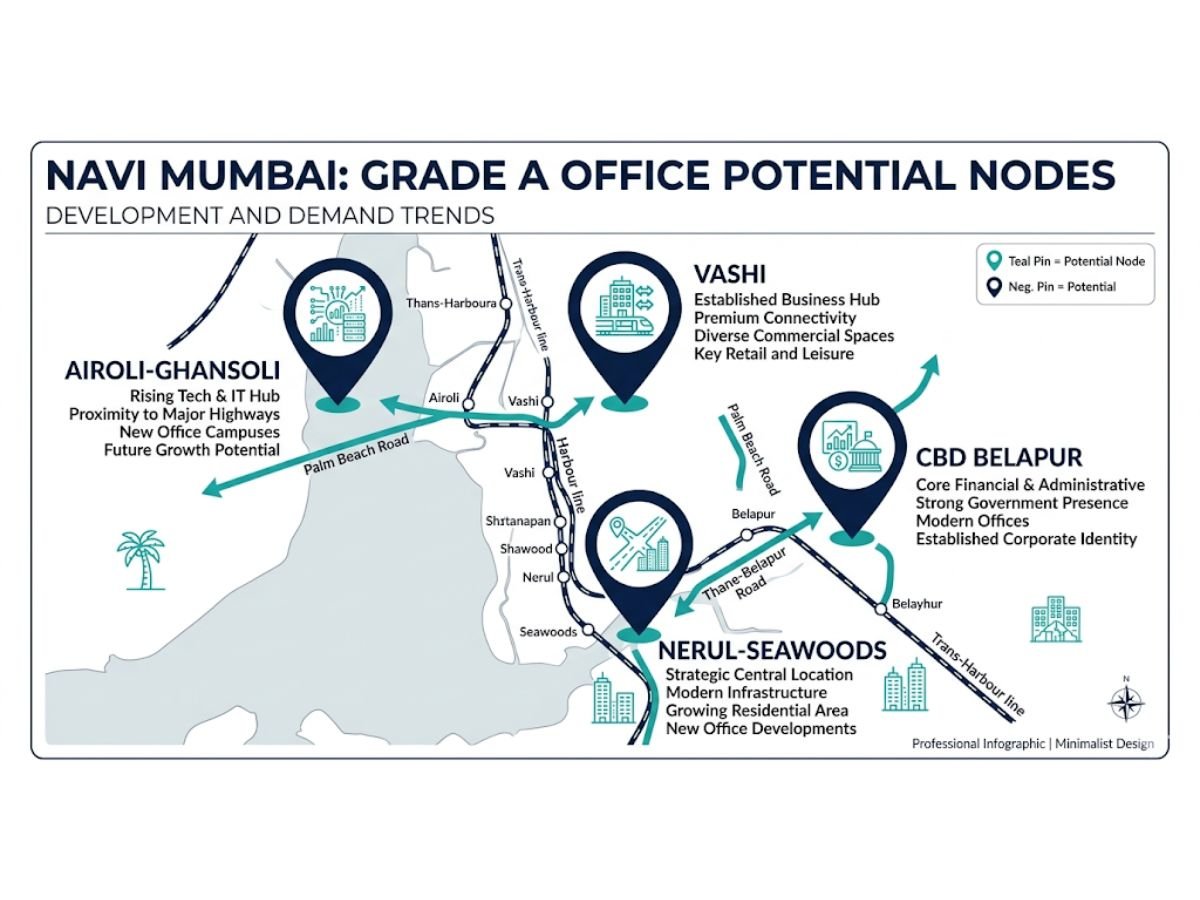
Not all nodes perform the same way. Navi Mumbai has different office ecosystems, and the meaning of Grade A changes slightly depending on the user profile and local building stock.
Vashi
Vashi remains one of the strongest commercial office locations in Navi Mumbai for visibility, established demand, and corporate recognisability. The better pockets, especially near stronger commercial sectors, tend to support more believable Grade A stock.
This is usually a strong fit for professional services, banking-related occupiers, business owners wanting brand presence, and firms that value a central Navi Mumbai identity.
CBD Belapur
CBD Belapur works well for administrative, legal, financial, and institutional users. It has a strong office identity and better comfort for businesses that value a formal address and structured commercial environment.
Some office buildings here benefit from location and ecosystem strength, but the difference between older strata stock and stronger premium stock must be judged carefully.
Nerul and Seawoods
These pockets are increasingly relevant where transit convenience, lifestyle ecosystem, and premium mixed-use surroundings matter. Seawoods especially has changed the conversation because station-linked commercial quality here feels more modern and experience-led.
This can suit firms that care about employee convenience, a modern environment, and stronger live-work-play appeal.
Airoli and Ghansoli
This side of Navi Mumbai is more institutional in feel and has stronger relevance for technology, back-office, GCC, and campus-style occupiers. Here, Grade A is often understood more through scale, infrastructure, and systems than through a conventional standalone office tower mindset.
For large occupiers, this cluster can offer the strongest case for true institutional-grade office stock.
Quick node comparison
|
|---|
Can a building be expensive and still not be Grade A?
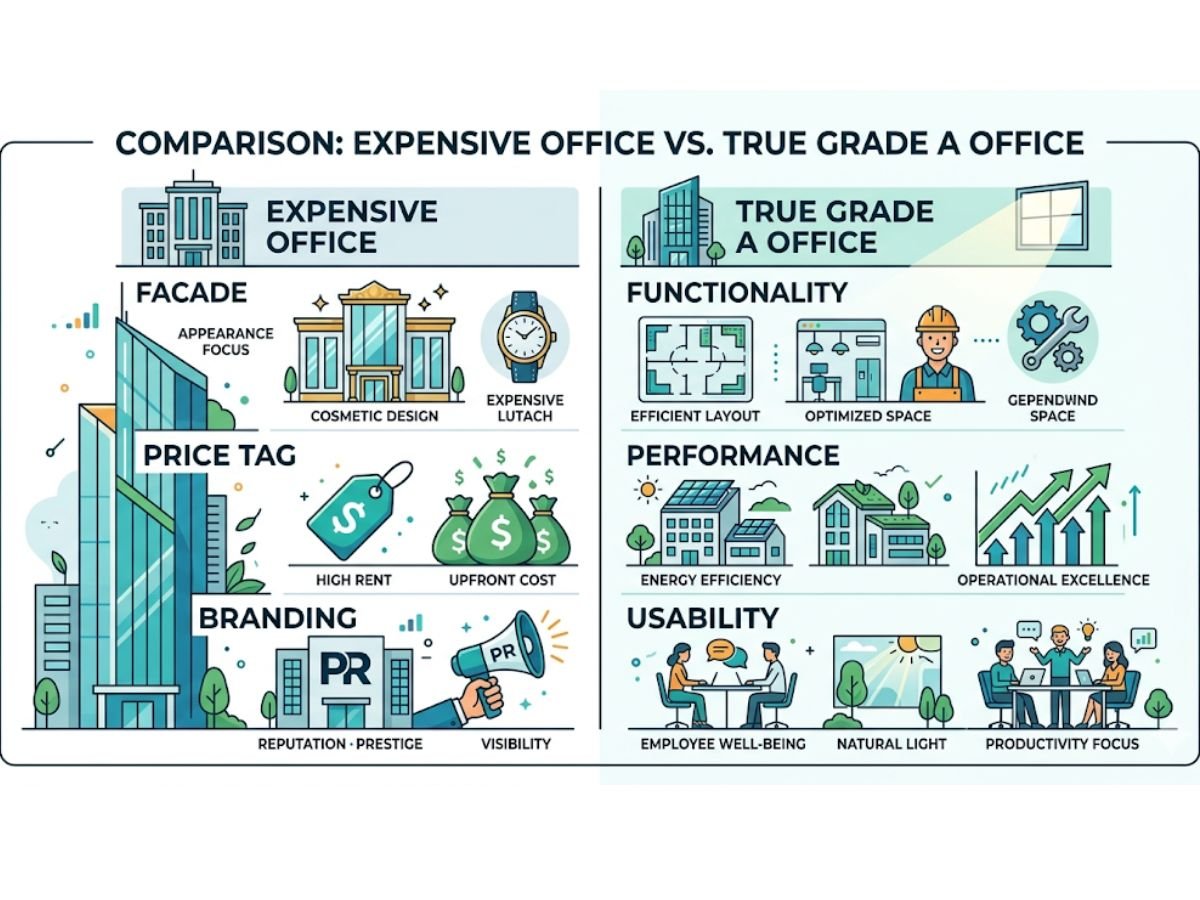
Yes. This is one of the biggest mistakes in commercial buying.
In Navi Mumbai, a building can be expensive because of branding, launch positioning, facade aesthetics, or speculative pricing. But price does not automatically mean better building performance.
The common mismatch between price, branding, and actual usability
Some projects spend heavily on visual presentation but remain weak where it matters most: parking flow, lift performance, floor efficiency, tenant mix, power comfort, or documentation clarity.
This creates a common trap. Buyers assume that a premium-looking office with a strong launch story must be Grade A. But once actual business use starts, the flaws become visible.
A project may be costly, but if it has awkward office layouts, visitor parking problems, slow lifts, fragmented building ownership, or weak common-area discipline, it may behave more like Grade B+ than real Grade A.
Signs that a “premium” office project is weaker than it looks
Watch for these warning signs:
- premium brochure language but no clear operational strengths
- high asking price but average floor efficiency
- good facade but weak drop-off and parking handling
- building finished visually but legal comfort not clean enough
- fragmented ownership that weakens common-area quality over time
- poor peak-hour movement inside the building
- no serious tenant profile despite strong pricing expectations
This is where Grade A vs Grade B office Navi Mumbai becomes a practical filter, not a label debate.
What do buyers, tenants, and investors each look for in a Grade A office?
The same building can look good to one person and average to another. That is because self-use buyers, tenants, and investors judge Grade A differently.
Self-use buyer lens
A self-use buyer usually wants convenience, business image, and fewer headaches. They care about the lobby, parking, access, reliability, and how the office feels to clients and staff.
They may happily pay more for a building that reduces future friction and supports stronger brand perception.
Tenant lens
A tenant cares most about day-to-day usability. Commute convenience, floor efficiency, reliable building services, clean common areas, and a better work environment matter more than ownership structure or launch story.
A tenant often prefers paying slightly more for a better functioning office if it improves employee experience and reduces operational pain.
Investor lens
An investor should think differently. For them, Grade A means stronger rentability, better tenant quality, lower vacancy risk, smoother exit, and better long-term asset perception.
That means office leasing demand Navi Mumbai depends not only on how premium the building looks, but on whether quality tenants actually want to stay there.
| User type | What Grade A usually means to them | Main filter |
|---|---|---|
| Self-use buyer | Better image and smoother business functioning | Access, parking, reliability |
| Tenant | Better employee experience and fit-out usability | Commute, efficiency, building systems |
| Investor | Better lease stability and exit quality | Tenant stickiness, management, legal comfort |
How do authority, approvals, and project documentation affect the Grade A claim?
A building cannot be treated as truly premium if the authority-side comfort is weak.
In Navi Mumbai, where CIDCO planning history, municipal processes, and project records all matter, legal and documentation hygiene support the Grade A claim in a very practical way. Banks, serious tenants, and informed buyers all become more comfortable when the documentation side is clean.
Why legal cleanliness supports premium perception
If a commercial office project has cleaner records, approved documentation visibility, and proper occupancy comfort, it becomes easier to finance, easier to lease, and easier to exit.
This does not mean every buyer must become a legal expert. But it does mean a premium building should not create avoidable doubt.
Aesthetic quality without documentation comfort is not enough.
Where CIDCO, MahaRERA, and local authority context matters
For Navi Mumbai projects, CIDCO-side planning context may matter depending on the land and project structure. MahaRERA visibility matters especially in under-construction or recently delivered projects where approval history, timelines, and disclosures shape buyer confidence.
Occupancy Certificate comfort is especially important. A polished office in a project with incomplete comfort on core approvals is not the same as a fully settled office asset.
Use legal and authority references carefully, but do not ignore them. A real CIDCO commercial office Navi Mumbai or MahaRERA office project Navi Mumbai evaluation should always include documentation hygiene, not just marketing language.
What is the fastest practical checklist to test whether an office is really Grade A?
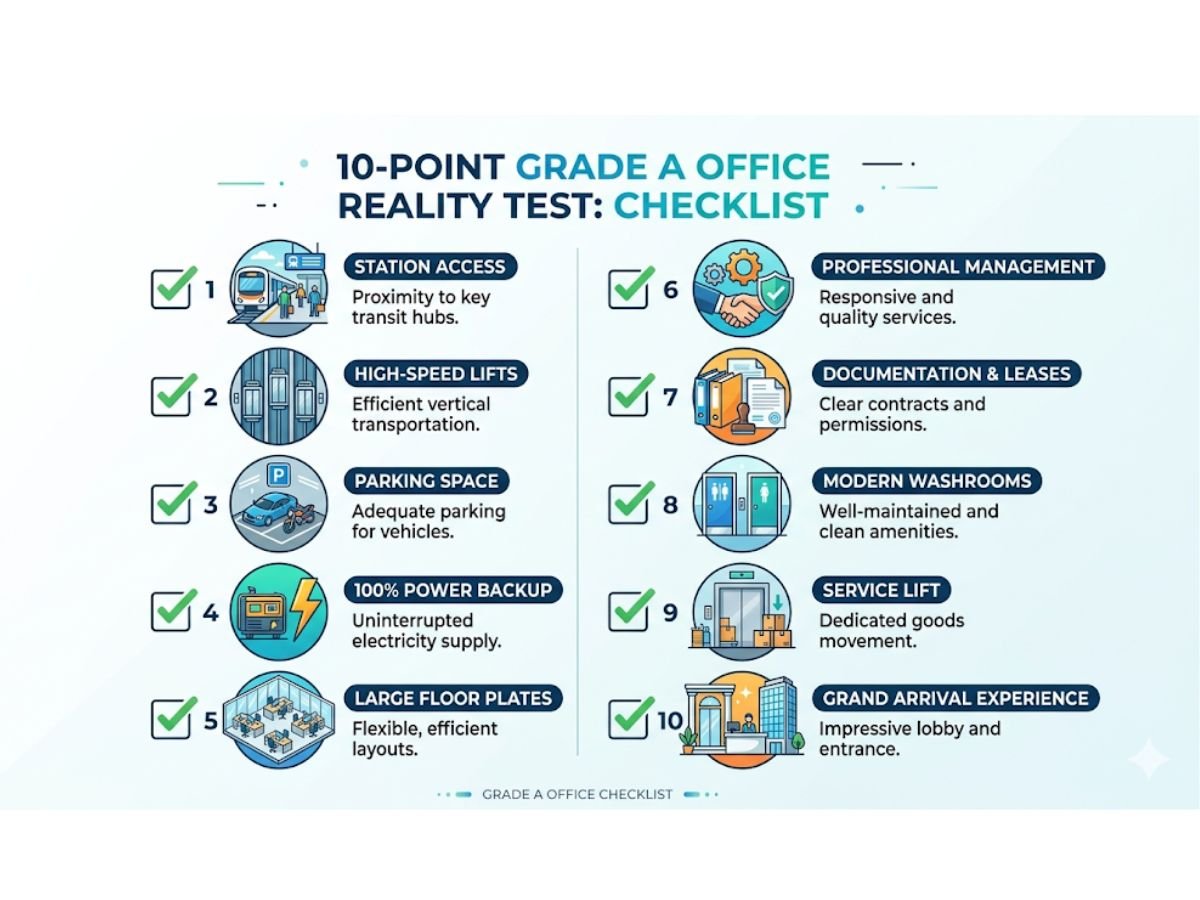
Use this as a real-world screening tool during site visits.
10-point Grade A reality test
1. Can employees reach the station or major transit link easily? If access is poor, the Grade A claim weakens immediately.
2. Does the building arrival experience feel organized and professional? Drop-off, lobby, reception flow, and security should work smoothly.
3. Are the lifts fast enough and sufficient for peak-hour use? A premium office cannot feel crowded and slow every morning.
4. Is there a dedicated service lift? This matters more than many buyers realize.
5. Is power backup truly robust? Ask clearly what is covered and what is not.
6. Is parking practical for owners, staff, and visitors? Premium pricing with poor parking is a warning sign.
7. Does the floor plate actually support efficient office planning? Look for awkward columns, wasted corners, and dark internal areas.
8. Are common washrooms, corridors, and shared spaces maintained at a high standard? These reveal the truth faster than the brochure does.
9. Is management professional and centralized? Buildings with stronger management usually age better.
10. Is documentation comfort clean enough for serious buyers and tenants? Ask about OC, approvals, and project disclosure trail.
If too many answers are weak, the building may be premium-looking, but it is not strong enough to be treated as real Grade A.
When should you pay the Grade A premium, and when should you avoid it?
You should pay the Grade A premium when better office quality creates real business value.
Cases where Grade A is worth paying for
Pay more when:
- your team depends on daily commuting from different parts of MMR
- your clients visit often and office image matters
- you need reliable uptime and fewer operational disruptions
- your business depends on hiring, retention, and employee experience
- you are investing for stronger tenant quality and better resale liquidity
In these cases, better office quality is not cosmetic. It improves real business outcomes.
Cases where Grade A branding adds little value
Do not overpay just because the word sounds premium.
You may avoid the Grade A premium when:
- your business is small, local, and low-footfall
- client visits are rare
- your team is hyperlocal and commute friction is limited
- a well-maintained non-Grade A building gives enough utility at a better cost
- your office need is functional presence, not image or talent attraction
A carefully chosen Grade B+ office in a useful location can sometimes make more financial sense than a heavily branded Grade A purchase.
Conclusion
In Navi Mumbai, a Grade A office is best understood as a performance standard, not a marketing tag. The real test is whether the building supports business continuity, employee convenience, operational reliability, tenant quality, and long-term asset confidence. That is why station access, parking, lifts, power backup, floor efficiency, management quality, and documentation comfort matter more than a fancy facade.
So before paying a premium, ask one blunt question: does this office only look premium, or does it actually function like premium office infrastructure every day? That answer usually tells you whether you are looking at real Grade A stock or just expensive commercial packaging.
FAQs
Frequently Asked Questions