
How to Check Title, Sanctioned Use and Approvals for Commercial Property in Navi Mumbai
If you want to check a commercial property in Navi Mumbai properly, you have to verify three separate things before paying token money: title, sanctioned use, and approvals. In simple words, you must confirm that the seller can legally transfer the property, that the unit is actually approved for commercial use, and that the building and floor have the required permissions such as sanctioned plans, CC and OC. In Navi Mumbai, this matters even more because CIDCO leasehold structure, NMMC or PMC records, and actual building use often do not tell the same story.
A shop that looks active is not automatically legal. An office inside a nice tower is not automatically approved. A project being MahaRERA registered does not automatically mean every unit being sold is safe for you.
That is why this guide is not about generic real estate advice. It is about how commercial property due diligence actually works in Navi Mumbai, where CIDCO, municipal records, sanctioned plans, transfer NOCs, and floor-wise construction permissions can make or break the deal.
Quick summary
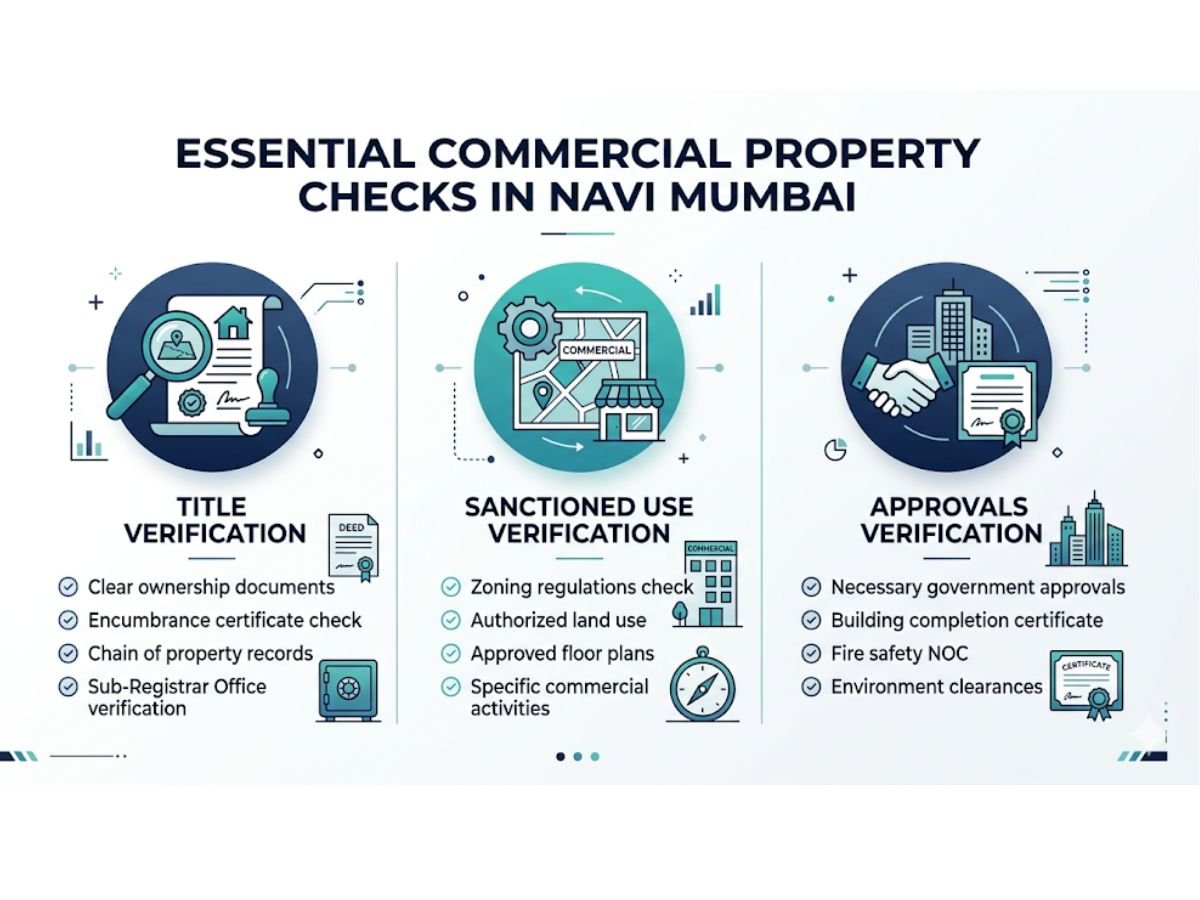
| What to check | Why it matters | Which record or authority helps | What red flag looks like |
|---|---|---|---|
| Title | Confirms the seller has the legal right to transfer the unit | Registered sale deed, Index II on IGR Maharashtra, CIDCO lease documents, title report | Seller shows only allotment paper, agreement copy, or incomplete chain |
| Sanctioned use | Confirms the unit is legally approved for commercial activity | Municipal sanctioned plan, property tax classification, project approvals | Unit is being used as office or shop, but records still show residential or unclear use |
| Approvals | Confirms the building and specific floor are legally sanctioned and fit for use | Commencement Certificate (CC), Occupancy Certificate (OC), MahaRERA disclosures | Part CC only covers lower floors, or possession is offered without OC |
| Transfer clearances | Confirms the leasehold transfer can actually happen without hidden dues | CIDCO transfer NOC, society no-dues, tax receipts | Seller pushes buyer to bear old transfer charges or avoids CIDCO clarity |
What does “title” actually mean in a Navi Mumbai commercial property deal?
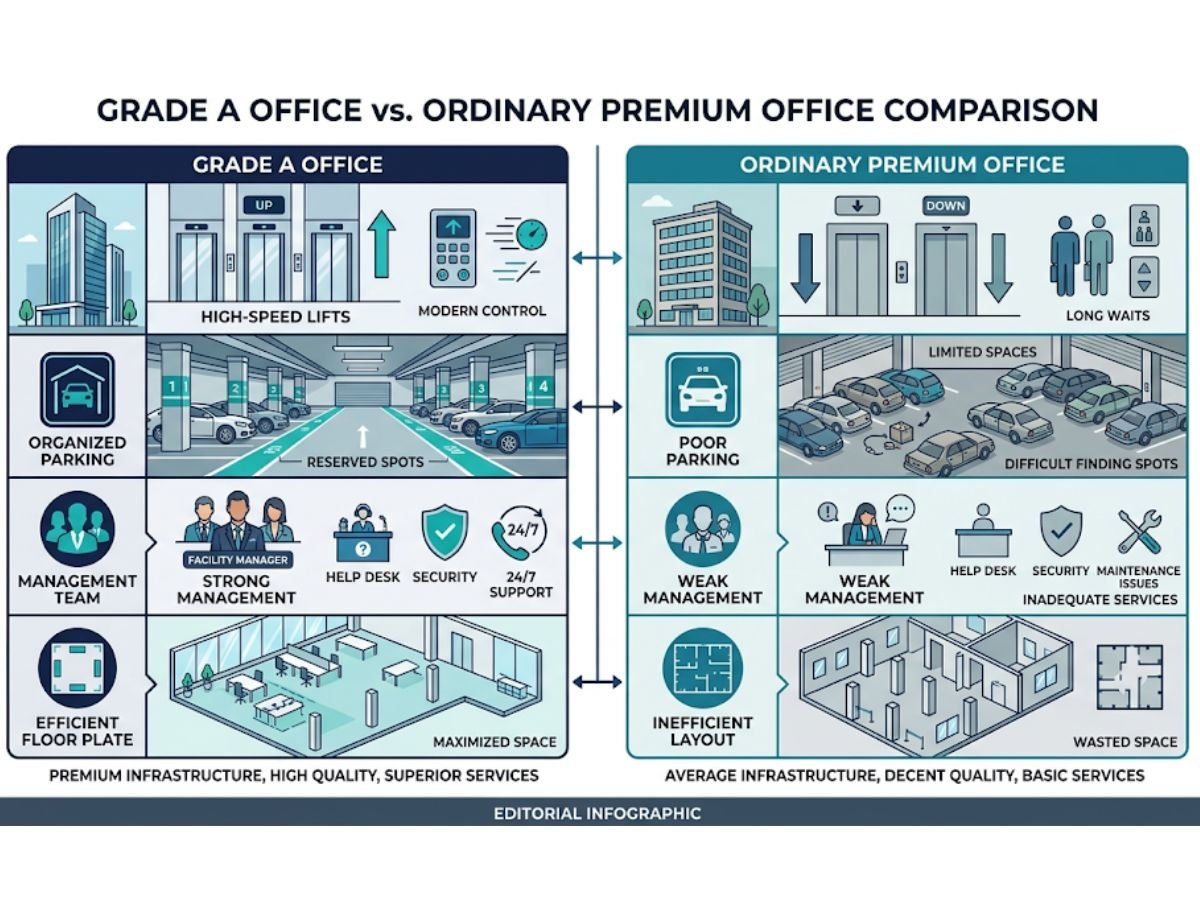
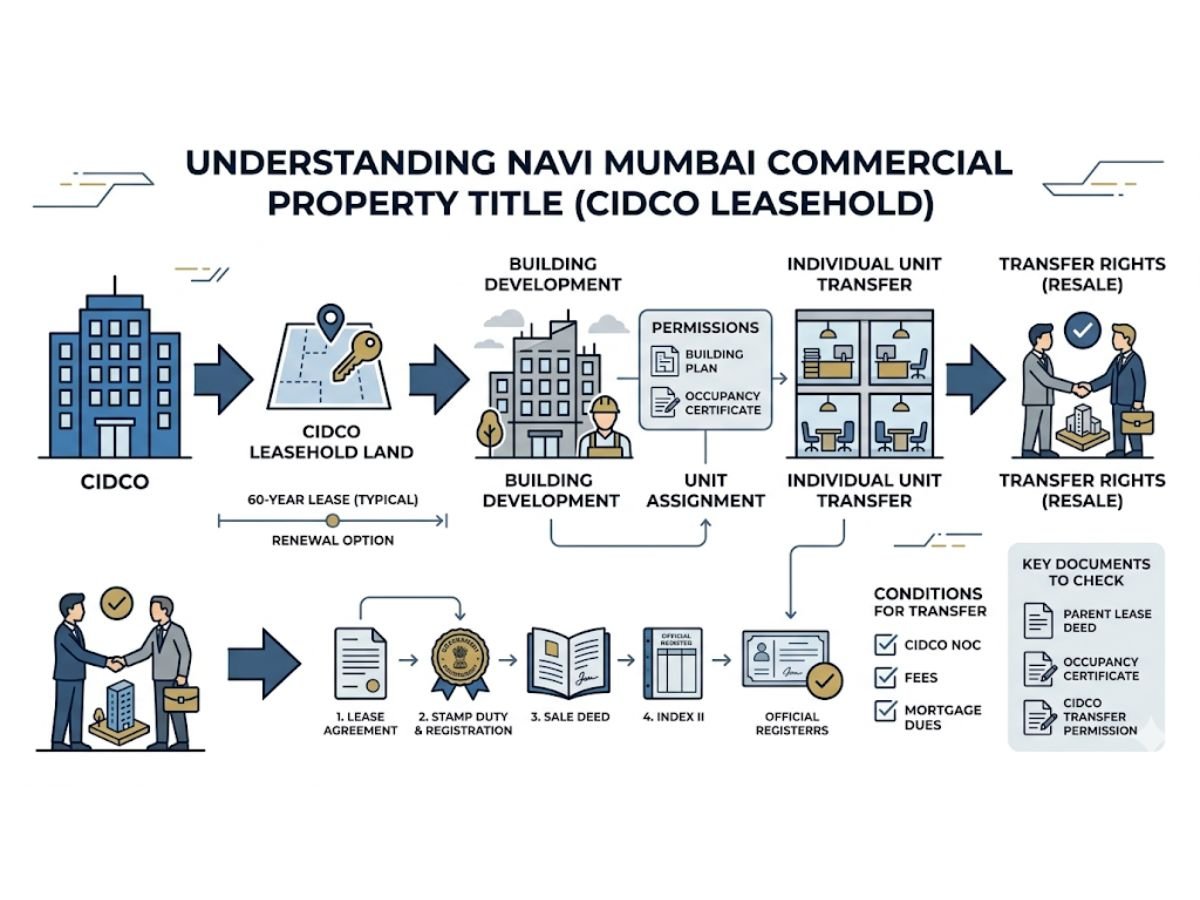
In Navi Mumbai, title usually does not mean classic freehold ownership in the way many buyers imagine it. In a large number of cases, the land is part of CIDCO-controlled leasehold structure, and the buyer is really dealing with leasehold rights and transfer rights, not absolute land ownership.
That changes the entire due diligence process.
A clean-looking sale deed alone is not enough. You have to understand whether the seller has a valid legal chain, whether the property can actually be transferred, and whether any authority-side conditions are still hanging over the unit.
Land title, building title and unit transfer are not the same thing
This is where many normal buyers get confused.
A builder may have rights over the larger plot. A building may be standing on that plot. A unit may be sold inside that building. But your risk sits at the unit transfer level. You are not buying a marketing story. You are buying a specific office, shop, showroom, or gala with a specific unit number on a specific floor.
So while checking commercial property title in Navi Mumbai, match these things carefully:
- seller name on the current registered document
- unit number and floor on the registered document
- Index II entry on IGR Maharashtra
- whether the unit forms part of a legally transferable structure
- whether older transfer dues or permission issues are unresolved
Why CIDCO leasehold changes the way title should be read
CIDCO is not a small side detail in Navi Mumbai. It is often the central legal layer behind the land itself. That means transfer, mortgage creation, major changes, and assignment of leasehold rights can depend on CIDCO conditions and NOC mechanics.
This is also where hidden financial shocks happen. As per the research dossier, CIDCO transfer charges were revised from April 1, 2025, and for commercial properties the impact can be serious. These charges are date-sensitive and can change again, but the main practical lesson is simple: never assume resale cost ends with stamp duty and registration. In some commercial transactions, old or current transfer charges can run into very large amounts.
For 12.5% scheme or PAP-linked plots, title checking becomes even more sensitive. There, the Tripartite Agreement chain may be critical. If that chain is weak, unclear, or incomplete, the deal deserves much deeper scrutiny.
Which papers should you ask for first before checking anything else?
Do not ask for “all documents” in a vague way. Ask for the minimum set that lets you test the property quickly and intelligently.
For most commercial property legal checklist work in Navi Mumbai, these are the first papers worth asking for.
Minimum papers for under-construction or recent builder inventory
Ask for:
- MahaRERA registration details
- latest sanctioned plan stamped by the approving authority
- active Commencement Certificate covering the exact floor of your unit
- title report or title search report
- draft agreement for sale
- project layout showing the exact unit and its use
Why this matters: under-construction risk is not just delay. In Navi Mumbai, one of the real traps is buying on a floor that is being marketed confidently, but the active CC does not actually cover that floor yet.
Minimum papers for resale commercial units in older buildings
Ask for:
- current registered sale deed
- older chain documents where relevant
- Index II copy from IGR Maharashtra
- Occupancy Certificate
- CIDCO transfer NOC or transfer clarity, where applicable
- society share certificate, if society structure applies
- society no-dues letter
- recent NMMC or PMC property tax receipt
- proof that the exact unit matches the current occupation pattern
For resale, the risk is often not future permission but old baggage. Missing transfer dues, unclear modifications, old mezzanine additions, mixed-use confusion, and gaps in document chain are more common here.
How do you check whether the property is actually approved for commercial use?
This is the part most people get wrong.
A unit can be functioning like a commercial property and still not be legally sanctioned for commercial use. That is the harsh reality. A lower-floor flat may be running as a clinic, consultancy, or office for years, but that physical reality does not automatically make it a legal commercial unit.
A unit being used as an office does not automatically make it approved commercial
This is the most dangerous assumption in mixed-use or older buildings.
If the building plan, zoning logic, or municipal classification does not support that use, then current activity is just current activity. It is not legal proof. This matters even more where customer footfall, staff entry, signage, inventory movement, or regular business operations are involved.
In Navi Mumbai, that can create trouble later through:
- society objections
- municipal action
- tax mismatch
- resale difficulty
- lender hesitation
- compliance trouble during fit-out or licensing
Where sanctioned use appears in plans, approvals and occupancy records
To check sanctioned commercial use properly, match the unit against:
- sanctioned architectural plan
- approved unit description such as shop, office, commercial, showroom, storage, residential
- municipal tax classification where available
- project disclosure documents on MahaRERA for under-construction inventory
A very practical local clue is the municipal tax side. The dossier notes that NMMC property tax classification can act as a useful backdoor check. If a unit is being used as a commercial office but is assessed and billed like a residential property, that deserves very careful scrutiny.
Shops, offices, showrooms, service spaces and mixed-use confusion
Not every commercial-looking unit is the same legally.
A shop with public footfall, an internal office, an IT/ITES unit, and a service-commercial unit can sit under very different restrictions. For example, in IT Parks or SEZ-style IT/ITES environments in areas like Mahape or Airoli, the space may look like general commercial inventory, but sanctioned use may be tied to IT or ITES activity. That means a general retailer or unrelated business may not automatically fit the legal use framework.
Caution
A commercial unit is not legal just because:
- a broker says “everyone is doing business here”
- there is already a tenant inside
- the tower looks premium
- the society has tolerated the use for years
You still need the papers to match the use.
Which approvals matter most, and what does each one actually prove?
| Document | What it proves | What it does not prove | Common trap |
|---|---|---|---|
| MahaRERA registration | Project is disclosed and monitored at the regulatory level; certain project documents are available | Does not prove every marketed unit or floor is cleared for your specific use | “RERA registered” is used like a blanket safety claim |
| Commencement Certificate (CC) | Construction is legally allowed up to a specific stage or floor | Does not prove possession readiness or full building completion | Buyer books upper-floor office while active CC only covers lower floors |
| Sanctioned plan | Legal layout, approved dimensions, and intended use of units | Does not prove actual construction exactly followed the plan | Brochure shows extra space or altered layout not found in approved plan |
| Occupancy Certificate (OC) | Building is completed as per approvals and legally fit for occupation/use | Does not by itself prove seller title is clean or transfer-ready | Builder offers fit-out possession without OC |
| Title report / title search | Helps assess chain and legal rights over land or unit | Does not by itself prove sanctioned use or physical compliance | Buyer assumes “title clear” means everything else is also fine |
Which authority matters here: CIDCO, NMMC, PMC or MahaRERA?
In Navi Mumbai, many buyers fail because they ask the right question to the wrong authority.
The system becomes much easier once you understand what each authority actually controls.
When CIDCO records become central
CIDCO matters most where the underlying land or leasehold rights are tied to CIDCO allotment and transfer conditions. In such cases, title checking is incomplete without understanding:
- leasehold status
- transfer permissions
- NOC requirement
- old unpaid transfer charges
- PAP or 12.5% scheme background where applicable
CIDCO is not replacing municipal approval checking. It is a different layer. One layer may be fine while the other is not.
When local municipal approval records matter more
For building permissions, sanctioned construction, OC, property tax classification, and many practical use questions, the municipal side becomes central.
As per the dossier:
- NMMC generally governs established nodes such as Vashi, Nerul, Belapur, Airoli, Ghansoli, Koparkhairane
- PMC generally governs growth corridors such as Panvel, Kharghar, Taloja, Kamothe, Kalamboli
This matters because approval trail, tax record, and ground-level verification route can differ depending on which side the property falls on.
What MahaRERA can help you verify and what it cannot settle fully
MahaRERA is useful, especially for builder inventory. It helps you inspect project-level disclosures such as sanctioned plans, title-related uploads, and construction progress records.
But it is not a substitute for:
- title verification
- sanctioned use matching at the unit level
- CIDCO transfer clarity
- floor-specific CC checking
- physical verification of alterations
In short, MahaRERA is a very useful disclosure layer, not a complete local authority replacement.
How should buyers verify title and approvals differently in builder sale vs resale sale?
The process changes a lot depending on whether you are buying fresh inventory or old resale stock.
In a builder sale, your biggest risk is often future legality. In a resale deal, your biggest risk is often past baggage.
For a builder sale, focus more on:
- whether the exact floor is covered under active CC
- whether sanctioned use matches how the unit is marketed
- what MahaRERA disclosures show
- whether the draft agreement shifts future charges unfairly
For a resale unit, focus more on:
- Index II and chain of title
- old CIDCO transfer issues
- society and tax dues
- old illegal changes inside the unit
- whether actual built form matches approved form
This is where many buyers make a serious mistake. They use the same short checklist for both. That is not enough. A ready resale office in an older building in Nerul is not checked the same way as a newly launched office in Kharghar or Taloja.
What are the most common red flags in Navi Mumbai commercial property transactions?
Some red flags are generic. Some are very Navi Mumbai-specific. These are the ones that deserve real attention.
1) The mezzanine trap
A gala or shop may be sold with a loft or mezzanine that looks like extra usable area and therefore extra value. But if that mezzanine is not in the sanctioned plan, it may be an unauthorized structure.
That matters because, as noted in the dossier, illegal mezzanine structures are not something you should casually assume can be regularised later. In practical terms, treat such additions as risk, not bonus area.
2) Transfer charge shock
In a leasehold-heavy market, title is not just about ownership. It is also about transfer cost. If a seller has not clearly worked out CIDCO transfer liability, the buyer can get a nasty shock later.
This is especially important after the April 2025 revision in commercial transfer charges, which the dossier describes as significant and date-sensitive.
3) “Commercial use” without commercial sanction
This is common in mixed-use buildings and some older stock. The unit operates like a business space, but the records are not fully aligned.
4) Part CC but full-confidence marketing
A polished sales office can sell a future office floor very confidently. The paper trail may say something else.
5) Project-level approval shown, unit-level mismatch hidden
The building may be generally approved, but the exact unit, floor, use category, or built form may still have issues. Buyers who stop at project-level comfort miss this.
How to do a practical document match before paying token money
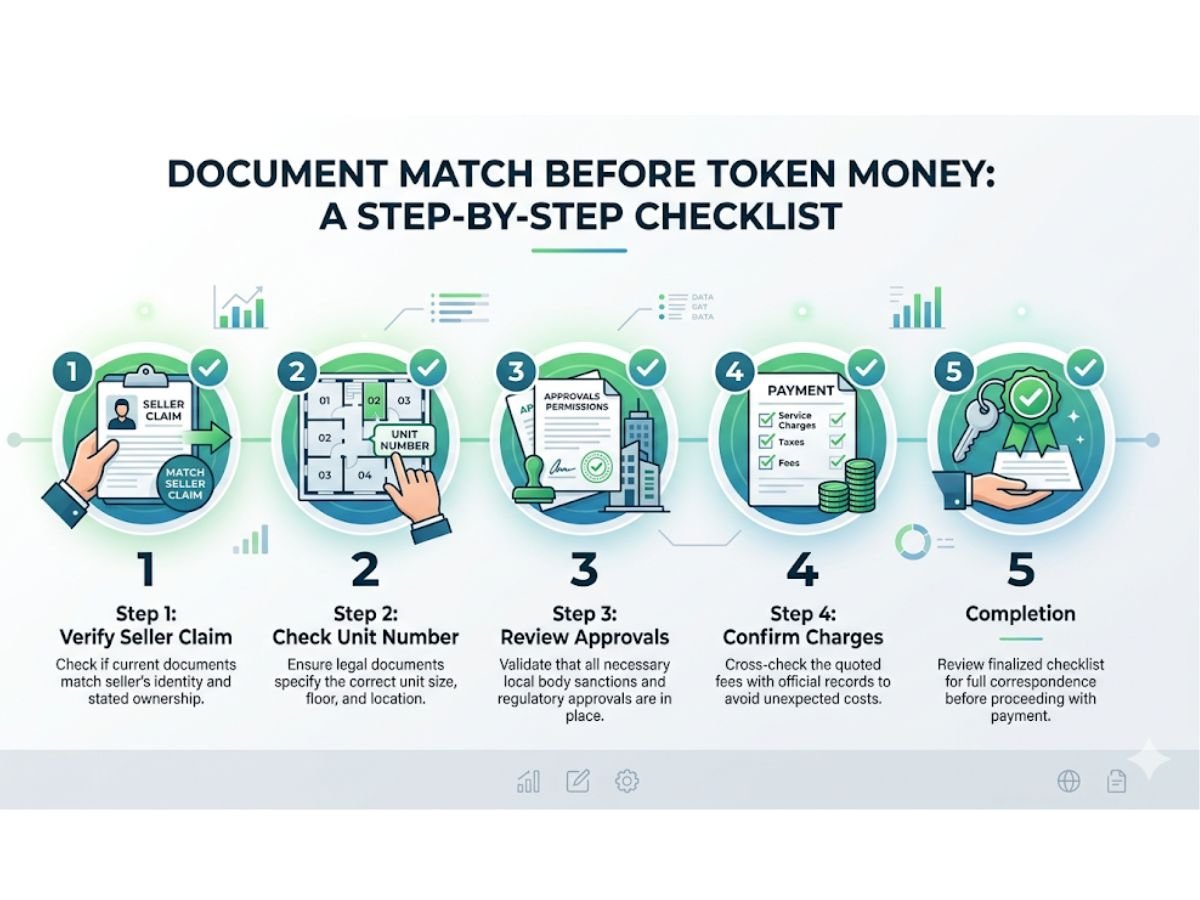
This is the most useful part of the process. Before token money, do a direct four-step match.
1) Match the seller’s claim to the exact document
If the seller says:
- “This is a legal office”
- “This is approved retail”
- “This is a proper showroom”
- “This floor is fully sanctioned”
then ask: Which exact document proves that?
Do not accept verbal comfort. Make the seller point to the document.
2) Match the exact unit number, floor and use
Now check whether the exact unit number and floor match across:
- sanctioned plan
- CC
- draft agreement or sale deed
- project layout
- actual physical unit
Even one mismatch here is a reason to slow down sharply.
3) Match the authority trail and current physical reality
If the unit is shown as office, does the plan say office? If it is on the 15th floor, does the active CC cover that level? If it is ready for use, does the building have OC? If it is a resale asset, does Index II support the seller’s claim?
This matching logic sounds simple, but it saves people from very expensive mistakes.
4) Match the legal story to the money story
Before token payment, ask one more hard question: What charges, dues, premiums, or NOCs still remain before a clean transfer can happen?
This matters because some deals look cheap only until the authority-side and transfer-side costs surface.
Does location or node change the approval risk in Navi Mumbai?
Yes, but not in a broad “every area is different” way. The real point is that the risk pattern changes.
In older, more established NMMC-side nodes such as Vashi, Nerul, Belapur, or Koparkhairane, the common problems are often:
- old internal modifications
- outdated paperwork presentation
- society-level restrictions
- building age-related risk
- illegal additions over time
In growth-side corridors such as Kharghar, Taloja, Kamothe, Panvel, Kalamboli, the common problems can lean more toward:
- builder-stage approval gaps
- Part CC dependence
- under-construction exposure
- title complexity in certain land backgrounds
- marketing running ahead of document comfort
That does not make one side safer than the other. It just means your checking angle changes.
When should you involve a property lawyer, architect or technical verifier?
A buyer can do the first level of filtering. But some cases should not be handled casually.
Situations where self-check is not enough
Bring in a good local property lawyer when:
- the property sits on 12.5% or PAP-linked land
- CIDCO leasehold chain looks complicated
- the document chain feels broken or too thin
- the agreement pushes future charges unfairly
- seller story and paper story are not matching
Bring in an architect or technical verifier when:
- the unit is in an older building
- you suspect unauthorized changes
- mezzanine, loft, or layout changes are involved
- you want to compare actual built form with sanctioned plan
What each professional should verify
A lawyer should check the legal chain, transferability, leasehold issues, encumbrances, and agreement risk.
A technical verifier or architect should check whether the actual unit on the ground matches the sanctioned and approved version of that unit.
Those are two different jobs. Buyers often combine them mentally. They should not.
Conclusion
Not every missing paper means automatic rejection on day one. But every missing paper does mean stop, verify, and do not move emotionally.
For commercial property in Navi Mumbai, the safe rule is simple: do not proceed until title, sanctioned use, and approvals align for the exact unit being sold. That means the seller’s right must be clear, the use must be legally commercial, and the building and floor must be covered by the right approvals. If even one of those three layers is weak, the property may still look attractive on site, but the transaction is not yet safe.
In this market, a polished building, an active business, or a confident broker is not enough. The document trail is the real property.
FAQs
Frequently Asked Questions