
Mahape vs Pawane for Industrial Users: Which MIDC Area Fits Your Business?
Mahape is usually better for electronics-linked units, light assembly, IT/back-end operations, industrial offices, and businesses that need a cleaner client-facing image around MBP and the Electronic Zone. Pawane is usually better for functional industrial users such as fabrication, packaging, warehousing, repair/service units, chemical-linked operations, and cost-sensitive occupiers. The final choice should depend on permitted use, power load, road width, loading access, fire safety, MPCB compliance, rent, and building condition.
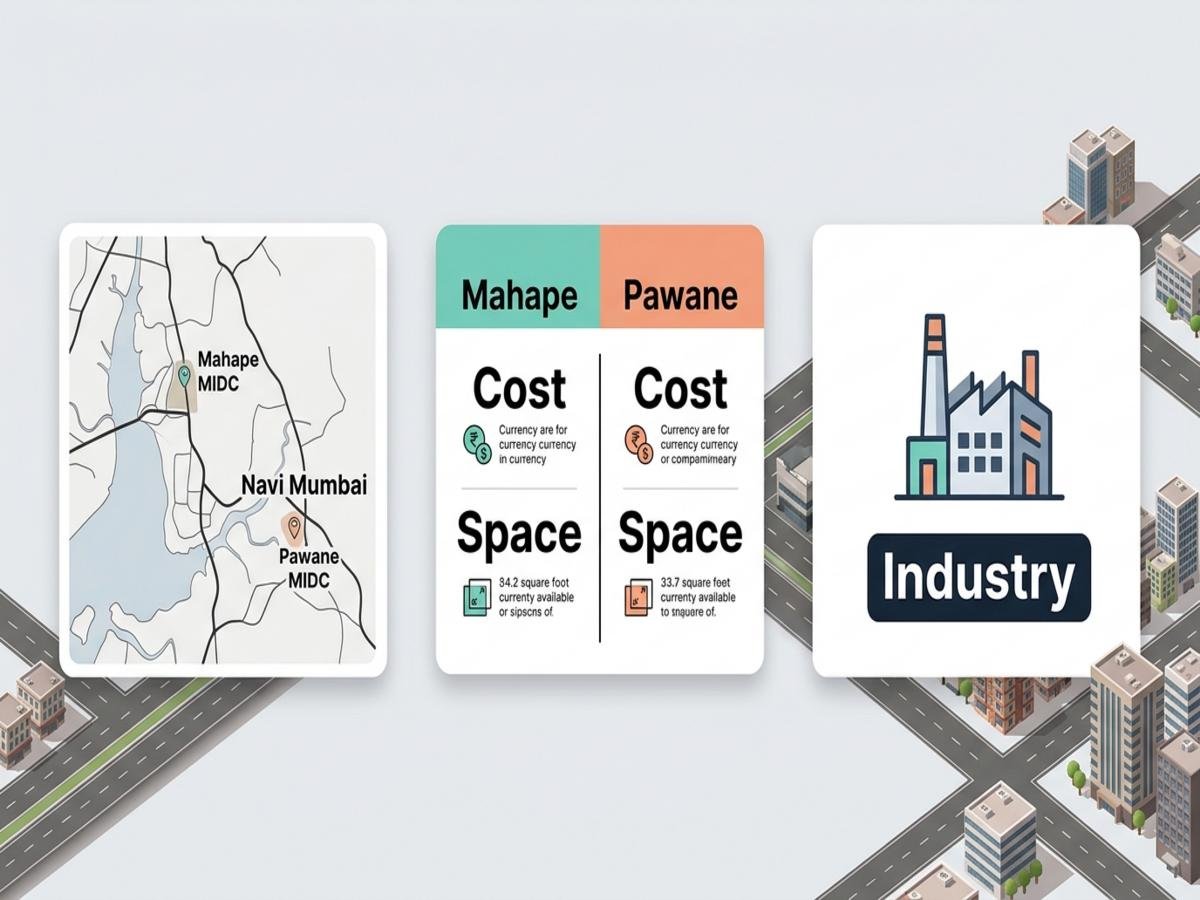
Quick Verdict: Mahape vs Pawane for Industrial Users
| Requirement | Better Fit | Practical Reason |
|---|---|---|
| Electronics, ESDM, testing, light assembly | Mahape | Better fit around Electronic Zone, MBP-side ecosystem, and cleaner office-industrial use |
| IT, ITES, back-end operations, office-industrial teams | Mahape | Better corporate environment and stronger white-collar suitability |
| Fabrication, repair, packaging, workshop-style operations | Pawane | More functional industrial ecosystem with older factory and shed availability |
| Warehousing and goods movement | Pawane | Better suited for loading, unloading, truck access, and storage-led use in many pockets |
| Chemical or pollution-linked activity | Pawane, but only after strict checks | Existing ecosystem exists, but MPCB, CETP, ZLD, fire, and storage compliance are critical |
| Investor-owned industrial property | Depends on the asset | Tenant quality, title, NMMC dues, MIDC transfer status, and compliance matter more than the area name |
The simple rule is this: if your business moves people, data, clients, and light components, Mahape usually makes more sense. If your business moves raw material, machinery, freight, chemicals, or bulky stock, Pawane is often more practical.
Is Mahape or Pawane Better for Industrial Users?
Mahape and Pawane both fall within the broader TTC industrial belt of Navi Mumbai, but they do not serve the same kind of industrial user. Treating both areas as equal MIDC locations is the first mistake many buyers and tenants make.
Mahape has a stronger identity around electronics, light industrial use, IT/ITES, back-end operations, and hybrid office-industrial properties. The presence of Millennium Business Park, Electronic Zone, data-centre and technology-linked activity has shaped the area differently from a traditional factory belt.
Pawane, on the other hand, feels more like a working industrial pocket. It is more suitable for businesses where the daily requirement is not presentation but function: movement of goods, machinery, loading bays, fabrication, packaging, storage, repair activity, and industrial services.
So the answer is not “Mahape is better” or “Pawane is better.” The correct answer is: Mahape is better for cleaner, people-heavy, client-facing, and electronics-linked operations. Pawane is better for machine-heavy, goods-heavy, workshop-style, and functional industrial operations.
What Type of Industrial User Fits Mahape Better?
Mahape works best for businesses that need an industrial address but cannot operate comfortably in a rough, heavy-industrial environment. It is stronger when the business has a mix of office staff, technical teams, testing work, assembly, client meetings, and vendor coordination.
Electronics, ESDM, and Light Assembly Units
Mahape is a better fit for electronics, embedded systems, testing labs, small assembly setups, automation firms, hardware support companies, and clean light-industrial operations. These users usually need stable power, controlled workspace, technical staff access, and a cleaner surrounding environment.
A business dealing with delicate components may not want the dust, odour, heavy vehicle disturbance, and high-risk adjacent activity found in some older heavy-industrial pockets. Mahape’s Electronic Zone and MBP-side business environment make it more suitable for such occupiers.
However, Mahape should not be selected blindly. A unit may look polished from outside but still fail on floor loading, power load, ceiling height, internal access, or permitted use. A 5,000 sq. ft. RCC gala and a 5,000 sq. ft. ground-floor industrial shed are not the same asset.
Back-End Operations and Industrial Office Teams
Mahape is also suitable for companies that run back-end support, engineering services, IT support, industrial design, product testing, service coordination, technical documentation, or operations teams connected to manufacturing.
These businesses need an address that employees can reach without too much friction. Access from Ghansoli, Kopar Khairane, Airoli, and the Thane-Belapur Road belt gives Mahape an advantage for staff movement. For teams with office employees, women staff, client visits, and regular meetings, this can matter more than a slightly lower rent.
Businesses That Need Better Client-Facing Image
Some industrial users need a practical space, but they also meet clients, auditors, bankers, international buyers, or corporate vendors. For such businesses, Mahape often feels more presentable than Pawane.
This does not mean Mahape is “premium” in every lane. Some buildings are old, some internal roads are narrow, and some properties have maintenance issues. But compared to Pawane’s heavier industrial character, Mahape is usually easier to position for clean operations and office-industrial use.
For example, an industrial automation company that needs a small assembly area, testing benches, service engineers, and client demos may prefer Mahape. A heavy metal fabrication unit with welding, raw material stock, and constant loading may not.
What Type of Industrial User Fits Pawane Better?
Pawane is more suitable when the business needs a functional industrial ecosystem rather than an office-led environment. It is a stronger fit for occupiers who judge property by ground-floor usability, loading access, power capacity, shed condition, material movement, and permission for the intended activity.
Fabrication, Packaging, Repair, and Service-Industrial Units
Fabrication units, packaging units, machinery repair workshops, service-industrial operators, and similar businesses often find Pawane more practical. These businesses usually need usable industrial floors, easier goods handling, tolerance for noise, and access to other industrial vendors.
Pawane’s ground reality is more rugged. That can be a disadvantage for a corporate visitor, but it can be useful for a business that simply needs the operation to run smoothly.
A workshop owner may not care whether the lane looks polished. He will care whether material can be unloaded, whether the power load is enough, whether the roof leaks during monsoon, whether labour can reach, and whether the landlord can provide proper documents.
Warehousing and Material Movement Users
For warehousing, storage, distribution, and goods movement, Pawane is often a stronger fit than Mahape. Many warehouse users need larger frontages, better loading-unloading space, and more forgiving movement for tempos and trucks.
A warehouse is not useful only because the covered area is large. It must allow vehicles to enter, reverse, load, unload, and leave without daily chaos. For large vehicles, turning radius becomes a real business issue, not a technical detail. A 40-foot trailer may need an outer turning radius of around 12.4 metres. If the internal road or gate approach cannot support that movement, the “warehouse” becomes operationally weak.
Cost-Sensitive Factory Occupiers
Pawane can also work better for cost-sensitive users, but this point needs caution. Lower rent is useful only if the property does not create hidden costs.
An old shed may need roof repair, electrical upgrade, floor strengthening, water storage, drainage correction, fire compliance work, or heavy maintenance. A cheap property can become expensive after occupation if the user signs before checking the basics.
This is very common in industrial real estate. The rent looks attractive during the first visit. The real cost appears after machinery shifting, power application, leakage repair, staff complaints, and compliance notices.
Mahape vs Pawane: Business Suitability Comparison
| Business Type | Better Fit | Why It Fits Better | What to Check Before Finalising |
|---|---|---|---|
| Electronics and embedded systems | Mahape | Better clean-industrial environment and Electronic Zone linkage | Power load, testing setup permission, ventilation, floor loading |
| Light assembly | Mahape | Suitable for small assembly with office and technical staff | Permitted use, goods lift, loading access, electrical capacity |
| IT/ITES and back-end operations | Mahape | Better fit near MBP and office-industrial ecosystem | Parking, lift, backup power, staff commute, commercial/industrial use clarity |
| Industrial automation and testing labs | Mahape | Works well for technical teams and client-facing operations | Power quality, safety approvals, equipment load, fire compliance |
| Fabrication and workshop activity | Pawane | More practical for heavier industrial work | Floor strength, crane/hoist option, noise tolerance, fire safety |
| Packaging and repair units | Pawane | Functional space and industrial surroundings are more suitable | Loading bay, storage permission, labour access, water/drainage |
| Warehousing and distribution | Pawane | Better for goods movement in many pockets | Road width, trailer turning, loading space, truck timing, parking |
| Chemical-linked operations | Pawane, with caution | Existing heavy-industrial ecosystem, but high compliance burden | MPCB CTE/CTO, ZLD requirement, fire NOC, storage rules, CETP access |
| Small corporate industrial office | Mahape | Better client and staff comfort | Building maintenance, parking, lift, mixed-use permission |
| Investor-owned leased industrial unit | Depends | Mahape may suit stable office-industrial tenants; Pawane may suit functional SME tenants | MIDC transfer, NMMC tax dues, tenant use, lease terms, property condition |
Which Area Has Better Connectivity for Workers, Vendors, and Goods Movement?
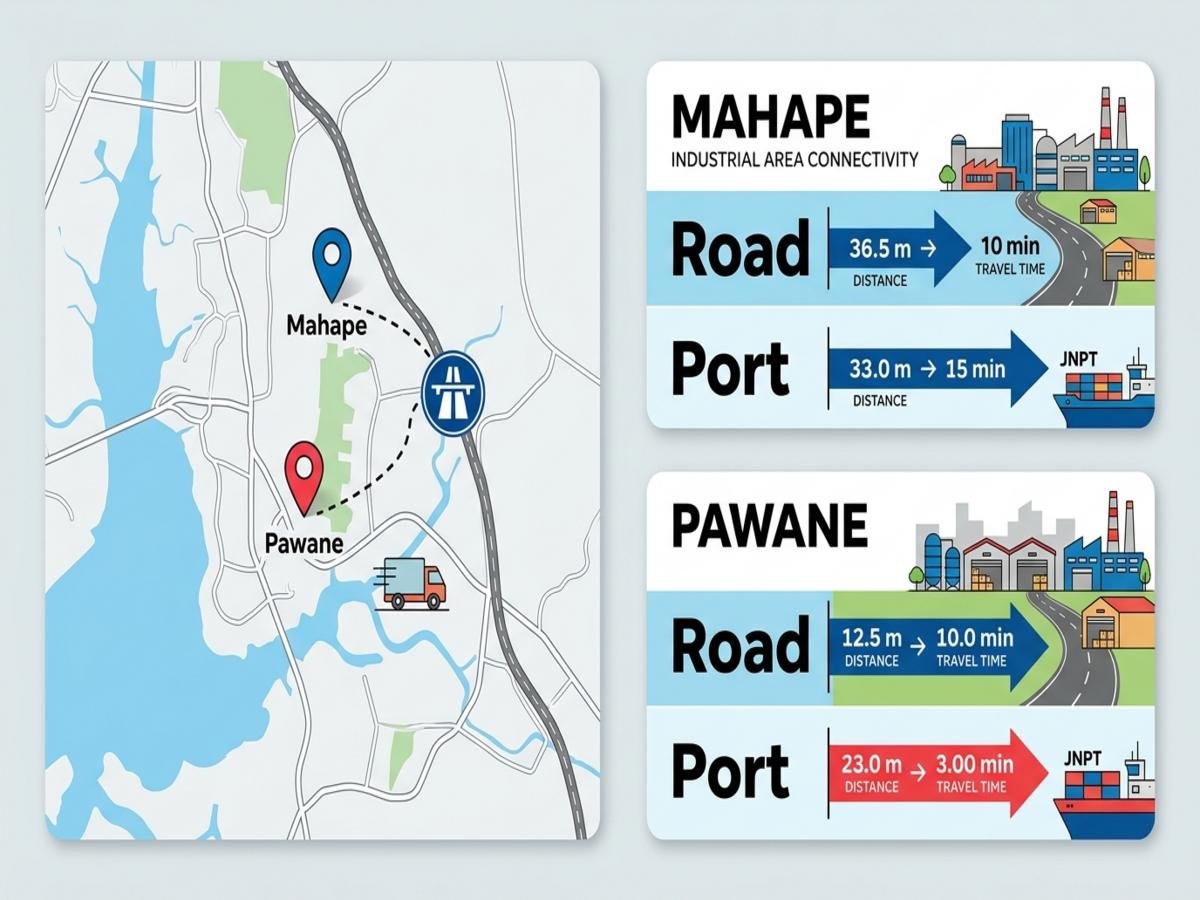
Mahape is generally better for employee movement and corporate access. Pawane is generally better for freight-led industrial movement. This is the cleanest way to understand connectivity between the two.
Both areas depend heavily on the Thane-Belapur Road industrial belt. Both connect with the wider Navi Mumbai, Thane, Mumbai, Turbhe, Ghansoli, Kopar Khairane, Airoli, and Sion-Panvel side movement in different ways. But the type of movement is not the same.
Employee Commute and Station Access
Mahape has an advantage for staff-heavy businesses because of its access to Ghansoli, Kopar Khairane, Airoli-side movement, and the MBP office ecosystem. For white-collar teams, technical staff, back-end employees, and client-facing teams, this matters.
A business may save money by choosing a rougher industrial pocket, but if employees find the commute unsafe, unpleasant, or inconvenient, retention becomes harder. This is especially important for companies with office staff, female employees, client servicing teams, or longer working hours.
Truck, Tempo, and Loading Movement
Pawane performs better for many goods-heavy users because its industrial character is more aligned with vehicle movement, storage, loading, and unloading. This does not mean every Pawane lane is perfect. Some pockets still need careful checking. But for freight-heavy use, Pawane is usually more logical than Mahape.
Mahape can become difficult for businesses that need daily movement of large trucks, repeated dispatches, or bulky material. Internal lanes, parked vehicles, office traffic, and tighter property approaches can create delays.
Client and Vendor Visit Convenience
Mahape is usually better when client visits matter. Pawane is better when vendor and material movement matter.
A company inviting corporate clients, auditors, buyers, or technology partners may find Mahape easier to present. A company receiving raw material, dispatching goods, repairing machinery, or coordinating with industrial suppliers may find Pawane more useful.
This is where many decisions go wrong. Owners compare rent, not workflow. In industrial real estate, workflow decides the real cost.
Which Area Gives Better Property Options: Shed, RCC Building, Warehouse, or Office-Industrial Unit?
Mahape and Pawane offer different property personalities. Mahape has more relevance for RCC buildings, office-industrial units, IT-park style spaces, and light industrial modules. Pawane has stronger relevance for ground-floor sheds, older factory structures, larger storage spaces, and functional industrial units.
For Mahape, the buyer or tenant must check whether the unit is actually suitable for machinery, testing, assembly, or storage. A neat-looking RCC unit may not allow heavy equipment. Floor loading, vibration tolerance, power load, ventilation, goods lift, and fire exit design should be checked carefully.
For Pawane, the main questions are different. Is the shed structurally sound? Does the roof leak? Is there enough height? Can material be unloaded? Is the floor strong enough? Is the electrical load already sanctioned? Are fire and MPCB requirements clear?
Do not compare only square footage. In industrial property, 10,000 sq. ft. with poor access can be worse than 6,000 sq. ft. with proper loading and compliant use.
Where Do Compliance Risks Matter More: Mahape or Pawane?
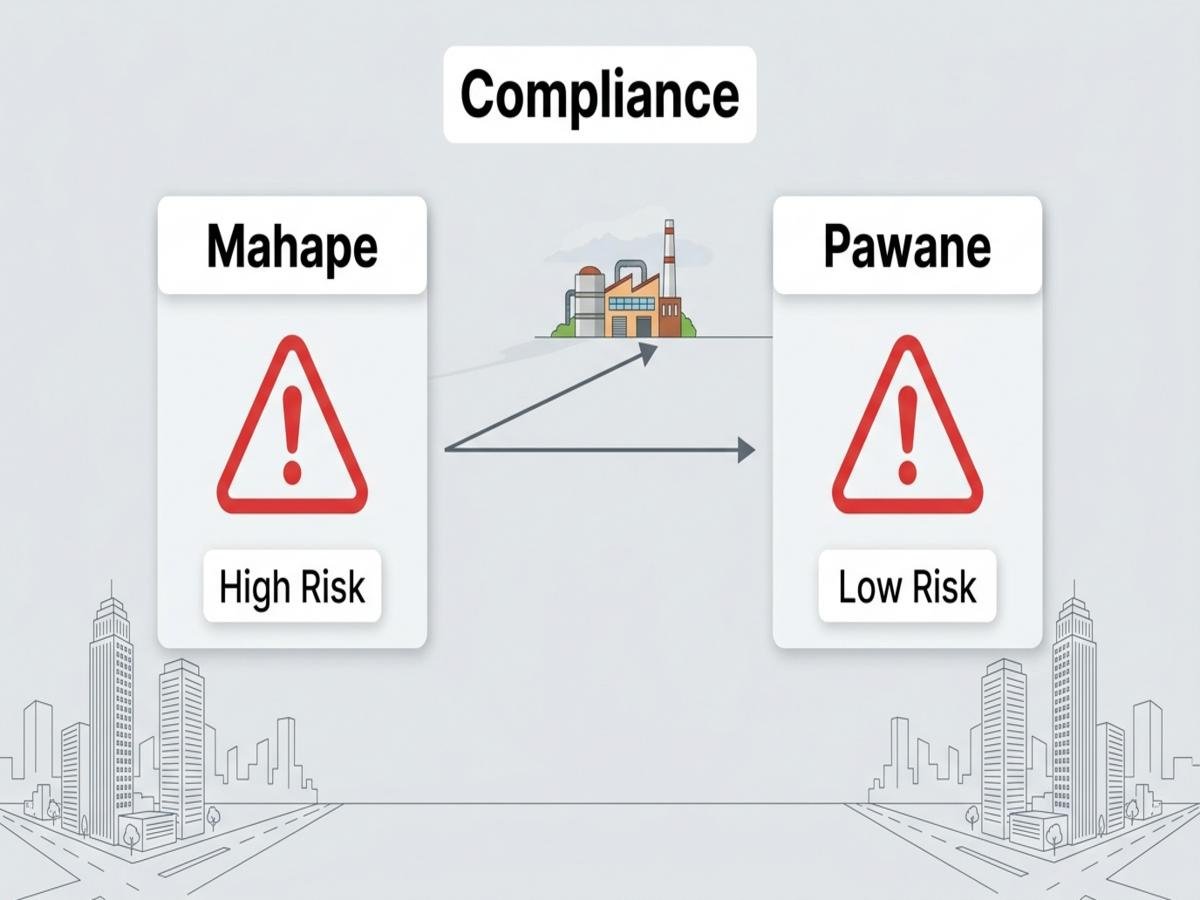
Compliance matters in both areas, but the risk pattern is different. Pawane generally carries higher environmental and fire-safety sensitivity because of chemical, processing, storage, and heavy-industrial activity in parts of the area. Mahape carries more risk around mixed use, building suitability, drainage, power load, and whether the actual activity matches the permission.
MIDC Use Permission and Transfer Conditions
Industrial users should not assume that any activity can be done inside any industrial unit. MIDC permitted use, lease conditions, transfer status, and actual sanctioned use must be checked before payment.
This is especially important for buyers. Industrial plots in the MIDC ecosystem are typically leasehold assets. Assignment, transfer, dues, and permissions can affect the real transaction cost. The dossier indicates that ULC-related transfer fees may apply at 25% of the prevailing Ready Reckoner rate for industrial plots in relevant cases. This can change investor calculations significantly.
MPCB Consent for Pollution-Linked Activities
For pollution-linked activities, MPCB compliance is not optional. Consent to Establish and Consent to Operate depend on the actual industrial process, effluent volume, category, and compliance status.
This is a major Pawane-side issue because many users look at Pawane for chemical-linked, processing, or heavy industrial activity. The TTC Common Effluent Treatment Plant capacity is stated at 27 MLD and is already under stress. For new polluting units, this may mean expensive Zero Liquid Discharge requirements instead of simple discharge into a common system.
That one point can change the entire budget. A property that looks affordable can become unviable if the occupier has to fund major environmental systems.
Fire Safety, Chemical Storage, and Adjacent-Unit Risk
Fire safety should be checked with extra seriousness in Pawane, especially if the unit is near chemical, storage, combustible material, or high-risk operations. The same applies to Mahape if the intended use involves electrical load, batteries, testing equipment, storage, or assembly.
Do not rent or buy only because another similar unit is operating nearby. Neighbouring activity does not prove legal permission for your activity. Your process, storage volume, machinery, and risk category must match the approvals.
Which Location Is Better for Warehousing and Logistics Users?
Pawane is usually better for warehousing and logistics users, especially when the business needs regular goods movement, loading-unloading, storage, and truck access. Mahape can work for small storage, service stock, spare parts, or light distribution, but it is not the first choice for heavy logistics.
The deciding factor is not only rent. It is movement.
A proper warehouse needs:
- usable road width,
- loading-unloading space,
- vehicle turning ability,
- parking or staging area,
- easy dispatch flow,
- safe entry and exit,
- enough height and floor strength.
If a 40-foot vehicle cannot comfortably reach the gate, reverse, and exit, the warehouse will create daily losses. Many tenants realise this only after shifting stock. By then, deposit, interiors, labour, and transport arrangements are already locked.
For small inventory or service stock connected to an office-industrial business, Mahape can work. For regular freight, bulky goods, dispatch-heavy operations, cold-chain style storage, packaging, and distribution, Pawane generally deserves priority.
Which Area Makes More Sense for Investors?
For investors, Mahape and Pawane offer different tenant profiles. Mahape may attract more office-industrial, electronics, IT-support, data, light assembly, and corporate back-end tenants. Pawane may attract functional SME tenants, warehouse users, industrial service companies, fabrication operators, and traditional manufacturing users.
The better investment is not the one in the more famous area. It is the one that can attract a compliant tenant and stay leased without major disputes.
Tenant Demand in Mahape
Mahape can be attractive for investors who want tenants with cleaner operations, office-style usage, technical teams, and longer-term business stability. Properties near MBP, Electronic Zone, and better access pockets may appeal to companies that need both industrial permission and a respectable business environment.
But the investor must check whether the building actually supports the tenant’s use. A polished unit with weak lift, poor parking, insufficient power, or unclear permissions can stay vacant or attract poor-quality tenants.
Tenant Demand in Pawane
Pawane can be attractive because functional industrial space is always in demand in the MMR region. Many SMEs need practical sheds, workshops, storage, and factory space. A compliant, well-maintained ground-floor unit with good access can remain valuable even if it is not glamorous.
However, Pawane investments require stricter due diligence. Fire safety, environmental risk, NMMC property tax dues, MIDC transfer status, water pressure, drainage, and old-building condition must be checked carefully.
Exit and Re-Leasing Risk
For both locations, re-leasing depends on practical usability. A property with clear documents, proper power load, usable access, and compliant activity options will have stronger demand.
Investors should be careful about legacy dues. The dossier highlights that NMMC has the authority to collect property tax from TTC MIDC units. Before buying or taking long lease rights, the buyer should verify NMMC property tax status, MIDC dues, water/drainage dues, and any pending liability. Ignoring this can turn a good-looking deal into a long headache.
When Should You Avoid Mahape?
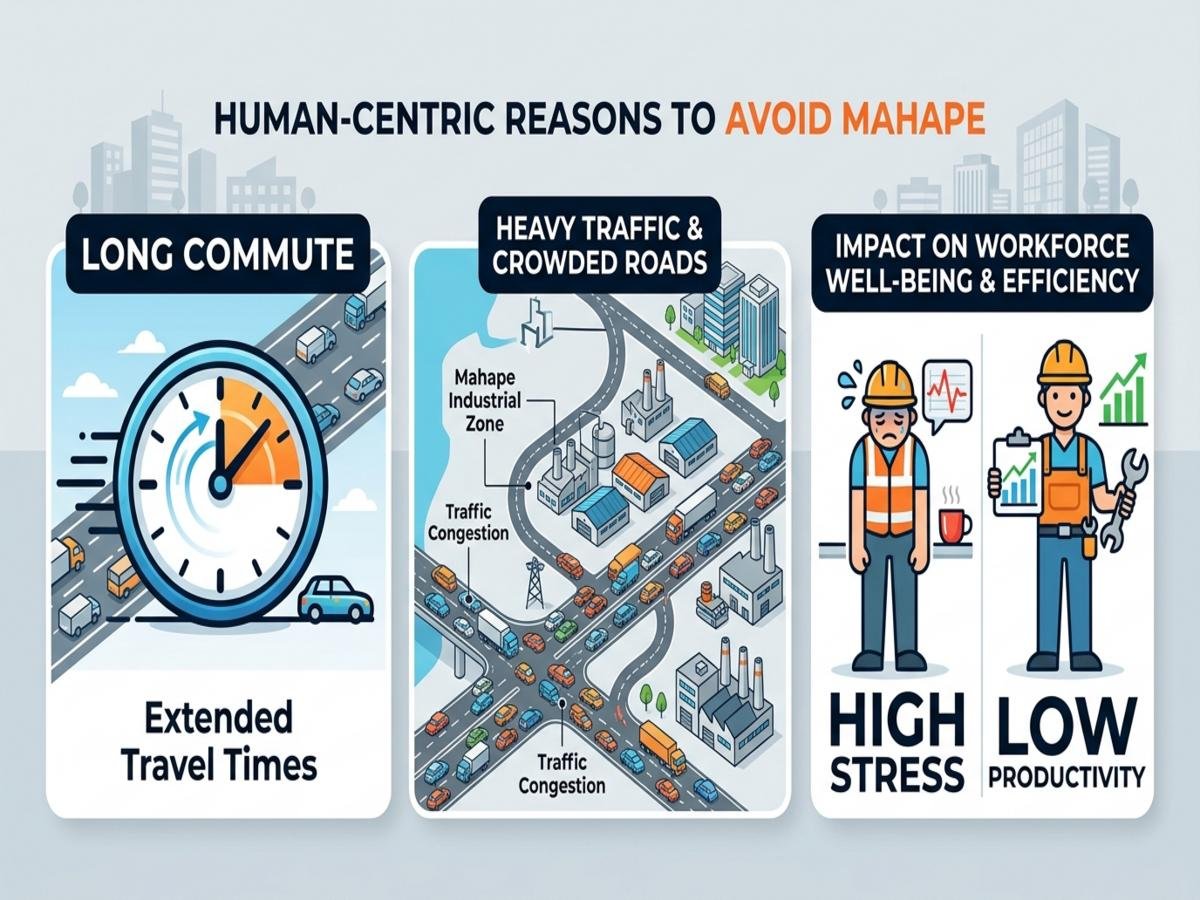
Avoid Mahape if your business mainly depends on heavy machinery, large freight, rough storage, chemical processing, or frequent movement of large trucks. Mahape may look better on paper, but it can become expensive if the property does not match the activity.
Mahape may not be suitable when:
- the unit is office-heavy but your business needs heavy loading,
- internal road access is weak,
- the building cannot handle machinery vibration or weight,
- the required power load is not available,
- the property has drainage or water-disposal limitations,
- the rent is high only because of location image, not practical utility.
Some Mahape pockets may also face localised monsoon waterlogging or drainage-related issues. This should be checked at the exact property level, especially near low-lying or historically affected junction-side pockets.
When Should You Avoid Pawane?
Avoid Pawane if your business needs a clean, polished, client-facing address or a high-density office environment. Pawane is useful, but it is not always comfortable for every type of team or visitor.
Pawane may not be suitable when:
- the business regularly hosts corporate or international clients,
- the operation needs a clean-room style environment,
- staff comfort and white-collar retention are major priorities,
- the building is old and poorly maintained,
- fire and MPCB documents are unclear,
- chemical-risk or adjacent-unit risk is high,
- the property is cheap mainly because of hidden repair or compliance issues.
A low-rent shed in Pawane can still be a bad deal if roof leakage, weak flooring, low water pressure, old wiring, poor fire access, or pending dues create operational trouble after occupation.
Property Visit Checks Before Choosing Mahape or Pawane
Before finalising any industrial property in Mahape or Pawane, the site visit should be treated as an operational audit, not a casual inspection.
Check the MIDC allotment, lease assignment chain, transfer status, permitted use, and any restrictions on the proposed activity. Ask for NMMC property tax receipts, MIDC dues, water and drainage dues, and proof that there are no major pending liabilities.
For the building, check power load, transformer capacity, ceiling height, floor loading, roof condition, water seepage, drainage, fire access, emergency exits, ventilation, goods lift or hoist provision, and loading-unloading space. During monsoon, ask specifically about waterlogging and past flooding history.
For pollution-linked activity, verify the MPCB category, Consent to Establish, Consent to Operate, effluent disposal method, ZLD requirement if applicable, and whether the existing infrastructure can legally support the process.
For warehousing, do not decide from the carpet area alone. Physically check whether trucks and tempos can enter, turn, reverse, unload, and leave without blocking the lane.
Final Decision: Mahape or Pawane Which One Should You Choose?
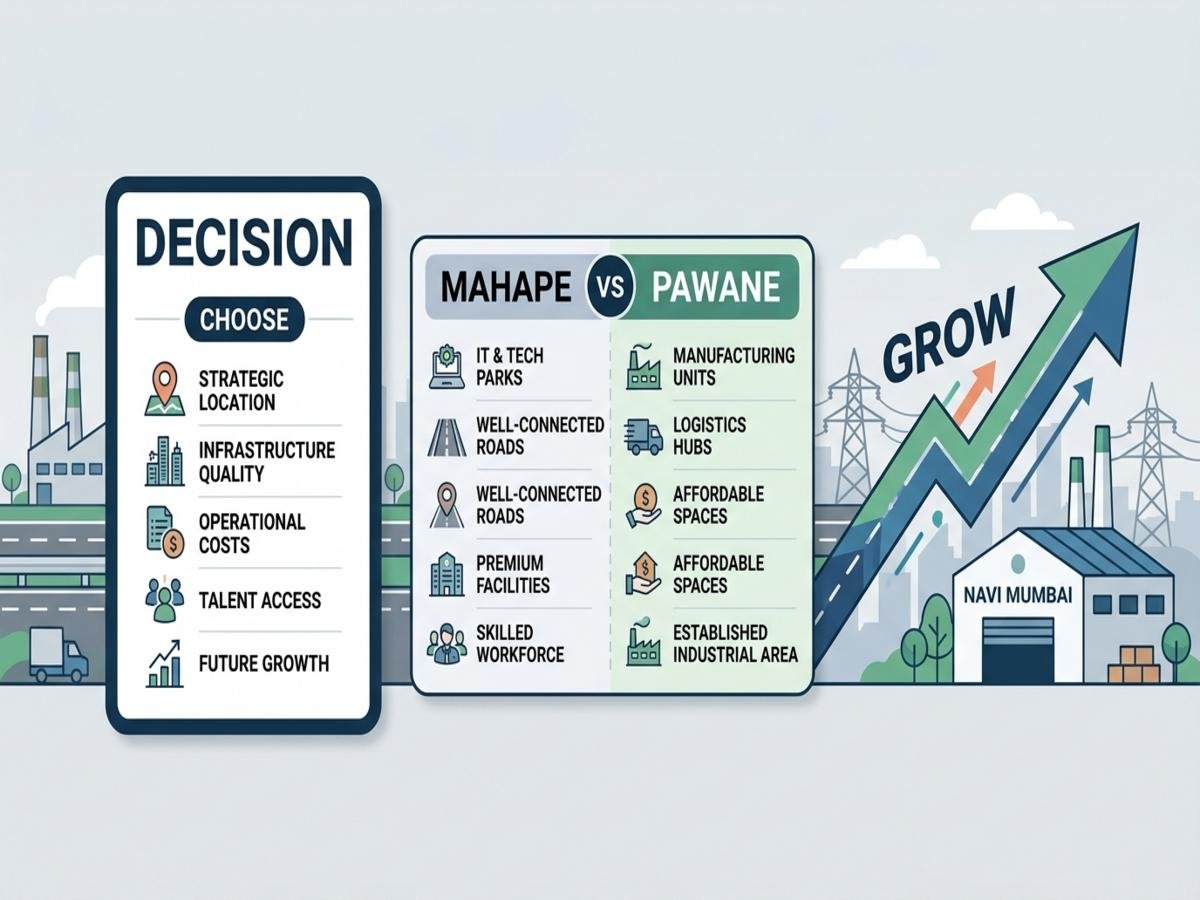
Choose Mahape if your business is cleaner, more technical, more office-linked, or more people-facing. Electronics, light assembly, IT support, testing, back-end operations, engineering services, industrial automation, and client-facing industrial offices usually fit Mahape better.
Choose Pawane if your business is more goods-heavy, machine-heavy, storage-heavy, or function-first. Fabrication, packaging, repair, warehousing, industrial services, chemical-linked work, and workshop-style operations often find Pawane more practical.
But do not choose either location only by reputation. In Mahape and Pawane, the exact lane, building age, power load, road width, loading access, MIDC permission, MPCB requirement, fire safety, drainage, and pending dues can completely change the answer.
The best industrial property is not the one with the best address. It is the one where your business can operate legally, safely, and profitably every day.
Pawane has an existing heavy-industrial and chemical-linked ecosystem, but new users must be very careful. MPCB consent, fire safety, storage rules, effluent disposal, CETP access, and possible ZLD requirements must be verified before committing to any property.
Which area is better for industrial property investment?
Mahape may suit investors looking for cleaner office-industrial or electronics-linked tenants. Pawane may suit investors looking for functional SME, warehousing, and factory tenants. In both cases, the best investment is a compliant property with clear dues, strong access, suitable power load, and realistic re-leasing demand.
FAQs
Frequently Asked Questions