
Navi Mumbai Airport Real Estate Impact: Which Areas Are Rising and by How Much
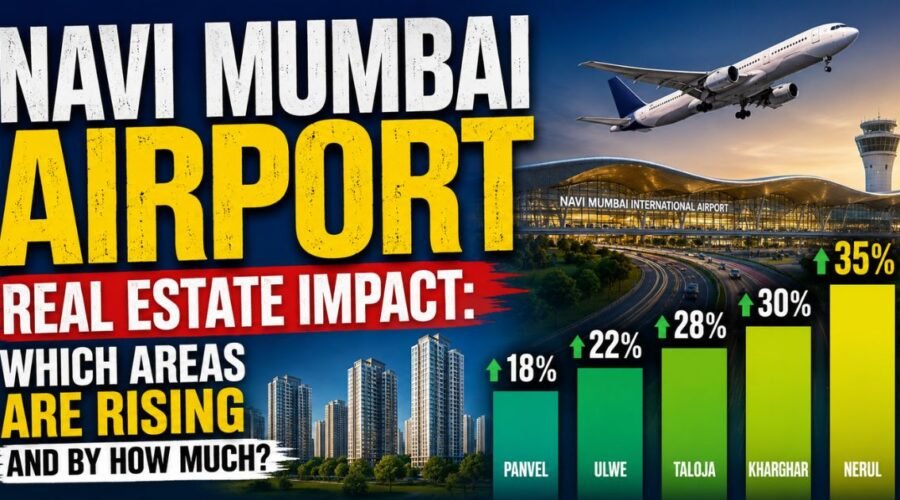
The Navi Mumbai International Airport (NMIA) has already triggered one of the most significant real estate surges in the Mumbai Metropolitan Region. Since NMIA began commercial operations in December 2025, apartment prices in key surrounding zones have risen 74% compared to 2021, with residential plots in some pockets appreciating by as much as 93%. For buyers and investors tracking the Navi Mumbai airport real estate impact, the data is now clear: the airport effect is not speculative anymore. It is measurable, on-ground, and still unfolding.
What Is the Navi Mumbai Airport and Why Does It Matter for Real Estate?
The Navi Mumbai International Airport (NMIA), developed by Adani Airports (74%) and CIDCO (26%), is built across 1,160 hectares in Ulwe. The total project investment stands at approximately Rs 16,700 crore. Phase 1 is designed to handle 20 million passengers annually, with a long-term capacity target of 90 million passengers.
NMIA was inaugurated by Prime Minister Narendra Modi on October 8, 2025. Commercial flights commenced on December 25, 2025, with the first IndiGo flight arriving from Bengaluru.
According to CIDCO, the airport was decades in planning and is now India’s most significant greenfield airport in terms of scale. Its impact on surrounding land values is being compared to how Hyderabad’s Rajiv Gandhi International Airport transformed the Shamshabad corridor.
The “airport effect” in real estate is well-documented globally: when a major transit hub opens, surrounding land sees strong appreciation driven by employment generation, commercial activity, and improved connectivity. In Navi Mumbai, all three are now active simultaneously.
Key Micro-Markets Seeing the Highest Appreciation
Ulwe: The Closest Bet to the Runway
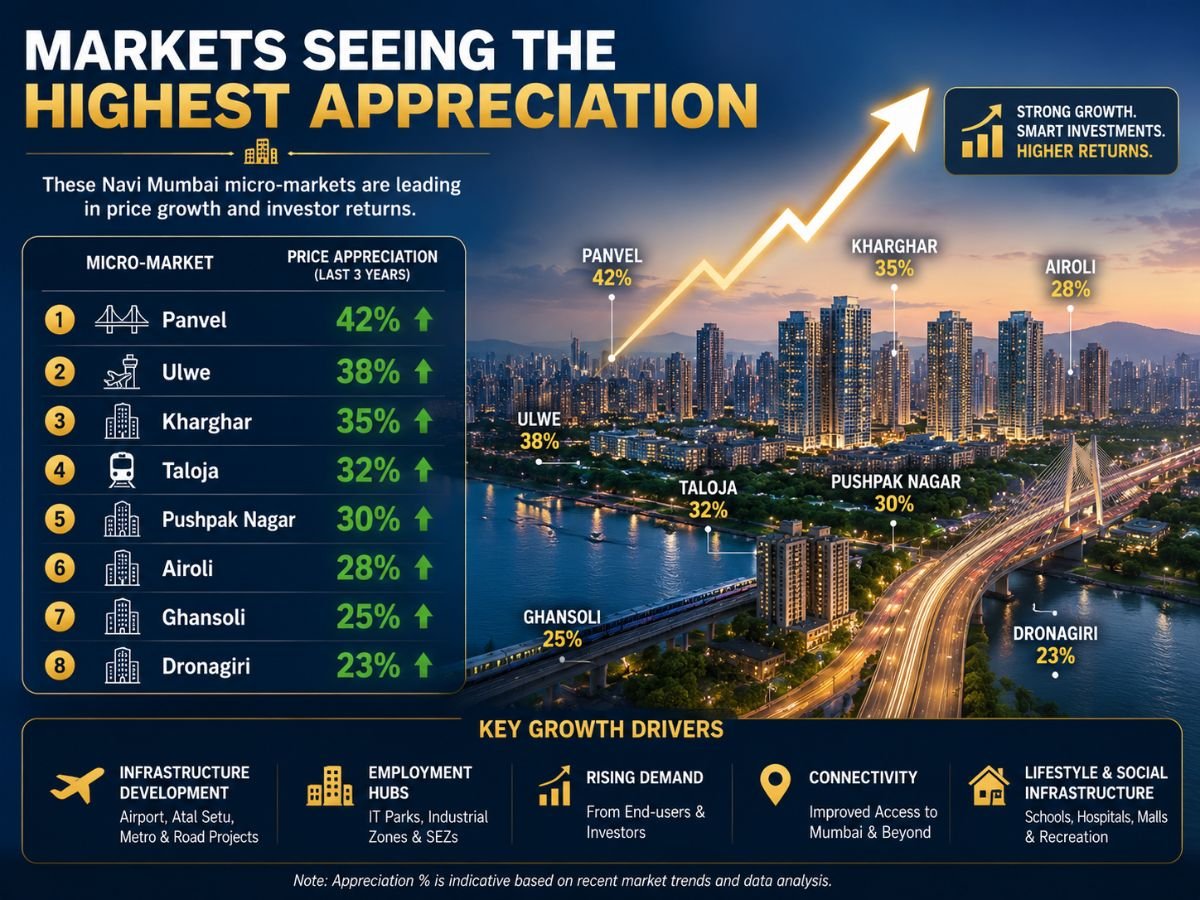
Ulwe sits directly adjacent to NMIA and has emerged as the highest-appreciation zone. Properties here have seen 40-80% appreciation over the past five years, depending on location and project quality. Current apartment rates are in the range of Rs 12,000 to Rs 18,000 per square foot.
Ulwe was considered an overlooked micro-market as recently as 2020. Post-airport, it has become one of Navi Mumbai’s most sought-after investment destinations, attracting both end-users and high-net-worth investors.
For investors with a 3 to 5-year horizon, Ulwe offers the strongest correlation between infrastructure and appreciation. The risk is that much of the speculative price movement has already occurred in the most premium projects.
Panvel: Infrastructure Depth, Not Just Airport Adjacency
Panvel’s strength is not just its proximity to NMIA. It is the convergence of multiple infrastructure projects: the Mumbai-Pune Expressway, Atal Setu (MTHL), metro line expansion, and the airport itself.
Between 2021 and 2025, apartment prices in Panvel climbed to Rs 10,000 to Rs 12,000 per square foot, representing a 74% increase in capital value. Residential plot prices have surged 93%, currently trading at Rs 80,000 to Rs 85,000 per square yard.
Panvel is increasingly being positioned as a transport and logistics hub for the broader MMR. With the airport operational and the Atal Setu reducing travel time to South Mumbai to 20-45 minutes, Panvel has effectively shed its satellite-city status.
Kharghar: Established Demand Meeting Fresh Momentum

Kharghar was already one of Navi Mumbai’s most developed residential zones before the airport boom. Appreciation here has been steadier rather than explosive. Some projects have reported 20% gains over 18 months.
Current rates in Kharghar range from Rs 12,000 to Rs 15,000+ per square foot depending on the project. The arrival of CIDCO’s 375-acre International Corporate Park and the airport’s employment ecosystem are expected to deepen commercial demand in Kharghar through 2027.
For buyers seeking livability alongside investment value, Kharghar remains one of the most balanced options in the airport influence zone.
Dronagiri: The Affordable Entry Point
Dronagiri is positioned as a future growth corridor. It offers relatively affordable entry points at Rs 6,500 to Rs 9,000 per square foot, making it the go-to zone for first-time buyers and long-horizon investors.
The trade-off is infrastructure maturity. Dronagiri still requires time for on-ground amenities, connectivity, and commercial activity to fully develop. Buyers entering here should plan for a minimum 5-year hold period.
Taloja: Metro-Driven Growth
Taloja is benefiting more from Metro Line 1 (Belapur-Pendhar) than directly from the airport. With the metro fully operational, Taloja is seeing 11-16% annual appreciation forecasts. Current rates are among the more affordable in the Navi Mumbai corridor at around Rs 8,700 per square foot, making it viable for mid-income buyers.
Property Price Data: What Numbers Actually Look Like
The table below summarizes current price benchmarks across key airport-influence zones as of 2026:
| Area | Approx. Rate (Per Sq Ft) | Appreciation (2021-2026) | Investor Profile |
|---|---|---|---|
| Ulwe | Rs 12,000 – Rs 18,000 | 40-80% | High-risk, high-return |
| Panvel | Rs 10,000 – Rs 12,000 | 74% | Balanced |
| Kharghar | Rs 12,000 – Rs 15,000+ | Steady 15-20% | Livability + growth |
| Dronagiri | Rs 6,500 – Rs 9,000 | Early appreciation | Long-horizon investors |
| Taloja | Rs 8,700 | 11-16% annually | Mid-income buyers |
Figures sourced from market reports and property consultants. Verify current rates directly with developers or [MahaRERA](https://maharera.maharegistration.gov.in) registered projects before transacting.
What Is Driving the Appreciation Beyond the Airport?
The NMIA’s impact is amplified by three parallel infrastructure developments that have matured simultaneously.
Atal Setu (MTHL): India’s longest sea bridge, inaugurated in January 2024, cut travel time between South Mumbai and Navi Mumbai from two hours to 20-25 minutes. Areas like Ulwe and Panvel, previously considered remote, are now viable daily commute zones for Mumbai’s business districts.
Navi Mumbai Metro Line 1: Fully operational on the Belapur-Pendhar corridor, the metro has opened up Kharghar and Taloja to a wider base of daily commuters. The planned extension connecting the airport to BKC (Bandra-Kurla Complex) is under development and will further reshape the southern corridor’s investment profile.
NAINA (Navi Mumbai Airport Influence Notified Area): CIDCO is implementing a planned urban development framework across 94 villages surrounding the airport. Infrastructure projects worth Rs 2,550 crore are underway, including roads, utilities, and civic amenities. NAINA is designed to function as an aerotropolis over the long term, ensuring that the growth around NMIA is structured rather than speculative sprawl.
Aerocity Development: The Maharashtra government has accelerated plans for a 667-acre Aerocity adjacent to NMIA, with dedicated zones for commercial, retail, residential, and industrial use. Once operational, this will create a second employment center in addition to the airport itself, generating significant commercial and residential demand in the immediate vicinity.
How Much Job Creation Is Involved?
Job generation is one of the most reliable long-term drivers of real estate demand. NMIA is expected to generate over 1 lakh direct and indirect jobs. When combined with the proposed Aerocity, logistics zones, cargo handling operations, and commercial development in the NAINA area, the employment ecosystem being built around the airport is substantial.
This employment-driven demand is what distinguishes airport-adjacent real estate from speculative land appreciation. The rental demand from professionals employed at or near the airport will sustain and grow as NMIA scales from 20 million to its eventual 90-million-passenger capacity.
Market analysts are forecasting sustained annual appreciation of 8-12% over the next seven years in the airport influence zone, with the sharpest gains in Ulwe and Panvel through 2027.
What About NAINA Land Rates?

For those tracking raw land rather than apartments, [NAINA land rates](https://cidco.maharashtra.gov.in) currently range from Rs 5 lakh to Rs 25 lakh per guntha (approximately 101 square meters) depending on proximity to the airport, road connectivity, and TPS (Town Planning Scheme) status.
CIDCO has reduced the NAINA betterment charge from 50% to just 0.05%, a policy change that significantly improves affordability for buyers within the NAINA zone and is expected to accelerate construction activity.
TPS 1 and 2 are ready for property transfers. Other schemes are under review. Before purchasing land within NAINA, verify the TPS status, building permission approvals, and CIDCO clearances. [Verify with a RERA-registered agent or lawyer before transacting.]
Is This a Bubble or Sustained Growth?

The concern around any rapid price appreciation is whether it is demand-driven or speculative. The Navi Mumbai airport real estate market has characteristics that distinguish it from a bubble.
The growth is anchored by real infrastructure that is now operational, not just planned. NMIA is flying passengers. MTHL is carrying traffic. Metro Line 1 is running. These are tangible connectivity improvements that translate into genuine demand from end-users and commercial tenants, not just speculative buyers.
The counterargument is affordability pressure. With prices in Panvel and Ulwe approaching Rs 10,000-18,000 per square foot, the entry barrier for middle-income buyers has risen significantly. Areas like Dronagiri and Taloja exist precisely to serve buyers priced out of the primary zones.
The consensus among market observers, as of 2026, is that Navi Mumbai property rates will continue appreciating at 10-20% annually through 2027. This is not guaranteed. It depends on how fast the airport scales operationally, how quickly NAINA infrastructure matures, and whether the broader MMR economy continues expanding.
Which Zones Are Still Early-Stage?
Buyers who missed the pre-airport entry point in Ulwe and Panvel still have options.
Dronagiri and Pushpak Nagar are the two areas where prices remain in the Rs 6,500-9,000 range. Both benefit from airport proximity but have not yet seen the infrastructure maturity that drives premium pricing. For investors comfortable with a 5-7 year horizon, these offer the best risk-adjusted entry given current pricing.
Karanjade is another emerging node in the southern corridor. With MTHL exits nearby and road access to NMIA improving, it is expected to see secondary appreciation as primary zones in Ulwe saturate.
FAQs
Frequently Asked Questions