Blogs

Everything about Navi Mumbai

Risks of Buying Property with Litigation in Navi Mumbai

Buying property with litigation is risky. Do not pay token money until you verify the court case, title chain, IGR records, 7/12 or property card, mutation entries, RERA status, CIDCO/NAINA approvals, CRZ restrictions, loan/mortgage records, and a lawyer’s title-search report. Some minor disputes may be manageable, but ownership disputes, stay orders, fraud claims, and approval issues are serious red flags. This is an educational guide. Verify the latest position with the relevant authority or a property lawyer before making a transaction. What Does Property with Litigation Mean? A property with litigation means there is some legal dispute, court case, revenue case, ownership claim, RERA complaint, bank recovery issue, or government-authority objection connected to the property. It may involve: Ownership dispute between family members Pending civil suit Stay order or injunction Boundary or encroachment dispute Mutation dispute Unpaid loan or mortgage issue RERA complaint against builder CIDCO transfer or allotment dispute NAINA zoning or approval issue CRZ, mangrove, green zone, or no-development-zone restriction In simple words, the seller may have a document, but the property may still not be clean enough for safe purchase. A sale deed, tax bill, or broker assurance alone does not remove litigation risk. Why Buying Litigated Property Is Risky The biggest risk is not only losing money. The bigger risk is getting stuck. You may pay token money, sign an agreement, apply for a loan, or take possession and later discover that the seller’s right to sell was disputed. For buyers in Navi Mumbai, Panvel, Ulwe, Kharghar, Taloja, Dronagiri, Uran, Raigad, Thane, CIDCO and NAINA areas, litigation risk can come from both legal and land-record issues. Risk What it can affect Title dispute Ownership and resale Stay order or injunction Registration, construction, possession Mutation dispute Revenue record and transfer clarity Loan or mortgage issue Bank approval and future claims CIDCO transfer issue Leasehold transfer and permissions NAINA zoning issue Development potential CRZ or mangrove issue Construction permission RERA complaint Project delay, builder compliance, possession A cheap property with litigation can become expensive if the case blocks resale, loan approval, registration, or possession. When Litigation May Be Manageable Not every dispute means the property is impossible to buy. Some issues may be manageable if they are minor, fully disclosed, documented, and cleared by a property lawyer. Examples: Old society dues dispute already settled Minor boundary clarification with no stay order RERA complaint unrelated to title or possession Mutation delay where the registered title chain is otherwise clear Old objection closed by final written order But do not decide this yourself. Ask for the latest order, case papers, settlement documents, and lawyer’s written opinion. When You Should Pause or Walk Away You should pause immediately if the property has: Ownership dispute Pending title suit Stay order Injunction Attachment order Multiple heirs claiming rights Forged document allegation Power of attorney dispute CIDCO allotment or transfer dispute NAINA approval mismatch CRZ or mangrove restriction Government land or reservation issue Builder refusing to share RERA, CC, OC, or title documents If the seller says, “case is only formal,” ask for proof. If the broker says, “pay token first, documents later,” treat it as a warning sign. Documents to Check Before Buying The documents depend on the property type. For Resale Flats in Navi Mumbai Check: Registered sale deed chain Agreement for sale Index II Society share certificate Society NOC, if applicable Maintenance dues statement Property tax record Occupancy Certificate Building Completion Certificate Existing loan closure letter or bank NOC IGR Maharashtra eSearch record Court case search by owner, seller, builder, and society name Property tax record is useful, but it should not be treated as ownership proof by itself. For NAINA Plots and Land Check: 7/12 extract 8A extract Mutation entries Survey number and village name Property card, if applicable Zone Confirmation Statement NAINA Development Plan status Town Planning Scheme status Development permission Commencement Certificate Occupancy Certificate, if construction exists IGR registration chain Court case status CERSAI mortgage/security-interest search 7/12 is called Satbara in Marathi. It records land details, occupant names, crop or land-use entries, and other revenue information. It supports verification, but buyers should not treat it as final ownership proof without title-chain review. Mutation is called Ferfar in Marathi. It records changes in revenue records after sale, inheritance, partition, or other transfer. A mutation entry supports record updating, but it does not automatically cure a defective title. For CIDCO Properties Check: CIDCO allotment letter Lease deed Transfer permission Possession letter CIDCO NOC, if applicable Payment receipts Tripartite documents, if applicable Building permission OC Any CIDCO 12.5% or scheme-related documents Seller’s legal authority to transfer CIDCO leasehold property has its own transfer and approval conditions. Do not rely only on seller-side documents. For Gaothan Property Check: Gaothan status Sanad, if applicable Property card or village records 7/12 and mutation entries, if applicable Heirship documents Construction permission Road access Encroachment risk Local authority confirmation Gaothan properties can have older records, family claims, informal construction history, and unclear documentation. Use a local property lawyer before payment. For CRZ, Creekside or Mangrove-Affected Property Check: CZMP map MCZMA status Development permission conditions Distance from creek, mangroves, wetlands, and high tide line Environmental restrictions Whether construction is allowed This is important in parts of Navi Mumbai, Panvel, Uran, Dronagiri, Kharghar, and coastal or creek-facing belts. How to Verify Litigation Status Use a step-by-step approach. 1. Ask for Written Disclosure Ask the seller or builder for: Case number Court name Names of parties Latest order Copy of plaint or application Written statement or reply Stay or injunction order, if any Settlement documents, if they claim the case is settled No document means no payment. 2. Search Court Records Search the case on eCourts using: CNR number Case number Party name Advocate name Court name Also search by seller name, builder name, project name, society name, and landowner name. If the case is in the Bombay High Court or another forum, ask a lawyer to verify the latest status. 3. Check IGR Maharashtra eSearch Use IGR

Read More

Unauthorized Layout Fraud in NAINA: How Navi Mumbai Buyers Can Verify a Plot Before Paying Token

Unauthorized layout fraud in NAINA happens when land is divided and sold as plots without proper layout approval, demarcation, development permission, or clear title verification. Do not pay token money only because the seller shows a 7/12 extract, WhatsApp location, private layout map, or “CIDCO approved” claim. First verify SPA-NAINA/CIDCO approval, land records, IGR documents, zoning, CRZ risk, and legal title. Why This Matters for Navi Mumbai Buyers NAINA has become a high-interest property zone because of Navi Mumbai International Airport, Panvel growth, Ulwe, Dronagiri, Uran, Taloja, and nearby Raigad-side land movement. That demand has also created one common risk: buyers are shown cheap “future bungalow plots” or “NAINA approved plots” without proper proof. The problem is not always that the land is fake. Sometimes the land exists. The owner may also exist. The 7/12 may be real. The real issue is different: The specific plotted layout being sold to you may not be officially sanctioned. That means the “plot number” shown on the brochure may be only a private drawing. It may not exist in an approved layout. Roads, open spaces, access, drainage, zoning, CRZ restrictions, DP reservations, and legal subdivision may not be clear. For a flat buyer, the main checks are usually RERA, commencement certificate, occupancy certificate, agreement, society documents, and title. For a NAINA plot buyer, the risk is deeper because the buyer must check land title, land use, layout sanction, demarcation, access road, revenue records, planning permissions, and environmental restrictions. What Is Unauthorized Layout Fraud in NAINA? Unauthorized layout fraud means a seller, broker, landowner, or local developer markets land as individual plots even though the layout has not received proper approval from the competent authority. In simple words: One large land parcel is shown as many small plots. A private map is created with plot numbers. Buyers are told that approval is “almost done” or “not needed.” Token money is collected before legal verification. The buyer later discovers that the plot was not part of an officially sanctioned layout. This is risky because a buyer may pay money for a plot that cannot be legally developed, transferred clearly, financed easily, or used as expected. Common Claims Used in NAINA Plot Fraud Be careful when you hear these lines: Seller or broker claim What you should ask “This is NAINA approved.” Show the official SPA-NAINA/CIDCO layout approval letter and plan. “7/12 is clear, so no issue.” 7/12 is not layout approval. Ask for sanctioned layout and title search. “Approval will come after booking.” Do not pay token before approval is verified. “This is CIDCO area.” CIDCO area does not automatically mean CIDCO-approved plot. “Road is planned here.” Check official DP/zoning plan, not only Google Maps or brochure map. “Only few plots left.” Urgency is not proof. Verify documents first. “Everyone has already booked.” Other buyers’ bookings do not make the layout legal. Who Approves or Verifies What? In NAINA and surrounding Navi Mumbai growth areas, different records come from different authorities. A buyer must not depend on one document only. Check Authority / source to verify What it tells you NAINA planning / layout approval CIDCO / SPA-NAINA Whether the layout or development proposal has official planning approval Building / development permission CIDCO / planning authority Whether development work is permitted under applicable rules 7/12 extract and 8A Mahabhulekh / Revenue Department Land survey details, owner name, land classification and revenue entries Mutation / Ferfar Revenue office / land records How ownership changes were recorded Property registration history IGR Maharashtra / eSearch Registered sale deeds, Index II and transaction history RERA status, if applicable MahaRERA Whether a real estate project/promoter/agent is registered or has complaints/status issues CRZ / coastal restrictions MCZMA / CZMP / planning authority Whether coastal regulation restrictions may affect the land DP road / reservation / zoning CIDCO / planning authority Whether land is affected by proposed roads, reservations or land-use restrictions Important Point: 7/12 Is Not Layout Approval Many buyers make this mistake. A 7/12 extract is a land record. It can help you check the survey number, owner name, land type, area and revenue-related entries. But it does not automatically prove that: The land can be sold as residential plots. The layout is sanctioned. The plot number shown in a brochure is official. Roads and open spaces are approved. Construction will be allowed. There is no CRZ, green zone, reservation or DP-road impact. The seller has the right to sell the exact small plot shown to you. So, if a seller says, “7/12 is enough,” treat it as a red flag. Step-by-Step Verification Process Before Paying Token Step 1: Get Exact Land Details Before any site visit or token discussion, ask for: Village name Taluka and district Survey number / Gat number Hissa number Total land area Seller name Claimed plot number Layout approval number, if any Copy of sanctioned layout plan, if claimed Development permission / commencement certificate, if applicable If the broker cannot give the survey number and village name, do not move ahead. Step 2: Check 7/12, 8A and Mutation Entries Use official land-record sources to check whether the seller name, land area, survey number and mutation entries match the documents shown to you. Check: Is the seller’s name visible? Is the land agricultural or already converted/approved for the claimed use? Are there multiple owners or heirs? Are there pending mutation issues? Is the copy recent? Is it digitally signed where required? Do not rely only on screenshots sent on WhatsApp. Step 3: Run IGR Maharashtra eSearch IGR eSearch helps you check registered document history. This is important because property fraud can happen when the same land is sold, mortgaged, transferred, or claimed through different documents. Ask a lawyer to check: Index II Sale deed chain Previous transfers Agreement history Power of attorney, if any Mortgage or encumbrance risk Whether the seller has a clear right to sell For a serious plot deal, do not do this casually. A proper title search is necessary. Step 4:

Read More

Risks of Buying Property Near Airport: Navi Mumbai Buyer Checklist

Buying property near an airport can be useful for connectivity and future demand, but it also carries serious risks. In Navi Mumbai, buyers must check title, land records, NAINA/CIDCO status, NA/use permission, RERA, AAI height restrictions, CRZ/CZMP, road access, and pending disputes before paying token money. Do not buy only because the broker says “airport area.” Is Buying Property Near an Airport Risky? Yes, it can be risky. The biggest risk is not the airport itself. The bigger risk is buying a property only because of airport hype without checking documents. This is common around Navi Mumbai International Airport, Panvel, Ulwe, Dronagiri, Uran, NAINA-side villages, and nearby Raigad locations. A flat in a registered project may be lower risk if the title, permissions, RERA record, CC, OC, and agreement are clear. A plot, gaothan property, agricultural land, or “future airport plot” can be much higher risk if zoning, land-use permission, title chain, access road, CRZ, or NAINA status is unclear. Airport proximity is a location advantage. It is not legal clearance. Quick Verdict for Navi Mumbai Buyers Property type Risk level What to check first RERA-registered flat Medium MahaRERA, CC, OC, title report, agreement Resale flat Medium Society papers, property card, IGR records, loan clearance NAINA plot High 7/12, mutation, CIDCO/NAINA zone, sanctioned layout Gaothan property High Gaothan status, sanad, title chain, construction permission Agricultural land Very high Permitted use, NA/development permission, access road, title Creek/coastal-side land Very high CRZ/CZMP, mangrove/wetland status, planning approval Biggest Risks of Buying Property Near Navi Mumbai Airport 1. Title and Ownership Risk Many airport-area deals are sold with future appreciation stories. But the first question is simple: who legally has the right to sell? For land and plots, check the 7/12 extract, 8A extract, mutation entries, registered sale deeds, Index II, and title chain. A 7/12 extract is a rural land record. It shows details such as survey number, area, landholder name, and land use. It supports verification, but it does not alone prove marketable ownership. Mutation entry, also called Ferfar in Maharashtra, records changes after sale, inheritance, partition, or other transactions. Pending or disputed mutation is a warning sign. 2. Fake Airport Plot or Fake CIDCO Claim This is a major risk near Panvel, NAINA, Ulwe, Dronagiri, and Uran. Common claims include: “CIDCO approved airport plot” “NAINA approved plot” “Future final plot” “Airport touch property” “Mumbai 3.0 investment land” “CIDCO allotment coming soon” Do not trust brochure language. Ask for official proof from CIDCO, NAINA records, registered documents, and planning permissions. If the seller cannot show verifiable records, pause the deal. 3. NAINA Zoning Mismatch NAINA means Navi Mumbai Airport Influence Notified Area. A property may fall near the airport influence area, but that does not mean it is automatically ready for construction. For NAINA-side land, check: Development Plan Interim Development Plan, where relevant DCPR Zone Confirmation Certificate Town Planning Scheme status Commencement Certificate, if development is approved Occupancy Certificate, if claimed Road/access reservation Sanctioned layout A plot can look attractive on Google Maps but may have zoning restrictions, road reservation, missing layout approval, or no legal access. 4. NA Permission and Land-Use Confusion NA means non-agricultural use. Many brokers casually say, “NA ho jayega,” or “NA automatic hai.” That is dangerous. Maharashtra has amended provisions around non-agricultural land use. In certain cases, where development permission or building plan approval is granted by the competent planning authority according to the applicable development plan, regional plan, or rules, a separate Collector NA permission may not be required. But this is not a blanket green signal for every land parcel. For buyers, the practical rule is: Verify the exact survey number, permitted use, planning authority approval, premium/payment status, and revenue-record update before transaction. For old layouts, agricultural land, informal plot divisions, gaothan areas, and NAINA-side lands, verify with a property lawyer, planning authority, and revenue office before paying token money. 5. AAI Height Restriction Risk Airport-area property may have height restrictions. This matters if you are buying: Land for future building Plot for bungalow or commercial use Old building for redevelopment Project where future tower height is part of the value AAI/NOCAS rules and CCZM height limits can affect permissible structure height. A location may be valuable, but the allowed construction height may be lower than expected. Do not rely only on a builder’s future tower promise. Ask an architect or planning consultant to verify height clearance and sanctioned-plan feasibility. 6. CRZ, Mangrove, Wetland, and Coastal Risk This risk is relevant around Uran, Dronagiri, creek-side locations, mangrove-side belts, and coastal pockets. CRZ means Coastal Regulation Zone. CZMP means Coastal Zone Management Plan. If land is near creek, coast, mangroves, wetlands, or low-lying areas, do not proceed without checking CRZ/CZMP status and planning permissions. A “sea-facing” or “creek-view” pitch can hide serious development restrictions. For CRZ-sensitive land, verify with MCZMA, the planning authority, and a property lawyer before transaction. 7. RERA Mismatch in Airport-Area Projects For flats and eligible plotted developments, check MahaRERA. Do not only ask, “Is it RERA registered?” Check: Project name Promoter name Registration status Possession date Uploaded approvals Legal title report Encumbrance details Commencement Certificate Layout approval Complaints or lapsed/revoked status, if any RERA helps buyers access project information, but it does not remove the need for title, approval, and agreement verification. 8. Access Road and Reservation Risk A cheap plot near the airport is not useful if it has no legal access road. Check: Village map Survey map Sanctioned layout DP road reservation Road widening proposal Private access dispute Actual approach road on site If the land is landlocked or dependent on informal access, resale and construction can become difficult. 9. Noise, Traffic, and Livability Risk Airport-area demand can increase, but buyers must also check practical livability. Possible issues include: Aircraft noise Cargo and logistics traffic Construction dust Heavy vehicle movement Parking pressure Rental mismatch Lower family demand in noisy pockets This does not mean every airport-area property is bad. It means you should check the exact micro-location, not just

Read More

Risks of Buying Property in Green Zone: Navi Mumbai Buyer Checklist

Buying property in Green Zone can be risky if you plan to build, resell, mortgage, convert, or develop the land later. Ownership does not automatically mean construction rights. Before paying token money, check zoning, 7/12, mutation entries, IGR records, title chain, NA/development permission, NAINA/CIDCO status, CRZ/CZMP exposure, and MahaRERA registration if it is sold as a plotted project. Disclaimer: This is an educational guide. Verify the latest position with the relevant authority or a property lawyer before making a transaction. What Does Green Zone Mean in Maharashtra Property? “Green Zone” usually refers to land where development is restricted or controlled under a Development Plan, Regional Plan, local planning rules, or environmental regulations. It is not the same as normal residential land. In Navi Mumbai, Panvel, NAINA, Uran, Dronagiri, Ulwe, Taloja, Kharghar or Raigad-side areas, a Green Zone plot may be shown as cheap because the buyer may not get normal residential development rights. The exact status depends on the land’s survey number, village, planning authority, zoning map, revenue records, CRZ status, road access, and development permissions. Do not rely on broker statements like “Green Zone will become residential soon.” Get written verification. Why Green Zone Property Looks Attractive Green Zone land is usually marketed with these claims: “Airport ke baad rate double.” “NAINA approval will come soon.” “CIDCO development is coming.” “Farmhouse allowed hai.” “Buy now before zoning changes.” “Only token now, documents later.” The problem is simple: future development is not guaranteed. A cheap plot can become expensive if you later discover that construction is restricted, NA conversion is not available for your intended use, the layout is not sanctioned, or the land is affected by CRZ, mangroves, road reservation, inheritance disputes, or title defects. Main Risks of Buying Property in Green Zone 1. You May Own the Land but Still Not Be Able to Build A sale deed may transfer ownership rights, but it does not automatically give construction rights. To build legally, you need land-use permission, planning approval, building permission, and compliance with the applicable Development Plan or Regional Plan. This is the biggest misunderstanding in Green Zone deals. A buyer sees the 7/12 extract and assumes, “The owner name is there, so the land is safe.” That is not enough. 7/12 supports land-record verification. It does not confirm clean title, construction permission, NA status, zoning safety, or future development rights. 2. NA Permission May Not Be Available for Your Use NA means non-agricultural use. Many buyers think agricultural or Green Zone land can easily be converted to NA later. That is unsafe thinking. Maharashtra’s updated land-revenue process has changed the role of separate Collector permission in certain cases where the proposed non-agricultural use is already permissible under the Development Plan, Regional Plan, planning rules, and the planning authority grants development or building permission. But this does not mean every Green Zone plot has become buildable. If the planning rules do not allow your intended use, the NA process change will not save the deal. Verify before transaction. 3. NAINA Zoning May Restrict the Land Many plots around Panvel, villages near the airport influence area, and Raigad-side growth pockets are sold using the word “NAINA.” That does not mean the plot is automatically approved. For NAINA-area land, check: NAINA Development Plan Interim Development Plan, if applicable NAINA DCPR Town Planning Scheme status Zone Confirmation Statement, also called ZCS Commencement Certificate list Occupancy Certificate list, if any built structure exists A plot may be inside the NAINA influence area but still not be usable for the buyer’s intended residential or commercial purpose. 4. CRZ, Mangroves, Creek or Wetland Risk In coastal and creek-side areas, Green Zone risk can overlap with CRZ risk. This matters in parts of Uran, Dronagiri, Ulwe, Kharghar creek-side pockets, Nerul, Raigad coastal belts, and Thane district coastal areas. CRZ means Coastal Regulation Zone. CZMP means Coastal Zone Management Plan. If the land is near mangroves, creek, coast, high-tide line, wetlands or water bodies, get a proper CRZ/CZMP check. A normal 7/12 extract will not tell you everything about coastal restrictions. 5. Title, Mutation and Family Ownership Problems Green Zone plots are often old village lands or survey-number lands. Common title risks include: Incomplete family partition Missing legal heirs Pending mutation entries Old Power of Attorney transactions Tenancy or occupancy restrictions Class-II or restricted tenure land Multiple agreements on the same land Unregistered sale arrangements Ferfar means mutation entry. It records changes such as sale, inheritance, partition or other ownership-related updates in revenue records. Mutation supports verification, but it does not replace a legal title search. 6. Bank Loan and Resale Problems Banks may avoid funding land with unclear title, non-NA status, restricted zoning, unsanctioned layout, CRZ exposure, or missing approvals. Even if you buy the land in cash, resale can become difficult later. The next buyer may ask the same questions you ignored: Is it residential? Is NA done? Is the layout sanctioned? Is the title clean? Is the plot affected by CRZ or reservation? Will a bank give loan? If the answer is unclear, your exit becomes weak. Green Zone vs R-Zone vs NA Land vs CRZ Term What it usually means Buyer risk Green Zone Development is restricted or controlled You may not get normal construction rights R-Zone Usually residential zoning Still check approvals, title, road and building permissions Agricultural land Land recorded for agricultural use Buyer eligibility, conversion and permitted use must be verified NA land Land permitted for non-agricultural use Check exact NA use, layout approval and development permission CRZ land Land affected by coastal regulation Construction may be restricted or require special clearance No-Development Zone Area where development may be restricted Do not proceed without written planning authority confirmation Documents to Check Before Buying Green Zone Property Use this table before paying token money. Document Why it matters Where to verify 7/12 extract Shows land survey details, holder name and land classification Mahabhumi / Digital Satbara 8A extract Shows account-level landholding details Mahabhumi Mutation entries / Ferfar Shows

Read More

Risks of Buying Property in Flood Prone Area: Navi Mumbai Buyer Checklist

Buying property in a flood-prone area is risky if you do not verify flood history, drainage, zoning, CRZ/CZMP, title records, building approvals, OC, and MahaRERA/CIDCO/NAINA status before paying token money. In Navi Mumbai, Panvel, Ulwe, Taloja, Dronagiri and Uran, waterlogging can be linked to low-lying land, creeks, nullahs, holding ponds, mangroves, or weak stormwater drainage. Verify first; pay later. Should You Buy Property in a Flood-Prone Area? You can buy a property in a flood-prone or waterlogging-prone area only after strong verification. Do not reject every property blindly. But do not treat flooding as a small monsoon problem either. Flood risk can affect safety, resale value, maintenance cost, loan comfort, insurance, building approvals, and future redevelopment potential. For wider buyer protection, read property buyer due diligence in Navi Mumbai before paying token money. Simple rule: no token money until flood risk, title, zoning, CRZ, approvals and OC status are checked. Why Flood Risk Matters in Navi Mumbai Navi Mumbai is a planned city, but that does not mean every pocket is risk-free. Some areas are close to creeks, mangroves, holding ponds, wetlands, low-lying roads, stormwater drains and reclaimed land. During heavy rain, high tide or poor drainage, waterlogging can become a real buyer problem. This is especially important in parts of Navi Mumbai, Panvel, Ulwe, Taloja, Dronagiri, Uran, Kharghar, Raigad and NAINA influence areas. A building may look good in summer. The real test is monsoon access, drainage, basement condition, stilt parking, lift pits, compound slope and nearby nullah flow. Main Risks of Buying Property in a Flood-Prone Area Risk What can go wrong Buyer action Physical damage Damp walls, damaged flooring, lift issues, parking flooding, electrical risk Inspect during monsoon or after heavy rain Safety risk Roads blocked, basement unsafe, emergency access affected Check access roads and society records Resale risk Buyers may avoid known waterlogging pockets Ask local residents and check past news Loan/insurance risk Lender or insurer may raise questions if title, approval or risk is unclear Confirm before final payment Approval risk CRZ, floodline, green zone, no-development zone or unauthorized construction issues may arise Verify with planning authority and lawyer Maintenance cost Pumps, drainage cleaning, waterproofing and repairs may increase society expense Check society minutes and repair history Flood-Prone Does Not Always Mean Illegal This point is important. A property having waterlogging history does not automatically mean the property is illegal. But flood risk may overlap with other serious issues. For example: Creek-side land may need CRZ/CZMP verification. Low-lying land may need drainage and floodline checks. Plot land may need zoning and development permission checks. NAINA plots may need ZCS, DCPR, TPS and authority approval checks. Gaothan or village properties may need stronger title, boundary and revenue-record verification. Under-construction projects need MahaRERA, CC, approved plan and OC status checks. Flood risk is not only a rain problem. It can become a legal, financial and resale problem. What to Check Before Paying Token Money Do not pay non-refundable token based on a broker’s WhatsApp documents. Ask for documents. Then verify them independently. Document / Source What it helps check Important note 7/12 Utara Land survey details, area, land type, names recorded in revenue records It supports verification; it does not by itself prove clean title 8A Extract Account-wise landholding details Match with 7/12 and seller claim Ferfar / Mutation Entry Changes after sale, inheritance, partition or transfer Check whether mutation trail matches the title chain Property Card Urban property record where applicable Useful for city property verification Index II Summary of registered document Match with sale deed and IGR records IGR e-search / registered documents Registration history and document trail Use for title-chain review Development Plan / Regional Plan Zone, reservation and permitted use Needed for plot and land transactions NAINA ZCS / DCPR / TPS records Zone and planning restrictions in NAINA areas Verify with CIDCO/NAINA source, not broker maps CRZ / CZMP records Coastal, creek, mangrove and CRZ restrictions Needed near creeks, coast, mangroves and wetlands Commencement Certificate Permission to start construction Verify from authority source Occupancy Certificate Building-use approval after completion Essential for resale flat and completed project MahaRERA project page Project registration, promoter details, complaints, lapsed/revoked/abeyance status Check before booking under-construction property Marathi terms in plain English: 7/12 Utara: A land record extract for agricultural or revenue land. Ferfar: Mutation entry showing a change recorded in revenue records. Index II: A registration summary of a registered document. Property Card: A city property record used in many urban areas. ZCS: Zone Confirmation Statement, useful in NAINA planning checks. How to Verify Flood Risk Before Buying 1. Check Local Flood History Ask nearby residents, shopkeepers, security guards and society members. Ask direct questions: Did water enter the building compound? Did basement or stilt parking flood? Were lifts stopped during monsoon? Did access roads get blocked? How many times has this happened in the last 3–5 years? Was any major repair done after flooding? Also search local news for waterlogging in the exact sector, village, road or node. 2. Visit During Monsoon A dry-season site visit is not enough. Visit during rain or within 24 hours after heavy rain. Check: Road level compared to building entrance Basement ramp slope Lift pit condition Parking dampness Compound water marks Nearby nullah or stormwater drain Smell, seepage and wall patches Pump room and drainage outlet Whether neighbouring buildings are raised higher If the seller refuses a monsoon inspection, treat it as a warning sign. 3. Check CRZ and CZMP Near Creek or Mangrove Areas For properties near creeks, mangroves, coast, wetlands or holding ponds, ask for CRZ/CZMP clarity. This is relevant in parts of Ulwe, Dronagiri, Uran, Nerul, Belapur, Taloja creek-side areas and other coastal or creek-influenced locations. Do not rely on “CRZ clear hai” from the broker. Ask a professional to verify the latest CZMP map, CRZ category, mangrove buffer, and authority permission. 4. Check NAINA and CIDCO Approvals For NAINA and CIDCO-influenced areas, check more than the sale deed. Verify: Zone Confirmation Statement Development Plan /

Read More

Risks of Buying Property in CRZ Area: Navi Mumbai Buyer Checklist

Buying property in a CRZ area is not automatically illegal, but it is high-risk. Before paying token money, verify the CRZ classification, approved CZMP map, HTL/LTL distance, mangrove buffer, land records, title, NA/development permission, RERA status, and CIDCO/NAINA/local authority approvals. If the seller cannot give plot-specific documents, pause the deal and verify before transaction. For the wider risk picture, also read Property Fraud Guide Navi Mumbai. What Is a CRZ Area? CRZ means Coastal Regulation Zone. It is a regulated coastal area where construction, land use, redevelopment, reclamation, and certain activities are controlled to protect coastal ecology. In simple words, if a property is near a sea, creek, mangrove, tidal waterbody, mudflat, salt pan, backwater, or coastal village, CRZ verification becomes important. Important terms: Term Simple meaning HTL High Tide Line LTL Low Tide Line CZMP Coastal Zone Management Plan map NDZ No Development Zone CRZ-I Ecologically sensitive coastal areas CRZ-II Developed urban coastal areas CRZ-III Less-developed or rural coastal areas CRZ-IV Water area and tidal waterbody zone A buyer should not decide only by looking at Google Maps, broker statements, or old layout plans. CRZ status must be checked using the latest applicable approved CZMP and plot-level records. Why CRZ Matters in Navi Mumbai Navi Mumbai and nearby growth belts have many creek-side, mangrove-side, village, CIDCO, NAINA, and coastal land pockets. This matters in areas such as Ulwe, Dronagiri, Uran, Nerul, Kharghar, Belapur, Panvel, Taloja, Raigad, Thane creek belt, and NAINA influence areas. Many deals are sold with growth stories: “Airport ke paas hai.” “NA soon ho jayega.” “CIDCO approval coming.” “CRZ issue manageable hai.” “Mangrove door hai.” “Future mein rate double.” Growth potential does not remove CRZ risk. A plot may look attractive because of airport, JNPT, MTHL, CIDCO, or NAINA development. But if the land is affected by CRZ, NDZ, mangrove buffer, green zone, reservation, title dispute, or missing approval, the buyer can face serious loss. For NAINA-side plots, also read NAINA Plot Fraud Guide. Main Risks of Buying Property in CRZ Area 1. Construction May Be Restricted The biggest risk is simple: you may buy land but may not be able to build what you planned. Ownership record and buildability are not the same. A 7/12 extract, sale deed, or mutation entry may support ownership history, but it does not automatically mean the land is approved for residential construction. You must separately verify: CRZ classification CZMP map HTL/LTL distance NDZ status Mangrove buffer Zone certificate NA or deemed NA applicability Layout approval Building permission Commencement Certificate Occupancy Certificate, where applicable 2. Land May Fall in NDZ Some CRZ areas have No Development Zone restrictions. If the land falls in NDZ, normal construction may not be allowed or may be heavily restricted. This is especially important for plots near creeks, mangroves, coastal villages, and undeveloped land pockets. Do not rely on verbal statements like “construction allowed hai.” Ask for written, plot-specific verification. 3. Mangrove Buffer Can Block Development In Navi Mumbai and surrounding coastal belts, mangroves are a major issue. A plot may not directly touch mangroves, but it can still be affected by buffer restrictions, access issues, CRZ mapping, or environmental objections. This is common near creek-side and low-lying land pockets. If mangroves, mudflats, salt pans, wetlands, or tidal waterbodies are nearby, get a professional CRZ check before paying token money. 4. Existing Construction May Not Be Authorised A house, bungalow, farmhouse, shed, boundary wall, resort structure, or old village construction may physically exist. That does not automatically make it legal. Before buying, check: Was the structure approved? Was it built before or after applicable restrictions? Is there a Commencement Certificate? Is there an Occupancy Certificate? Is it regularised? Does CRZ allow that use? Does the planning authority recognise it? This is especially important for resale flats, gaothan structures, old layouts, and farmhouse-style coastal plots. For related local risk, read Risks of Buying Gaothan Property. 5. Bank Loan and Resale Can Become Difficult Banks usually check title, land use, approvals, building permissions, and project documents before giving loans. If the property has unclear CRZ status, missing NA permission, weak title, no OC, no CC, or unapproved layout, loan approval can become difficult. Even if you buy without a loan, resale can become a problem later. Future buyers may ask the same questions you ignored today. 6. Token Money Fraud Risk Increases CRZ property deals often become risky because buyers are pushed to pay token money before document verification. Common pressure lines: “Sir, airport ke baad rate badh jayega.” “Aaj token do, kal documents de denge.” “CRZ ka kuch issue nahi hai.” “Local level pe sab clear hai.” “Ye old gaothan land hai.” “NA process mein hai.” Do not pay token money without written refund conditions if CRZ, title, NA, RERA, or approval verification fails. For this specific risk, read Token Amount Fraud Guide. Documents to Check Before Paying Token Money Document Why it matters Red flag Survey number / gut number / CTS number Identifies the exact land parcel Seller gives only location pin Village, taluka, district details Required for official records Location details keep changing Latest 7/12 extract Shows land-record entry for rural land Old extract or name mismatch 8A extract Helps check holding details Missing or inconsistent record Mutation / Ferfar entries Shows past changes in land record Recent disputed mutation Property card Important for CTS / city survey areas Seller has only tax receipt Registered sale deeds Shows transaction chain Missing link in ownership chain Index II Helps verify registered document details Deed not traceable Approved CZMP map Shows coastal zone classification Screenshot without source CRZ plot overlay Shows plot position against CRZ lines No plot-level map HTL/LTL demarcation Checks tidal influence distance Verbal distance claim Zone certificate / ZCS Shows planning zone and reservation Green zone / reservation ignored NA / deemed NA / land-use record Shows permitted land use status “NA soon” promise Layout approval Confirms approved subdivision Unapproved plotting CC / OC Important for buildings Ready flat without OC

Read More

Risks of Buying Property Near MIDC in Navi Mumbai

Buying property near MIDC is not automatically unsafe. The risk depends on the exact location, land use, title, approvals, pollution exposure, road access, CRZ or green-zone status, and whether the property is legally approved for the use being sold. Before paying token money, verify land records, IGR documents, zoning, MahaRERA status, CC/OC, CIDCO/NAINA approvals and environmental red flags. Start with the property fraud and buyer protection guide in Navi Mumbai if you are comparing multiple risky property options. Is Buying Property Near MIDC Risky? It depends. A legally approved flat near an employment belt can be practical for rental demand and daily travel. But a cheap plot near an MIDC boundary can be risky if it has unclear title, wrong land use, missing conversion, CRZ impact, green-zone restriction, NAINA uncertainty or industrial pollution exposure. The real question is not “Is MIDC nearby?” The real question is: Can this exact property be safely used, sold, financed and occupied for the purpose you are buying it for? For flats, check approvals, MahaRERA status, OC and builder compliance. For plots, gaothan land, agricultural land, MIDC leasehold property or NAINA-area land, take legal and revenue verification before payment. Main Risks of Buying Property Near MIDC 1. Pollution, Odour, Noise and Water Risk MIDC areas can include factories, logistics yards, chemical activity, engineering units, warehouses, scrap movement, effluent treatment, tankers and heavy vehicles. That does not mean every nearby property is bad. But buyers should physically check: Smell during morning and evening Smoke or dust from nearby units Noise at night Truck movement Drainage and waterlogging Distance from factories, waste yards or chemical units Local resident complaints MPCB, the Maharashtra Pollution Control Board, regulates industrial consent and pollution-related compliance. But as a buyer, you should not rely only on “area is developed” or “many people live here.” Visit the site at different times before deciding. 2. Wrong Land Use or Zoning Conflict A property may be near MIDC but not legally usable for the purpose shown to you. This is common in plot deals. A seller may say: “Residential plotting will come soon.” “NA ho jayega.” “NAINA area hai, airport ke paas hai.” “CIDCO approval coming.” These statements are not enough. You must check the planning authority, development plan, zoning, road reservation and permitted use. In Navi Mumbai and surrounding areas, the authority may be CIDCO, NAINA, NMMC, Panvel Municipal Corporation, MIDC, Gram Panchayat, MMRDA, Collector office or another planning body depending on the exact land. For NAINA or peripheral Panvel-side plots, also read NAINA plot fraud red flags before paying token money. 3. MIDC Leasehold and Transfer Restrictions Some industrial plots, galas, sheds or commercial units may be connected to MIDC leasehold land. Leasehold means the land is not owned in the same way as freehold land. The rights depend on the lease terms, allotment conditions and transfer permission. If you are buying any MIDC-linked unit, do not rely only on a sale agreement. Check: MIDC allotment letter Lease deed Transfer permission Sub-lease or assignment permission Dues Plot use restrictions Litigation or encumbrance Whether the seller is legally allowed to transfer the interest This is not a normal resale-flat check. Get a lawyer who understands MIDC or industrial property. 4. Title and Mutation Risk For land, title risk is one of the biggest dangers. A 7/12 extract, called Satbara in Marathi, is a rural land record. It may show the survey number, landholder name, cultivation details, land type and mutation references. An 8A extract shows account-wise revenue details. A property card or Malmatta Patrak is usually important for city survey or urban land. Mutation, called Ferfar in Marathi, records changes such as sale, inheritance or transfer in revenue records. These documents support verification, but they should not be treated as a complete legal guarantee by themselves. Also check registered documents through IGR Maharashtra, especially Index II and past sale deeds. IGR search should be done close to the transaction date because new registrations can happen after an old search. Use the 7/12, 8A and property card guide for a deeper land-record check. 5. CRZ, Creek, Mangrove and Flood Risk This matters in coastal and creek-side belts. In Navi Mumbai and nearby areas, CRZ or mangrove-related checks may become important around Uran, Dronagiri, Khopta, parts of Kharghar, Panvel creek influence areas, Thane creek areas and Raigad coastal belts. Do not accept “CRZ not applicable” verbally. Check CZMP maps, planning authority records and professional opinion. If the property is near creek, mangrove, water body, hill slope, green zone or no-development zone, verify before transaction. 6. MahaRERA and Builder Approval Risk For under-construction projects near MIDC or NAINA areas, check the MahaRERA project page. Do not stop at the RERA number. Check: Project name Promoter name Completion date Project status Uploaded approvals Building plan details Litigation or complaint information Whether the project is lapsed, revoked or under abeyance MahaRERA registration helps buyers verify project information. It does not automatically remove title, zoning, environmental or construction risks. For project-level checks, also read builder fraud checks before booking. Navi Mumbai Areas Where MIDC-Adjacent Risk Matters Area Common buyer attraction Main risk to check Taloja MIDC / Panvel belt Lower price, rental demand, airport-side pitch Pollution, NAINA zoning, land use, NA status, road access TTC / Mahape / Rabale / Turbhe / Pawne Jobs, commercial demand, office/industrial units Leasehold terms, truck movement, fire risk, title, transfer permission Dronagiri / Uran / Khopta Port, logistics, future growth CRZ, CIDCO/NAINA planning, coastal restrictions, access Ulwe / Pushpak / Kalamboli edge areas Airport and connectivity pitch Planning authority, land status, title, reservation Kharghar creek-side or hill-side pockets Residential demand CRZ, mangrove, hill zone, environmental and approval checks The risk is never only the area name. The risk is buying without checking the exact survey number, plot number, CTS number, RERA number and approval chain. Documents to Check Before Paying Token Money Document / check Why it matters Where to verify 7/12 extract Helps verify rural land details and recorded landholder Mahabhumi /

Read More

Refund Issue with Builder? Navi Mumbai Buyer’s Guide to Get Your Money Back Safely

If you are facing a refund issue with builder, first stop verbal follow-ups and collect proof: booking form, payment receipts, bank transfer details, allotment letter, WhatsApp chats, emails, brochure, agreement draft, and MahaRERA project details. Your next step depends on why the refund is needed: buyer cancellation, builder delay, false promise, missing approval, title issue, or project risk. Do not accept “non-refundable” blindly. Also do not assume that every case gets a full refund automatically. Refund depends on documents, payment proof, agreement terms, builder default, and the correct complaint route. Why This Matters for Navi Mumbai Buyers In Navi Mumbai, many refund disputes do not start as legal cases. They usually start with one small sentence: “Sir, token refundable hai. Don’t worry.” Later, when the buyer cancels or finds a problem, the builder or broker may say: “Booking amount non-refundable hai.” This is common in areas like Panvel, Ulwe, Kharghar, Taloja, Dronagiri, Uran, Pushpak Nagar, Kalamboli, Kamothe, and NAINA-influence locations where buyers often book early based on future growth, airport development, CIDCO references, or upcoming infrastructure. A refund issue may be a simple cancellation dispute. But sometimes it can point to a deeper problem: Project delay Missing approval Unclear MahaRERA status Change in possession date False promise by sales team Mismatch in flat/unit details CIDCO or NAINA approval confusion Land title or 7/12 issue in plot deals Builder collecting large money before agreement That is why the first job is not to panic. The first job is to build your evidence file. What “Refund Issue with Builder” Actually Means A refund issue with builder means the buyer has paid money to the builder, developer, channel partner, or broker and is now unable to recover it fully or on time. This money may be called: Payment Term Simple Meaning Risk Token amount Small amount paid to block a flat or plot Often disputed if receipt and terms are weak Booking amount Amount paid to book the unit formally Refund depends on booking form and facts Application money Money paid with application form Should be supported by official receipt Advance payment Payment before agreement Needs careful RERA and document check Part payment Larger payment after allotment or agreement Higher risk if project documents are unclear Stamp duty / registration fee Government payment for registered agreement Refund route is separate from builder refund Brokerage Payment to broker/property consultant Separate issue unless misrepresentation is involved The biggest mistake is treating all refunds the same. A buyer who cancels voluntarily is not in the same position as a buyer who cancels because the builder delayed possession or gave wrong project information. — First Identify the Reason for Refund Before sending a complaint, identify your refund category. Situation What It Means Possible Route You cancelled by choice You changed your mind, loan failed, or budget changed Check booking form, cancellation clause, written terms Builder delayed possession Builder could not deliver as promised MahaRERA or legal route may apply Builder gave wrong promise Wrong possession date, carpet area, approval, view, amenity, or project claim Evidence-based complaint may apply Builder collected large advance before agreement Money taken before registered agreement Check RERA compliance and consult lawyer Project approval is unclear CC, OC, land title, CIDCO/NAINA, CRZ, or zoning issue Verify official records first Agreement already registered More complex cancellation and stamp duty issue Lawyer + IGR/stamp duty process Payment went to broker Builder may deny liability if receipt is not in builder name Check receipt trail and broker role Buyer-safe rule: never argue only on phone. Put the issue in writing. Key Legal Points Buyers Should Know This is not legal advice, but every homebuyer should know these basic points. Under RERA, a promoter is restricted from taking more than 10% of the apartment, plot, or building cost as advance or application fee before entering into a written and registered agreement for sale. RERA also provides remedies in certain cases where the promoter fails to complete or give possession as per the agreement, or where the buyer suffers because of false or incorrect project information. This does not mean every refund case is automatic. A voluntary cancellation, loan rejection, family decision, or buyer-side delay may be treated differently depending on documents. So the practical question is not just: “Can I get refund?” The better question is: “Which fact supports my refund claim?” Step-by-Step Action Plan Step 1: Stop Verbal Follow-Up If the builder’s sales team keeps saying “next week,” “sir approval is coming,” or “accounts team will call,” stop depending only on calls. From now on, use written communication: Email WhatsApp message Letter with acknowledgement Courier with tracking Official customer-care ticket, if available Keep the tone calm. Do not threaten in the first message. Step 2: Collect Your Payment Proof Create one folder on your phone or laptop. Add: Bank transfer proof UTR number Cheque copy Builder receipt GST invoice, if issued Booking form Application form Allotment letter WhatsApp chat with sales team Emails Brochure or offer screenshot Payment demand letter Agreement draft Registered agreement, if signed Stamp duty and registration proof, if paid If payment was made in cash, the case becomes more difficult. Cash payment without receipt is one of the biggest buyer mistakes. Step 3: Read the Booking Form and Cancellation Clause Many buyers sign the booking form quickly because they are told: “This is just a formality.” But later, the builder may use the same form to deduct or forfeit the booking amount. Check these points: Is the amount called token, booking, earnest money, or application fee? Is the refund clause clear? Is there a fixed deduction amount? Is the clause one-sided? Did the builder give you a receipt? Is the receipt in the same legal entity name as the project? Is the project name the same as the advertised name? Did the form mention the flat number, wing, carpet area, and possession date? Was the cancellation clause explained before payment? If the clause looks unfair or confusing, verify it with a lawyer

Read More

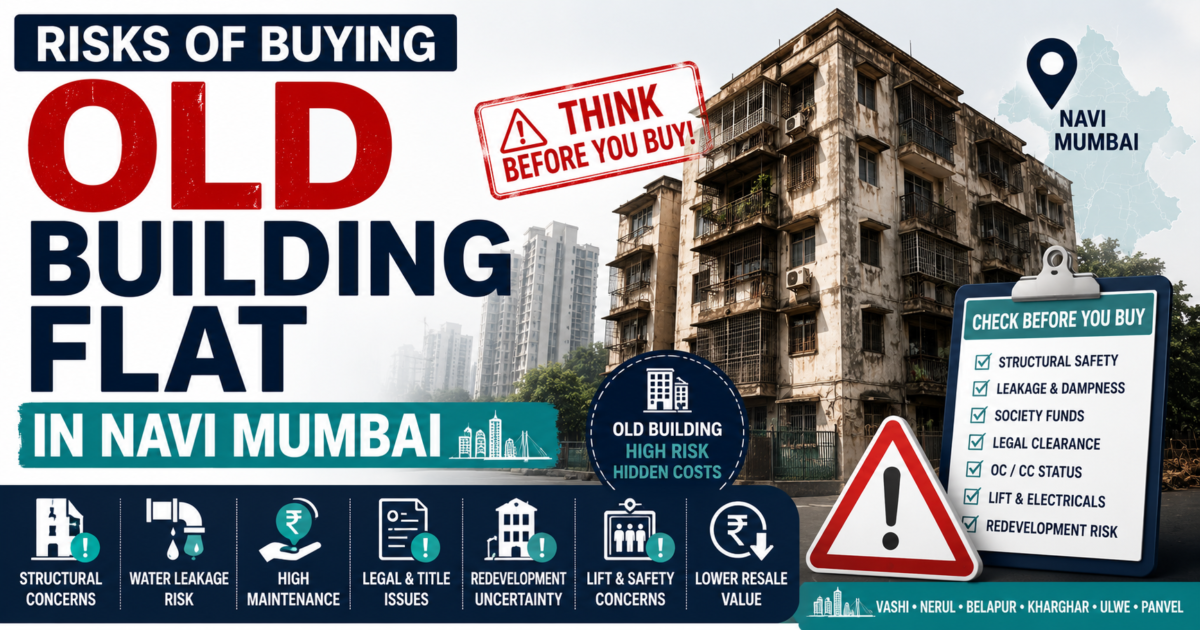
Risks of Buying Old Building Flat in Navi Mumbai: Buyer Checklist

The main risks of buying old building flat in Navi Mumbai are weak structure, missing OC or CC, unclear title, unpaid society dues, hidden mortgage, illegal alterations, no conveyance, and false redevelopment promises. Before paying token money, check the structural audit, society records, title chain, IGR records, MahaRERA status if applicable, CIDCO/NAINA permissions, and CRZ or land-use restrictions where relevant. Is Buying an Old Building Flat Risky? Buying an old building flat is not automatically bad. Many old buildings in Vashi, Nerul, Kopar Khairane, Airoli, Ghansoli, Belapur, Kharghar or Panvel have good locations, bigger usable space and active societies. But the risk is higher than buying a newer flat. Why? Because old flats usually carry more history. There may be multiple past owners, old agreements, missing original documents, repair issues, society disputes, unpaid dues, weak structure or redevelopment rumours. So the right question is not “Is old flat good or bad?” The right question is: Can this old flat pass legal, structural, society and authority verification before I pay token money? If the answer is no, pause the deal. This is an educational guide. Verify the latest position with the relevant authority or a property lawyer before making a transaction. Main Risks of Buying Old Building Flat 1. Weak Structure or Dangerous-Building Risk This is the biggest old-building risk. A flat may look renovated from inside, but the building may have: leakage, cracks, exposed steel, weak columns, terrace seepage, lift problems, poor drainage, unsafe staircases. In Navi Mumbai, structural safety is a serious issue for old buildings. Buyers should ask whether the society has completed a recent structural audit through a qualified structural engineer. Do not trust only fresh paint, new tiles or a renovated kitchen. A renovated flat inside a weak building is still a risky purchase. Ask for: Check Why it matters Structural audit report Shows building condition Repair recommendations Shows pending safety work Dangerous-building notice Shows municipal risk Engineer certificate after repair Shows whether repair was completed Society repair fund status Shows whether society can handle major repairs 2. Missing OC, CC or Approved Plan OC means Occupancy Certificate. CC means Commencement Certificate. The approved building plan shows what was legally permitted. For an old flat, these documents help you check whether the building and flat were built with proper approval. If OC, CC or approved plans are missing, it can affect resale, home loan, redevelopment, repair permission and future buyer confidence. Ask for: OC, CC, approved building plan, completion certificate, if available, municipal or planning authority records. The correct authority depends on the location. It may be NMMC, Panvel Municipal Corporation, CIDCO, NAINA or another planning authority. 3. Unclear Title Chain Old flats may have many past transactions. The seller may have purchased it, inherited it, received it through gift deed, or got it after family settlement. So check the title chain properly. Ask for: current sale deed, previous sale agreements, Index II, share certificate, title deed, gift deed, release deed or heirship documents, if applicable, death certificate and legal heir documents in inheritance cases, Power of Attorney, if the seller is not personally signing. A document supports verification. It should not be treated as automatic ownership proof without lawyer review. If seller name, society record and registered document do not match, do not pay token money. — 4. Society Share Certificate and Membership Issues In a cooperative housing society, the share certificate is important. It should show the seller as the society member. Also check: society NOC, no-dues certificate, transfer forms, maintenance payment record, repair fund dues, pending disputes, redevelopment meeting records, if any. If the seller says “society will give documents later,” pause. For old flats, society records often reveal hidden problems faster than the broker does. 5. No Conveyance or Deemed Conveyance Many old societies still have weak land/title documentation. Conveyance means the land and building rights are transferred to the society. Deemed conveyance is a legal route where society applies to get conveyance when the builder has not completed it. This becomes very important during redevelopment. If the seller or broker says “redevelopment is coming soon,” ask: Does the society have conveyance or deemed conveyance? Has the society passed redevelopment resolutions? Is a developer selected? Is there a development agreement? Are rent, corpus, extra area and timelines written? Is the project registered with MahaRERA where applicable? Do not pay a higher price only because someone says redevelopment will happen. A redevelopment promise is not the same as redevelopment approval. 6. Hidden Loan, Mortgage or Litigation An old flat may have a pending loan, bank charge, family dispute or court matter. Check: bank NOC, loan closure letter, CERSAI search, IGR search, litigation search by lawyer, society dispute records, whether all co-owners are signing. IGR Maharashtra eSearch can support document-history checking, but online eSearch information should not be treated as an ownership certificate. Use it as a verification tool, not as final legal proof.  7. Unpaid Society Dues and Repair Liabilities Old buildings may have high repair costs. Before purchase, check whether the seller has cleared: monthly maintenance, sinking fund, repair fund, property tax, water dues, electricity dues, parking charges, penalty charges, redevelopment contribution, if any. Ask for written no-dues confirmation from the society. Do not rely only on the seller’s statement.  8. Illegal Alterations Inside the Flat Many old flats have internal changes. Common examples: enclosed balcony, shifted kitchen, changed bathroom position, broken internal walls, loft or mezzanine, duct modification, merged rooms, parking conversion. Some changes may be minor. Some may affect structure, drainage, fire safety or approval compliance. If the flat has major changes, ask for society permission and relevant approval where needed. For structural changes, verify with an architect or structural engineer. 9. CIDCO, NAINA, Gaothan, NA or CRZ Risk This applies more in areas such as Panvel, Ulwe, Taloja, Dronagiri, Uran, Raigad belt, gaothan pockets, village-side properties and NAINA-influence areas. For such properties, flat-level documents may not be enough. You may also need to check: Area / issue What

Read More

Risks of Buying Gaothan Property in Navi Mumbai: Buyer Checklist

In Maharashtra, “gaothan” or “village site” generally refers to land included within the site of a village, town or city as determined under the Maharashtra Land Revenue Code. [1] In simple words, it is usually connected to the original village settlement area. But this is the part buyers often misunderstand: Gaothan status does not automatically mean clear ownership, legal construction or safe resale title. A property may be inside a gaothan area, but the seller may still have incomplete title, pending mutation, family disputes, missing permissions, access problems, CIDCO transfer issues, NAINA planning restrictions or CRZ-related restrictions. This is especially important in Navi Mumbai, Panvel, Ulwe, Taloja, Dronagiri, Uran, Raigad and Thane belt, where gaothan, CIDCO, NAINA, Gram Panchayat, municipal and revenue records can overlap. Main Risks of Buying Gaothan Property Risk Why it matters What to check Unclear ownership Seller may not have full right to sell Title chain, sale deeds, heirship papers Family dispute Ancestral property may need consent from legal heirs Release deed, family NOC, succession papers Seller name mismatch Seller may not match revenue or city survey records 7/12, property card, mutation Pending mutation Name transfer may be incomplete or objected Ferfar / mutation status Fake CIDCO claim Seller may claim future allotment or transfer CIDCO allotment, lease, NOC, transfer papers NAINA approval confusion Plot may need planning permission CIDCO/NAINA CC, OC, zoning, BP number Unauthorized construction Existing structure may not be sanctioned Sanctioned plan, CC, OC CRZ or green-zone issue Development may be restricted CZMP, zone certificate, planning authority check No legal access road Physical access may not be legal access Layout road, right of way, survey map Loan or encumbrance Property may be mortgaged or disputed IGR search, bank NOC, lawyer title search Documents to Check Before Buying Gaothan Property Do not check only one document. You need a connected picture. Document What it supports Red flag Sale deed / title chain Past transfers Missing previous documents 7/12 extract Rural land record details Seller name mismatch Property card City survey / CTS record Wrong area or owner name Mutation / Ferfar entry Revenue-record update Pending or objected mutation 8A extract Landholding account details Different holder name Index II Registered transaction summary Wrong property number Encumbrance / loan check Mortgage or charge risk Existing bank charge CIDCO allotment / lease papers CIDCO-related claim “Transfer later” promise NAINA / CIDCO permission Development approval No valid BP / CC record Sanctioned plan, CC, OC Building legality Built structure without approval CRZ / CZMP check Coastal restriction Plot near creek, mangrove or coast Tax receipt Payment history Used as “ownership proof” POA / heirship documents Seller authority Unregistered or old POA Tax receipt, electricity bill, possession or old village reputation is not enough to confirm saleable title. These documents only support verification. They do not replace a proper title search. How to Verify Gaothan Property in Navi Mumbai Step 1: Identify the exact property type First identify what you are buying: Old village house Gaothan plot Gaothan expansion property CIDCO 12.5% plot NAINA-area plot Gram Panchayat property Resale flat in old gaothan structure Unauthorized room or structure Each type has a different verification path. Step 2: Identify the correct authority Depending on the location, records may involve: Gram Panchayat Talathi office Tahsildar office City Survey office NMMC Panvel Municipal Corporation CIDCO CIDCO-NAINA MahaRERA MCZMA / CZMP authority For example, a plot near Panvel or Ulwe may need revenue-record verification plus NAINA planning verification. A property near Uran, Dronagiri, creek-side belts or mangrove-sensitive areas may also need CRZ/CZMP review. Step 3: Match all numbers Match the survey number, gat number, CTS number, plot number, area, boundaries and owner name across all documents. If the numbers do not match, stop. Do not accept “small spelling mistake” or “old record problem” casually. Ask the seller to correct or explain it before token money. Step 4: Check 7/12, property card and mutation For rural or semi-rural land, check the 7/12 extract. For city survey property, check the property card. For ownership updates, check mutation or Ferfar status. Ferfar means mutation entry the revenue-record update made after sale, inheritance, partition or other ownership change. Mahabhumi provides mutation and property-card application status checks. [2] Step 5: Check registration history on IGR Use IGR Maharashtra eSearch to check registered transaction history, Index II and document references. But be careful. IGR itself states that eSearch data is for information and is not an ownership certificate. Certified copies should be taken from the concerned Sub Registrar Office when needed. [3] Step 6: Check CIDCO and NAINA records If the seller mentions CIDCO, CIDCO 12.5% scheme, NAINA, development permission, final plot, BP number, commencement certificate or occupancy certificate, verify it from official CIDCO/NAINA records. CIDCO has official pages for the 12.5% scheme, online application, lottery results and allotment status. [5] CIDCO’s NAINA section also lists planning items such as development plan, building permission, NAINA DCPR, zoning certificate system, commencement certificate and occupancy certificate lists. [6] Step 7: Check MahaRERA if it is a project sale If the property is part of a builder project, redevelopment project or apartment sale, check MahaRERA. MahaRERA provides search options for projects, promoters, real estate agents, complaints, registered projects and revoked projects. [4] MahaRERA registration is useful, but it does not replace title search, land-record verification or approval verification. Step 8: Check CRZ, green zone and no-development risk For coastal, creek-side or mangrove-sensitive areas, check CRZ/CZMP status. MCZMA publishes approved CZMP maps for districts including Mumbai, Raigad and Thane. [7] This matters for locations around Uran, Dronagiri, Ulwe, Panvel belt, Thane creek-side pockets and other sensitive zones. A map screenshot is not enough. For transaction decisions, verify with the planning authority, environmental consultant or property lawyer. Step 9: Be careful with NA permission claims Maharashtra’s 2025 land-revenue changes have affected the separate NA permission process in certain planning-compliant situations. The safer buyer view is this: If land use is allowed under the development plan or regional plan and the planning authority grants

Read More