
Blogs

Everything about Navi Mumbai

Ghansoli IT Corridor Real Estate Impact: What Buyers Should Check Before Paying Token

Ghansoli’s IT corridor impact is real mainly because of employment demand from Reliance Corporate Park, Thane-Belapur Road, Rabale, Mahape and Airoli. This helps rental demand and resale interest. But do not buy only because a broker says “IT corridor.” Before token money, verify title, IGR records, OC/CC, MahaRERA, land records, CRZ risk and municipal or CIDCO approvals. This is an educational guide. Verify the latest position with the relevant authority or a property lawyer before making a transaction. Quick Verdict Ghansoli is a strong practical location for people working around Reliance Corporate Park, Rabale, Mahape, Airoli and the wider Thane-Belapur business belt. The biggest real estate impact is not “guaranteed price growth.” It is simpler: Impact Area What Ghansoli Gets Buyer Caution Rental demand Working professionals prefer shorter commute Check actual building-wise rent Resale liquidity More end-user demand than isolated areas Liquidity depends on documents and building quality Price premium IT proximity can support demand Do not overpay for a marketing tag Investment safety Better employment catchment Weak title or missing OC can damage the deal For broader context, this article connects with Navi Mumbai employment hubs real estate impact. Why Ghansoli Gets IT Demand Reliance Corporate Park Effect Reliance Corporate Park is one of the strongest employment anchors around Ghansoli. Many buyers and tenants consider Ghansoli because it keeps them close to large office campuses, business parks and the Thane-Belapur Road corridor. This matters because real estate demand usually follows daily convenience. A tenant may not care about a “future promise” if the daily commute is painful. Ghansoli’s advantage is that many jobs are already within reachable distance. Rabale, Mahape and Airoli Spillover Ghansoli also benefits from nearby employment belts. A person working in Rabale MIDC, Mahape, Airoli, Kopar Khairane or along Thane-Belapur Road may still consider Ghansoli if the rent, society quality and commute make sense. This is why Ghansoli should not be judged alone. Compare it with Airoli IT Park property impact, Rabale MIDC impact on nearby property and best Navi Mumbai areas for IT employees before deciding. Rail and Road Connectivity Ghansoli has local train access and road connectivity toward Thane-Belapur Road, Kopar Khairane, Rabale, Airoli and Vashi side. But do not depend only on map distance. Visit during office hours. Check actual travel time, parking, traffic bottlenecks, station access and last-mile transport. Real Estate Impact on Rentals and Resale Rental Demand Rental demand is the clearest Ghansoli IT corridor impact. A working professional normally wants three things: 1. Short commute 2. Safe building and society 3. Predictable monthly cost If a flat gives these three, it has better tenant demand. This is why 1 BHK and 2 BHK units near usable transport, offices, hospitals and daily needs can attract steady interest. But rental demand is building-specific. Two flats in the same area can perform differently because of maintenance, parking, lift condition, society rules, water supply, view, furnishing and distance from the station or office belt. Use the article employment impact on rental demand in Navi Mumbai as the next supporting read. Resale Liquidity Ghansoli can have better resale liquidity than areas with weaker employment access. End-users like locations where they can live and work without depending on long travel. Still, liquidity is not automatic. A flat with missing OC, unclear title, heavy repairs, high maintenance, parking disputes or poor society records can be difficult to sell. Price Premium Ghansoli may command a premium in certain pockets because of employment access. But a premium is justified only when the property also has: Clear title chain Occupancy Certificate, where applicable Proper society records Loan eligibility Good building condition Realistic rent potential Clean access and parking Do not pay extra only because the listing says “near IT corridor.” Best Buyer Fit IT Employee End-Use Buyer Ghansoli can work well if your job is in RCP, Airoli, Rabale, Mahape or the Thane-Belapur belt. Before buying, compare: Question Why It Matters Is commute practical daily? Saves time and fatigue Is the building loan-approved? Reduces transaction risk Does the society maintain records? Helps resale and dispute control Is the price justified by actual comparables? Prevents overpaying NRI Landlord For NRIs, Ghansoli may work if the building has regular rental demand and manageable society operations. But NRIs should avoid properties where constant local follow-up is needed. Choose cleaner documentation, stable society management and easier tenant demand. Rental Investor A rental investor should not think only about appreciation. Check rent-to-price ratio, vacancy risk, tenant profile, maintenance, repair cost and resale exit. A high-priced flat with average rent may not be a strong investment. Micro-Locations to Compare Ghansoli Station Side Useful for tenants who depend on rail travel. Usually easier for daily commuting. Check noise, parking and walkability. RCP / Thane-Belapur Road Side Strong employment story. Good for office proximity. Check traffic, pollution, road access, commercial activity and actual distance from the office gate. Ghansoli Gaon and Older Pockets Be more careful in older village-style or gaothan-linked pockets. Check title chain, mutation entry, property card, 7/12 extract where applicable, access road and society or municipal status. If there is any mismatch, verify before transaction with a lawyer or revenue office. Creek or Mangrove-Edge Parcels If a plot or building is near creek, mangroves, waterbody or environmentally sensitive land, check CRZ/CZMP and MCZMA records. Do not rely on broker assurance. A map screenshot is not enough. Documents to Check Property Type Key Checks Resale flat Sale deed, Index II, title chain, share certificate, society NOC, OC, CC, approved plan, tax dues, loan NOC, maintenance dues Under-construction flat MahaRERA number, project status, promoter status, completion date, complaints, sanctioned plan, CC, phase details, agreement for sale Plot / gaothan / fringe land 7/12, 8A, property card, mutation entry, survey/CTS number, title chain, access road, NA/development permission, zoning, CRZ risk Older building OC, structural condition, society records, repair history, redevelopment discussion, pending dues Marathi terms explained: 7/12 extract: Land record showing survey details, holder name and land-use information for agricultural/revenue land. 8A: Record linked to landholding and

Read More

Navi Mumbai IT Hubs Property Impact: Where Demand Rises and What Buyers Must Verify

The Navi Mumbai IT hubs property impact is strongest around Airoli, Ghansoli, Kopar Khairane, Rabale, Mahape and Turbhe because these areas are closer to major office and industrial employment zones. Spillover demand can also reach Kharghar, Taloja, Ulwe, Panvel and NAINA. But IT demand alone does not make a property safe. Always verify title, RERA, land records, approvals, NA status, CRZ risk and OC before token money. Disclaimer: This is an educational guide. Verify the latest position with the relevant authority or a property lawyer before making a transaction. Why IT Hubs Matter in Navi Mumbai IT hubs affect property in a simple way. More offices create more jobs. More jobs create rental demand. Rental demand improves resale liquidity. Better liquidity can support price premiums in areas with good commute, railway access, road access, and liveable housing stock. This is why Airoli, Ghansoli, Kopar Khairane, Rabale, Mahape, Turbhe and Sanpada often come into the discussion when buyers search for residential areas near IT hubs in Navi Mumbai. For the bigger corridor view, internally link to Navi Mumbai employment hubs real estate impact. But there is one mistake buyers make. They assume “near IT hub” automatically means “safe investment.” That is wrong. A good property near an IT hub must pass two tests: Test What it means Demand test Will tenants, end-users or resale buyers want this location? Document test Is the title, approval, land use and construction status safe enough to proceed? If either test fails, the buyer should pause. Area-Wise Navi Mumbai IT Hubs Property Impact IT / employment zone Better-fit residential areas Likely property impact Main caution Airoli Airoli, Ghansoli, Kopar Khairane, Thane edge Strong rental and end-user demand from IT employees Price premium, older buildings, OC and society documents Ghansoli Ghansoli, Kopar Khairane, Airoli Practical residential belt for IT and corporate employees Check title, OC, society records and redevelopment risk Rabale / Mahape Rabale, Ghansoli, Kopar Khairane, Mahape-side pockets Demand from IT, ITeS, data centre, MIDC and corporate activity Industrial traffic, leasehold/MIDC restrictions, permitted use Turbhe / Sanpada / Vashi Sanpada, Vashi, Juinagar, Turbhe Mature connectivity and office/industrial access Older buildings, structural condition, OC, society conveyance Kharghar / Taloja Kharghar, Taloja, Roadpali, Kalamboli Budget spillover from job hubs and future connectivity Commute, approvals, land use, construction quality Ulwe / Panvel / Pushpak / NAINA Ulwe, Panvel, Pushpak Node, NAINA villages Future demand linked to airport, logistics and planning zones NAINA zoning, TPS, title, access road, NA, CRZ, reservations For deeper micro-market articles, internally link to Airoli IT Park real estate impact, Ghansoli IT corridor property impact, and Rabale MIDC property impact. Best Areas by Buyer Type Buyer type Better-fit areas Why Main check IT employee end-user Airoli, Ghansoli, Kopar Khairane, Sanpada Shorter commute to office zones OC, title, society records Rental investor Airoli, Ghansoli, Kopar Khairane, Mahape-side pockets Regular tenant demand Do not overpay only because of “IT hub” branding Budget buyer Kharghar, Taloja, Kalamboli, Panvel More affordable than core IT belt Commute time, RERA, approvals Plot buyer NAINA, Panvel, Pushpak-side, selected Raigad belts Long-term planning story Title, 7/12, ZCS, TPS, NA, access road NRI buyer RERA projects in established nodes Easier verification and rental management Lawyer review, POA, tax and possession documents For rental-focused decisions, internally link to employment impact on rental demand Navi Mumbai. Documents to Check Before Trusting the IT Hub Story Employment demand can increase interest in a location. It cannot clean a bad title. Before paying token, check documents based on the property type. For flats and apartments Check: MahaRERA registration, if applicable Project status on MahaRERA Agreement for sale Title report Commencement Certificate Occupation Certificate Sanctioned plan Building completion documents Society registration Share certificate for resale flats Maintenance dues and property tax Parking allotment proof RERA registration supports transparency. It does not remove the need for title, approval and OC verification. For plots and land Check: 7/12 extract, also called Satbara 8A extract Property card, where applicable Mutation entries, also called Ferfar Title chain IGR Index II Sale deed history Encumbrance, mortgage or charge Land-use zone NA status or applicable land-conversion process Access road DP, RP or TPS reservation Litigation, acquisition or family dispute risk Plain meaning: Term Simple meaning 7/12 / Satbara Rural land record showing survey number, holder details and land information 8A Village account extract connected to land holding Mutation / Ferfar Revenue-record entry after sale, inheritance, partition or other change Property card Urban land record for city survey / CTS property Index II Registered document summary from the registration department These records support verification. They should not be treated as complete ownership proof by themselves. For land-record help, internally link to check 7/12 mutation and property card online. For CIDCO, NAINA and leasehold property Check: Allotment letter Lease deed Transfer permission CIDCO NOC, where applicable Final order or possession letter Approved layout CC and OC NAINA Zone Confirmation Statement Town Planning Scheme status Development Plan reservation DCPR compliance For NAINA buyers, internally link to verify NAINA plot zoning and TPS status. For CRZ or creek-side locations Be extra careful in areas close to creeks, mangroves, coastal influence or low-lying land. Check: CRZ applicability CZMP map MCZMA recommendation, if required MoEFCC clearance, if required Mangrove or buffer restrictions Development permission conditions This can matter in parts of Ulwe, Dronagiri, Uran, Panvel creek-side pockets, Belapur, Nerul and other coastal-influence zones. How to Verify the Property Do not rely only on broker-forwarded PDFs or WhatsApp screenshots. Use official portals and professional review. Step 1: Check MahaRERA Use MahaRERA for under-construction projects and registered plotted developments. Check: Project registration Promoter name Project status Uploaded approvals Complaints and orders Lapsed or revoked status Quarterly updates Step 2: Check land records Use Mahabhumi / Mahabhulekh for 7/12, 8A, property card, mutation and related land-record checks. Match names, survey numbers, area, village, taluka and mutation entries. Step 3: Check registration records Use IGR Maharashtra to check registered document records, Index II and transaction history. This helps verify whether the claimed sale deed or

Read More

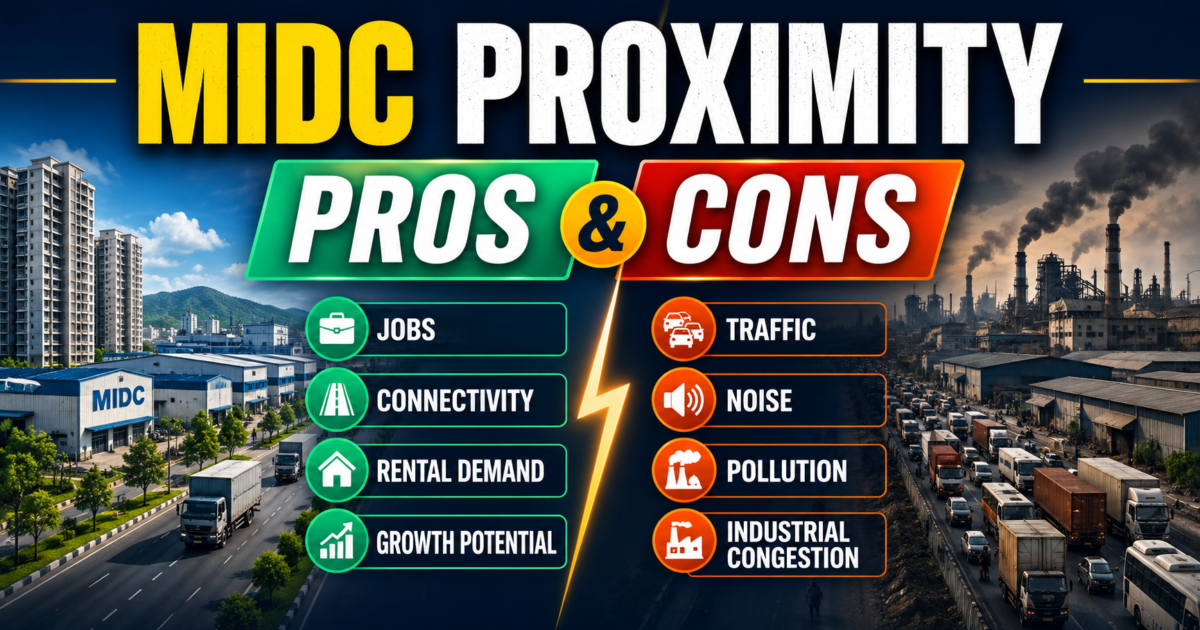
MIDC Proximity Pros and Cons in Navi Mumbai: What Buyers Must Check Before Token

MIDC proximity can be good for rental demand, job access and resale liquidity. But it can also bring pollution, truck traffic, noise, zoning restrictions, leasehold complications, CRZ risk, NAINA planning issues and title-verification problems. In Navi Mumbai, the right decision depends on the exact belt, distance from the industrial area, land use, approvals and documents verified before paying token money. To see the larger picture, buyers should first understand how Navi Mumbai’s employment hubs are shaping real estate demand before judging any MIDC-side property. Disclaimer: This is an educational guide. Verify the latest position with the relevant authority or a property lawyer before making a transaction. What MIDC Proximity Means in Navi Mumbai MIDC proximity means the property is close to an industrial, IT, logistics or manufacturing belt developed around Maharashtra Industrial Development Corporation areas. In Navi Mumbai, this usually includes belts such as: Rabale MIDC Mahape MIDC TTC Industrial Area Turbhe / Pawane industrial belt Taloja MIDC Uran / Dronagiri / JNPT logistics belt Panvel and NAINA-side industrial-growth pockets But “near MIDC” is not one single advantage. A flat 3 km away from an employment hub is different from a plot next to a chemical unit, truck road or drainage channel. Buying near MIDC is not the same as buying an actual MIDC leasehold industrial plot or unit. MIDC leasehold property has separate transfer, use, dues and permission checks. Pros of Buying Near MIDC 1. Better Rental Demand Employment hubs create rental demand. Workers, managers, small business owners, logistics staff and service providers often prefer homes near work. This can help areas around Airoli, Ghansoli, Rabale, Mahape, Kopar Khairane, Taloja, Turbhe, Sanpada and Panvel. But do not assume guaranteed rent. Rental demand depends on the building quality, commute time, road access, public transport, safety, pollution level and monthly maintenance. 2. Shorter Commute for Working Professionals For buyers working in Rabale, Mahape, Airoli IT parks, Turbhe, Taloja MIDC or JNPT-side logistics companies, nearby housing can reduce daily travel stress. This is one reason some buyers prefer Ghansoli, Airoli, Kopar Khairane, Kharghar, Kalamboli, Panvel or Ulwe depending on workplace location. 3. Demand for Small Commercial Spaces MIDC belts also create demand for: Food outlets Staff accommodation Transport offices Repair services Warehousing support Small offices PG-style rental housing For commercial buyers, this can be useful. But the unit must have proper commercial permission, parking, access, fire safety and society approval where applicable. 4. Price Advantage in Some Micro-Markets Some properties near industrial belts are cheaper than premium residential pockets. That can be an opportunity. But lower price may also reflect pollution, truck movement, title risk, illegal land use, poor access or future resale hesitation. Cheap should not mean unchecked. Cons of Buying Near MIDC 1. Pollution and Odour Risk Industrial areas may have air-quality, odour, dust, smoke, chemical or drainage concerns depending on the belt and activity. This is especially important near Taloja MIDC, Turbhe, Pawane, Rabale, Mahape and some JNPT-side logistics routes. Do not decide from a Sunday afternoon visit. Visit in the morning, evening and night. 2. Truck Traffic and Noise MIDC and logistics belts often have heavy vehicle movement. This can affect family living, senior citizens, children, parking and road safety. Check truck routes near Turbhe, Taloja, Dronagiri, Uran, JNPT, Pawane and industrial service roads. 3. Resale Hesitation Some tenants like being near work. But many family buyers avoid properties too close to factories, warehouses, smoke, noise or truck routes. This can reduce resale demand in some pockets. 4. Zoning and Land-Use Confusion A common mistake is assuming that all land near MIDC can be used for residential or commercial construction. It cannot. For plots and land parcels, check the development plan, zoning, NAINA status, CRZ/CZMP status, green zone, no-development-zone restrictions and access road legality. 5. MIDC Leasehold Complications If you are buying an actual MIDC industrial plot, shed or unit, check: Agreement to Lease Lease deed MIDC allotment letter MIDC transfer approval Dues certificate Water/service/CETP dues, if applicable Permitted industrial use MPCB consent, if applicable Fire and factory compliance, if applicable Do not treat MIDC leasehold property like normal freehold land. Area-Wise MIDC Proximity Risk Table Belt / Area Buyer Upside Main Risk Must Check Rabale / Airoli / Ghansoli / Mahape IT, industrial and office rental demand Traffic, industrial exposure, resale preference MahaRERA, OC, title, pollution/site visit Turbhe / Pawane / Sanpada / Vashi Strong commercial and transport access Truck movement, noise, older industrial pockets OC, society records, access, land use Taloja / Kharghar / Kalamboli / Panvel Affordability, MIDC and future growth narrative Pollution, NAINA/zoning confusion, land conversion risk 7/12, mutation, NAINA ZCS, DP, approvals Dronagiri / Uran / JNPT Port, logistics and warehousing demand CRZ, mangroves, truck routes, infrastructure gaps CRZ/CZMP, title, access road, approvals Pushpak / NAINA / Airport Influence Area Airport and planning-area demand Overhyped land sales, unclear permission, plot risk CIDCO/NAINA, 7/12, IGR, development permission Documents to Check Before Buying Near MIDC For Flats or Under-Construction Projects Check: MahaRERA registration number Project name and promoter name Landowner details Legal title report Encumbrance details Layout approval Building plan approval Commencement Certificate Occupancy Certificate or partial OC Agreement for Sale draft Parking details Society registration, if resale Conveyance status, if resale Pending litigation or complaints MahaRERA project documents help buyers verify whether the project has basic uploaded legal, financial and technical records. Still, buyers should verify originals with a lawyer before transaction. For Plots, Land and Gaothan Property Check: 7/12 extract 8A extract Mutation entries Property card, where applicable Survey number or CTS number Village map or survey map IGR registered document search 30-year title chain Encumbrance or mortgage check Access road proof Zoning certificate NAINA status, where applicable CRZ/CZMP status, where applicable NA permission or applicable development permission position DP road reservation, acquisition or no-development-zone risk 7/12 extract means the village land record showing survey number, landholder details, crop/land-use entries and other revenue details. It supports verification, but it should not be treated as final ownership proof by itself. Mutation entry means

Read More

JNPT Real Estate Impact on Navi Mumbai: Areas, Risks & Buyer Checklist

JNPT real estate impact is visible in Dronagiri, Uran, Ulwe, Panvel, Pushpak Node and nearby logistics-linked areas. The port, SEZ, container terminals, warehousing, transport links and employment activity can support property demand. But “near JNPT” is not enough reason to buy. Buyers must verify title, 7/12, IGR records, CIDCO or NAINA approvals, CRZ/CZMP status and MahaRERA details before paying token money. Disclaimer: This is an educational guide. Verify the latest position with the relevant authority or a property lawyer before making a transaction. What JNPT Real Estate Impact Really Means JNPT, now officially known as JNPA, is one of India’s most important container ports. Its impact on real estate comes from jobs, transport activity, logistics, warehousing, port-linked businesses, export-import movement, and long-term infrastructure planning. But this impact is not equal everywhere. A flat in Ulwe, a CIDCO plot in Dronagiri, a resale property in Uran, and a NAINA village plot near Panvel do not carry the same risk. The demand story may sound similar, but the documents are completely different. Simple rule: JNPT can support demand, but documents decide safety. Why JNPT Matters for Navi Mumbai Property JNPT matters because it is not only a port. It is an economic engine. The port supports container movement, port operations, customs-linked services, transport companies, warehousing, cold storage, freight forwarding, export-import businesses and industrial users. This creates direct and indirect employment. That employment can support housing demand in nearby areas. For real estate buyers, JNPT matters in three ways: Impact area What it means for buyers Employment More workers, managers, transporters and service providers need housing Logistics Warehousing, CFS, ICD, container movement and SEZ activity create commercial demand Connectivity Port roads, Atal Setu, airport-side development and freight corridors can improve access But this does not mean every property near JNPT will appreciate. Some locations may perform well. Some may remain slow. Some may have legal, CRZ, title, access road or approval problems. Areas Most Affected by JNPT Dronagiri and Uran Dronagiri and Uran are among the most directly affected locations because they sit closer to the port and port-linked movement. Dronagiri attracts attention because of CIDCO planning, port proximity, future connectivity and relative affordability compared to established Navi Mumbai nodes. Uran is more mixed. It has old settlements, village land, coastal influence, port-related movement and land parcels with different legal histories. For buyers, these areas need extra care. Check: CIDCO allotment or lease documents MahaRERA project details sanctioned plan, CC and OC CRZ/CZMP status title chain access road pending dues or transfer permissions Do not buy only because someone says “JNPT nearby.” Ulwe and Pushpak Node Ulwe and Pushpak Node may benefit from a combined story: JNPT, Navi Mumbai International Airport, Atal Setu, logistics activity and airport-side development. These areas are more suitable for flat buyers and long-term investors than risky document-heavy land buyers. But overpricing is a real risk. If the seller is charging a heavy “future infrastructure premium,” check whether current rental demand and liveability justify the price. For under-construction projects, verify MahaRERA details. For resale flats, check society records, OC, property tax, share certificate, loan NOC and registered agreement chain. Panvel and NAINA Villages Panvel and NAINA areas may see indirect JNPT and logistics impact. But land and plot buying here needs serious verification. A broker may say: “This land is near JNPT, airport, DFC and logistics park.” That statement alone is not enough. For NAINA and Panvel-side land, check the 7/12 extract, 8A, mutation entries, zoning, NAINA Development Plan, ZCS, layout approval, road access and development permission. If the land is agricultural, gaothan, inherited, jointly owned or part of a plotted layout, take legal review before token. Kharghar, Taloja and Kalamboli These locations may benefit from the wider Navi Mumbai employment and logistics ecosystem, but their JNPT link is indirect. Kharghar is stronger for residential lifestyle and connectivity. Taloja has MIDC and industrial influence. Kalamboli has transport, warehousing and highway-side advantages. Do not treat these locations as direct “JNPT premium” areas unless the property has clear demand logic. JNPT Impact by Location Location JNPT impact level Best suited for Main risk Must-check documents Dronagiri High Long-term buyers, port-linked investors CRZ, CIDCO terms, project delay CIDCO papers, MahaRERA, CC/OC, CZMP check Uran High Land buyers, port-linked users Title, agricultural land, CRZ, access 7/12, mutation, IGR search, CZMP, NA/planning status Ulwe Medium-high End-users, rental investors Overpaying for future growth RERA, OC, society papers, title chain Pushpak Node Medium-high Airport/logistics-led buyers Future-infra pricing CIDCO/NAINA status, approvals, RERA Panvel / NAINA Medium-high Plot buyers, long-term investors Zoning, layout approval, NA ambiguity 7/12, ZCS, NAINA permission, IGR, title search Kharghar / Taloja / Kalamboli Medium End-users, rental buyers Weak direct JNPT link RERA, title, commute, rental demand Flats vs Plots Near JNPT For Flat Buyers Flat buyers should focus on legal approval, project status and liveability. Check: MahaRERA registration project phase sanctioned plan commencement certificate occupancy certificate registered agreement society formation conveyance or lease structure actual commute to job hubs resale and rental demand A RERA number alone is not enough. Match the project name, phase, promoter name, building details and possession status. For Plot and Land Buyers Plot buyers face more risk than flat buyers. Why? Because a plot may be sold on future potential, not current legal buildability. Check: 7/12 extract, also called Satbara 8A extract mutation entries, also called Ferfar title chain IGR registered document search land-use zone NAINA status CRZ/CZMP status road access NA or planning permission position sanctioned layout approval A 7/12 extract supports land-record verification. It should not be treated as full ownership proof by itself. For Rental Investors JNPT can support rental demand, but the tenant profile may differ from IT hubs like Airoli or Ghansoli. Near JNPT, demand can come from: port employees logistics managers transport operators CFS and ICD workers customs-linked professionals airport and logistics workers small business owners Before buying for rent, check actual demand in the building, not only future promises. Documents to Check Before Paying Token Money This is the most

Read More

IT ITeS Growth and Navi Mumbai Real Estate: What Buyers Must Check Before Investing

IT/ITeS growth is a real demand driver for Navi Mumbai real estate, especially around Airoli, Ghansoli, Mahape, Rabale, Turbhe and nearby residential areas. But job growth does not make every property safe. Before paying token money, buyers must verify MahaRERA status, title chain, 7/12, 8A, property card, IGR records, CIDCO/NAINA zoning, NA/development permission, CRZ/CZMP and occupancy documents. This is an educational guide. Verify the latest position with the relevant authority or a property lawyer before making a transaction. Does IT/ITeS Growth Help Navi Mumbai Real Estate? Yes, IT/ITeS growth helps Navi Mumbai real estate when it creates actual job demand, office occupancy, rental demand and better resale liquidity. But the impact is not equal everywhere. A flat near Airoli or Ghansoli may benefit from daily office demand. A plot in Panvel, Ulwe, Pushpak, Dronagiri or NAINA may depend more on future infrastructure, zoning and long-term development. For the wider cluster, read Navi Mumbai employment hubs and property demand. The simple rule is this: Employment growth improves demand. Documents decide safety. Do not buy only because a broker says “IT hub,” “data centre,” “airport growth” or “Third Mumbai future.” These are demand signals, not legal approvals. Why IT/ITeS Is a Strong Demand Signal Navi Mumbai has a clear employment base along the Thane-Belapur belt. Airoli, Ghansoli, Mahape, Rabale and Turbhe are important because they connect office parks, IT/ITeS companies, MIDC areas, railway access and residential catchments. Airoli is especially important because of large office parks and its connection to Thane, Mulund, Vashi, Ghansoli and Mahape. This creates demand from employees who want shorter commute, better rental options and stable social infrastructure. Ghansoli benefits from proximity to Airoli, Reliance Corporate Park, Millennium Business Park and the wider Thane-Belapur corridor. Mahape and Rabale attract people who work near TTC/MIDC and want practical housing options. For buyers comparing Airoli, Ghansoli and Mahape, this detailed guide on Ghansoli IT corridor real estate impact explains the local property demand better. But not every location near an employment belt is automatically good. Buyers must check distance, connectivity, building quality, rent evidence, legal title and approval status. For a deeper local comparison, use Airoli IT Park property impact and Ghansoli IT corridor real estate impact. Which Navi Mumbai Areas Benefit Most? Area Main demand driver Buyer fit Main risk to check Airoli IT parks, office campuses, Thane-Belapur access IT employees, rental investors, end-users Premium pricing, OC/CC, society documents, RERA Ghansoli IT corridor, Reliance Corporate Park, Airoli/Mahape access Working professionals, rental buyers Project status, traffic, full vs partial OC Mahape IT, MIDC, commercial offices Office employees, practical commuters Industrial zoning, land-use mismatch Rabale MIDC, Airoli-Ghansoli proximity Budget buyers, rental investors Industrial nuisance, access, approval status Turbhe / Sanpada MIDC, station access, commercial activity End-users, redevelopment buyers Old buildings, conveyance, redevelopment risk Kharghar / Taloja Residential catchment, metro/road links, affordability Budget buyers, long-term investors Commute reality, project completion, RERA Ulwe / Panvel / Pushpak Airport, NAINA, logistics and future employment Long-term buyers, plot buyers NAINA zoning, TPS, NA/development permission Dronagiri / Uran JNPT, port and logistics economy Long-term investors CRZ, mangroves, industrial impact, access For area selection, read best Navi Mumbai areas for IT employees. How IT Jobs Affect Rental Demand IT/ITeS employees usually look for four things: Shorter commute Safe building and society Parking and lift quality Access to station, road, food and daily services That is why demand is usually stronger in areas with both employment access and liveability. Airoli and Ghansoli may perform better for daily office access. Sanpada, Vashi and Nerul may work for people who want better social infrastructure. Kharghar and Taloja may appeal to budget buyers who accept longer travel. For investors, the key question is not “Is there an IT hub nearby?” The better question is: Can this exact building attract a tenant at the rent I am assuming? Ask for rent evidence from the same building or same lane. Do not rely only on broker projections. Do Not Confuse MIDC Growth With Residential Safety Mahape, Rabale and Turbhe have strong employment activity. But MIDC proximity also creates checks that many buyers ignore. Some locations may face industrial traffic, noise, pollution, parking pressure or zoning limitations. If you are buying a flat, check livability. If you are buying land, check land use and development permission carefully. For this risk, read MIDC proximity pros and cons. Documents to Check Before Buying The document checklist depends on the property type. For Under-Construction Flats Check these before paying token: Document / record What to verify MahaRERA registration Project name, registration number, promoter name Project status Active, lapsed, revoked, suspended or abeyance Commencement Certificate Whether construction approval matches the claimed phase Occupancy Certificate Full OC or partial OC Approved layout Building, wing, floor and carpet area Agreement draft Carpet area, payment schedule, possession date, penalties Promoter updates Quarterly progress, complaints, changes, approvals Do not buy an under-construction flat only from brochure claims. Check MahaRERA first. For Resale Flats Check: Registered agreement chain Index II Share certificate Society NOC Property tax records Electricity bill Occupancy Certificate / Completion Certificate Conveyance or deemed conveyance status Loan closure letter, if the flat was mortgaged Pending society dues Any redevelopment notice or litigation A resale flat near an IT hub may look attractive because of rent demand. But if society documents are weak, resale and loan approval can become difficult. For Plots, NAINA Land and Gaothan Property Check: Term Plain English meaning 7/12 Utara / Satbara Village land record showing survey number, area, holder names and land details 8A extract Account/khata extract linked to landholding Ferfar / Mutation Change entry after sale, inheritance, partition or other event Property card Urban property record, often used for city survey/CTS properties NA permission Non-agricultural use permission or land-use conversion status ZCS Zoning Confirmation Statement, important in NAINA/CIDCO areas TPS Town Planning Scheme, used in planned development areas These documents support verification. They do not replace a full title search. For land-record basics, read 7/12, 8A and property card verification. What to Check Before

Read More

Integrated Logistics Park Navi Mumbai Impact: Real Estate, Jobs and Buyer Due Diligence

CIDCO’s proposed Integrated Logistics Park near Chirle / Pushpak Node can support logistics jobs, warehousing, transport activity and rental demand around Panvel, Ulwe, Dronagiri, Uran and nearby NAINA areas. But it does not make every nearby plot safe. Before paying token, buyers must verify title, 7/12, 8A/property card, IGR records, NAINA/CIDCO zoning, NA status, CRZ/CZMP, access road and RERA status. Disclaimer: This is an educational guide. Verify the latest position with the relevant authority or a property lawyer before making a transaction. Buyers should get their property documents verified before paying token and complete a property title search in Navi Mumbai to reduce title, zoning and approval-related risks. What Is the Integrated Logistics Park in Navi Mumbai? The Integrated Logistics Park is a proposed CIDCO-led logistics hub planned near Chirle village in Pushpak Node. Buyers studying this location should also read the Pushpak Node real estate guide to understand nearby connectivity, airport influence and approval-related risks.. The idea is simple: create a large logistics ecosystem close to major transport assets such as: JNPT / JNPA Navi Mumbai International Airport Mumbai Trans Harbour Link / Atal Setu Dedicated Freight Corridor Multi-modal transport corridors Panvel, Uran and Dronagiri industrial movement zones The park is expected to support uses like warehousing, cargo movement, container-linked facilities, logistics services, sorting, packaging, storage and light industrial activity where permitted. For property buyers, the main question is not only: “Will prices rise?” The better question is: Will this specific property become more useful, more rentable, legally safer, and easier to exit later? That answer depends on location, documents, approvals and actual project progress. Why the Integrated Logistics Park Matters for Real Estate A logistics park can change real estate demand in three ways. First, it can create employment. Logistics parks need managers, warehouse staff, drivers, transport operators, security teams, packaging teams, maintenance vendors and office support. Second, it can increase rental demand. People working around the corridor may prefer nearby homes in Panvel, Ulwe, Pushpak Node, Dronagiri, Uran or other connected areas. Third, it can increase demand for commercial and industrial support services. Small offices, godowns, staff housing, eateries, repair workshops, transport offices and last-mile delivery businesses may benefit. But there is one serious warning. Infrastructure can improve demand, but it does not fix bad title, wrong zoning, CRZ restrictions, unclear NA status or missing approvals. That is why the Integrated Logistics Park Navi Mumbai impact must be studied with both lenses: Lens What to Ask Growth lens Can this corridor increase jobs, rentals and commercial movement? Risk lens Is this specific property legally safe and approved for the claimed use? Area-Wise Property Impact Area Possible Benefit Main Risk to Check Pushpak Node / Chirle Closest impact zone for logistics activity and infrastructure-led attention Acquisition status, CIDCO/NAINA zoning, road access, land-use permission Ulwe Residential demand from airport, logistics and connectivity Project approval, RERA status, social infrastructure, flooding/access issues Panvel Rental and end-use demand from airport, logistics and industrial workforce Title, NA status, municipal/NAINA permissions, traffic congestion Dronagiri Port-linked and logistics-linked demand CRZ, mangroves, road connectivity, slow social infrastructure Uran JNPT/JNPA and coastal logistics relevance CRZ/CZMP, coastal restrictions, title and land-use limits Taloja Industrial and warehousing support demand MIDC proximity, pollution, truck movement, residential suitability Kharghar Better residential base for professionals, but indirect logistics impact Price premium, commute reality, project-stage risk NAINA villages Long-term planning impact around airport influence area ZCS, TPS, development permission, agricultural land status The highest upside may not always be closest to the logistics park. For residential buyers, a slightly better-connected and liveable location may perform better than a plot next to heavy truck movement.   Residential Impact: Who May Benefit? The residential impact may be visible in three buyer segments. 1. Working professionals People working in airport, logistics, warehousing, port services and industrial operations may look for rentals in Panvel, Ulwe, Pushpak Node, Dronagiri and nearby connected pockets. This can support rental demand, especially for practical 1 BHK and 2 BHK homes. 2. Investors Investors may look for properties near logistics-linked employment corridors. But they should avoid buying only on future promises. A property with clear title, RERA compliance, good access road and livable surroundings is usually safer than a cheap, unclear plot near a “future growth” claim. 3. Plot buyers Plot buyers face the highest risk. A land parcel may be marketed as “near logistics park” but still have issues like agricultural status, unclear mutation, CRZ impact, acquisition risk, no road access or NAINA zoning restrictions. Plot buyers must verify before token. Documents Buyers Must Check If you are buying a flat, plot, gaothan property, land parcel or under-construction project near this corridor, check these documents first. Document / Record Plain-English Meaning Why It Matters 7/12 extract Land record showing survey number, holder name, area, crop/use and remarks Helps verify land details, but does not by itself give complete title clearance 8A extract Village-level holding record showing land held by a person Helps cross-check ownership and landholding Property card Urban property record, often used in city survey areas Useful for CTS/property details Mutation / Ferfar entry Record of change after sale, inheritance, partition or other event Shows ownership flow, but mutation is not final title proof Index II Summary of registered property document Helps verify registered transactions Title search report Lawyer’s review of ownership and encumbrance history Critical before large payment NAINA / CIDCO zoning Land-use classification and planning status Shows whether proposed use is allowed NA / land-use permission Permission or legal basis for non-agricultural use where applicable Important for plots and land conversion CRZ / CZMP check Coastal-zone and map verification Critical near creek, mangroves, Uran, Dronagiri and coastal areas MahaRERA record Project registration and compliance record Important for under-construction projects and applicable plotted developments Important: A 7/12 extract, mutation entry or online record supports verification. It should not be treated as full ownership proof without legal title search.   NA Permission and Land Conversion: What Changed After 2025? Maharashtra has changed the land-conversion framework. In specified cases, separate

Read More

Risks of Buying Property Without Conveyance in Navi Mumbai

Buying property without conveyance is risky because the society or buyer may not have clear legal control over the land or building. It can affect resale, redevelopment, bank comfort, mutation, property-card updates and future disputes. Before paying token money, verify the registered document chain, society conveyance status, IGR records, 7/12 or property card, OC/CC, MahaRERA, CIDCO or NAINA approvals where applicable. For broader safety checks, also read Navi Mumbai property fraud and buyer protection guide. What Conveyance Means in Maharashtra Conveyance means transfer of right, title and interest in land and building from the promoter, builder or landowner to the society, company, association or buyer, depending on the property structure. For a flat buyer, there are two different documents to understand. Document Simple meaning Why it matters Sale deed / agreement for sale Your transaction document with the seller or builder Shows your flat purchase transaction Society conveyance deed Transfer of land/building rights to the society Helps the society control land, redevelopment and common areas A registered flat agreement does not always mean the society has received conveyance of the land and building. In Maharashtra, “deemed conveyance” is a legal route used when the promoter does not execute conveyance in favour of the society or association. But deemed conveyance is not automatic. It requires proper application, scrutiny, order and registration. Is It Safe to Buy Property Without Conveyance? Not automatically. Some old societies in Navi Mumbai, Thane and Maharashtra still operate without completed conveyance. Some may later obtain deemed conveyance. But that does not make every such property safe. The practical answer is this: Do not pay non-refundable token money until the conveyance risk is verified by documents. Use this risk table. Situation Risk level Buyer action Society has registered conveyance Lower Still verify IGR, land records and society records Society has deemed conveyance order but registration is pending Medium Check order, registration status and objections Society has applied for deemed conveyance Medium to high Check application status and reason for delay No conveyance, no application, builder uncooperative High Avoid non-refundable token Plot, gaothan or NAINA land has unclear title/mutation Very high Verify with lawyer/revenue office before payment Main Risks of Buying Property Without Conveyance 1. Society may not fully control the land The biggest risk is simple. The building may exist. Flats may be registered. People may be living there. But the land and building title may still not be properly transferred to the society. This can create problems when the society wants to repair, redevelop, sell development rights, update records or defend its title. 2. Redevelopment can become difficult In older buildings across Vashi, Nerul, Kopar Khairane, Airoli, Kharghar, Panvel and other Navi Mumbai nodes, redevelopment is a major future issue. If the society has no conveyance, disputes can arise over: who controls redevelopment rights; who can use balance FSI or TDR; whether builder or landowner claims rights; whether common areas are properly transferred; whether the society can sign a clean development agreement. For redevelopment-related risk, read redevelopment risks for society members. 3. Property card or 7/12 may not match In Maharashtra, land records may include 7/12 extract, 8A extract, mutation entry and property card, depending on whether the property is agricultural, village, city survey or urban land. Plain meaning: 7/12 extract: village land record showing land details, holder names and related entries. 8A extract: account-style landholding record. Mutation entry / फेरफार नोंद: record update after sale, inheritance, partition or other change. Property card: urban land/property record used in city survey areas. If the old landowner, builder or wrong name still appears in records, it does not automatically prove fraud. But it is a serious mismatch that must be checked before transaction. For deeper checks, read 7/12 extract, 8A, property card and mutation guide. 4. Resale and bank comfort may reduce A bank loan approval is not the same as clean title. Some banks may approve loans in old societies even if conveyance is pending. Another bank or future buyer may take a stricter view. This can affect: resale speed; buyer confidence; NRI buyer comfort; redevelopment negotiations; future loan or mortgage processing. 5. Builder or landowner disputes may continue If conveyance is not done, the builder, original landowner, heirs or third parties may still appear in the document chain. This can create issues around: open spaces; parking; terrace rights; additional construction rights; unsold flats; development potential; society handover documents. For builder-side warning signs, read builder fraud in Navi Mumbai. 6. CIDCO, leasehold and NAINA issues can increase the risk In Navi Mumbai, many properties are linked to CIDCO allotment, leasehold title, transfer permissions or planning approvals. For CIDCO-origin properties, buyers should verify allotment, lease deed, transfer permission, pending dues, society handover and development permission. For NAINA, Panvel, Ulwe, Dronagiri, Uran, Taloja or nearby village areas, the buyer should also check: NAINA zone certificate; development plan status; approved layout; commencement certificate; occupancy certificate; road access; reservation; land-use permissions; mutation status. For local plot risks, read NAINA plot verification and fake CIDCO plot fraud. 7. CRZ, green zone or gaothan risk may combine with title risk If the property is near creek, coast, mangroves or village land, conveyance is only one part of due diligence. In areas such as Uran, Dronagiri, Ulwe, Panvel creek belt, Raigad and Thane-side locations, check whether CRZ, CZMP, green zone, no-development zone or reservation restrictions apply. For village property, read gaothan property verification guide. What to Check Before Paying Token Money Use this checklist before paying token money. Document Where to check What to watch Registered conveyance deed Society file + IGR search Society name, land details, registration Deemed conveyance order Society file / competent authority records Whether order is final and registered Society registration certificate Society office / registrar record Confirms society exists, not land title Share certificate Society file Confirms membership, not complete title Sale deed / agreement chain Seller + IGR Missing or unregistered links Index II IGR Maharashtra Buyer, seller, property details, document number 7/12, 8A or property card Mahabhumi

Read More

Risks of Buying Property with Unpaid Dues in Navi Mumbai

Buying property with unpaid dues is risky unless each liability is verified and settled before registration. In Navi Mumbai, check property tax, society maintenance dues, CIDCO service or water charges, electricity bills, bank loan dues, land records, and NAINA-related permissions. Do not pay token money unless the seller gives written no-dues proof or the unpaid amount is clearly adjusted in the agreement. What Are Unpaid Dues in a Property Deal? Unpaid dues are pending payments connected to the flat, shop, plot, land, building, society, authority, bank, or utility provider. Many buyers think unpaid dues only mean electricity or maintenance bills. That is a mistake. In Navi Mumbai and nearby areas like Panvel, Ulwe, Kharghar, Taloja, Dronagiri, Uran, Raigad and Thane, unpaid dues may include: Type of due Why it matters What to ask for Property tax Can delay transfer and create penalties Latest paid receipt and demand notice Society maintenance May affect NOC, membership transfer and share certificate Society no-dues certificate CIDCO dues Important for leasehold, service, water or transfer-related properties CIDCO payment receipts and transfer status Utility bills Can delay meter transfer or possession Latest paid electricity, water and gas bills Bank loan dues Can mean mortgage, original documents with bank, or CERSAI charge Bank NOC, loan closure letter, original document release proof Land revenue / NA charges Important for plots, gaothan, agricultural or converted land 7/12, 8A, property card, mutation entries and authority confirmation NAINA / planning dues May affect development permission or plot usability ZCS, CC, OC, DCPR and planning authority records RERA project issues Can show project-level delay, complaints or compliance problems MahaRERA project and promoter details This is an educational guide. Verify the latest position with the relevant authority or a property lawyer before making a transaction. Should You Buy a Property with Unpaid Dues? You can consider buying only if the dues are fully disclosed, verified and handled in writing. The safest options are: 1. The seller clears all dues before agreement or registration. 2. The buyer pays verified dues directly to the authority and deducts the amount from the sale price. 3. A holdback amount is kept until all no-dues certificates are received. Do not proceed only because the broker says, “This is normal.” For a safer buying process, start with Navi Mumbai Property Buyer Due Diligence Guide before moving ahead. Main Risks of Buying Property with Unpaid Dues 1. Society Transfer Can Get Delayed In resale flats, pending society maintenance, repair fund, sinking fund, interest or penalties can delay the society NOC. The society may also delay membership transfer or share certificate update until dues are settled. 2. Property Tax Arrears Can Create Problems Municipal tax dues can create penalties and transfer complications. For flats or shops under NMMC, Panvel Municipal Corporation or another local body, verify the latest tax demand and paid receipt before signing. 3. CIDCO Transfer or Service Issues Can Come Up Many Navi Mumbai properties have a CIDCO angle. For CIDCO leasehold properties, check service charges, water charges, estate receipts, transfer permissions and lease conditions. Do not assume a normal sale deed is enough. If the property is linked to allotment, lease transfer or 12.5% scheme claims, also read CIDCO 12.5% Scheme Fraud Guide and Fake CIDCO Plot Fraud Guide. 4. Hidden Loan Dues Can Block the Deal If the seller has an active home loan, the original documents may be with the bank. Ask for: Loan statement Bank NOC Closure letter, if loan is closed Original document release proof CERSAI charge search, where applicable A seller saying “loan is almost closed” is not enough. 5. Land Records May Not Match the Seller’s Claim For plots, gaothan property, NAINA land or village land, check land records carefully. Important Marathi / land-record terms: 7/12 extract / Satbara: A rural land record showing survey number, area, holder details and land-related entries. 8A extract: A landholding summary. Ferfar / mutation entry: A record change after sale, inheritance, partition or other transaction. Property card: Urban land/property record used in many city areas. These records support verification. They should not be treated as complete ownership proof by themselves. For title-risk checks, connect this article with Title Fraud Property Guide. 6. NAINA or CRZ Issues Can Create Bigger Risk If the property is in NAINA, check Zone Confirmation Statement, development permission, commencement certificate, occupancy certificate and applicable DCPR. If the land is near creek, mangroves, coast or CRZ-sensitive areas such as parts of Uran, Dronagiri, Kharghar creek-side belts or Raigad coastal areas, check CZMP / CRZ applicability. For NAINA plot risk, use NAINA Plot Fraud Guide as the next reading step. What to Check Before Paying Token Money Do not pay token money first and verify later. Use this checklist before any token, booking amount or written commitment. Check Document / proof needed Where to verify Property tax Latest bill and paid receipt NMMC / Panvel MC / relevant local body Society dues No-dues certificate, ledger, NOC Society office CIDCO dues Service charge, water charge, transfer-related receipts CIDCO portal or office Electricity / water / gas Latest paid bills Utility provider Bank loan Bank NOC, closure letter, original document release proof Bank and CERSAI Registered history Sale deed, Index II, eSearch result IGR Maharashtra Land record 7/12, 8A, property card, mutation entries Mahabhulekh / Mahabhumi / revenue office RERA project Project status, promoter details, complaints MahaRERA NAINA property ZCS, CC, OC, DCPR, TPS status CIDCO / NAINA records CRZ-sensitive property CZMP map and clearance position MCZMA / authority check If the seller refuses these documents, treat it as a warning. For token-money protection, also read Token Amount Fraud Guide. How to Verify Dues in Navi Mumbai Step 1: Identify the Correct Authority First identify where the property falls. A Vashi or Nerul flat may involve NMMC. A Panvel property may involve Panvel Municipal Corporation. A CIDCO leasehold property may involve CIDCO. A NAINA plot may involve CIDCO NAINA and revenue records. A village or gaothan property may involve the revenue office and gram-level

Read More

Risks of Buying Property with Loan Pending in Navi Mumbai

Buying property with a loan pending is possible, but it is not automatically safe. Before paying token money, verify the bank loan, foreclosure amount, original documents, IGR records, CERSAI charge, land records, RERA status and local approvals. In Navi Mumbai, also check CIDCO, NAINA, gaothan, CRZ or zoning issues where relevant. This is an educational guide. Verify the latest position with the relevant authority or a property lawyer before making a transaction. Can You Buy Property With a Loan Pending? Yes, you can buy a property where the seller still has a home loan or mortgage. But the deal must be handled carefully. The key question is not: “Is loan pending?” The key question is: Can the bank’s charge be cleared safely before or during registration? If the seller has mortgaged the property, the lender may be holding the original documents. The lender may also have a charge or security interest on the property. Until this is cleared, the buyer should not treat the property as financially clean. A pending loan is not always a deal-breaker. But it is a strong signal that the transaction needs deeper checking. Main Risks of Buying Property with Loan Pending Risk Why it matters Buyer action Bank charge on property The property may be security for the seller’s loan Verify foreclosure letter and bank NOC Original documents with bank Seller may only have photocopies Get document list from lender Fake NOC Scanned letters can be forged Confirm directly with bank branch Hidden loan or mortgage Seller may not disclose all liabilities Check IGR and CERSAI Token money dispute Seller may delay loan closure after taking money Add refund and condition clauses Local approval risk Bank loan does not mean all approvals are clean Check CIDCO, NAINA, RERA, CRZ or land records Important: A bank giving a loan earlier does not guarantee that the title, approvals, land use and society records are safe today. What to Check Before Paying Token Money Do this before giving token, advance or “loan closure support” money. 1. Bank Loan Documents Ask for: Latest loan outstanding statement Foreclosure letter Bank NOC or sale consent, if applicable Loan account details List of original documents held by the bank No-dues certificate after closure Loan closure letter Confirmation of when originals will be released Do not rely only on WhatsApp photos. Ask the seller to arrange direct confirmation with the bank. 2. Property Registration Documents Check: Sale deed Index II Previous agreements Chain of title Stamp duty and registration proof IGR Maharashtra eSearch records Notice of Intimation, if any mortgage by deposit of title deeds was registered Index II is a short registration summary. It supports verification of registered transactions, but it does not by itself prove complete ownership. 3. Land Records, if Land or Plot Is Involved For Panvel, NAINA, gaothan, Raigad-side plots, village properties or agricultural-to-NA land, check: 7/12 extract 8A extract Property card Mutation / Ferfar entries Survey number / gut number / CTS number Occupant class Land use Reservations, road markings or acquisition entries In simple words: 7/12 extract shows village land details such as survey number, area, cultivator/holder and some land-use notes. 8A shows landholding/account details. Property card is commonly used for urban land/CTS records. Mutation or Ferfar means a change entry in revenue records. These documents support verification. They should not be treated as final legal proof without title review. 4. Society and Flat Documents For resale flats in Navi Mumbai, Kharghar, Ulwe, Vashi, Nerul, Seawoods, Airoli, Ghansoli or Panvel, check: Society NOC Share certificate Maintenance dues certificate Property tax receipt Electricity and water dues Occupancy Certificate Previous transfer records Any litigation or society dispute 5. CIDCO, NAINA and RERA Checks If the property is connected with CIDCO, NAINA or an under-construction project, do not stop at bank verification. Check: CIDCO allotment or lease documents CIDCO transfer permission, where applicable CIDCO dues or service charges NAINA Zone Confirmation Statement NAINA building permission / CC / OC, if applicable MahaRERA project and promoter details, if project-related MahaRERA complaints, orders or project status where relevant For creek-side, coastal, mangrove-adjacent or Uran/Dronagiri/Ulwe/Nerul-side properties, check CRZ/CZMP status through the proper authority. How to Verify the Loan and Title Step 1: Get the seller’s loan details in writing Ask for the lender name, branch, loan account reference and outstanding amount. If the seller avoids this, pause. Step 2: Confirm directly with the bank The safest method is direct bank confirmation. The seller may need to authorise the bank to share details. Confirm: Outstanding loan amount Foreclosure process Whether the bank will issue NOC Whether originals are with the bank Release timeline after repayment Whether bank-to-bank payment is possible Step 3: Search IGR Maharashtra Use IGR Maharashtra eSearch / Index II / document search to check registered transaction history. Also ask your lawyer to check whether any mortgage notice, charge, prior agreement, release deed or suspicious transaction appears. Step 4: Check CERSAI CERSAI is used to check registered security interests. It can help identify whether a financial institution has recorded a charge on the property. This is especially important where the seller claims, “Loan almost closed hai.” Step 5: Check land records For plots and land, match the seller’s name, area, survey number, gut number, CTS number and mutation entries with the actual property. If there is any mismatch, verify with a lawyer and revenue office before transaction. Step 6: Check local authority records A bank loan does not clear CIDCO, NAINA, CRZ, gaothan, NA permission, development permission or zoning risk. For NAINA and Panvel-side land, also check whether the 2025 Maharashtra land conversion changes actually apply to that case. Applicability can depend on development plan, regional plan, planning authority approval, land class and local facts. Verify before transaction. Safe Payment Routes Payment route Safety level Notes Seller closes loan before sale High Best for buyer if seller has funds Buyer’s bank pays seller’s bank High Common in loan-funded resale deals Same-bank loan transfer Medium to high Can be smoother, but still

Read More

Police Complaint Against Builder? Navi Mumbai Buyer’s Guide to Take the Right Action

You can file a police complaint against builder when the matter involves suspected cheating, forged documents, fake approvals, double sale, threats, or money collected through false promises. But every builder dispute is not automatically a police case. If the issue is possession delay, refund, amenities, carpet area, or project commitment, MahaRERA or consumer complaint routes may also be relevant. First collect proof. Then verify the builder’s claims on official portals. Then choose the correct complaint route. Why This Matters for Navi Mumbai Buyers In Navi Mumbai, builder complaints are not limited to delayed possession. A buyer may face problems like: Fake MahaRERA number Wrong possession promise Booking amount not refunded Builder refusing registered agreement Fake CIDCO approval claim NAINA plot marketed without clear approval Gaothan or village land sold with unclear title Same flat, shop, or plot promised to more than one buyer Broker or sales team collecting money without proper receipt This is common in high-demand and fast-developing areas like Panvel, Ulwe, Kharghar, Taloja, Dronagiri, Uran, Pushpak Nagar, Kamothe, Kalamboli, and NAINA-influence locations. The biggest mistake is filing a weak complaint without documents. A strong complaint is not emotional. It is factual. It should show: What the builder promised How much money you paid Which document was shown Why the claim appears false What official verification shows What loss or risk you are facing What “Police Complaint Against Builder” Actually Means A police complaint against builder is a written complaint submitted to the police when the buyer believes the builder, developer, broker, salesperson, or related party has committed a criminal wrong. This may include cheating, forged documents, fake approvals, threats, duplicate sale, false identity, or dishonest collection of money. But many builder disputes are not purely police matters. For example: Issue Usually Better Route Project delay MahaRERA / consumer route Refund dispute MahaRERA / consumer route / lawyer review Possession not given MahaRERA, depending on facts Amenities not delivered MahaRERA / consumer route Construction defect MahaRERA / consumer route Fake document shown Police + authority verification Same flat sold twice Police + title lawyer Threats by builder or broker Police Fake online payment link Cybercrime complaint + police A police complaint is mainly for suspected criminal conduct. MahaRERA and consumer complaint routes are usually for project obligations, service deficiency, refund, delay, compensation, and buyer rights. Do not copy old FIR templates blindly. India’s new criminal laws came into effect from 1 July 2024. Exact sections should be checked with a lawyer or police officer before filing. First Identify the Type of Builder Problem Before filing any complaint, identify your issue clearly. Situation What It May Mean Possible Next Step Builder delayed possession Project delivery issue Check MahaRERA Builder refuses refund Contract / RERA / consumer issue Check documents and send written request Builder showed fake approval Possible cheating or forgery Verify with authority, then police/lawyer Builder sold same flat twice Serious fraud/title issue Police + lawyer Builder collected money before agreement RERA/document risk Check payment and project status Broker collected token in personal account Broker fraud risk Check receipt and authority Fake RERA number used Misrepresentation risk Verify on MahaRERA Fake CIDCO/NAINA claim Local authority risk Verify with CIDCO/NAINA records Online scam or fake website Cyber fraud risk Cybercrime portal + police Buyer-safe rule: do not decide the complaint route based only on anger. Decide based on evidence. When a Police Complaint May Be Relevant A police complaint may be relevant when there are facts like: Builder took money by making a false promise from the beginning Builder showed fake MahaRERA certificate Builder used fake CIDCO, NAINA, NA, CC, OC, or layout approval Builder sold the same unit to more than one buyer Builder used forged signature, fake power of attorney, or fake landowner consent Builder collected money but refused to issue receipt Builder took money but refused to execute a registered agreement Builder or broker threatened the buyer Builder used fake website, fake QR code, or fake payment link Land records do not match the builder’s ownership claim The complaint should not simply say: “Builder cheated me.” It should say: “On this date, this amount was paid. This promise was made. This document was shown. On official verification, this mismatch was found. The builder is now refusing refund/agreement/documents.” That is stronger. When MahaRERA or Consumer Complaint May Be Better MahaRERA may be more suitable when the issue is related to a registered real estate project and involves: Delay in possession Refund due to builder default Interest for delay False project information Promoter not following agreement terms Project not completed as promised Non-disclosure of project details RERA registration-related issue Consumer complaint may be relevant where the buyer is facing deficiency in service, unfair trade practice, refund dispute, poor construction, or non-delivery of promised service. This does not mean police is impossible. It means the buyer should not use the wrong forum for the wrong problem. One builder dispute may need more than one route. Example: Fake approval document: police route may be relevant. Possession delay: MahaRERA may be relevant. Refund/compensation: consumer or RERA route may be relevant. Title issue: property lawyer/title search may be needed. Step-by-Step Action Plan Before Filing a Complaint Step 1: Stop Paying More Money If you suspect fraud, stop further payment until documents are verified. Do not pay: Extra token Balance booking amount Brokerage Cash adjustment “File charge” “Approval charge” “Registration urgency amount” If the builder or broker says “pay now, documents later,” treat it as a red flag. Step 2: Collect Your Evidence Create one folder on your phone or laptop. Add: Booking form Allotment letter Payment receipt Bank transfer proof UPI proof Cheque copy Cash receipt, if any Builder emails WhatsApp chats Call summary notes Brochure Price sheet Advertisement screenshot Agreement draft Registered agreement, if signed MahaRERA project details Builder demand letters Cancellation/refund request Builder reply, if any Do not delete WhatsApp chats. Export them if needed. Step 3: Make a Date-Wise Timeline Write events in order. Detail What to Record First

Read More