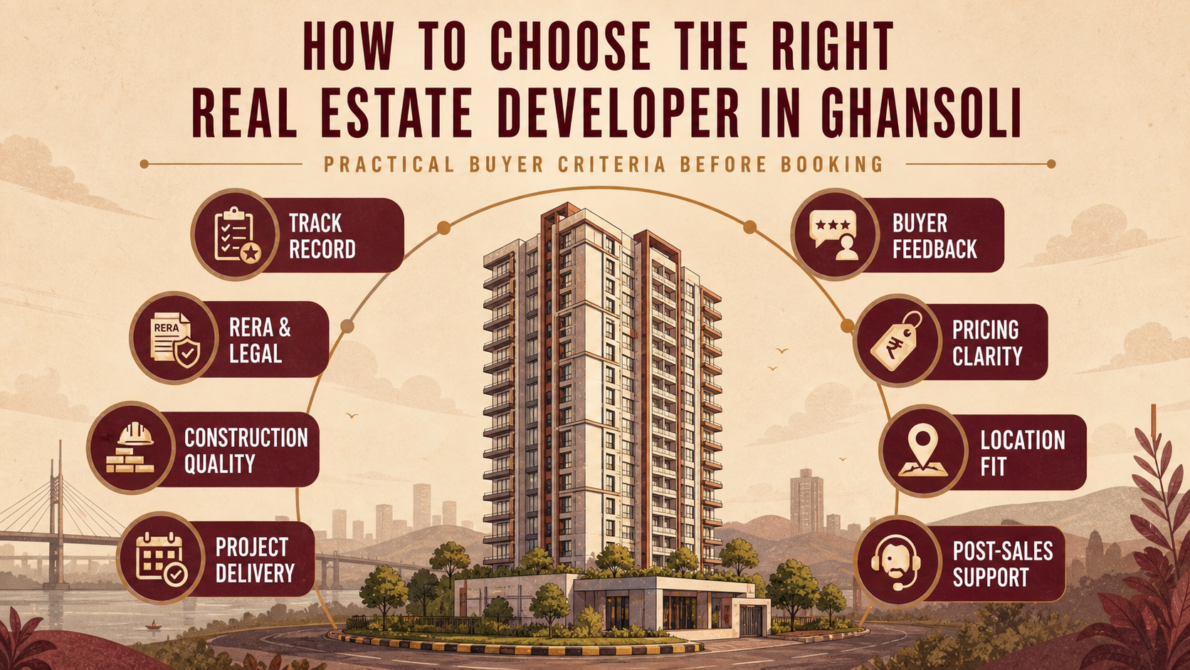
How to Choose the Right Real Estate Developer in Ghansoli
To choose the right real estate developer in Ghansoli, buyers should check the developer’s past delivery record, MahaRERA registration, legal documents, construction quality, pricing transparency, completed projects, buyer reviews, and possession history before paying token money. In Ghansoli, this becomes especially important because approvals, CIDCO land history, NMMC jurisdiction, PAP plot issues, coastal construction quality, and project reliability can differ from sector to sector. Ghansoli is one of Navi Mumbai’s important residential and mixed-use nodes. It has strong demand because of its proximity to Thane-Belapur Road, Reliance Corporate Park, Mahape MIDC, Airoli, Kopar Khairane, and other employment zones. At the same time, buyers must be careful because the market has a mix of large branded developers, local Navi Mumbai builders, older CIDCO-sector properties, redevelopment potential, Gaothan pockets, and under-construction projects. This guide is written for practical buyer decision-making. It explains what to check, how to verify it, what good signs look like, and which red flags should make you pause before booking a flat in Ghansoli. This article is for general buyer awareness. Before booking, paying token money, or signing any agreement, buyers should verify all property documents with a qualified legal professional. Quick Summary: How to Choose the Right Real Estate Developer in Ghansoli The safest way to choose a real estate developer in Ghansoli is to verify legal documents, completed projects, pricing clarity, and buyer feedback before paying token money. MahaRERA registration is important, but it should not be treated as the only proof of developer quality. What to Check Why It Matters in Ghansoli Good Sign Red Flag MahaRERA details Confirms registration, possession date, promoter details and litigation status Project is active and details match sales claims Sales team gives vague or incorrect RERA details Commencement Certificate Confirms legal permission to construct up to a specific floor CC covers the floor you are buying Builder sells upper floors without floor-specific CC Occupancy Certificate Confirms building is approved for legal occupation OC available for ready-to-move flat “Fit-out possession” is offered without OC CIDCO / NMMC documents Ghansoli has CIDCO-origin land and NMMC approval relevance Clear authority documents and transfer records Confusion about land title, leasehold rights or transfer status Completed projects Shows real construction quality after possession Older buildings are well maintained Seepage, cracks, poor lifts, basement waterlogging Pricing clarity Prevents budget shock from hidden charges Stamped all-inclusive cost sheet Verbal quotes with unclear parking, PLC or floor-rise charges Buyer feedback Reveals post-sales support and actual issues Residents confirm fair maintenance and support Repeated complaints about leakage, delay or poor handover Ghansoli buyers should be extra careful in Gaothan and newly developing pockets where unauthorized construction, incomplete approvals or CIDCO title complications may appear. In more organized sectors, the focus should be on OC, society handover, maintenance cost, construction quality and long-term resale value. For wider comparison, readers can also refer to [real estate developers in Navi Mumbai](ADD INTERNAL LINK HERE) and [real estate developers in Ghansoli](ADD INTERNAL LINK HERE). Builders and Developers in Ghansoli Why Choosing the Right Real Estate Developer Matters in Ghansoli Choosing the developer is not only about choosing a flat layout. In Ghansoli, it affects legal safety, possession risk, maintenance cost, resale value, rental demand and long-term peace of mind. Ghansoli has a strong location advantage because it sits near important commercial and industrial employment belts. Many buyers here are working professionals, business owners, investors, and families who want better connectivity to Airoli, Mahape, Kopar Khairane, Vashi and Thane. This demand has encouraged both premium developments and smaller local projects. But fast development also brings risks. A buyer may face delayed possession, incomplete approvals, poor waterproofing, hidden charges, unclear CIDCO transfer history, or builder-controlled maintenance after possession. In Navi Mumbai’s coastal and humid climate, weak construction quality can show very quickly through seepage, plaster damage, basement leakage and corrosion-related issues. The right developer should offer three things together: clear legal documents, reliable construction quality and honest financial terms. A reputed developer is not always the right developer if the project has unclear approvals, delayed possession, hidden charges or weak after-sales support. Understand the Developer’s Past Track Record A developer’s past record is usually more reliable than sales promises. New launch brochures, 3D renders and sample flats are designed to impress. Older completed buildings show the truth. Check Completed Projects Before Trusting New Launches Before booking in Ghansoli, ask the developer for a list of completed projects, preferably in Navi Mumbai or nearby markets. Then physically verify at least one or two completed projects of similar scale. Check whether the developer delivered near the promised timeline. Also check whether amenities shown during sales were actually completed. A builder who has delivered several buildings with clear OC, stable maintenance and functioning societies is usually safer than a builder whose only strength is attractive marketing. This is especially important for under-construction projects. If a developer’s earlier projects show repeated delay, poor handover or weak maintenance, a new launch in Ghansoli should be treated carefully. Visit Older Buildings Developed by the Same Builder In Ghansoli, older buildings can reveal construction quality better than a sample flat. Try to visit buildings that are at least three to five years old. This is enough time for real issues to appear. Look for: Damp walls and ceiling patches Basement waterlogging during monsoon Rust marks near exposed concrete Lift condition and lobby maintenance Cracks in external plaster Quality of parking and common areas Whether society handover was done properly Navi Mumbai’s coastal climate and heavy monsoon are tough on buildings. A developer who uses poor waterproofing, weak external paint, or low-quality plumbing may create a building that looks good at possession but starts troubling residents after one or two monsoons. Speak to Existing Residents and Buyers Residents give the most honest feedback. Ask them simple questions: Was possession delayed? Were the final charges higher than promised? Did the builder complete promised amenities? Are there seepage or leakage issues? Was society formed on time? Was corpus or maintenance money handed over
Read More