

How NAINA, Rail and Highway Connectivity Affect Panvel Housing Demand
Panvel housing demand is being shaped by NAINA, rail, and highways, but not in the same way. Rail connectivity usually creates the strongest immediate demand because it improves daily commute and rental viability. Highway connectivity mainly boosts regional access and investor confidence. NAINA influences long-term planning, future supply, and land expectations more than immediate end-user demand. In simple words, what drives demand in Panvel today depends heavily on whether the buyer is a commuter, family, landlord, or patient investor.
Panvel is now being discussed as part of a much larger growth belt. Words like “Mumbai 3.0” and “Third Mumbai” are everywhere. But that is exactly why buyers need clarity. A brochure may show airport access, a new bridge, a future corridor, and a master plan on one page. Real housing demand does not work like that.
Some demand is real and already visible. Some demand is early-stage and still fragile. Some of it is purely future-facing. If you do not separate those layers, it becomes very easy to overpay for a story instead of buying into a usable location.
Panvel housing demand is rising, but not every growth driver works in the same way

Housing demand in Panvel is rising, but the market is not moving as one single block. Old Panvel, New Panvel, Karanjade, Palaspe, and NAINA-linked villages are not behaving the same way. Some areas are seeing practical end-user demand. Some are seeing investor-led booking activity. Some are being pushed by affordability spillover from costlier parts of Navi Mumbai.
That difference matters. A project can have strong bookings and still have weak real livability. A locality can have price movement and still struggle with water, last-mile access, or slow occupancy. So before talking about NAINA, rail, or highways, it is important to define what “housing demand” actually means.
What “housing demand” actually means in Panvel
In Panvel, housing demand usually comes through three channels:
- End-user demand: families and working buyers actually planning to live there
- Rental demand: tenants looking for commute-friendly and practical homes
- Investor demand: buyers entering early for future appreciation or land value growth
These three are related, but they are not the same. A station-linked area may attract end-users and tenants quickly. A highway-facing stretch may attract investors before families. A NAINA village may attract land speculation long before apartment occupancy becomes strong.
Why buyers often misunderstand infrastructure-led demand
The common mistake is assuming that any major infrastructure announcement automatically improves residential life. It does not.
The Mumbai Trans Harbour Link can improve regional access. The Panvel-Karjat rail line can improve commute viability. NAINA can shape future zoning and planned development. But none of these, by themselves, guarantee water supply, schools, walkability, builder execution, or immediate rental absorption in every Panvel pocket.
Quick summary: how each driver affects demand
| Growth driver | What it affects most | Best for | Demand timeline | What buyers should remember |
|---|---|---|---|---|
| Rail connectivity | Daily commute, rental absorption, practical end-user demand | Commuters, tenants, landlords | Immediate to near-term | Usually the strongest real housing demand trigger |
| Highway connectivity | Regional access, land value perception, investor confidence | Investors, logistics-linked buyers, some township buyers | Short to medium term | Good for access, but not always equal to residential comfort |
| NAINA | Future planning, zoning, supply structure, land expectation | Patient investors, landowners, long-term strategic buyers | Long term | Important structurally, but not a short-term occupancy guarantee |
Which matters more in Panvel today: rail access, highway connectivity, or the NAINA growth story?
Today, rail access usually matters most for real housing demand. Highway connectivity comes next, but its benefit is more selective. NAINA matters a lot strategically, but mostly as a future-shaping force rather than an immediate occupancy trigger.
That hierarchy is important because many buyers are hearing all three stories together and treating them as equal. They are not equal.
Rail connectivity and immediate end-user demand

Rail changes daily life directly. If a working person can reach employment zones more easily, that location becomes more livable almost immediately. This is why suburban rail has historically been one of the strongest drivers of real residential demand in the Mumbai Metropolitan Region.
The Panvel-Karjat suburban corridor under MUTP-III is especially important here. It is a 29.6 km double-line corridor with new stations such as Chikhle, Poyanje Mahope, and Chowk. Physical completion has already reached an advanced stage, and operations are projected between March and July 2026. The line is designed to cut Panvel-Karjat travel time from about 2 hours 15 minutes through the older detour route to roughly 45 minutes on the direct alignment.
That kind of change does not just look good in a brochure. It changes where people can realistically live.
Highway connectivity and regional buyer movement

Highways change geography faster than they change neighbourhood quality. That is the right way to see them.
The operational MTHL or Atal Setu has already reduced the South Mumbai to Panvel-side drive substantially, and that has had a visible effect on market confidence. Panvel plot rates reportedly moved up from around ₹6,000 to ₹8,000 per sq. ft. to around ₹8,000 to ₹10,000 per sq. ft. within about 15 months after the bridge opened. Nearby Ulwe also saw strong appreciation.
That proves highways can move capital. But capital movement is not the same as strong end-user housing demand in every pocket.
NAINA and future-facing confidence demand

NAINA affects Panvel differently. It is not a daily commute trigger. It is a statutory planning framework.
The notified area spans about 371.35 sq. km. across 174 villages, with active development focus concentrated in a smaller core zone. CIDCO is implementing the area through phased Town Planning Schemes and a 60:40 land-pooling model. That means NAINA is very important for future road networks, zoning discipline, planned development format, and land-use structure.
But for a flat buyer today, NAINA is not the same thing as immediate livability. In many cases, it is more a signal of what the region may become over the next 7 to 15 years.
Why rail connectivity usually converts into real housing demand faster than future development narratives
Rail usually wins because people can feel its effect in everyday life. That is the core reason.
A person working in CBD Belapur, Thane, JNPT-linked zones, or even broader Navi Mumbai employment clusters does not judge a home only by future appreciation. They judge it by whether the commute is possible, sustainable, and not exhausting. Tenants do the same.
Station access and daily commute logic
Once a station becomes active, the surrounding area starts making more sense to a wider group of people. That is why rail-led demand often becomes visible faster than road-led or planning-led demand.
A station within usable reach can improve:
- daily travel time
- reliability of commute
- tenant interest
- resale comfort
- acceptability for middle-income families
This is why station-linked pockets near new corridor alignments often see more grounded demand than brochure-heavy “future city” locations with weaker daily usability.
Why tenants and self-users react faster to rail than to planning announcements
Tenants pay for convenience, not planning theory. Self-users also think this way, even if they do not say it openly.
A renter may happily choose a compact apartment near a reliable suburban rail corridor over a bigger home in a highway-side location with weak last-mile access. A family may tolerate average amenities if commute and daily functioning are stable. But they will hesitate in areas where future growth is promised while present-day life remains uncertain.
That is why, in Panvel, rail connectivity usually converts into real demand faster than future development narratives.
Example: A new station at Poyanje Mahope or Chowk can begin influencing rental and end-user interest much sooner than a large future-planned zone that still depends on phasing, pooling, and civic upgrades. The moment commuting becomes viable, the demand equation changes.
How highway access changes Panvel demand, and where that benefit becomes overstated
Highway access absolutely matters. It improves reach, supports regional movement, and can reshape land value expectations very quickly. But it is often oversold as a complete housing-demand answer.
That is where buyers need to slow down.
Better access for intercity movement, business travel, and regional commuting
The MTHL and the planned Virar-Alibaug Multimodal Corridor have widened the strategic value of the Panvel belt. The VAMC land acquisition process has already reached a very advanced stage in Phase 1. That tells you the wider region is being restructured for long-term mobility and logistics strength.
This helps Panvel in several ways:
- stronger investor attention
- better regional positioning
- more interest from businesses and logistics players
- higher confidence in large-format township development
- better appeal for buyers who travel by road frequently
This is real. It should not be dismissed.
Why highway-side advantage does not always mean better residential livability
Still, a highway is not a railway station. And a major road is not a neighbourhood ecosystem.
Projects close to expressways or large corridors may face noise, dust, unsafe pedestrian conditions, and weaker local social infrastructure. For a family, daily life depends on schools, internal roads, stores, clinics, public transport, and predictable civic conditions. A fast drive to South Mumbai or a strong junction location does not solve those things by itself.
This is why highway connectivity often boosts investor demand faster than family demand.
> Caution: If a project’s biggest selling point is “airport distance” or “bridge access,” but there is weak water reliability, poor last-mile transport, or thin neighbourhood life, then the connectivity story may be stronger than the residential story.
What NAINA actually changes for Panvel buyers, and what it does not change yet
NAINA is one of the biggest reasons Panvel is being discussed so aggressively. It is also one of the most misunderstood.
NAINA does not instantly create a functioning city. What it does is set the legal and planning framework for one.
Confidence, planning horizon, and future supply logic
For long-term market structure, NAINA is powerful. It gives the region a formal planning path. It shapes road widths, land use, development potential, and future density. CIDCO’s phased TPS model and land pooling mechanism are meant to avoid random, unplanned growth.
That matters because one of the biggest risks in fringe growth areas is uncontrolled development. NAINA, at least in concept and regulatory structure, tries to prevent that.
It also matters for landowners and long-horizon investors because it affects what type of development can happen later and how valuable the land may become once infrastructure matures.
Why NAINA should not be read as instant occupancy demand
At the same time, NAINA is not a short-term substitute for mature civic life. Ground execution is still uneven. Villager disputes over the 60:40 pooling formula, delays, and local resistance have already affected work in some locations. That means the planning vision may be strong, but the on-ground transition is not linear.
For buyers, the practical meaning is simple: buying inside or near a NAINA-linked zone today often means buying into a location that is still early, still forming, and still dependent on future execution.
A practical NAINA reality check
Before buying on a NAINA-led story, ask:
- Is this demand based on current livability or future expectations?
- Is the area already functioning as a residential ecosystem?
- Is the project relying on tankers or stable municipal water?
- Is this a flat purchase for self-use, or a long-horizon strategic bet?
- Is the premium already too high for how early the area still is?
Which parts of Panvel benefit more from rail-led demand, and which parts benefit more from road-led growth?
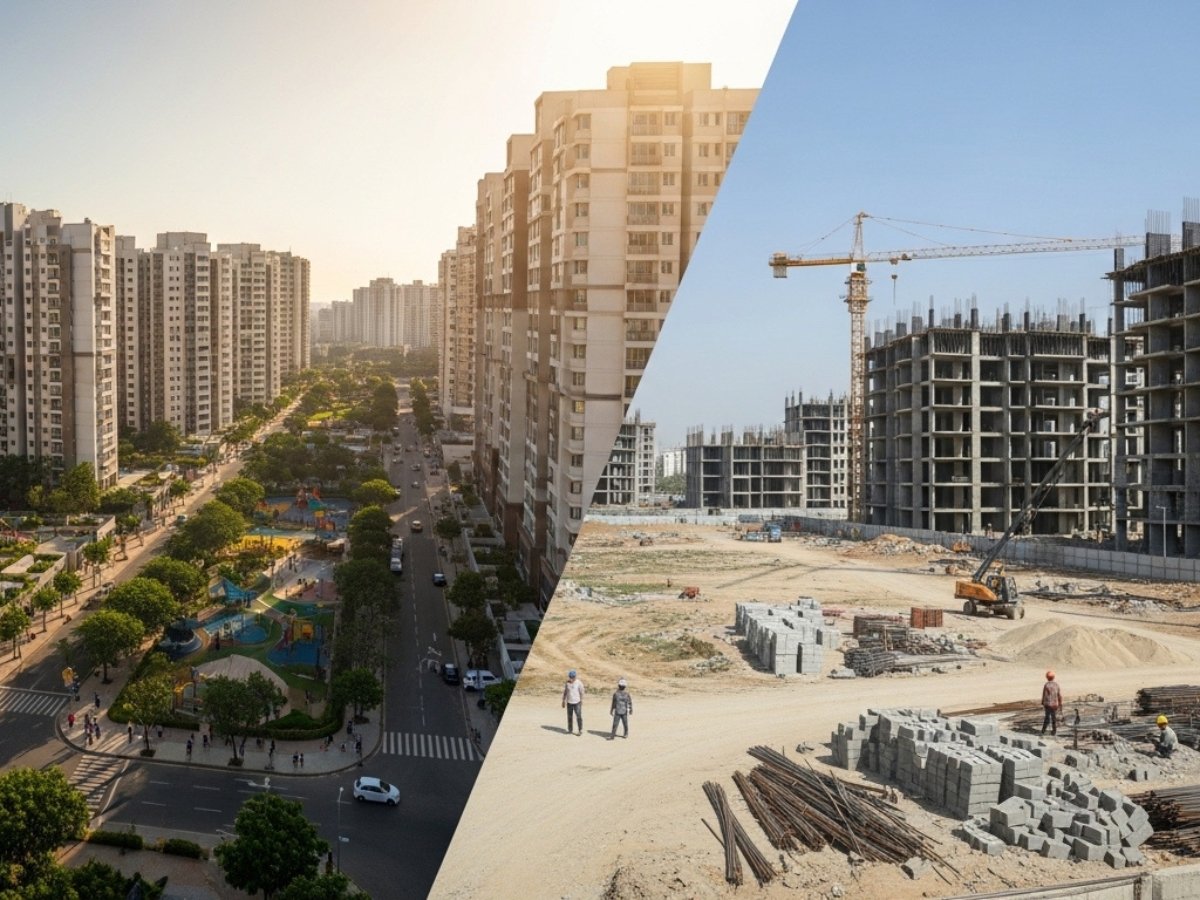
Panvel’s market is very local. This is where many articles fail. They talk about Panvel as if it is one single real estate zone. It is not.
Old Panvel behaves differently from New Panvel. Karanjade behaves differently from station-linked pockets. NAINA TPS villages behave differently from mature CIDCO-type planned environments.
Station-linked practical demand pockets
Areas closer to established or improving rail-based utility usually have better conditions for practical demand. New Panvel East and some rail-oriented locations hold that advantage more naturally because station access supports both family buyers and tenants.
The upcoming Panvel-Karjat corridor also brings fresh attention to locations aligned with new stations like Chikhle, Poyanje Mahope, and Chowk. These areas may become more relevant for genuine commuter-led demand as services start.
Highway-convenient but lifestyle-dependent pockets
Locations such as Karanjade and Palaspe are more exposed to the road-led growth story. They benefit from access and affordability. They can attract buyers who believe in future upside and are comfortable entering slightly earlier.
But these are also the kinds of areas where you must check civic depth carefully. Lower entry price does not automatically mean better value if water, internal access, and daily convenience remain weak.
Growth-story locations that still need patience
NAINA-linked villages and early-stage corridors may become important over time, especially where planned roads and future airport influence are strong. But patience is not optional here. Buyers entering these zones should understand that planning-led value and end-user-led demand do not mature at the same speed.
Indicative Panvel micro-market pattern
| Micro-market | Indicative price band | Demand pattern today | What is driving it most |
|---|---|---|---|
| Old Panvel | ₹10,000–₹14,000 per sq. ft. | Stable end-user demand | Mature civic base, established life |
| New Panvel East | ₹7,000–₹9,500 per sq. ft. | Practical buyer demand | Rail proximity, planned environment |
| New Panvel West | ₹6,500–₹8,500 per sq. ft. | Mixed demand | Rail access and growing commercial activity |
| Karanjade / Palaspe | ₹5,000–₹7,500 per sq. ft. | Affordability + future access play | Highway access, spillover demand |
| NAINA-linked villages | Varies sharply | Mostly future-facing and speculative in many pockets | Planning story, airport influence, land expectation |
Is Panvel’s housing demand end-user driven, investor driven, or affordability spillover from other Navi Mumbai areas?
The honest answer is that Panvel is a hybrid market. It is not purely end-user driven. It is not purely investor driven either.
Different parts of Panvel are being pushed by different types of demand at the same time.
In mature or more usable pockets, end-user demand is real. In emerging edge locations, affordability spillover is a major force. In airport-influence or NAINA-linked growth stories, investor participation is much stronger.
This is also where rent-versus-buy math becomes very important. A typical 2BHK rent in Panvel may be around ₹16,500, while a new 2BHK home loan EMI can easily move toward ₹60,000 to ₹70,000 in many cases. That gap is large. It means many households may still prefer renting until the location becomes more stable or the economics improve.
So when developers talk about booking momentum, buyers should ask a harder question: Who is buying, and who is actually going to live there?
If more of the demand is investor-led, price can move faster than genuine occupancy. If more of the demand is commuter-led and tenant-led, the market is usually healthier.
What this means for different buyers: family buyer, commuter, landlord, and long-term investor
Not every buyer should read Panvel the same way. In fact, this is where the best decisions are made.
Family buyers should usually value stable daily living over future narratives. That means looking harder at established or better-functioning Panvel pockets where water, local access, and daily services are less uncertain.
Commuters should focus on railway usefulness first. A project that looks slightly smaller or older but sits in a more workable station-linked environment may be the better purchase.
Landlords should care about tenant behaviour, not just brochure appeal. Compact homes near rail-linked corridors or future workforce catchments often make more sense than large units in thinly occupied edge projects.
Long-term investors can consider NAINA and major road-led growth corridors more seriously, but only with the right time horizon. A 7 to 10 year mindset is far more realistic than expecting quick occupancy-led gains.
When connectivity headlines should make you interested, and when they should make you cautious
Connectivity headlines should interest you when they align with real on-ground utility. They should make you cautious when they are being used to hide weak fundamentals.
This is especially important in Panvel because the region is moving through a high-hype phase.
Healthy signals of real demand
Good signs usually include:
- improving station-linked accessibility
- visible occupancy in surrounding projects
- usable local roads and transport
- stable neighbourhood services
- practical rental demand
- realistic pricing relative to location maturity
Warning signs of over-marketed demand
Risk signs are just as important. The Panvel-side water issue is not a small footnote. Areas such as Kamothe, Taloja, and Karanjade have faced serious water stress, and this has become a political issue too. Long-term augmentation plans like the Kondhane pipeline and Balganga Dam matter, but those are future-facing solutions and should be described carefully as projected support, not present certainty.
Regulation is another major warning layer. MahaRERA has taken a much stricter line on project compliance, and the broader MMR has a very large number of lapsed projects. That does not mean every delayed or lapsed case is fraud, but it does mean buyers should stop assuming that infrastructure growth protects them from builder risk. It does not.
A project can be close to the airport influence zone, close to the bridge, and still be a bad decision if delivery, approvals, water, or occupation readiness are weak.
A practical way to judge whether Panvel demand in a specific project or sector is genuinely strong
This is the most useful question in the entire article: how do you tell whether demand is actually strong, not just advertised as strong?
Start with what people on the ground would feel, not what the sales deck says.
What to check around the station, road network, and surrounding occupancy
Visit the area at peak time, not only in the afternoon when everything looks calm. Check whether the road feels connected to daily life. See whether autos are available. Check bus movement. Understand how long it actually takes to reach the nearest active or upcoming rail node.
Look around the project too. Are there occupied buildings nearby? Are shops functioning? Does the area feel like people already live there, or only like people have booked there?
What to verify before trusting future-growth claims
Use this simple checklist before buying:
- Check the MahaRERA registration and current project status
- Verify whether the project has real civic support or is overly dependent on future promises
- Ask the builder clearly about the water source: municipal line, MJP-linked supply, or tanker dependence
- Understand whether the area falls under a more mature planning environment or an early-stage peripheral one
- Compare the project’s price with the actual maturity of the location
- Ask whether the demand there is mainly investor-led or end-user-led
- Check if the project benefits from actual commute improvement or only abstract regional growth
A strong Panvel location usually shows at least some mix of access, real usage, and realistic buyer fit. A weak one usually depends too much on “coming soon.”
So, how much do NAINA, rail and highways really affect Panvel housing demand?
They affect it a lot, but they affect different parts of the market in different ways.
Rail is the strongest immediate driver of real housing demand because it improves daily life. That matters most for commuters, tenants, and practical end-users. Highway connectivity is powerful, but more selective. It boosts regional access, land value perception, and investor confidence faster than it builds fully comfortable residential life. NAINA is the biggest long-term structural story, but it works on a much longer clock.
That is the real answer. Panvel is not one uniform demand market. It is a layered market where the meaning of “growth” changes from one pocket to another.
If you are buying for self-use, rail and civic quality should usually matter more than future hype. If you are buying for long-term positioning, NAINA and road-led corridors become more relevant. If you are buying for rent, focus hard on commute logic and real occupancy.
In other words, the best Panvel decisions come from matching the right infrastructure story to the right buyer type. Not every story converts into real housing demand at the same speed.
FAQs
Does NAINA directly increase Panvel property demand right now?
Not in the same way as rail access. NAINA mainly increases future planning confidence, land-use clarity, and long-term development expectations. In some locations, that can attract investors early, but it does not automatically create immediate end-user or tenant demand.
Is railway access more important than highway access for Panvel homebuyers?
For most end-users and tenants, yes. Railway access usually improves daily livability faster because it directly affects commute time and practical travel. Highway access is valuable too, but often helps investor confidence more than everyday residential comfort.
Which type of Panvel buyer benefits most from connectivity-led growth?
Different buyers benefit differently. Commuters benefit most from rail. Long-term investors may benefit more from NAINA and major road corridors. Families usually benefit most from a combination of rail usefulness and stable civic conditions.
Does highway connectivity improve rental demand in Panvel?
Sometimes, but not always strongly on its own. Highway access can improve appeal for some tenants, especially road commuters, but rental demand usually becomes much stronger when a location also has rail access, better neighbourhood services, and daily-use convenience.
Are all Panvel sectors benefiting equally from future growth plans?
No. This is one of the biggest misconceptions in the market. Old Panvel, New Panvel, Karanjade, Palaspe, and NAINA-linked villages are all reacting differently based on planning maturity, connectivity type, pricing, and civic condition.
Can infrastructure headlines alone justify buying in Panvel?
No. Infrastructure can improve the long-term case for a location, but buyers still need to verify water reliability, regulatory status, access, occupancy pattern, and actual neighbourhood readiness before deciding.
Final verdict
NAINA, rail, and highway connectivity are all important to Panvel’s future, but rail is usually the clearest driver of immediate housing demand. It supports commuting, rental absorption, and real residential use. Highway connectivity is meaningful, especially for regional access and investor confidence, but it is not a guarantee of good daily life. NAINA is the deepest long-term force, but it should be read as a planning and land-structure story, not an instant livability signal.
So if the question is what is really driving Panvel housing demand today, the answer is simple: rail leads, highways support selectively, and NAINA shapes the long game. The smartest buyers are the ones who understand that difference before they commit their money.
—
Suggested internal links for ilovenavimumbai.com
- Panvel Property Rates and Market Trend: When Is the Right Time to Buy?
- Old Panvel vs New Panvel: Which Is Better for Living and Buying?
- Kharghar vs Panvel: Which Is Better for Buying Property?
- New Projects vs Resale Flats in Panvel: Which Should You Buy Right Now?
- Rent vs Buy in Panvel: Which Option Makes More Sense Right Now?