Under-Construction vs Ready-to-Move Property in Navi Mumbai: Which Is Better?
Navi Mumbai in 2026 does not feel like the same old extension market people casually dismissed years ago. It has become a serious real estate zone with its own momentum, its own price logic, and its own buyer psychology. The operational impact of Navi Mumbai International Airport and the connectivity boost from Atal Setu have changed how people evaluate property here. Today, the decision is not just about buying a home. It is about timing, risk, cash flow, location maturity, and future upside.
That is why the debate around under-construction vs ready-to-move property in Navi Mumbai matters more than ever. Some buyers want lower entry cost and future appreciation. Others want immediate possession, visible product quality, and freedom from uncertainty. Both sides have a strong case. But the better option depends on who you are, where you want to buy, and how much risk you are honestly comfortable taking.
The price difference between ready and under-construction property is not just about the base rate, because hidden costs can change the real budget quite significantly.
Quick Summary
| Factor | Under-Construction Property | Ready-to-Move Property |
|---|---|---|
| Entry Price | Usually lower initially | Usually higher |
| GST | Applicable in most cases | Not applicable if OC received |
| Possession | Future delivery | Immediate |
| Risk | Delay and execution risk | Lower delivery risk |
| Rental Income | Starts after possession | Starts immediately |
| Best For | Investors, patient buyers, budget-conscious buyers | Families, low-risk buyers, rental seekers |
| Strong Areas | Ulwe, Panvel, Taloja | Vashi, Nerul, Seawoods |
| Main Benefit | Appreciation potential | Certainty and usability |
What Is the Difference Between Under-Construction and Ready-to-Move Property?
Under-construction property meaning
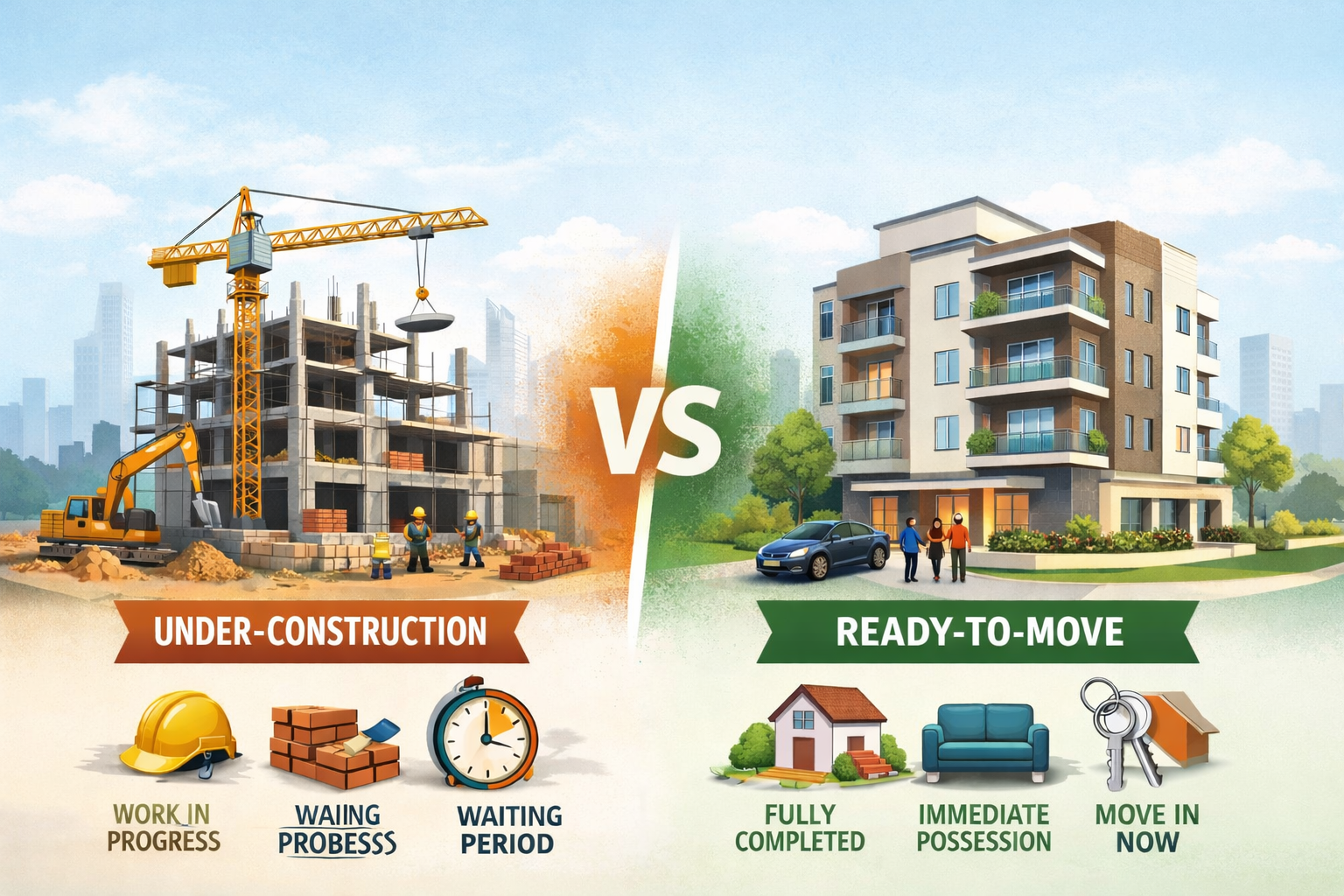
An under-construction property is a project that is still being built and has not yet received final possession-ready status. The buyer books before completion and pays according to a schedule linked to stages of development. In Navi Mumbai, a large share of new inventory in expansion zones falls into this category.
These properties are often marketed as future-ready homes with better layouts, newer amenities, and early-stage pricing. And yes, sometimes that promise is valid. But until possession is actually handed over, it remains a promise tied to approvals, funding, execution, and timelines.
Ready-to-move property meaning
A ready-to-move property is a flat or unit that is complete and available for immediate possession. Ideally, it should already have an Occupancy Certificate, functioning utilities, and legal readiness for registration and shifting. In mature nodes, this category includes both resale flats and newly completed inventory.
For most end users, this is the more tangible category. Buyers can inspect construction quality, light, ventilation, society condition, traffic flow, and neighborhood reality before making the final decision. That visibility reduces guesswork.
Main difference buyers should know
The biggest difference is simple. In under-construction property, you are buying future value. In ready-to-move property, you are buying present certainty. One gives you entry advantage. The other gives you immediate usability.
In Navi Mumbai, this difference has become sharper in 2026 because infrastructure is already impacting pricing. Buyers now have to ask a harder question. Is it better to enter early near future growth, or pay a premium for an already functioning micro-market? That is the real debate.
Your bargaining approach should also change based on project stage, which is why buyers should understand how to negotiate flat prices before making an offer.
Price Comparison in Navi Mumbai
Why under-construction flats usually cost less initially
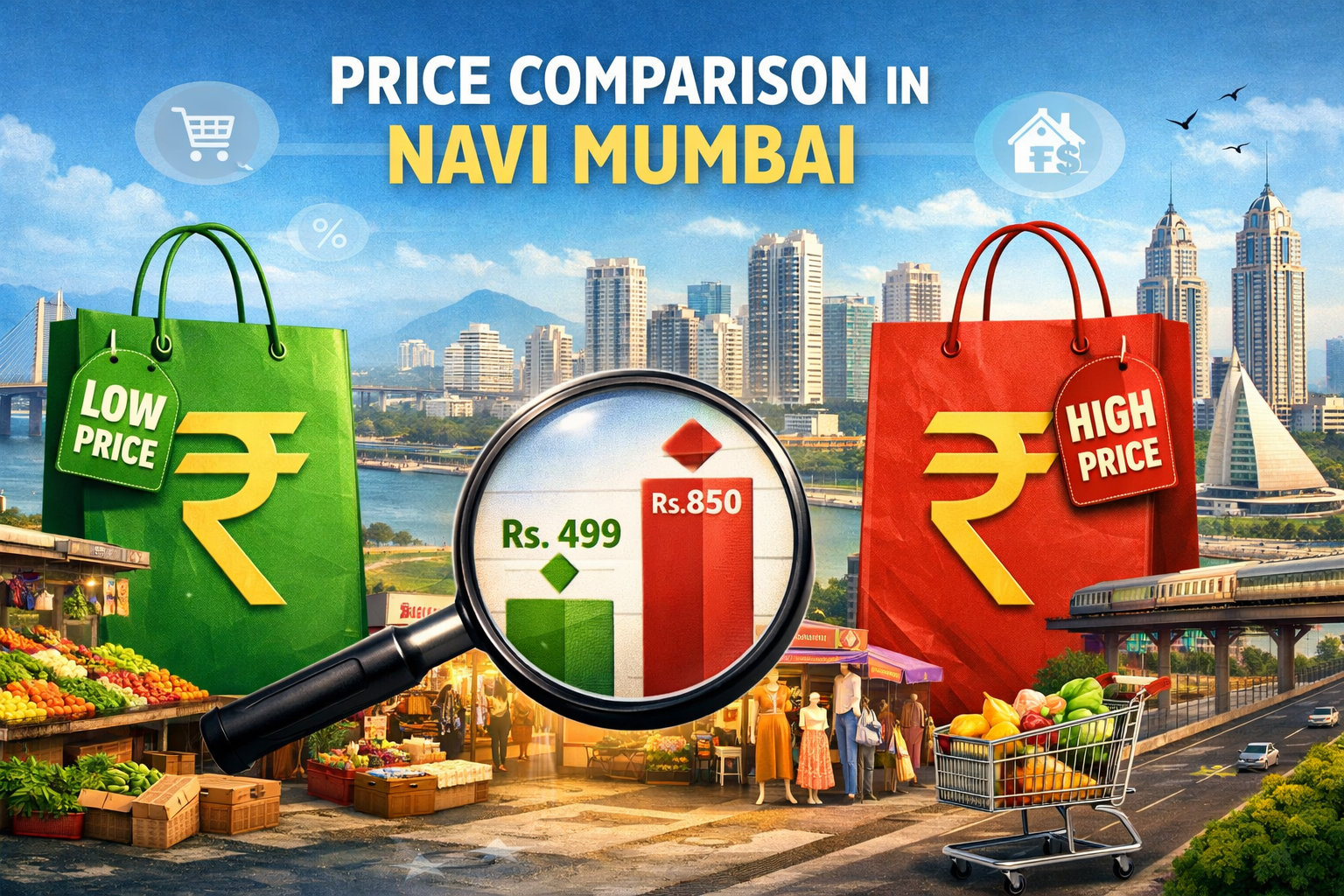
Under-construction flats usually cost less at the launch or early construction stage because buyers are taking time risk. In nodes like Panvel, Ulwe, and Taloja, the difference between UC and RTM pricing can still be meaningful. In Panvel, UC projects may sit around the lower band while RTM options can move notably higher. In Ulwe too, the price gap often remains attractive for investors entering early.
This lower starting price creates a sense of affordability, especially for first-time buyers. But affordability should never be judged only by brochure price. That is where many buyers go wrong.
Why ready-to-move flats cost more
Ready-to-move flats cost more because the uncertainty has already reduced.The building exists, possession is available, and the buyer does not have to wait through construction cycles. In premium nodes like Seawoods and Vashi, this premium can be substantial because land is limited and established social infrastructure already exists.
There is also a demand premium attached to convenience. A family choosing a ready home is not just paying for carpet area. They are paying for time, certainty, location maturity, and immediate use. In many cases, that premium is justified.
Hidden cost difference buyers ignore
This is where the game changes. Under-construction buyers often focus on the lower base rate, but additional costs such as GST, floor rise, PLC, clubhouse fees, legal charges, corpus fund, advance maintenance, and society formation expenses can push the final number much higher. Ready-to-move properties may avoid GST if OC is available, but resale transactions in Navi Mumbai can trigger CIDCO transfer charges and NMMC transfer fees depending on the property and jurisdiction.
So the real comparison is not just UC price vs RTM price. It is all-in cost vs all-in cost. And once that calculation is done honestly, the difference may shrink more than expected.
Risk and Possession Comparison
Delay risk in under-construction projects
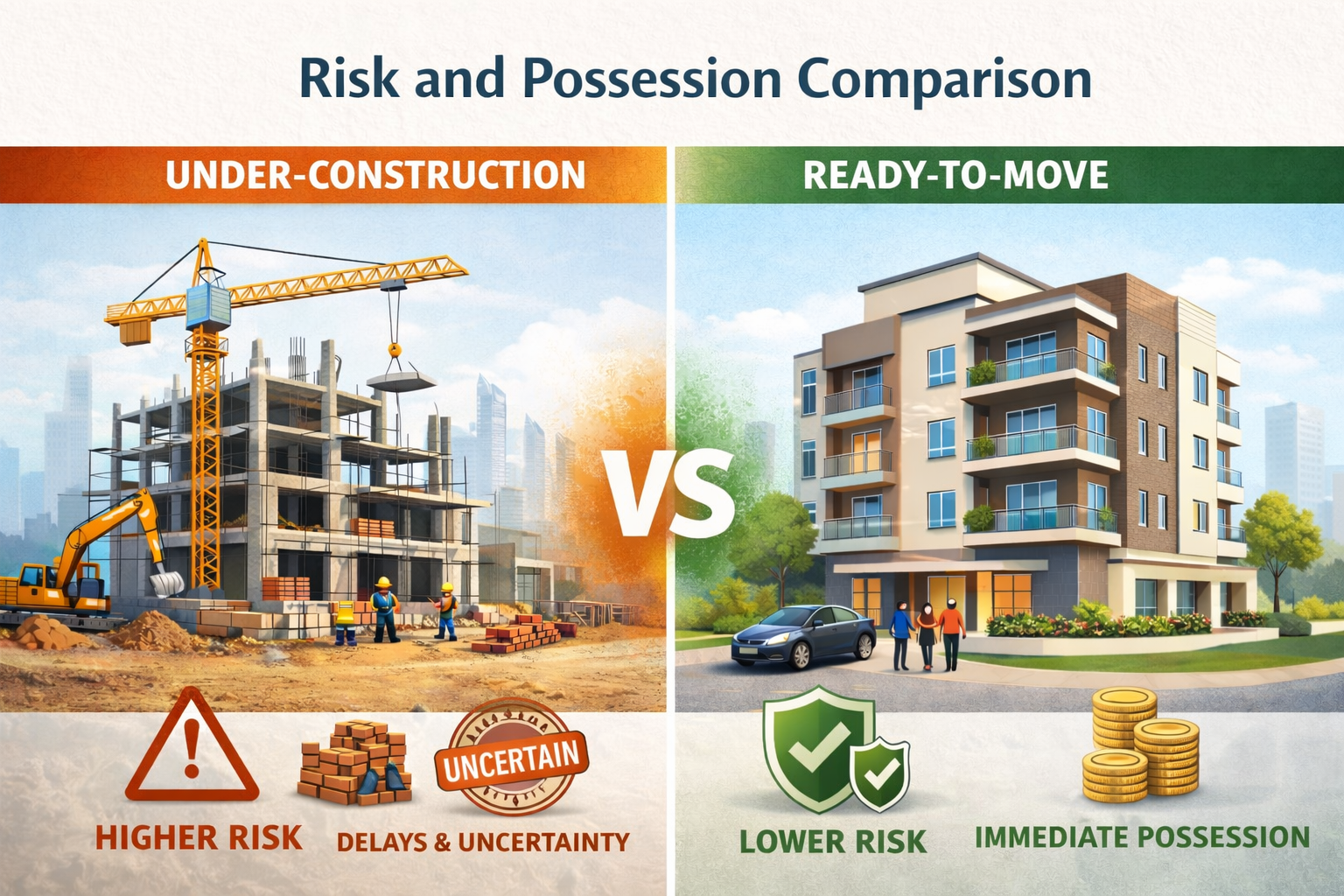
The biggest risk in under-construction property is not design. It is delay. Maharashtra’s market has seen thousands of delayed or lapsed projects since RERA came in, and Navi Mumbai has not been fully immune. Even in 2026, despite stronger MahaRERA enforcement, the risk does not disappear completely.
A delay affects more than your possession date. It affects your rent burden, your financial planning, and sometimes your confidence in the entire purchase. For a buyer already stretched, this becomes emotionally exhausting. Not just financially inconvenient. Exhausting.
Immediate possession benefit in ready-to-move flats
Ready-to-move flats solve this problem directly. You can shift, rent out, inspect the unit, and start using the asset almost immediately. For buyers who are already paying rent elsewhere, this is a major advantage. The dual burden of rent plus EMI can seriously damage monthly cash flow if possession gets delayed in a UC project.
There is also a tax timing advantage. Since possession is available immediately, eligible home loan tax benefits can begin sooner. That makes ready-to-move property more practical for many salaried households.
Which option is safer in Navi Mumbai?
From a pure safety perspective, ready-to-move property is safer. But only if it has proper legal compliance, especially a valid Occupancy Certificate. Even in Navi Mumbai, many occupied buildings have faced OC-related scrutiny. So ready possession does not automatically mean risk-free.
Still, if your question is simply about execution risk, ready-to-move wins. Under-construction can be rewarding, but it is never the lower-risk path.
Which Is Better for Investment in Navi Mumbai?

Appreciation potential in under-construction projects
For capital appreciation, under-construction property usually has the stronger upside, especially in infrastructure-led micro-markets. The airport effect around NMIA influence zones and connectivity improvements through Atal Setu have already pushed values in Panvel and nearby areas sharply upward. Investors entering the right UC project before full maturity can capture that growth curve.
That is why areas like Ulwe, Panvel, Dronagiri, and parts of NAINA continue to attract forward-looking investors. The story here is not just housing. It is ecosystem growth. Logistics, hospitality, office movement, and regional mobility all feed residential demand.
Rental income advantage in ready-to-move properties
Ready-to-move property wins when immediate rental income is the goal. You buy, you furnish, you lease. There is no waiting period. In well-connected nodes, especially those benefiting from the airport and major transport links, rental yields have improved meaningfully compared to older assumptions about Navi Mumbai.
For passive income seekers, this matters a lot. A flat that starts generating rent quickly becomes easier to justify even if the entry price is higher. The asset begins working immediately.
Best option for long-term investors
For long-term investors willing to wait, under-construction property remains the stronger bet in growth corridors. For investors who want stability and immediate yield, ready-to-move is more suitable. Neither is universally superior.
The better question is this: are you chasing future value or current cash flow? Once that is clear, the answer becomes much simpler.
Which Is Better for End Use and Families?

Best choice for first-time homebuyers
First-time homebuyers often underestimate how stressful uncertainty can feel after booking. Because of that, ready-to-move flats are often a safer choice for beginners, especially in Kharghar, Vashi, or Nerul where everyday infrastructure is already established.
That said, if a first-time buyer has a stable income, low urgency to shift, and is entering a trusted RERA-registered project in a growth node, under-construction can still work. But it requires more discipline and more due diligence.
Best option for families who want immediate shifting
Families planning immediate relocation should usually prefer ready-to-move property. School access, commute certainty, nearby hospitals, grocery convenience, and social environment matter more once real life starts. That is why mature nodes continue to command strong end-user demand despite higher prices.
There is a practical comfort in moving into a home that is already functioning within a functioning neighborhood. Families value that deeply. And honestly, they should.
Best option if you are already living on rent
If you are already paying a high monthly rent, ready-to-move property often makes more sense. Waiting two or three years for possession while also paying rent can reduce the apparent savings of buying under-construction. What looked cheaper at booking can become heavier over time.
This is why many end users in 2026 are choosing certainty over theoretical savings. Monthly life has a way of exposing every weak financial assumption.
Area-Wise Difference in Navi Mumbai
To understand why ready and under-construction choices behave so differently across nodes, it helps to check Navi Mumbai property rates and price trends alongside this comparison.
Under-construction projects in Ulwe, Taloja and Panvel
Ulwe, Taloja, and Panvel remain the strongest UC-led zones because they still offer land availability, future growth narratives, and relatively better entry pricing. Ulwe benefits from airport and connectivity triggers. Panvel benefits from its regional gateway character and township-scale development. Taloja remains relevant for budget-driven buyers and industrial workforce demand.
These are not identical markets, though. Ulwe feels like a strategic growth play. Panvel feels broader and more integrated. Taloja feels price-sensitive and practical. That difference matters while choosing.
Ready-to-move preference in Vashi, Nerul and Seawoods
Vashi, Nerul, and Seawoods are far more mature and RTM-friendly. Buyers here are often paying for location stability, established infrastructure, and stronger quality filters. In Seawoods especially, the premium positioning and presence of top-tier development have pushed the market into a different category altogether.
For buyers who want an already-settled environment, these nodes often justify the premium. They are not cheap, but they are easier to understand and easier to trust.
What works better in Kharghar?
Kharghar sits in the middle and that is exactly what makes it interesting. It offers both under-construction and ready-to-move choices, and the right pick depends on the buyer’s purpose. Newer projects offer lifestyle upgrades and modern amenities. Older ready stock offers immediate possession and neighborhood familiarity.
For many mid-income professionals, Kharghar is the most balanced node in Navi Mumbai. Not the cheapest. Not the most premium. But strategically very sensible.
Pros of Buying an Under-Construction Property
Lower entry price
The lower starting cost is the biggest attraction. In an expensive market, this becomes the doorway through which many buyers enter. It keeps aspiration alive.
Better appreciation potential
When infrastructure is still unfolding, early entry can produce strong upside. That is why UC buyers in airport-influence zones remain optimistic.
More options in new projects
New launches often offer better layouts, new amenities, and more inventory choice. Buyers can choose floor, view, and unit configuration more freely in the early stages.
Pros of Buying a Ready-to-Move Property
Immediate possession
The strongest advantage is obvious. You can move in, use the property, or rent it out without waiting for delivery.
Lower uncertainty
There is less ambiguity around the final product, local condition, and legal readiness if the documentation is in place.
Faster rental income and actual site clarity
For investors, rental activation can begin sooner. For end users, the ability to inspect the actual building removes many hidden doubts.
Important Legal Checks Before Buying Any Property in Navi Mumbai
What to check in under-construction property
For UC projects, buyers should verify the Commencement Certificate, MahaRERA registration, sanctioned plans, stage-wise progress updates, and title chain. Do not rely only on verbal commitments or glossy brochures. In Navi Mumbai, authority and approval clarity matter a lot because CIDCO and local municipal processes can create confusion for uninformed buyers.
Key documents for UC buyers
Check the CC, MahaRERA details, title documents, builder history, payment schedule, and possession commitments carefully. A lower rate means nothing if the legal base is weak.
What to check in ready-to-move property
For RTM properties, the Occupancy Certificate is critical. Also verify the registered sale deed, society share certificate, utility readiness, maintenance dues, and NOC where applicable. In resale cases, transfer-related costs and land authority conditions must also be checked properly.
Key documents for RTM buyers
OC first. Then sale deed, society papers, transfer charges, and title continuity. If OC is missing, treat the deal with extreme caution.
RERA, OC, CC and title verification basics
RERA helps improve transparency for UC projects, but it is not a substitute for independent legal review. OC confirms habitability for RTM buildings, and CC permits lawful construction progression. Title verification remains fundamental in both cases.
This part is not optional. Buyers who skip document verification usually regret it later, not immediately. Later. And later is always more expensive.
Under-Construction vs Ready-to-Move Property: Final Verdict
Best for budget buyers
Under-construction property is usually better for budget buyers, especially in Panvel, Taloja, and Ulwe where entry cost still remains relatively lower.
Best for low-risk buyers
Ready-to-move is clearly better for low-risk buyers because possession, visibility, and immediate use reduce uncertainty.
Best for investors
Investors focused on appreciation should look at under-construction in future growth corridors. Investors focused on rental income should lean toward ready-to-move in strong connectivity zones.
Best for end users in Navi Mumbai
For most end users, especially families and rent-paying households, ready-to-move is the more practical and safer option. For patient buyers with a long horizon, under-construction can still be the smarter financial move.
FAQs
Frequently Asked Questions