

Rent vs Buy in Navi Mumbai: Which Option Is Better Financially in 2026?
Renting usually makes more sense in premium, mature nodes like Seawoods and Vashi, while buying usually makes more sense in long-term growth corridors like Kharghar, Ulwe, and selective Panvel-side markets. In Navi Mumbai, the correct decision depends on area, stay horizon, and financial comfort, not on one city-wide rule.
Choosing between renting and buying a home in Navi Mumbai used to feel simpler. Rent if life was still uncertain. Buy once income improved and family plans became stable. That old logic still sounds reasonable, but in 2026 it is no longer enough.
Navi Mumbai is no longer moving like one single housing market. Seawoods does not behave like Ulwe. Vashi does not move like Panvel-side growth belts. Kharghar is not in the same financial category as older premium nodes. Some areas are already mature and expensive. Some other areas are still being shaped by long-term infrastructure, future demand, and corridor-level growth.
That is why the real question is no longer just, “Should I rent or buy in Navi Mumbai?”
The real question is this:
Which choice makes more financial sense in this exact area, for my likely stay period, without putting too much pressure on my cash flow?
Quick Summary Table
| Factor | Renting | Buying |
|---|---|---|
| Upfront cost | Lower | Much higher |
| Monthly burden | Rent | EMI + maintenance + tax |
| Flexibility | High | Lower |
| Asset creation | No direct asset | Yes |
| Early-year pressure | Lower | Higher |
| Best for | Short-term stay, uncertain plans, mobility | Long-term stability, family use, wealth building |
| Exit if things go wrong | Easier | Harder |
Rent vs Buy in Navi Mumbai
For most people in 2026, the broad pattern looks like this:
- Rent in Seawoods and Vashi if you want location quality without heavy capital lock-in.
- Take a more balanced call in Nerul because it depends more on family use, budget, and holding period.
- Lean more toward buying in Kharghar, Ulwe, and selective Panvel-side markets if your income is stable and your plan is long term.
- Stay selective in Kamothe and Taloja because affordability alone is not enough reason to buy.
This is the cleanest Navi Mumbai answer right now. But real decisions need more detail than one line.
To understand why some nodes are rent-leaning while others are buy-leaning, it is worth checking Navi Mumbai property rates and price trends alongside this comparison.
Why This Decision Matters More in Navi Mumbai in 2026

A few years ago, many people still saw Navi Mumbai mainly as the more affordable side of the region. That view does not fully fit the market anymore. The city has become a stronger residential and infrastructure-led real estate zone in its own right.
That has changed the rent-versus-buy equation.
In some nodes, buying too early can put serious pressure on monthly cash flow because ownership cost is already too heavy. In other nodes, waiting too long can make future entry harder because the area is still in a stronger growth phase.
So this is no longer just a lifestyle choice. It is now:
- a cash-flow decision
- a micro-market decision
- a long-term value decision
And that is exactly why generic advice usually fails here.
If buying starts making more sense than renting, the next decision is understanding under-construction vs ready-to-move so you can match the property type to your budget, timeline, and risk comfort.
The Biggest Mistake People Make
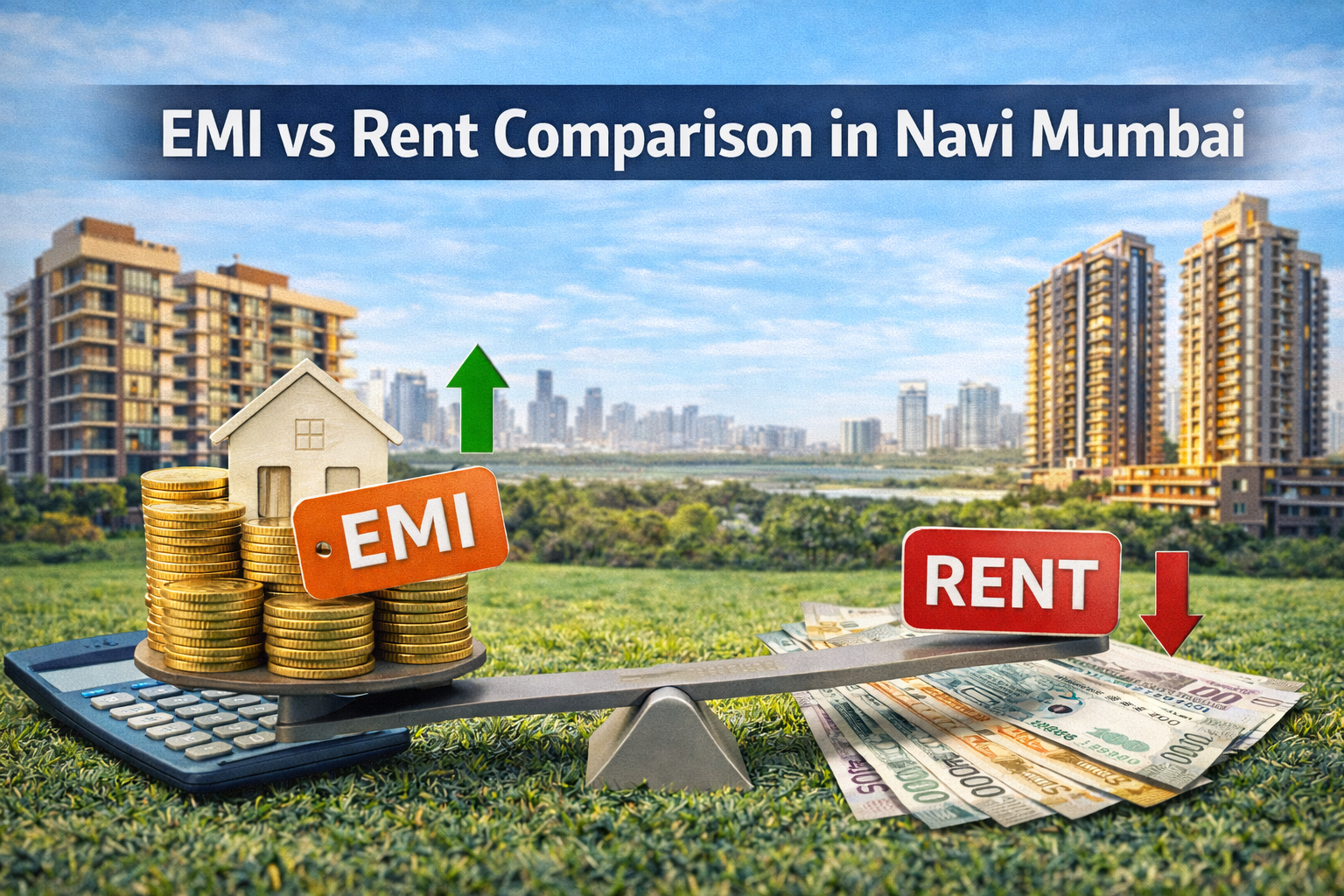
The biggest mistake is comparing only rent vs EMI.
That sounds practical, but it is incomplete.
When people say, “My rent is ₹X and EMI is ₹Y, so which one is better?” they usually ignore the fact that rent and ownership do not carry the same type of burden.
Renting cost is not only monthly rent

Renting usually includes:
- security deposit
- brokerage
- shifting cost
- furnishing gaps in some cases
- annual rent increases
Buying cost is not only EMI

Buying usually includes:
- down payment
- stamp duty
- registration
- legal and processing costs
- interiors and setup
- EMI
- monthly maintenance
- property tax
- repairs and upkeep
- opportunity cost of blocked capital
That is why EMI should never be compared directly with rent as if both are equal categories. They are not.
Navi Mumbai Is Not One Market
This is the single most important idea in this article.
Navi Mumbai is not one real estate market.
It contains different kinds of housing logic at the same time:
- mature premium nodes
- stable end-use residential nodes
- infrastructure-led growth corridors
- affordability-driven outer markets
- selective investor pockets
So a financial decision that works in Seawoods may fail in Taloja. A move that makes sense in Kharghar may not be the best one in Vashi. A family planning school continuity may choose differently from a professional whose office location may change next year.
This is why city-level advice often sounds smart but leads to bad decisions.
For buyers thinking beyond today’s monthly cost, future infrastructure and property values can play a major role in whether buying feels justified.
The 3-Filter Test Before You Decide
Before deciding whether to rent or buy in Navi Mumbai, ask these three questions.
1. How long will you realistically stay?
Not the ideal answer. The realistic one.
If you may move within the next few years because of job shifts, business uncertainty, commute changes, or family transitions, renting usually becomes more sensible. Buying works best when you are reasonably sure you will stay long enough to absorb the upfront burden and let ownership start making sense.
2. Can you handle the real cost of buying, not just the loan?
The better question is not “Can I get this home loan?”
The better questions are:
- Can I pay the down payment without wiping out my savings?
- Can I handle registration, stamp duty, maintenance, and tax too?
- Will I still have an emergency fund left?
- Will this purchase make me financially stronger or just emotionally satisfied?
3. Is the area mature, balanced, or still growing?
If the node is already premium and capital-heavy, renting may be more efficient. If the node still has long-term demand depth and future upside, buying may become stronger.
These three filters alone can prevent a lot of bad decisions.
Short-Term Cost vs Long-Term Value
In the short term, renting usually wins
Renting usually comes with:
- lower entry burden
- lower lock-in
- easier exit
- better liquidity preservation
This matters if:
- you are still building savings
- your income is not fully stable
- your work location may change
- you are unsure where to settle
- the area you want is too expensive to buy comfortably
In the long term, buying can become stronger
Buying starts making more sense when:
- your stay horizon is long
- the location has future demand strength
- the purchase does not destroy liquidity
- you want stability and asset creation together
That does not mean buying is always better. It means buying becomes stronger only when time horizon, affordability, and area quality are aligned.
Rent vs Buy by Area in Navi Mumbai
Area-Wise Comparison Table
| Area | Rent or Buy? | Core Logic | Best For |
|---|---|---|---|
| Seawoods | Rent leaning | Premium, mature, ownership entry is heavy | Professionals, premium lifestyle users |
| Vashi | Rent leaning | Strong location but capital-heavy ownership | Convenience-focused residents |
| Nerul | Mixed | Stable end-use location, depends on goals | Families, long-term residents |
| Kharghar | Buy leaning | Strong balance of liveability and future demand | Long-term end users |
| Ulwe | Buy leaning | Growth corridor with long-term relevance | Buyers with patience |
| Panvel-side belts | Buy leaning | Lower entry and corridor upside | Budget-conscious long-term buyers |
| Kamothe | Mixed | Project quality and exact location matter | Selective buyers |
| Taloja | Selective buy only | Affordability alone is not enough | Very selective long-term buyers |
Seawoods: Renting Usually Makes More Sense
Seawoods is one of the clearest rent-leaning markets for many end users. It is premium, established, and attractive from a lifestyle point of view. But that also means buying here usually needs stronger financial justification.
A purchase in Seawoods makes more sense only if:
- your income is very stable
- you want long-term family use
- you are strongly committed to staying
- you are comfortable deploying premium capital
Verdict for Seawoods
Rent usually makes more sense unless the buyer is highly long-term and financially very comfortable.
Vashi: Strong Utility, Heavy Ownership Cost
Vashi remains one of the most practical locations in Navi Mumbai because of its centrality, convenience, and commercial relevance. But from a rent-versus-buy angle, it often behaves like a capital-heavy mature node.
Renting still lets you enjoy:
- central location
- daily convenience
- established infrastructure
- strong work access
Verdict for Vashi
Rent-leaning market for many users who want access without large capital lock-in.
Nerul: Balanced and Goal-Dependent
Nerul is not as sharply rent-leaning as Seawoods or Vashi, but it is also not an automatic aggressive buy for everyone.
It works well as a stable residential node. It has liveability, family appeal, and stronger end-use depth. That makes it attractive for families and long-term residents. But from a pure financial perspective, the buy case often depends more on personal use than on dramatic future upside.
Verdict for Nerul
Mixed market. Good for selective long-term buyers and still practical for renters.
Kharghar: One of the Stronger Buy Cases
Kharghar has become one of the strongest ownership stories in Navi Mumbai because it offers a better balance of:
- liveability
- family appeal
- institutional presence
- daily ecosystem
- long-term relevance
It is no longer just a “future area.” It has developed enough to support serious end-use demand, while still keeping a stronger ownership case than older premium nodes.
Verdict for Kharghar
Buy-leaning market, especially for long-term end users and families.
Ulwe: Strong Growth Corridor, Strong Buy Logic
Ulwe remains one of the clearest examples of why area matters so much in Navi Mumbai. Its housing story is much more tied to long-term corridor growth than mature premium nodes.
That is why Ulwe usually looks stronger from a buy perspective than from a rent-first perspective, especially for buyers who can hold patiently and choose projects carefully.
Verdict for Ulwe
Clear buy-leaning market for long-term buyers, though project and sector selection remain critical.
Panvel-Side Markets: Buy With Patience
Panvel-side markets attract many buyers because they feel more reachable than inner premium nodes. For budget-conscious households, that matters a lot.
But these are patience-driven markets. They are not always instant-result markets. The strongest case here usually comes from:
- longer holding horizon
- realistic expectations
- selective project choice
- belief in corridor-level strengthening over time
Verdict for Panvel-Side Markets
Buy-leaning, but patience-driven market.
Kamothe: Selective, Not Automatic
Kamothe sits somewhere in the middle. It is more manageable than premium nodes, but not every part of Kamothe carries the same strength.
Verdict for Kamothe
Mixed, project-specific market.
Taloja: Buy Only Selectively
Taloja often attracts attention because the entry ticket can look easier. But low price alone is never enough reason to buy anywhere.
A Taloja purchase should be based on:
- exact connectivity
- project credibility
- daily liveability
- surrounding development
- realistic rental and resale logic
Verdict for Taloja
Selective-buy market only.
When Renting Is the Better Option
Renting is usually the better option when flexibility has real value.
It usually makes more sense if:
- your office location may change
- your business income is still uneven
- your life plans are not fixed
- you want to preserve liquidity
- the area you want has already become too capital-heavy
In these cases, renting is not weakness. It is usually discipline.
When Buying Is the Better Option
Buying becomes stronger when clarity enters the picture.
It usually makes more sense if:
- you expect to stay for 7 years or more
- your monthly cash flow is stable
- your down payment is ready without destroying liquidity
- your chosen node still has long-term demand strength
- you want stability and future asset creation together
This is especially true in stronger growth corridors.
Who Should Rent Right Now?
Renting is better for you if:
- you may move within 3 to 7 years
- your income is still changing
- you are building emergency savings
- you want premium-area access without a huge capital lock
- you are not yet sure which part of Navi Mumbai suits your long-term life
Who Should Buy Right Now?
Buying is better for you if:
- you already know where you want to settle
- your income is stable
- your savings are strong enough
- you still have a safety buffer after the down payment
- your chosen market has future upside
- your plan is long term, not short term
When Renting Is Smarter Than People Admit
There is a very common line in housing conversations: rent is wasted money. It sounds powerful and practical, but in many cases it is a lazy statement. Rent is only truly “wasted” if the alternative purchase is financially healthy, sensibly timed, located in the right micro-market, and still sustainable after counting all ownership costs. If buying a home leaves you with no emergency fund, creates a stressful EMI from the very first month, locks you into the wrong project, or pushes you into a weak location simply because it looked cheaper, then renting may actually be the wiser financial decision.
When Buying Is Smarter Than People Delay
On the other hand, some people delay so much that they weaken their own future buying position.
If you already have:
- long-term clarity
- stable income
- enough savings for a down payment
- a chosen growth-oriented area
and you still keep postponing only because renting feels easier in the short term, then delay itself can become costly.
In stronger growth corridors, waiting is not always neutral. Sometimes it simply makes future entry harder.
Common Mistakes People Make in Navi Mumbai
1. Comparing only rent vs EMI
This is the biggest mistake because ownership cost is wider than EMI.
2. Buying only because rent feels “wasted”
A weak purchase is worse than disciplined renting.
3. Choosing a cheap area without checking liveability
Low entry price is not enough. Daily life matters.
4. Buying without a safety buffer
If the purchase destroys liquidity, the house can become a burden.
5. Treating all of Navi Mumbai like one market
This is where most generic advice fails.
Final Verdict on Renting vs Buying in Navi Mumbai
The biggest mistake people make is asking, “Should I rent or buy in Navi Mumbai?” as if the whole city behaves like one market.
It does not.
That is why the financially correct answer changes by node.
- In Seawoods and Vashi, renting often makes more sense because ownership is too capital-heavy for many households.
- In Nerul, the answer is more balanced and depends on whether the decision is for long-term family use or short-to-medium-term flexibility.
- In Kharghar, Ulwe, and selective Panvel-side markets, buying generally becomes the stronger long-term move if income, holding period, and project selection are right.
- In Kamothe and Taloja, decisions should be more selective and project-led.
Final One-Line Answer
Rent in saturated premium nodes. Buy in stronger long-term growth corridors. Stay selective in affordability-led outer markets. Decide only after checking your stay horizon, affordability, and micro-market quality.
FAQs
Is it better to rent or buy in Navi Mumbai?
It depends on the area and your financial position. Premium mature nodes often favour renting, while stronger growth-oriented corridors can favour buying over the long term.
Is EMI better than rent in Navi Mumbai?
Not always. EMI is only one part of ownership cost. You must also count down payment, registration, maintenance, tax, and lost liquidity.
Which areas in Navi Mumbai are better for renting?
Seawoods and Vashi are usually more rent-friendly for many users because they are mature and capital-heavy. Nerul can also be practical for renting depending on budget and lifestyle.
Which areas in Navi Mumbai are better for buying?
Kharghar, Ulwe, and selective Panvel-side corridors usually show a stronger buying case because they combine longer-term demand logic with future-oriented location relevance.
Is Ulwe good for buying in 2026?
Ulwe usually has a stronger buy case than many mature nodes because of its corridor-level relevance, but that does not make every project a good buy. Sector, project quality, and liveability still matter.
Should families rent or buy in Navi Mumbai?
Families with long-term location clarity, stable income, and a well-chosen node often benefit more from buying because ownership supports both stability and future asset creation.
Should professionals rent in Navi Mumbai?
Professionals whose jobs, commute patterns, or city preferences may change often benefit from renting first, especially in premium nodes where buying creates a large capital lock-in.
Conclusion
Renting and buying are not opposite ideologies. They are two different financial tools.
If your goal is flexibility, lower pressure, and premium-area access without heavy capital lock-in, renting can be the smarter move.
If your goal is long-term stability, family use, and ownership in a corridor with future relevance, buying can become the stronger move.
In Navi Mumbai, the right answer is not city-wide. It is area-specific, financially disciplined, and time-horizon dependent.