
Maintenance and Hidden Costs in Commercial Property in Navi Mumbai
CAM charges are only one part of commercial property cost. In Navi Mumbai, the real risk is that a shop, office, or commercial unit may look affordable on paper but become expensive after CAM, property tax, power load, parking, fit-out, signage, deposits, and authority-side dues are added. That is why buyers and tenants should compare total occupancy cost, not just base rent or brochure price.
If you are reviewing a lease, LOI, cost sheet, or resale commercial deal, this is the practical way to think about it: separate monthly charges, annual charges, one-time setup costs, and local authority-linked liabilities. That is where most “hidden costs” sit.
Quick Summary
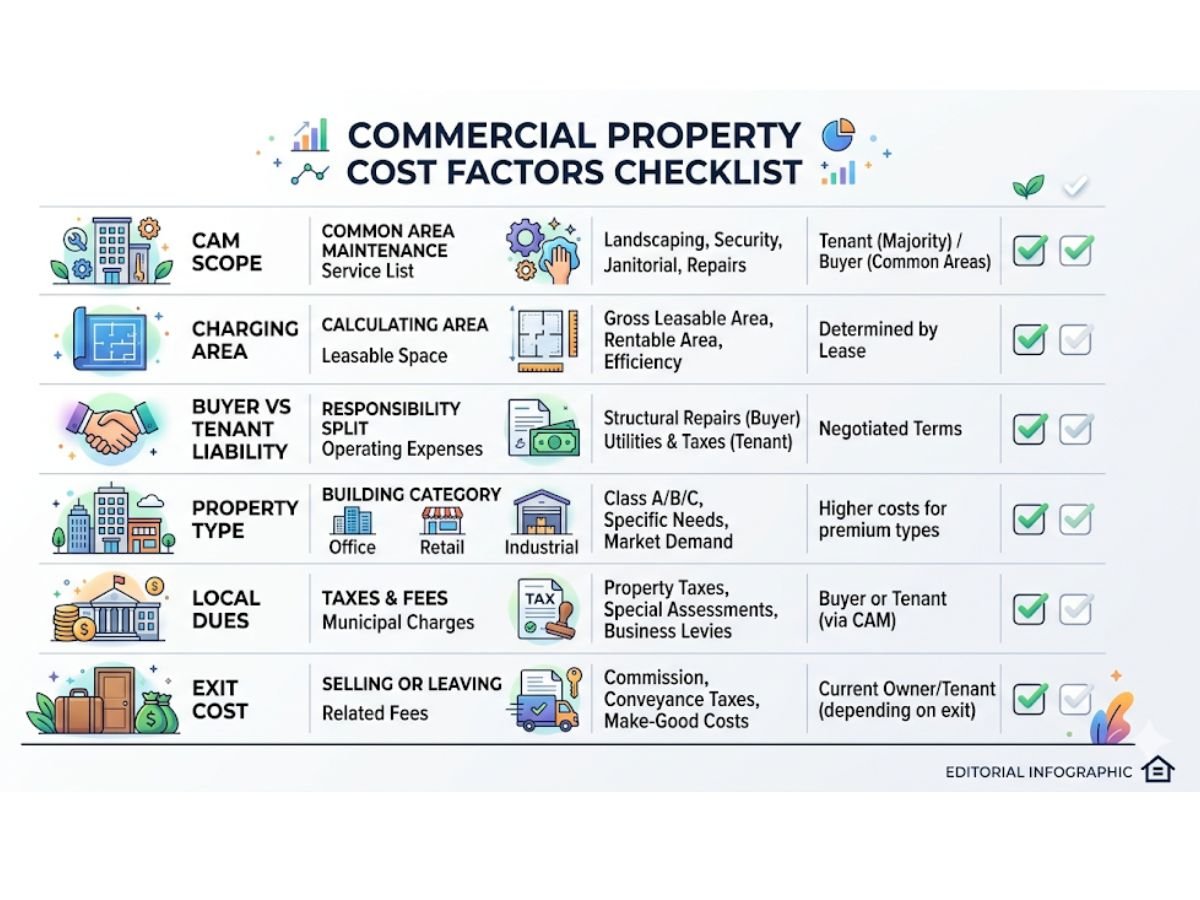
| What to check | Why it matters |
|---|---|
| CAM scope | Many disputes start because the quote says “CAM extra” but does not define what is included |
| Charging area | CAM is often billed on saleable or super built-up area, not carpet area |
| Buyer vs tenant liability | Tenants usually face operating and exit costs, buyers face tax, transfer, and structural-risk costs |
| Property type | Airoli-grade managed offices behave differently from older Vashi or Belapur mixed-use stock |
| Local dues | In Navi Mumbai, CIDCO, NMMC, or Panvel-side dues can materially change the true cost |
| Exit cost | Reinstatement, deposits, and pending dues can hurt more than entry cost |
CAM Charges in Commercial Property: What the Reader Should Understand First
CAM means Common Area Maintenance. In commercial property, it usually covers the cost of operating and maintaining shared parts of a building or complex, such as lobbies, common lighting, security, lifts, fire systems, shared toilets, housekeeping, and landscaped or parking common areas.
But this is the important part: CAM is not the full cost of holding or occupying commercial property. It is only one layer.
A shop quoted at a lower rent in an older Vashi building may still end up costing more than a better-managed office in Airoli if the first unit has poor power efficiency, no proper parking, ad hoc repair levies, and unclear society collections. Similarly, a buyer who focuses only on the purchase price may ignore property tax, local transfer exposure, and later capital repair contributions.
So the right question is not “What is the CAM rate?” The right question is “What will this unit actually cost me every month, every year, and at exit?”
What CAM Usually Includes and What It Often Does Not
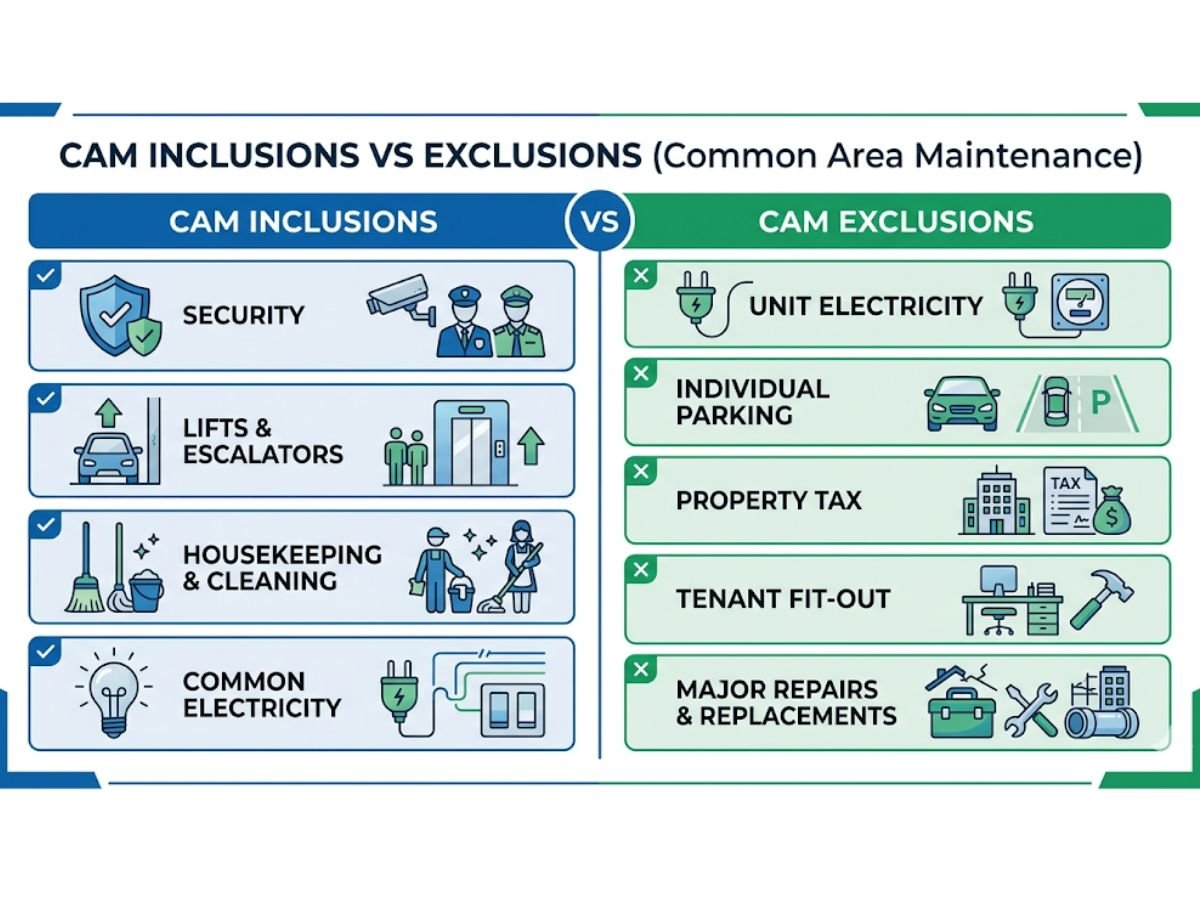
A standard commercial CAM pool usually includes day-to-day common area operations. Think of security guards, common electricity, housekeeping of shared spaces, lift AMC, fire-safety testing, pest control in common areas, and basic property-management services.
What often creates trouble is what sits outside CAM, or gets mixed into it later.
Items commonly included in CAM
In a normal commercial setting, CAM may include:
- common area lighting and water use
- lobby, staircase, lift, and parking upkeep
- security staff and housekeeping
- landscaping and common pest control
- annual service contracts for lifts, pumps, and fire systems
- basic building management fees
Items often billed separately even when people assume they are included
This is where many buyers and tenants get caught:
- unit electricity, not common electricity
- private AC servicing or internal plumbing/electrical repair
- dedicated parking fees
- DG backup usage or central HVAC consumption allocations
- municipal property tax, depending on lease structure
- internal fit-out, signage, façade works, and approvals
- major structural repairs or capital upgrades
CAM should not be treated casually. If the cost sheet says only “maintenance extra” or “CAM at actuals,” that is not enough. You need the breakup and the charging basis.
Which Commercial Property Costs Are Monthly, Annual, One-Time, and Surprise/Event-Based?
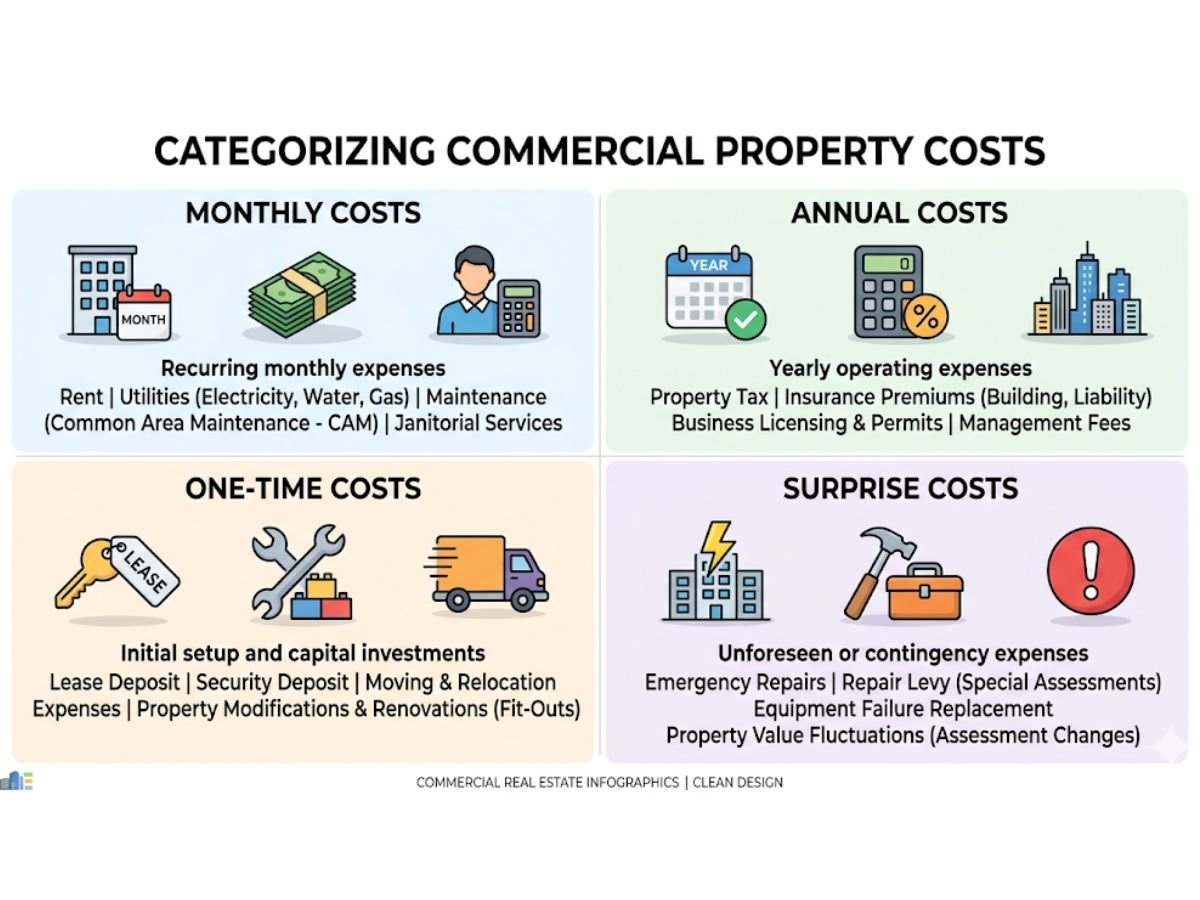
This is the cleanest way to avoid confusion.
Monthly costs are the visible ones. Base rent or EMI sits here. CAM sits here. Electricity sits here. Parking may sit here. In some buildings, HVAC recovery, DG backup, or service charges sit here too.
Annual costs are easy to underestimate. Property tax, insurance, trade-license renewals, and some compliance costs do not hit every month, but they still affect the real cost of occupation or ownership. In Navi Mumbai, this matters more than many first-time commercial buyers realise because the tax and dues structure changes by jurisdiction.
One-time costs are the entry shock. Security deposit, stamp duty, registration, brokerage, interior fit-out, MSEDCL connection-related deposit, access-control setup, and furniture all belong here. This is where a “good deal” can become a capital-heavy decision.
Surprise or event-based costs are the most dangerous. These include sudden society repair levies, CIDCO transfer premiums in a resale deal, reinstatement cost when vacating a lease, load-enhancement cost, or delayed demands that appear only when finance, transfer, or possession is underway.
This separation matters because people often compare one unit using only the monthly number and forget the rest.
Why a Low Quote Can Still Be Expensive After CAM, Taxes, Power, and Fit-Out
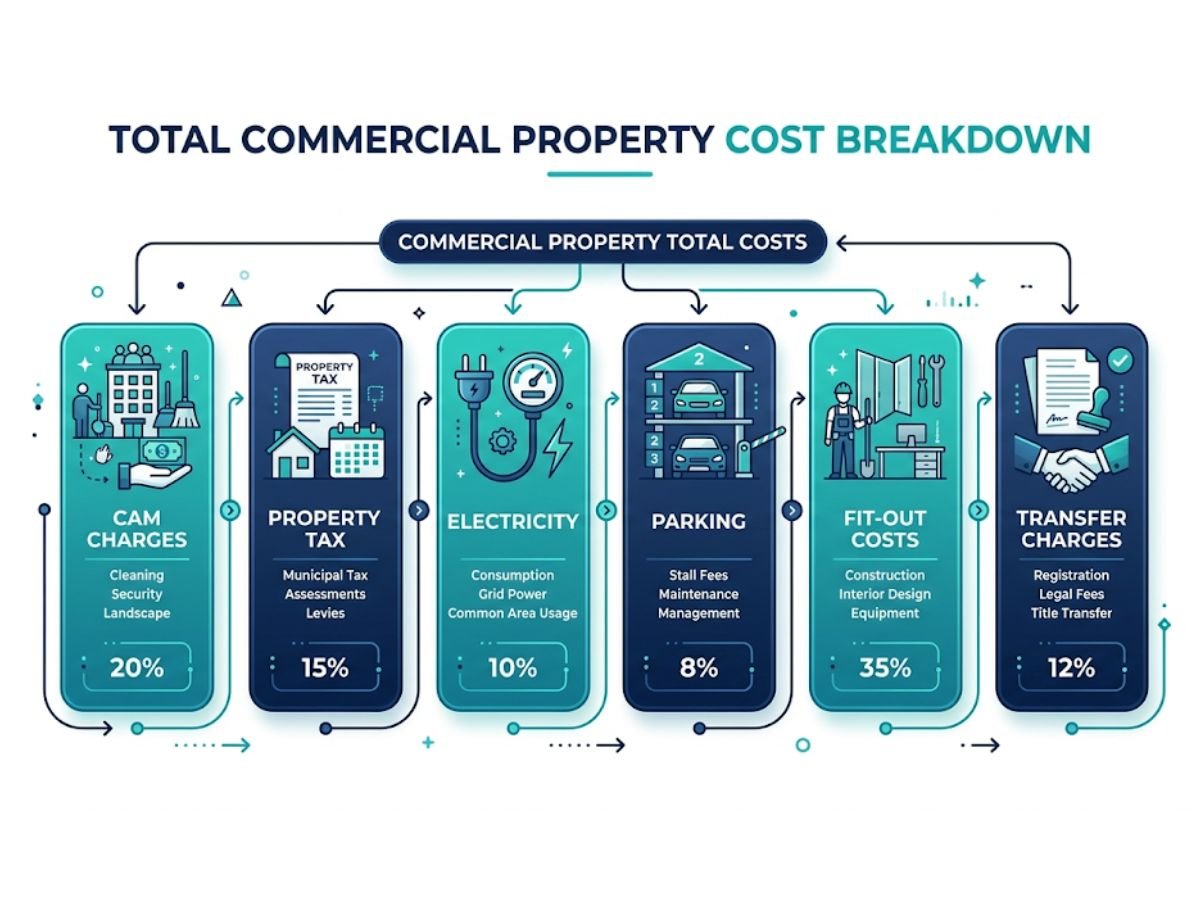
This is one of the biggest practical mistakes in commercial property.
Suppose you are comparing two office options of similar usable size.
One is in an older building near Vashi station. The base quote looks attractive. Maintenance is low on paper. But you later discover that parking is separate, power consumption is high because the building is inefficient, the common areas are poorly maintained, and the society raises ad hoc repair demands because there is no healthy sinking fund.
The second is in a managed office building in Airoli or Mahape. The base quote is higher, and CAM is clearly stated. At first glance it feels expensive. But common systems are professionally run, parking is defined, central services are better planned, and surprise repair levies are less frequent.
Now compare the total:
- base rent or EMI
- CAM
- electricity and demand-related burden
- parking
- annual taxes or pass-through charges
- fit-out and setup cost
- likely repair or exit cost
Very often, the “cheap” unit only looks cheap because the quote hides fragmentation. The more managed unit may be costlier upfront but more predictable over time. Predictability itself has value, especially for a business.
Buyer vs Tenant: Who Usually Pays What in Commercial Property?
This distinction changes the entire decision.
A tenant usually worries about operational cash flow. A buyer worries about ownership burden, transfer exposure, and long-term building health.
For a tenant, the pain points are usually CAM, electricity, deposit, fit-out, escalation, parking, and the reinstatement clause at exit. For a buyer, the pain points are usually property tax, transfer premium, structural repair burden, sinking fund contributions, and vacant-period holding cost.
If the document is a commercial lease, read it like an operating-cost document. If it is a purchase deal, read it like a holding-cost and transfer-risk document.
The Hidden Costs That Most Commercial Quotes Do Not Show Clearly Upfront
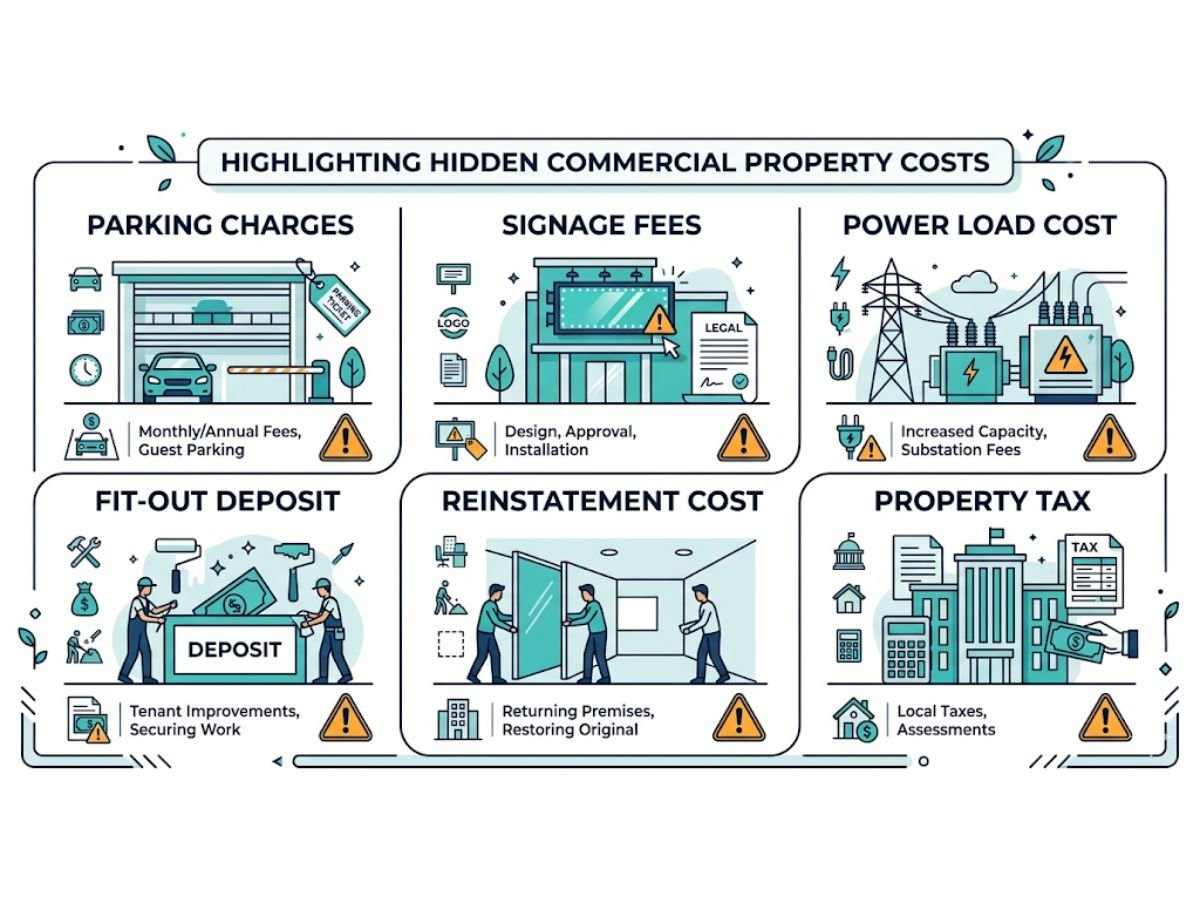
This is the section most readers are actually looking for.
Parking, signage, loading-unloading, and access-related charges
Parking is rarely as simple as people assume. In premium commercial belts such as Vashi, Seawoods, CBD Belapur, and parts of Airoli, dedicated parking may be separately purchased or charged. Visitor parking may also be limited, creating daily friction for clients and staff.
Signage is another hidden layer. Shop owners often focus on the unit and forget that visibility itself may need permissions, design compliance, and recurring fees. In practice, façade signage is not just a branding issue. It is a cost issue.
Electricity load, meter, DG backup, AC plant, and power-related cost
Commercial power is not only about per-unit electricity consumption. In Maharashtra, commercial users also face fixed or demand-related charges, and the burden rises with sanctioned load. That matters a lot for offices with heavy AC usage, clinics, food businesses, IT back-end operations, and retail formats with display or cooling equipment.
A bare-shell unit may look affordable until you realise the sanctioned load is inadequate. Then the cost and delay of load enhancement become your problem.
Fit-out deposit, reinstatement, interiors, and handover-readiness cost
For tenants, this is one of the most damaging hidden costs.
Interior fit-out in commercial property is not a small finishing expense. Flooring, partitions, lighting, air-conditioning distribution, network cabling, pantry work, fire compliance, glass work, and reception finishing can run into serious money, especially in modern office stock.
Then comes the exit problem. Many tenants wrongly assume the security deposit will protect them at the end. In reality, the landlord often protects that deposit and uses it to enforce reinstatement. If the lease says the unit must be returned in original bare-shell condition, your exit cost can be painful.
Property tax, insurance, sinking fund, corpus, and compliance-related cost
Property tax is not maintenance. This sounds basic, but people mix them up all the time.
In NMMC areas, commercial property tax is materially higher than residential tax and works on rateable-value logic, not on the property’s market price. In Panvel-side areas such as Kharghar, Taloja, Kamothe, Kalamboli, and Panvel, the property-tax story has had a different and more turbulent history, including retrospective demand disputes linked to the period after the municipal setup from October 2016 onward.
For older commercial stock, the hidden cost is often not CAM but building-age stress. A building with artificially low monthly maintenance may simply be underfunded. That usually means future repair pain.
How This Changes by Property Type in Navi Mumbai
Not all commercial stock behaves the same. This is where local ground reality matters.
Office towers and managed commercial buildings
In Airoli and Mahape, institutional or managed office environments usually have more formal CAM structures. CAM is often higher and less negotiable, but the systems are clearer. Security, HVAC planning, common services, parking logic, and infrastructure upkeep are usually better organised.
This does not automatically make them cheaper. It makes them easier to model.
High-street shops and mixed-use buildings
In older Vashi or Belapur high-street belts, formal CAM may look low. But low CAM is not always a benefit. It can simply mean fragmented maintenance, lower service quality, poor parking management, and sudden society levies when building systems start failing.
For a shop owner, real visibility, footfall quality, access, and loading-unloading ease may matter more than a low maintenance line item.
Mall-style or managed retail stock
In managed retail environments, CAM can look heavy because the building is running lighting, security, housekeeping, façade upkeep, and customer-facing systems at a different standard. But that cost is part of the retail format itself. A retail operator should not compare this casually with a street shop where the business has to solve many of these issues independently.
Older society-linked commercial stock
This category traps many value buyers. The monthly outgo looks light, so the property feels cheap. Then the surprises start: lift replacement, waterproofing, structural audit, façade repairs, parking confusion, and collections that were never budgeted properly.
Low maintenance in an old commercial building is not automatically a positive signal. Sometimes it is the warning sign.
Where Navi Mumbai Readers Need Extra Caution on Local Dues and Building Structure
This is where Navi Mumbai becomes very different from a generic commercial property article.
First, jurisdiction matters. The NMMC belt and the Panvel-side belt do not behave the same from a tax and dues perspective. If you are buying or leasing in Vashi, Nerul, Belapur, Airoli, or Ghansoli, your municipal logic differs from Kharghar, Taloja, Kamothe, Kalamboli, and Panvel.
Second, CIDCO matters in many leasehold-linked assets. In resale commercial property, CIDCO transfer permission and premium can materially change the acquisition cost. After the April 2025 revision, transfer charges became far more serious, and top-end commercial slabs became headline-level expensive for larger spaces. That is not a small paperwork issue. It can change deal viability.
Third, MahaRERA matters mainly for newer or registered project stock. Its value here is not only compliance visibility. It also helps decode what the promoter is collecting, how project-linked accounts are structured, and how maintenance or corpus-related collections should be handled in a regulated project environment. That matters far less in an old legacy resale building than in a newer commercial project.
What to Check in the Quotation, Cost Sheet, LOI, Lease, or Agreement Before You Commit
This is where you protect yourself.
Area basis used for charging
Ask one direct question: is CAM charged on carpet area, built-up area, saleable area, or super built-up area?
Many commercial occupiers budget using the area they can physically use and later realise billing is happening on a much larger chargeable figure. This one mistake can distort the monthly cost badly.
Fixed vs variable CAM wording
If CAM is fixed for a period, that is clearer. If it is “at actuals,” “revisable,” or loosely pass-through based, read more carefully. Variable wording gives future pricing power to the other side.
Escalation, revision, and pass-through clauses
Rent escalation is expected. CAM escalation or tax pass-through is where the real trouble starts. Read who bears future increases in property tax, utility tariffs, building insurance, and other shared costs.
What is expressly excluded
This is the most practical test. Ask what is not included. If the other side explains only inclusions and avoids exclusions, the cost sheet is incomplete.
A Simple Formula to Compare Two Commercial Units Properly
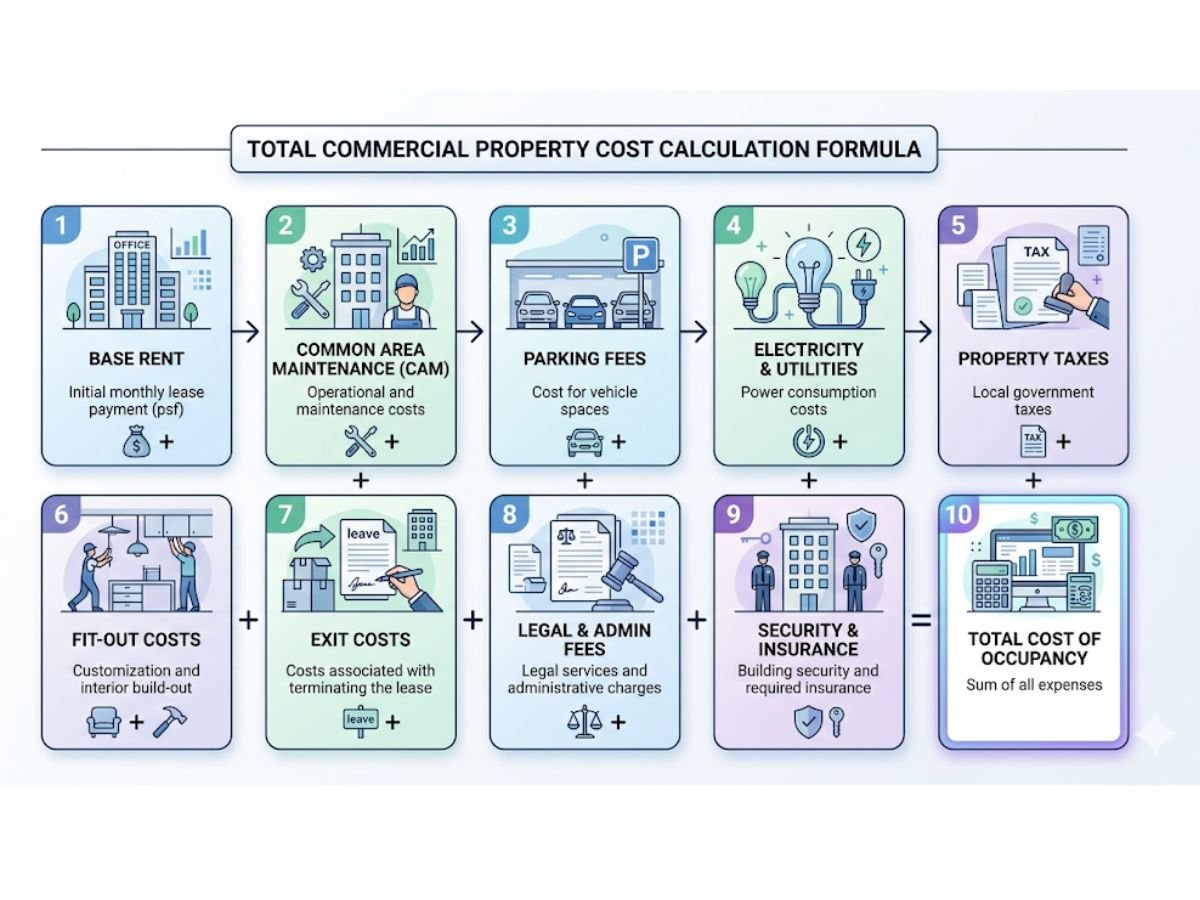
Do not compare commercial property using only the headline ₹ per sq ft figure.
Use this practical method:
True Monthly Cost = Base rent or EMI + CAM + parking and service add-ons + expected electricity and demand burden + monthly share of annual taxes/insurance + fit-out and setup cost spread across the likely holding period + likely exit or reinstatement burden spread across the lease term
Then divide that by the actual usable carpet area.
This gives you a much better comparison than brochure pricing. A unit with higher headline rent but lower hidden friction can still be the smarter deal.
Red Flags That Usually Mean the Cost Sheet Is Not Transparent
Be careful if you see any of these:
- “CAM extra” with no breakup
- no clarity on charging area
- no statement on who bears municipal tax increases
- separate parking terms disclosed late
- load, HVAC, DG backup, or signage cost not explained
- advance maintenance collected without proper project/account clarity in new stock
- CIDCO transfer burden discussed casually in a resale deal
- vague statements like “all-inclusive” that later break into multiple heads
If the deal becomes less clear every time you ask a direct cost question, it is not a transparent cost sheet.
Final Pre-Commitment Checklist for CAM, Maintenance, and Hidden Cost Risk
Before token, lease signing, or registration, verify these points in sequence:
1. Confirm the exact carpet area and the exact billing area. 2. Ask for the CAM breakup in writing. 3. Confirm which costs are outside CAM. 4. Check whether parking is included, licensed separately, or sold separately. 5. Verify the sanctioned power load and whether it suits your business model. 6. Read the escalation and pass-through clauses carefully. 7. For resale assets, verify tax receipts, no-dues position, and transfer responsibility. 8. In CIDCO-linked stock, clarify who bears transfer premium and NOC-related burden. 9. In Panvel-side commercial property, check the municipal dues trail with extra care. 10. If it is a lease, review the reinstatement clause before paying the deposit.
Conclusion
In commercial property, CAM is not the real problem by itself. The real problem is incomplete cost understanding.
If you are buying or leasing commercial property in Navi Mumbai, do not judge the deal by the base rent, quoted price, or maintenance line alone. Judge it by the total monthly outgo, annual statutory burden, one-time setup cost, and local authority-linked risk. That is the difference between a property that looks affordable and one that actually works.
FAQs
Frequently Asked Questions