Blogs

Everything about Navi Mumbai

Builders and Developers in Ghansoli, Navi Mumbai: 2026 Buyer Guide

The most relevant builders and developers in Ghansoli for 2026 buyers are Aurum Ventures, Gami Group, Bhairaav Group, GeeCee Ventures, and Shree Ramtanu Group, with Arihant considered only for nearby relevance. The right choice depends on buyer type, micro-location, and project-level verification, not just builder brand recognition. People searching for builders and developers in Ghansoli usually want three things at once: a shortlist of credible names, clarity on which builder fits their budget and lifestyle, and a practical way to avoid booking mistakes. That is exactly where most ranking pages are weak. Portal pages show inventory. Lead-gen pages push enquiry forms. Very few pages explain who should choose Ghansoli, which developer fits which buyer, and what must be verified before paying token money. Ghansoli works especially well for salaried professionals, families who want better daily connectivity, and buyers comparing nearby employment-heavy nodes such as Airoli, Mahape, Rabale, and Kopar Khairane. It has a stronger balance of newer residential stock, station-led access, and office-corridor convenience than purely industrial-feeling pockets nearby. Based on the research provided, the highest-confidence shortlist for Ghansoli is: Aurum Ventures for premium and integrated-campus buyers Gami Group for broad Ghansoli footprint and end-user relevance Bhairaav Group for Goldcrest-led mid-premium comparison GeeCee Ventures for selective premium high-rise buyers Shree Ramtanu Group for local-market relevance where extra due diligence is essential Arihant for nearby verified relevance only, not as a primary Ghansoli-first pick If you want the practical answer first, start your shortlist this way: Premium buyers: Aurum, GeeCee End-users and professionals: Gami, Bhairaav Local-market and ready-stock comparers: Shree Ramtanu, selected resale inventory Nearby comparison only: Arihant The most important filter is not “who is the biggest builder.” The correct filter is: which developer has a verifiable project footprint in Ghansoli, fits your buyer profile, and passes project-wise documentation checks. Quick Comparison Table Developer Best For Strong Areas Segment Project Type Buyer Fit What To Verify Aurum Ventures Premium buyers, township-style seekers, senior professionals Ghansoli station belt, Thane-Belapur Road-facing premium pocket Premium Integrated campus, residential, mixed-use Best if you want brand visibility, modern product, and a premium live-work feel Exact tower or phase, promoter entity, possession-related claims, RERA phase match, payment milestones Gami Group End-users, office commuters, first serious shortlisters Broader Ghansoli footprint with multiple project references; nearby Airoli relevance Mid to mid-premium Residential towers, multiple project formats Best if you want more choice inside one local developer ecosystem Exact project/tower, launch stage vs live status, OC/CC where relevant, current RERA status Bhairaav Group Mid-premium families, Goldcrest-led buyers Ghansoli with Goldcrest project relevance Mid-premium Residential tower cluster Best if you prefer a focused project family rather than a scattered shortlist Whether you are booking the correct phase, current completion stage, written amenities and parking details GeeCee Ventures Premium buyers wanting a selective shortlist Sector-led Ghansoli premium comparison Premium High-rise residential Best if you want a narrower premium tower comparison instead of too many options Exact RERA registration, handover or occupancy-related claims, maintenance and parking terms Shree Ramtanu Group Local-market buyers, deeper on-ground comparison Ghansoli local residential pockets Mid-segment to local mid-premium Local residential projects Best if you are comfortable doing deeper document-level verification Promoter identity, live project status, title and approvals, portal claims vs actual documents Arihant Superstructures Nearby Ghansoli–Airoli comparison Nearby verified relevance only Mid to upper-mid Residential Useful only as a comparison name if you are expanding outward from Ghansoli Whether the exact project is in Ghansoli or only nearby, current live relevance, project-wise status How We Selected These Developers Not every builder with a Navi Mumbai listing deserves inclusion on a Ghansoli page. This shortlist was built to be more useful than SERP competitors by using selection logic, not brochure language. The selection methodology Local project footprint A developer was included only if the research showed an identifiable Ghansoli project presence or, in Arihant’s case, verified nearby relevance worth comparing. Area relevance This page is about Ghansoli, not generic Navi Mumbai. So priority was given to developers whose projects genuinely matter when someone is comparing Ghansoli with Airoli, Mahape, Rabale, or Kopar Khairane. Buyer fit A premium buyer, first-time buyer, investor, and ready-to-move buyer should not receive the same recommendation. Developers were grouped by actual use case, not generic “top builder” language. Segment We separated premium, mid-premium, and local mid-segment relevance instead of pretending every builder serves the same market. Project type Integrated campuses, premium towers, local residential projects, and mixed-use developments solve different buyer problems. The format of the project matters as much as the brand. RERA and project verification The strongest names are not automatically the safest projects. We prioritized developers and projects with public verification signals, and we clearly marked any gaps. Delivery visibility Where public signs suggested ready, ongoing, phase-wise, or mixed delivery visibility, that affected buyer fit recommendations. Public market presence If a project appears consistently across official pages and major public property portals, it is easier for buyers to cross-check. That does not make it risk-free, but it improves verification visibility. Risk factors Where an official corporate site was not clearly surfaced, or where a developer’s Ghansoli relevance seemed narrower than the brand name suggested, that was treated as a caution. Search intent behind this topic The search intent for builders in Ghansoli and developers in Ghansoli Navi Mumbai is a mix of: informational intent: “Who are the relevant developers here?” comparative intent: “Who fits my budget and needs?” transactional-prep intent: “What should I verify before booking?” That is why this guide is structured around buyer fit, local fit, and verification risk rather than just listing names. Best Developers by Buyer Type Premium buyers If your budget and expectations are on the premium side, start with Aurum Ventures and GeeCee Ventures. Aurum fits buyers who want a stronger overall ecosystem feel, modern product language, and brand-led visibility. GeeCee fits buyers who want a more selective premium shortlist and are happy comparing fewer towers in more detail. Choose Aurum if: you want an integrated, premium, location-led lifestyle proposition. Choose GeeCee if:

Read More
How to Choose the Right Real Estate Developer in Belapur

To choose the right real estate developer in Belapur, buyers should check the developer’s past delivery record, MahaRERA details, NMMC approvals, legal documents, CIDCO land clarity, construction quality, pricing transparency, buyer feedback, and possession history before paying token money. In Belapur, this is especially important because property values are high, redevelopment is active, and some projects may involve CIDCO leasehold rules, CRZ clearances, NMMC permissions, and society-related legal complexity. Belapur is one of Navi Mumbai’s most important real estate markets. It is not just another residential node. It is the Central Business District of Navi Mumbai, with government offices, commercial buildings, railway connectivity, premium residential pockets, hill-side locations, and creek-facing sectors. This makes the area attractive, but it also makes due diligence more serious. A reputed developer is not always the right developer if the project has unclear approvals, delayed possession, hidden charges, weak construction quality, or poor after-sales support. The safest way to choose a real estate developer in Belapur is to verify everything before booking, not after paying the token amount. This article is for general buyer awareness. Before booking or signing an agreement, buyers should verify documents with a qualified legal professional. Quick Summary: How to Choose the Right Real Estate Developer in Belapur What to Check Why It Matters in Belapur Good Sign Red Flag MahaRERA registration Confirms basic project compliance and buyer protection Valid registration, updated project details, clear possession date Lapsed status, missing updates, litigation not explained NMMC Commencement Certificate Shows that construction is legally approved up to specific floors CC clearly covers the floor being sold Builder sells higher floors before approval Occupancy Certificate Confirms the building is legally fit for possession Final OC issued by the authority “Fit-out possession” without OC CIDCO title and transfer documents Many Navi Mumbai plots have CIDCO-origin leasehold history Clear allotment, transfer, leasehold/freehold clarity Missing CIDCO NOC or unclear transfer chain CRZ clearance where relevant Important for waterfront or creek-side Belapur sectors MCZMA clearance available where applicable Sea-view project without CRZ paperwork Completed projects Shows actual delivery quality Older buildings are maintained well Seepage, poor lifts, poor parking, delayed society handover Pricing clarity Prevents budget shocks Signed all-inclusive cost sheet Verbal pricing, hidden parking, PLC, floor-rise charges Buyer feedback Reveals real after-sales behaviour Residents confirm smooth handover and maintenance Repeated complaints about water, parking, OC, leakage The buyer should not depend only on the project brochure, sample flat, or sales team explanation. In Belapur, a practical decision should be made only after checking legal approvals, old project quality, pricing, possession status, and local risks. Why Choosing the Right Real Estate Developer Matters in Belapur Belapur is a high-value and mature Navi Mumbai location. Property rates in many established and premium pockets can be significantly higher than in growth nodes, and the ticket size for a flat can be large. When the investment is high, the cost of choosing the wrong developer also becomes high. Belapur has three realities that buyers should understand clearly: 1. It has premium residential demand, especially around CBD Belapur, Sector 11, Sector 15, Sector 20, and nearby well-connected pockets. 2. It has many older CIDCO and cooperative housing buildings that are entering redevelopment. 3. It has local approval complexity because NMMC, CIDCO, MahaRERA, and sometimes CRZ-related permissions may all become relevant depending on the plot. A weak developer can create problems that do not appear during the sales presentation. These problems may include delayed possession, missing OC, unclear CIDCO transfer, water seepage, poor parking planning, inflated maintenance charges, or society handover disputes. In Belapur, developer selection is not only about luxury amenities. It is about protecting capital, avoiding legal stress, and ensuring that the flat remains easy to live in, finance, rent, and resell. Understand the Developer’s Past Track Record A developer’s past work is the strongest signal of future performance. Sales offices can be polished. Sample flats can look perfect. Brochures can show ideal images. But completed buildings reveal the truth. Before trusting a developer in Belapur, check what they have already delivered in Navi Mumbai, especially in nearby mature nodes like Belapur, Nerul, Seawoods, Sanpada, Vashi, and Kharghar. Check Completed Projects Before Trusting New Launches A new launch may offer attractive pricing, flexible payment plans, or future appreciation potential. But buyers should first ask one simple question: Has this developer completed similar projects before? If the developer has multiple completed projects, check whether they were delivered close to the promised timeline. MahaRERA details, resident feedback, and old project visits can help verify this. A developer who has delayed several past projects may delay the current project too. Delays are often not accidental. They may reflect weak finance, poor contractor management, or poor approval planning. For Belapur buyers, this matters more because under-construction redevelopment projects can involve additional legal and society-related complexity. Visit Older Buildings Developed by the Same Builder The true test of construction quality in Navi Mumbai is not possession day. It is the third, fifth, or tenth monsoon. Visit at least one older building completed by the same developer. Do not only look at the entrance lobby. Check: External plaster condition Basement or stilt parking dampness Lift condition Staircase leakage Terrace waterproofing Wall seepage near windows Drainage during rain Common area maintenance Belapur receives heavy monsoon impact like other parts of Navi Mumbai. Low-lying pockets and creek-side locations can face drainage and waterlogging pressure during intense rainfall. A developer with poor waterproofing practices can cause long-term damage to residents. Speak to Existing Residents and Buyers Existing residents will often tell you what no brochure will say. Ask them: Was possession delayed? Was the OC received before possession? Is there regular water supply? Are lifts maintained properly? Was society formation done smoothly? Was the maintenance corpus handed over transparently? Did the builder respond after possession? Are there leakage or parking disputes? A five-minute conversation with a resident can save a buyer from a five-year problem. For internal linking, this section can naturally link to [real estate developers in Navi

Read More

How to Choose the Right Real Estate Developer in Kopar Khairane

To choose the right real estate developer in Kopar Khairane, buyers should check the developer’s past delivery record, MahaRERA details, legal documents, construction quality, pricing transparency, completed projects, buyer feedback and possession history before paying token money. In Kopar Khairane, this becomes especially important because many properties involve CIDCO-origin land, NMMC approvals, older society redevelopment, PAP plot risks and sector-wise differences in water, parking and building condition. Quick Summary: How to Choose the Right Real Estate Developer in Kopar Khairane What to Check Why It Matters in Kopar Khairane Good Sign Red Flag MahaRERA registration Confirms basic project registration and uploaded documents Valid RERA number with clear project details No RERA number or vague “under process” answer Title and CIDCO documents Many properties have CIDCO leasehold or transfer history Clear title report, CIDCO allotment/transfer clarity Missing title chain or unclear PAP plot status Commencement Certificate Confirms legal construction permission up to a certain floor CC covers the floor you are buying CC approved only up to a lower floor Occupancy Certificate Confirms legal completion and habitability OC received or written OC timeline “Fit-out possession” without OC Completed projects Shows actual delivery quality Older buildings are structurally stable Leakage, cracks, poor lift and lobby condition Pricing clarity Prevents hidden charges after token payment Stamped all-inclusive cost sheet Verbal discounts, unclear parking or PLC charges Buyer feedback Reveals after-sales reality Residents speak positively about handover and maintenance Repeated complaints about water, parking, leakage or corpus Society handover Important for long-term control and redevelopment Society formed and conveyance/deemed conveyance done Builder still controls maintenance after years The safest way to choose a real estate developer in Kopar Khairane is to verify legal documents, completed projects, pricing clarity and buyer feedback before paying token money. A reputed developer is not always the right developer if the project has unclear approvals, delayed possession, hidden charges or weak after-sales support. Why Choosing the Right Real Estate Developer Matters in Kopar Khairane Kopar Khairane is not a new experimental market. It is a mature Navi Mumbai node located between Vashi, Ghansoli, Airoli, Mahape and the Thane-Belapur business belt. Many homebuyers here are end-users working in nearby employment hubs such as Millennium Business Park, Reliance Corporate Park and DAKC. That makes the area practical for families, working professionals and investors. But maturity also brings complications. Many buildings are older CIDCO-era cooperative societies. Some are moving towards redevelopment. Some pockets have mixed land histories involving gaothan extensions, PAP or 12.5% scheme plots and leasehold transfer issues. A buyer cannot judge a developer only by brochure design, sample flat lighting or sales office confidence. A wrong developer can create problems such as delayed possession, no Occupancy Certificate, unclear CIDCO transfer charges, poor waterproofing, weak parking planning, society handover disputes and hidden cost shocks. In Kopar Khairane, the developer must understand both the legal framework and the ground reality of Navi Mumbai living. This article is for general buyer awareness. Before booking or signing an agreement, buyers should verify documents with a qualified legal professional. Understand the Developer’s Past Track Record A developer’s past record is the strongest indicator of future performance. Do not judge only by current project advertising. Check what the builder has already delivered in Kopar Khairane, Ghansoli, Vashi, Sanpada, Airoli or other Navi Mumbai nodes. A reliable developer should have a clean pattern of completed projects, proper handovers, working lifts, usable parking, clear documents and satisfied residents. A weak developer usually leaves clues in older buildings: leakage, poor common areas, broken promises, delayed OC, incomplete amenities and society disputes. Check Completed Projects Before Trusting New Launches New launches always look attractive. The brochure is clean, the sample flat is well-lit and the sales team speaks confidently. But a completed project shows the real truth. Before booking an under-construction flat, visit at least two completed projects by the same developer. Prefer projects that are 5 to 7 years old. This is enough time for poor waterproofing, weak plaster, lift issues and maintenance problems to become visible. In Kopar Khairane, buyers should also look at older sectors such as Sector 9, 11, 12, 14 and 15 where building ageing, redevelopment and maintenance quality are easier to observe. Visit Older Buildings Developed by the Same Builder During a site visit, do not look only at the lobby. Check the building like a buyer, not like a guest. Look for: Damp patches near windows and bathrooms Peeling paint on external walls Basement water seepage Lift breakdown frequency Parking congestion Cracks in common areas Quality of staircase, lobby and terrace waterproofing Whether the society has proper records and handover documents Navi Mumbai’s coastal humidity and monsoon rainfall test every building. If a developer’s older buildings look tired within a few years, be cautious. Speak to Existing Residents and Buyers Existing residents are often more useful than online reviews. They can tell you what the developer actually delivered after taking money. Ask residents: Was possession given as promised? Was OC received before possession? Were there hidden charges after booking? Was the society formed on time? Did the builder hand over maintenance corpus clearly? Are there water supply, lift or parking issues? Does the developer respond to defects after possession? In Kopar Khairane, also ask about NMMC water supply, tanker dependency, parking discipline and monsoon leakage. These are practical issues that affect daily living more than brochure amenities. Check MahaRERA Registration and Project Transparency MahaRERA registration is important because it gives buyers access to project information, declared possession timelines, uploaded approvals, legal title reports, financial details and complaints where available. For projects above the applicable size and unit threshold, MahaRERA registration is a basic legal requirement. However, a buyer should not stop at seeing the RERA logo on the hoarding. The RERA number must be checked on the official MahaRERA website. Why MahaRERA Is Important for Kopar Khairane Buyers Kopar Khairane buyers need MahaRERA verification because many projects involve high-value transactions, redevelopment, CIDCO-origin plots or complex approval histories. MahaRERA helps buyers see whether

Read More

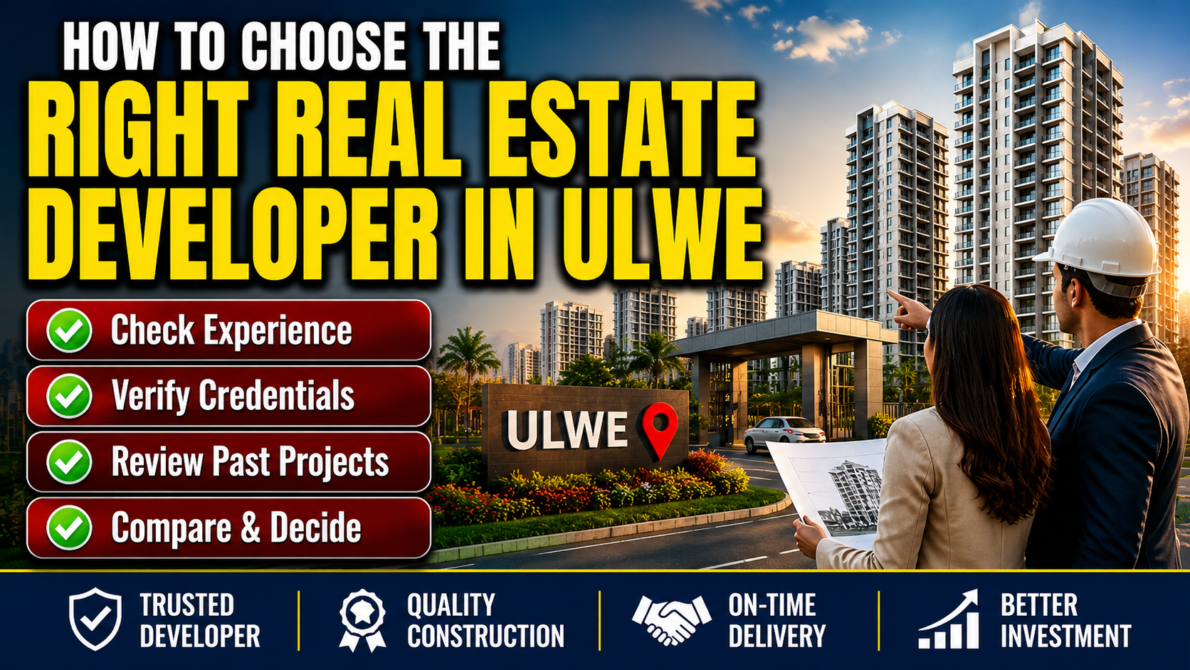
How to Choose the Right Real Estate Developer in Ulwe

To choose the right real estate developer in Ulwe, buyers should verify the developer’s past delivery record, MahaRERA registration, CIDCO documents, Commencement Certificate, Occupancy Certificate history, construction quality, pricing clarity, completed projects and buyer feedback before paying token money. In Ulwe, this is especially important because many projects are linked to CIDCO leasehold land, PAP or 12.5% scheme plots, and airport-led price expectations. Ulwe has become one of Navi Mumbai’s most discussed residential markets because of Atal Setu, Navi Mumbai International Airport, Bamandongri station, Kharkopar station and future connectivity expectations. But a good location does not automatically make every project safe. Some projects may have strong legal clarity and good execution, while others may have delayed approvals, weak construction quality, unclear OC status or hidden charges. This guide is written for homebuyers, investors, NRIs and first-time flat buyers who want to shortlist the right developer in Ulwe with a practical checklist, not just marketing claims. This article is for general buyer awareness. Before booking, paying token money or signing an agreement, buyers should verify all documents with a qualified property lawyer or legal professional. To compare reliable real estate brands across different nodes, check our complete guide on Builders and Developers in Navi Mumbai. Quick Summary: How to Choose the Right Real Estate Developer in Ulwe The safest way to choose a real estate developer in Ulwe is to check documents first, then inspect actual construction quality, then compare pricing, and only then decide. Do not depend only on the builder’s brochure, sample flat or broker assurance. What to Check Why It Matters in Ulwe Good Sign Red Flag MahaRERA registration Confirms baseline project registration and declared timeline Active registration with clear project details No RERA number or expired registration CIDCO documents Many Ulwe plots involve CIDCO leasehold and 12.5% scheme land Tripartite Agreement, Final Order and transfer clarity available Builder avoids sharing CIDCO papers Commencement Certificate Confirms legal permission to construct CC covers the booked floor and wing CC only covers lower floors or is not shown Occupancy Certificate Confirms building is legally fit for possession OC received before handover “Fit-out possession” without OC Completed projects Shows real execution capability Older projects are maintained and legally clear Seepage, poor maintenance or delayed society handover Pricing clarity Prevents cost shocks Written all-inclusive cost sheet Verbal quote with hidden parking, PLC or maintenance charges Construction quality Ulwe’s coastal monsoon exposes weak waterproofing No leakage, clean basement, good common areas Damp walls, fungus, efflorescence, waterlogging Buyer feedback Reveals after-sales behaviour Residents confirm OC, maintenance and handover Repeated complaints about delay or poor support If you are comparing multiple options, shortlist only those developers who pass legal, financial, construction and reputation checks together. A reputed developer is not always the right developer if the project has unclear approvals, delayed possession, hidden charges or weak after-sales support. For more local research, you can also connect this article with [real estate developers in Ulwe](ADD INTERNAL LINK HERE), [real estate developers in Navi Mumbai](ADD INTERNAL LINK HERE), and [questions to ask before buying a flat in Navi Mumbai](ADD INTERNAL LINK HERE). Why Choosing the Right Real Estate Developer Matters in Ulwe Choosing the right developer matters in Ulwe because the area has moved from a speculative market to a serious end-user and investment market. Property rates, buyer expectations and infrastructure promises have all increased. When buyers pay a premium because of Atal Setu, airport proximity or railway access, they must be even more careful about what they are actually buying. Ulwe has many local standalone developers constructing G+4, G+7, G+14 or similar buildings on CIDCO-origin plots. Larger regional and branded developers are also entering the area with bigger projects and more amenities. Both categories can be good, and both can be risky if documents or execution are weak. The main risks in Ulwe are not only price-related. Buyers must also check: CIDCO leasehold and transfer clarity PAP or 12.5% scheme plot documentation MahaRERA validity and project progress CC and OC status Monsoon leakage and waterproofing quality Water supply planning and storage capacity Parking, maintenance and hidden charges Society formation and conveyance status In mature pockets such as Sector 17, Sector 18 and parts near Bamandongri station, the buyer’s focus may be more on OC, resale value, building maintenance and water issues. In newer or developing pockets closer to airport-linked growth areas, buyers must be extra careful about title, approvals, access roads, waterlogging and construction pace. Understand the Developer’s Past Track Record A developer’s past record is one of the strongest indicators of future delivery. In Ulwe, do not judge a builder only by hoardings, office presentation, sample flat or launch price. Check what the developer has already delivered. Before finalizing any project, go through How to Choose the Right Real Estate Developer in Navi Mumbai to understand builder reputation, legal checks, RERA verification, and possession risks. Check Completed Projects Before Trusting New Launches Before booking in a new project, ask the developer for a list of completed projects in Ulwe, Navi Mumbai or nearby nodes. Then physically visit at least one or two of those buildings. Check whether: The building received OC Residents have proper utility connections The society is formed Common areas are maintained Lifts are working properly Basement or stilt parking has leakage External walls show dampness or cracks Residents are satisfied with builder support A builder who has delivered clean, legally compliant and well-maintained buildings deserves more trust than a builder who only has attractive launch material. Visit Older Buildings Developed by the Same Builder A building that looks good at possession may not look good after three monsoons. Ulwe’s coastal climate can quickly expose poor waterproofing, weak plaster, low-quality paint and careless construction. When visiting an older project, look for: White salty deposits on walls Damp patches near windows and bathrooms Fungus in parking or staircase areas Water seepage in basement or stilt areas Broken tiles in common areas Poor lift maintenance Unfinished society handover work A three-to-five-year-old completed building will

Read More

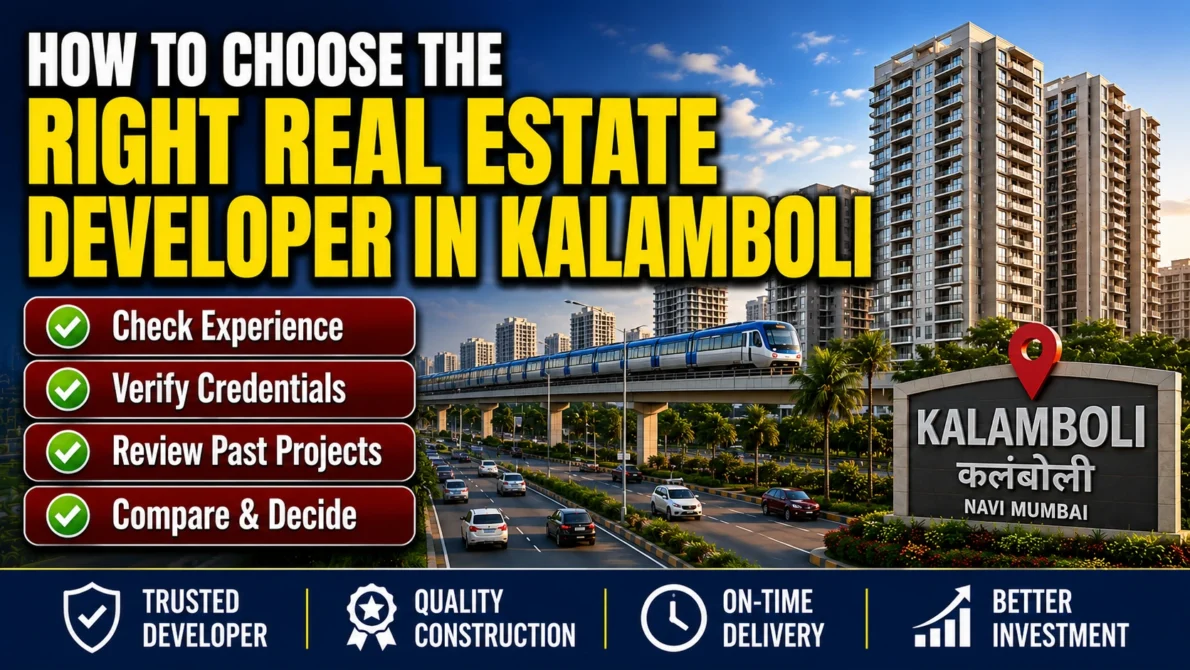
How to Choose the Right Real Estate Developer in Kalamboli

To choose the right real estate developer in Kalamboli, buyers should check the developer’s past delivery record, MahaRERA details, legal documents, construction quality, pricing transparency, completed projects, buyer feedback, and possession history before paying token money. In Kalamboli, this is especially important because projects may involve PMC approvals, CIDCO-origin land, leasehold issues, PAP or 12.5% scheme plots, monsoon risks, and heavy infrastructure-led growth expectations. Kalamboli is no longer only known for its steel market, truck terminals, and logistics movement. It is now also becoming a serious residential choice for families, working professionals, MSME owners, and investors looking at the Panvel-Kalamboli growth belt. Its location near the Sion-Panvel Highway, Mumbai-Pune Expressway, NH-48, NH-66, Roadpali, Kamothe, Kharghar, Panvel, Taloja, and the upcoming airport corridor makes it attractive. But a good location does not automatically make a project safe. The right developer must be legally clear, financially stable, transparent with documents, strong in construction quality, and honest about pricing and possession. This article is for general buyer awareness. Before booking or signing an agreement, buyers should verify documents with a qualified legal professional. Quick Summary: How to Choose the Right Real Estate Developer in Kalamboli The safest way to choose a real estate developer in Kalamboli is to verify the builder, the land, the approvals, the construction, and the total cost before paying any token amount. What to Check Why It Matters in Kalamboli Good Sign Red Flag MahaRERA registration Confirms regulatory registration and project disclosures Valid registration with clear project details No RERA number or mismatch in project details Developer track record Shows how the builder performs after selling flats Completed projects with OC and resident satisfaction Delayed older projects or poor maintenance CIDCO and PMC documents Kalamboli has CIDCO land history and PMC civic authority relevance Clear allotment, lease, transfer, CC and OC documents Confusion about which authority approved what PAP or 12.5% scheme plot clarity These plots may carry title and heirship risks Proper tripartite agreement and CIDCO NOC Missing NOC or unclear original allotment Construction quality Coastal monsoon and local drainage issues expose weak construction Dry basements, good plastering, working lifts Leakage, damp walls, rust, poor common areas Pricing clarity Base price can differ heavily from final cost Written all-inclusive cost sheet Verbal discount, hidden PLC, parking or maintenance Occupancy Certificate Needed for legal possession and resale safety Final OC available before possession Fit-out possession without OC Buyer feedback Existing residents reveal actual builder behaviour Positive after-sales and society handover record Repeated complaints about leakage, delay or corpus issues If you remember only one thing, remember this: do not choose a developer in Kalamboli only because of price, brochure, brand name, or sales pressure. Choose only after written legal, technical, and financial clarity. Why Choosing the Right Real Estate Developer Matters in Kalamboli Kalamboli is a practical and strategic real estate market. It has strong road connectivity, access to industrial and logistics employment, proximity to Panvel and Kharghar, and long-term growth potential due to regional infrastructure. At the same time, it is also a market where buyers must be extra careful. Kalamboli has a mix of residential towers, older CIDCO-era pockets, Roadpali-side residential growth, logistics-linked areas, commercial pockets, and projects influenced by nearby industrial belts. Some projects are in better residential micro-locations, while others may face truck traffic, drainage concerns, pollution carryover, or weaker civic surroundings. This is why the developer’s role becomes critical. A good developer cannot change the entire location, but they can reduce buyer risk through: Clean legal title Proper approvals Strong construction quality Transparent pricing Timely OC Proper society formation Honest after-sales support A weak developer, even in a good Kalamboli location, can create years of stress through delayed possession, unclear CIDCO documents, fit-out possession without OC, leakage issues, hidden charges, and poor society handover. For related buyer research, readers can also refer to [questions to ask before buying a flat in Navi Mumbai](ADD INTERNAL LINK HERE). Understand the Developer’s Past Track Record A developer’s past record is one of the strongest indicators of future behaviour. Sales offices show the best version of a project. Completed buildings show the truth. Check Completed Projects Before Trusting New Launches Before trusting a new launch in Kalamboli, check what the same developer delivered earlier. Do not look only at the elevation, lobby, or brochure images. Visit a 5-to-10-year-old project if possible. Check: Was possession given near the promised timeline? Did the project receive Occupancy Certificate? Are residents satisfied with the construction? Are lifts, pumps, security systems, and common areas maintained? Did the builder form the society properly? Was the maintenance corpus handed over clearly? In Kalamboli and nearby Roadpali, Sector 16, Kamothe, Panvel and Kharghar belts, many local and mid-tier developers have built multiple projects. A serious buyer should compare their older work before trusting their newest marketing. A developer is not judged by the best 3D render. A developer is judged by how the building looks after five monsoons. Visit Older Buildings Developed by the Same Builder An older building tells you what the sales brochure will never say. When you visit an old project by the same builder, look carefully at: Basement parking walls Leakage marks near shafts Paint peeling on external walls Water stains near windows Lift condition Lobby maintenance Drainage arrangement Quality of internal roads and ramps Security and fire safety provisions This is especially important in Kalamboli because some areas face monsoon waterlogging concerns, drainage stress, and heavy vehicle movement. If a builder has poor waterproofing or weak basement design, the problem usually appears quickly during the monsoon. Speak to Existing Residents and Buyers Existing residents are often the best source of truth. Speak to people who have already lived in the developer’s completed project for at least one or two years. Ask them: Did the builder respond after possession? Were promised amenities delivered? Were there leakage or plumbing issues? Was society formation done properly? Was the maintenance corpus clearly handed over? Are there water supply problems? Did the developer delay OC

Read More

How to Choose the Right Real Estate Developer in Kharghar

The right real estate developer in Kharghar is not always the builder with the biggest hoarding, the most polished sample flat, or the loudest sales pitch. It is the developer whose delivery record, legal visibility, construction quality, pricing clarity, and buyer feedback still look strong after you verify them properly. Kharghar needs local checking because it is not one uniform market. A project near the station, a tower closer to Central Park, and a project in a newer edge sector can behave very differently in daily life, resale comfort, and possession risk. To choose the right real estate developer in Kharghar, check the builder’s completed projects, verify the project on MahaRERA, compare actual site progress with promised possession, review CC/OC and approval status, ask for an itemised cost sheet, and speak to residents in older projects before paying token money. The builder must be judged at the project level and the micro-location level, not by branding alone. A good developer in one Navi Mumbai node does not automatically mean the same quality, paperwork, timeline, and after-sales experience will apply to every Kharghar project. Quick Checklist for Choosing a Builder in Kharghar What to check Why it matters in Kharghar Buyer action Completed projects Past delivery shows execution quality Visit older buildings by the same developer MahaRERA status Legal registration is the first filter Search project and promoter details on MahaRERA Construction progress Sales promise and site reality may differ Visit the actual site, not only the sample flat Approval chain CC, OC, and sanctioned plans affect legal safety Ask for document copies and legal review Pricing clarity Hidden charges change the real budget Demand a full cost sheet before token money Resident feedback Old buyers reveal handover and maintenance reality Speak to residents in completed projects Kharghar sector fit Every sector has different access and maturity Compare location, roads, station access, and daily convenience This checklist is useful because Kharghar buyers are usually not choosing only between two flats. They are choosing between different developers, different project stages, different authority contexts, and different micro-markets inside the same node. Builders and Developers in Kharghar Start with the Developer’s Kharghar Track Record A builder’s general brand name is useful, but it is not enough. In Kharghar, the better question is whether the developer has actually delivered projects in Kharghar or nearby Navi Mumbai nodes in a way that still looks good after handover. Look at completed projects first. Do not get impressed only by the number of launches. A developer may advertise many projects, but the real test is how many were completed, handed over, maintained, and accepted by buyers without major unresolved issues. When visiting older projects, check: Lobby condition Lift performance Basement and parking condition Terrace waterproofing Seepage-prone areas Exterior paint quality Fire exits and common lights Society handover status Resident complaints after possession Older handovers are one of the strongest truth-tests because they show what happens after the launch-stage glamour is over. Verify the Project on MahaRERA Before paying token money, verify the project on the official MahaRERA portal. This is the first serious filter for any MahaRERA Kharghar project check. Check these details carefully: Project registration number Promoter name Registered completion date Current project status Quarterly or annual update trail, where available Extension history, if any Uploaded approvals and disclosures Complaints, orders, or warning signs, where available MahaRERA registration does not automatically mean the project is perfect. It is the first legal filter, not the final trust signal. You still need site verification, legal review, pricing clarity, and resident feedback. A buyer should not stop after seeing a RERA number in the brochure. The project details, promoter name, timeline, uploaded documents, and current status should match what the sales team is claiming. Check the Actual Site, Not Only the Sample Flat A sample flat is designed to impress. The real project should be checked separately. At the project site, look at: Construction pace Labour activity Material storage Basement work Lift-core progress Podium work Drainage condition Approach road condition Surrounding construction Daily access and traffic reality If the promise is “possession soon,” the site should visibly support that claim. If the site looks slow, disorganised, or far behind the sales promise, treat that as a risk signal. For ready or near-ready projects, check the common areas with more skepticism than the apartment interior. A flat may look polished while the building still has weak execution in basement water handling, parking design, service shafts, terrace waterproofing, clubhouse completion, or society-readiness. Understand Kharghar’s Authority and Approval Context Kharghar buyers should not ignore the authority layer. In Navi Mumbai, property risk is not only about carpet area, amenities, and tower design. It also depends on the authority chain, title structure, approvals, commencement status, occupancy status, and land-history clarity. Before booking, ask these questions in writing: Which authority approved the project? Is the sanctioned plan available for review? What is the current CC status? Has OC been received, if the project is ready? Is there any CIDCO-linked land, transfer, or tenure issue? Are there pending conditions attached to approvals? Has society formation or handover planning started? Do not rely only on the builder’s sales explanation. For final legal clearance, use a property lawyer. Kharghar’s layered authority context is exactly why independent document review matters. Compare the Full Price, Not Only the Base Rate Many buyers compare only the quoted rate per square foot. That is incomplete. Ask for a written itemised cost sheet covering: Base price Floor rise Parking GST, if applicable Stamp duty Registration Development charges Maintenance deposit Club or amenity charges Corpus fund Legal charges Society formation charges Any other mandatory payment The most dangerous cost is the one explained after the token amount is paid. A serious developer should be able to give pricing clarity before money changes hands. If the cost sheet keeps changing, slow down. If the sales team avoids written clarity, treat that as a warning sign. Read Reviews, But Look for Patterns Online reviews can

Read More

How to Choose the Right Real Estate Developer in Turbhe | Buyer Checklist

To choose the right real estate developer in Turbhe, buyers should check the developer’s past delivery record, MahaRERA registration, legal documents, construction quality, pricing transparency, completed projects, buyer feedback, and OC possession history before paying token money. In Turbhe, this is even more important because the area has a mixed industrial, commercial, CIDCO, MIDC and NMMC approval environment where one weak document can create long-term trouble. Turbhe is not a simple residential market like some planned Navi Mumbai nodes. It sits close to the TTC industrial belt, Mahape, Sanpada, Vashi, Juinagar and Ghansoli. Some pockets are commercial-heavy, some are industrial-influenced, and some are gradually seeing residential and mixed-use development. Because of this, buyers must judge the developer not only by the building design, but also by legal clarity, land background, approvals, environmental conditions, and post-possession responsibility. This article is for general buyer awareness. Before booking or signing an agreement, buyers should verify documents with a qualified legal professional. Quick Summary: How to Choose the Right Real Estate Developer in Turbhe The safest way to choose a real estate developer in Turbhe is to verify legal documents, completed projects, pricing clarity, construction quality, and buyer feedback before paying token money. What to Check Why It Matters in Turbhe Good Sign Red Flag MahaRERA registration Confirms project registration and disclosed timelines Active project profile with uploaded documents Sales team gives only verbal assurance NMMC/MIDC approval Turbhe has civic, industrial and mixed-use pockets Clear CC and approved plan No approval copy before booking Land title CIDCO, MIDC, PAP and leasehold issues may apply Clean title report and transfer clarity Unclear ownership chain Completed projects Shows real delivery quality Older buildings are maintained well Seepage, cracks and poor common areas OC status Legal possession depends on OC Final OC or tower-specific OC available Fit-out possession without OC Pricing sheet Prevents financial shock All-inclusive written cost sheet Hidden parking, PLC or maintenance charges Local reputation Reveals after-sales conduct Residents speak positively Repeated delay or corpus complaints A reputed developer is not always the right developer if the project has unclear approvals, delayed possession, hidden charges, poor construction quality or weak after-sales support. Why Choosing the Right Real Estate Developer Matters in Turbhe Choosing the right real estate developer in Turbhe is not only about brand name or amenities. It is a risk-management decision. Turbhe has a different property character compared to purely residential nodes. It is influenced by: TTC MIDC industrial activity Thane-Belapur Road connectivity Sion-Panvel highway access Commercial projects and business parks Nearby residential demand from Sanpada, Juinagar, Ghansoli, Vashi and Mahape CIDCO leasehold and PAP plot history in Navi Mumbai NMMC civic approvals and property tax systems Possible MIDC-to-commercial or MIDC-to-residential land conversion issues in specific pockets A developer who understands this local structure can manage approvals, land documentation, construction compliance and possession better. A developer who does not understand Turbhe’s legal and civic environment can leave buyers stuck between RERA timelines, authority approvals, unpaid dues, delayed OC and unclear handover. For broader comparison, buyers can also refer to [real estate developers in Navi Mumbai](ADD INTERNAL LINK HERE) before shortlisting a Turbhe project. Understand the Developer’s Past Track Record A developer’s past work is more useful than a sales brochure. In Turbhe, buyers should not judge a project only by the sample flat, launch offer or elevation image. They should check what the same developer has actually delivered in Navi Mumbai. The most important question is simple: Has this developer successfully completed similar projects in Navi Mumbai’s legal, coastal and authority-driven environment? Check Completed Projects Before Trusting New Launches Under-construction projects may look attractive because of lower entry price or early-buyer offers. But they also carry higher risk. Before trusting a new launch in Turbhe, check the developer’s completed projects. Look for: Whether the project was delivered close to the promised timeline Whether OC was received before possession Whether amenities promised in the brochure were actually delivered Whether the building looks stable after a few monsoons Whether residents are satisfied with maintenance and handover A completed project is the developer’s real resume. If the older project looks neglected, the new project should be checked with extra caution. Visit Older Buildings Developed by the Same Builder Navi Mumbai’s monsoon and coastal humidity test construction quality very quickly. A building may look good in the first year, but seepage, dampness, paint peeling, rust marks and basement waterlogging usually appear after a few rainy seasons if workmanship is poor. When visiting an older building by the same developer, check: Basement parking for water seepage Top floors for leakage External walls for cracks and damp patches Lift condition and maintenance Lobby and staircase quality Drainage during monsoon Overall society cleanliness Do not visit only the developer’s sales office. Visit at least one 5-to-10-year-old completed building if possible. Speak to Existing Residents and Buyers Existing residents can tell you what the sales team will not. Ask residents: Was possession delayed? Did the builder give OC before handover? Was society formed on time? Was maintenance corpus handed over properly? Were there hidden charges at possession? Are there leakage or structural issues? Does the builder respond after possession? Was parking allocation clear? This one step can save lakhs of rupees and years of stress. A short conversation with residents often reveals more than a full day of online research. Check MahaRERA Registration and Project Transparency MahaRERA registration is important, but it should not be treated as the only proof of developer quality. It is the starting point of verification. For any under-construction residential or commercial project in Turbhe, buyers should verify the project details on the MahaRERA website. Do not rely only on the RERA number printed on a brochure. Search the exact project name and promoter name. Why MahaRERA Is Important for Turbhe Buyers MahaRERA helps buyers check whether the project is officially registered, what possession timeline has been declared, what legal documents have been uploaded, and whether the developer has disclosed approvals and professionals involved in the

Read More

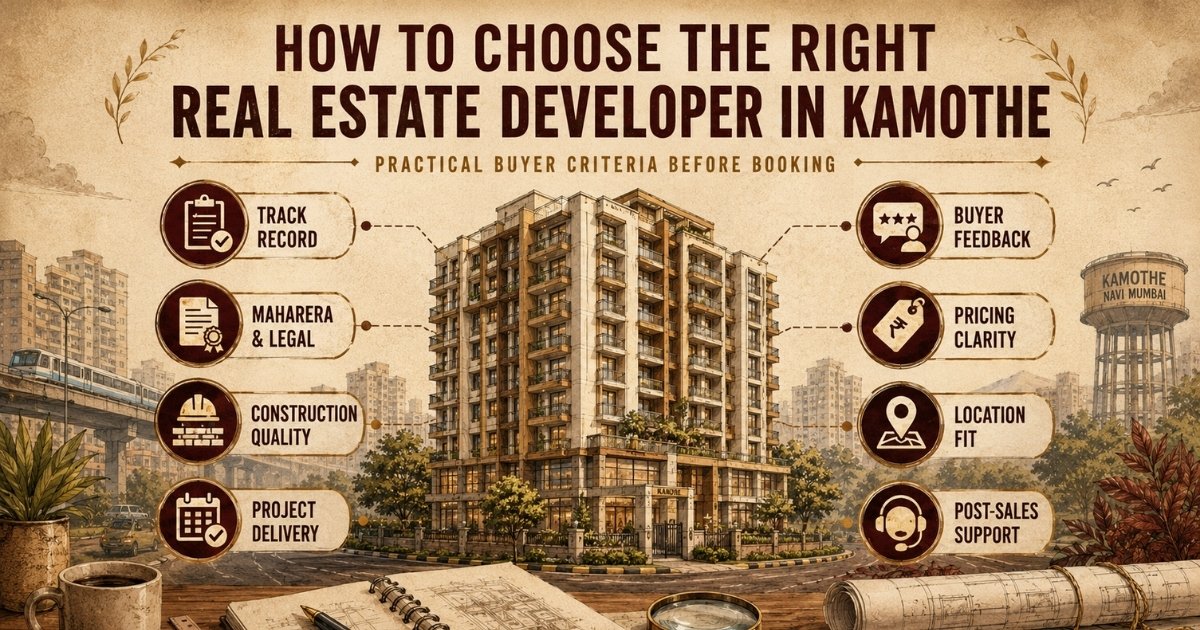
How to Choose the Right Real Estate Developer in Kamothe | Buyer Guide

To choose the right real estate developer in Kamothe, buyers should check the developer’s past delivery record, MahaRERA details, legal documents, construction quality, pricing transparency, completed projects, buyer feedback and OC status before paying token money. In Kamothe, this is especially important because many projects involve CIDCO-origin land, PMC civic services, 12.5% PAP plot documentation, water supply concerns and sector-level drainage issues. This article is for general buyer awareness. Before booking or signing an agreement, buyers should verify all documents with a qualified property lawyer or legal professional. Quick Summary: How to Choose the Right Real Estate Developer in Kamothe Kamothe is a mature, mid-budget residential node between Kharghar, Kalamboli and Panvel. It is practical for families because of its connectivity to Mansarovar railway station, Sion-Panvel Highway, schools, markets and daily-use services. But choosing a developer here should not be based only on brochure design, sample flat beauty or low per-square-foot rate. A safer developer in Kamothe is one who can prove clear title, valid approvals, realistic possession timelines, good construction quality, transparent pricing and proper post-handover support. What to Check Why It Matters in Kamothe Good Sign Red Flag MahaRERA registration Confirms regulatory registration and basic project transparency Active RERA number with regular updates Expired, lapsed or unclear project record Legal documents Kamothe has many CIDCO-origin and 12.5% PAP plot properties Clear title chain, CC, approved plan and CIDCO documents Builder avoids sharing legal file Occupancy Certificate OC proves legal occupation and safety compliance Ready-to-move property has valid OC “Fit-out possession” without OC Construction quality Monsoon leakage, parking and lift quality matter in daily life Older projects are well maintained Seepage, poor common areas, basement issues Water and drainage Kamothe has reported water and drainage stress in some pockets Functional PMC water connection and proper drainage Heavy tanker dependency or sewage overflow complaints Pricing clarity Final cost can be much higher than base rate Written all-inclusive cost sheet Verbal promises and hidden charges Buyer feedback Existing residents reveal real after-sales behaviour Society formed, maintenance handed over Complaints about delays, OC, water or maintenance The safest way to choose a real estate developer in Kamothe is to verify legal documents, completed projects, pricing clarity and buyer feedback before paying token money. Why Choosing the Right Real Estate Developer Matters in Kamothe Choosing the right developer in Kamothe is not only about getting possession on time. It affects your legal safety, monthly maintenance, water supply reliability, society handover, resale value and peace of mind after moving in. Kamothe is not an undeveloped location, but it has its own local challenges. The land planning history is linked to CIDCO, while present civic administration, property tax and many utility-related matters come under Panvel Municipal Corporation. This means buyers must understand both CIDCO-related land documents and PMC-related civic approvals. A weak developer can create problems long after possession, such as: No proper Occupancy Certificate Delay in society formation Unclear conveyance status Poor waterproofing and monsoon leakage Inadequate water storage or tanker dependency Pending municipal dues Parking disputes Hidden charges after token payment In Kamothe, the developer’s quality directly affects the society’s long-term functioning. A well-built flat in a poorly managed project can still become stressful if water supply, drainage, legal title and maintenance handover are weak. For broader comparison, buyers can also read [real estate developers in Navi Mumbai](ADD INTERNAL LINK HERE) and [Kamothe real estate guide](ADD INTERNAL LINK HERE). Understand the Developer’s Past Track Record A developer’s past work is usually more reliable than their current sales pitch. Before trusting a new launch or under-construction project, check what the same developer has already delivered. Check Completed Projects Before Trusting New Launches Completed projects show the real ability of a developer. A new launch may have excellent renders, a polished sales office and attractive offers, but the real test is whether the builder has delivered earlier projects with OC, basic amenities and proper handover. Check: How many projects the developer has completed Whether possession was given close to the promised timeline Whether completed buildings have OC Whether residents are satisfied with construction and maintenance Whether the developer has too many ongoing projects compared to completed projects On the MahaRERA website, buyers should search the promoter name, not only the project name. Some developers may use different project entities or special purpose vehicles, so checking only one project may not show the full picture. Visit Older Buildings Developed by the Same Builder Do not judge a developer only by a sample flat. Visit one or two buildings completed by the same developer at least three to five years ago. In Kamothe and nearby Navi Mumbai nodes, monsoon performance is a serious quality test. Poor construction usually starts showing through wall seepage, plaster cracks, basement dampness, lift issues and parking problems within a few years. During your visit, observe: Exterior wall condition Leakage marks near windows and ceilings Basement or stilt parking condition Lift brand and lift maintenance Lobby and staircase condition Water tank and common area cleanliness Fire safety equipment condition A building that looks stable and well maintained after multiple monsoons is a stronger sign than a beautiful sample flat. Speak to Existing Residents and Buyers Existing residents are one of the best sources of truth. They know whether the builder handled possession properly, whether the OC was received, whether water supply is regular and whether maintenance money was handed over properly. Ask residents direct questions: Was possession given on time? Did the builder give OC before possession? Is there PMC water supply or regular tanker dependency? Was the society formed properly? Was the maintenance corpus handed over? Are lifts, pumps and common areas maintained well? Were there any hidden charges during possession? Even a five-minute conversation with a resident or security staff can reveal more than a long sales presentation. Check MahaRERA Registration and Project Transparency MahaRERA registration is a basic requirement for eligible real estate projects. It gives buyers access to important project information, but it should not be treated as

Read More

How to Choose the Right Real Estate Developer in Airoli

To choose the right real estate developer in Airoli, buyers should check the developer’s past delivery record, MahaRERA details, legal documents, CIDCO and NMMC approval clarity, construction quality, pricing transparency, completed projects, buyer feedback and possession history before paying token money. In Airoli, this is especially important because property risk can change sharply between mature sectors, redevelopment pockets and Gaothan-adjacent areas. Airoli is not a simple real estate market. It has mature residential sectors, IT-driven rental demand, older CIDCO buildings, redevelopment activity, 12.5% PAP plot concerns, and projects that may involve CIDCO, NMMC or other approval layers. A good developer in Airoli is not only the one with attractive brochures or a strong brand name. The safer developer is the one who can prove legal clarity, construction discipline, financial transparency and proper handover after possession. This article is for general buyer awareness. Before booking, paying token money or signing an Agreement for Sale, buyers should verify all documents with a qualified legal professional. Quick Summary: How to Choose the Right Real Estate Developer in Airoli The safest way to choose a real estate developer in Airoli is to verify legal documents, completed projects, pricing clarity and buyer feedback before paying token money. MahaRERA registration is important, but it should not be treated as the only proof of developer quality. What to Check Why It Matters in Airoli Good Sign Red Flag MahaRERA registration Confirms basic regulatory registration and project disclosures Project details, possession date and documents are updated Lapsed updates, litigation, unclear possession date Past completed projects Shows actual delivery quality, not brochure promises Older buildings are maintained and structurally sound Leakage, poor lifts, society disputes CIDCO/NMMC documents Airoli has leasehold, redevelopment and PAP plot complexities Clear CC, OC, title and transfer documents Verbal promises about approvals Construction quality Airoli faces heavy monsoon exposure and creek-side humidity in some pockets Dry basements, strong facade, good drainage Seepage, damp ducts, waterlogged parking Pricing clarity Hidden charges can increase the actual cost sharply Written all-inclusive cost sheet Vague estimates and “later adjustment” claims Buyer feedback Reveals after-sales support and real possession experience Residents confirm smooth handover Repeated complaints across projects If you are comparing multiple [real estate developers in Airoli](ADD INTERNAL LINK HERE), shortlist only those who pass both legal and ground-level checks. Builders and Developers in Airoli Why Choosing the Right Real Estate Developer Matters in Airoli Choosing the right developer in Airoli is not just about getting a better flat. It is about protecting your money, legal ownership, resale value and future peace of mind. Airoli has strong demand because of its connectivity to Thane, Vashi, Ghansoli, Kopar Khairane and Mumbai-side job markets. Its IT and commercial ecosystem, including major office campuses, supports rental demand from salaried professionals and working families. But the same market also has sector-wise differences. Mature pockets such as Sectors 8, 9, 14, 19 and 20 behave differently from older redevelopment or Gaothan-linked pockets around Sector 1, Sector 5, Diva and Digha side areas. A buyer cannot use one simple rule for the whole node. A new project in a mature sector, a resale flat in an older CIDCO building and a redevelopment project near a Gaothan area need different levels of verification. The main risks in Airoli include: Delayed possession in under-construction projects Unclear CIDCO leasehold or transfer documentation PAP or 12.5% scheme plot complications Buildings without final Occupancy Certificate Poor monsoon waterproofing and leakage Hidden floor-rise, parking, maintenance and legal charges Delayed society formation and corpus handover A reputed developer is not always the right developer if the project has unclear approvals, delayed possession, hidden charges or weak after-sales support. Understand the Developer’s Past Track Record A developer’s past record is usually more reliable than their sales pitch. Brochures show ambition. Completed buildings show reality. Before trusting any new launch in Airoli, buyers should check whether the developer has completed similar projects in Airoli, Ghansoli, Kopar Khairane, Vashi or nearby Navi Mumbai nodes. A builder who has only done small buildings may struggle with a complex high-rise redevelopment project. Similarly, a developer successful in another city may not automatically understand CIDCO leasehold procedures, NMMC approvals and Navi Mumbai’s local documentation culture. Check Completed Projects Before Trusting New Launches Completed projects reveal three things: whether the developer delivered, whether the construction aged well, and whether buyers were treated properly after possession. When visiting a completed project, check: Was possession given close to the promised timeline? Was the Occupancy Certificate received? Is the building exterior still in good condition? Are lifts, parking, lobby and water supply properly maintained? Did the developer form the society and hand over funds cleanly? A five-year-old building can tell you more than a new sample flat. If the developer’s older projects already show leakage, peeling plaster, poor drainage or resident disputes, the same pattern may repeat. Visit Older Buildings Developed by the Same Builder Do not visit only the developer’s new sales office. Visit their older building without relying fully on the sales team. In Airoli, monsoon performance matters. A good building should not show major seepage in common ducts, basement parking, lift shafts, terrace areas or external walls after a few monsoons. Airoli’s climate, creek-side humidity in some pockets and heavy rain make waterproofing and drainage serious quality checks. Look at the actual building condition: Area to Inspect What to Look For External walls Cracks, peeling paint, seepage patches Basement or podium parking Waterlogging, damp smell, poor drainage Lift lobby Poor finishing, leakage, low maintenance Staircase and ducts Dampness, mold, exposed pipes Terrace and top floors Waterproofing issues Society office Clarity on handover, maintenance and corpus Speak to Existing Residents and Buyers Existing residents are often the best source of truth. They know what the brochure does not say. Ask residents: Was possession delayed? Did the builder respond after handover? Were there leakage or lift problems? Did the society receive maintenance corpus properly? Are there parking disputes? Is municipal water supply stable? Are there pending legal or OC issues?

Read More

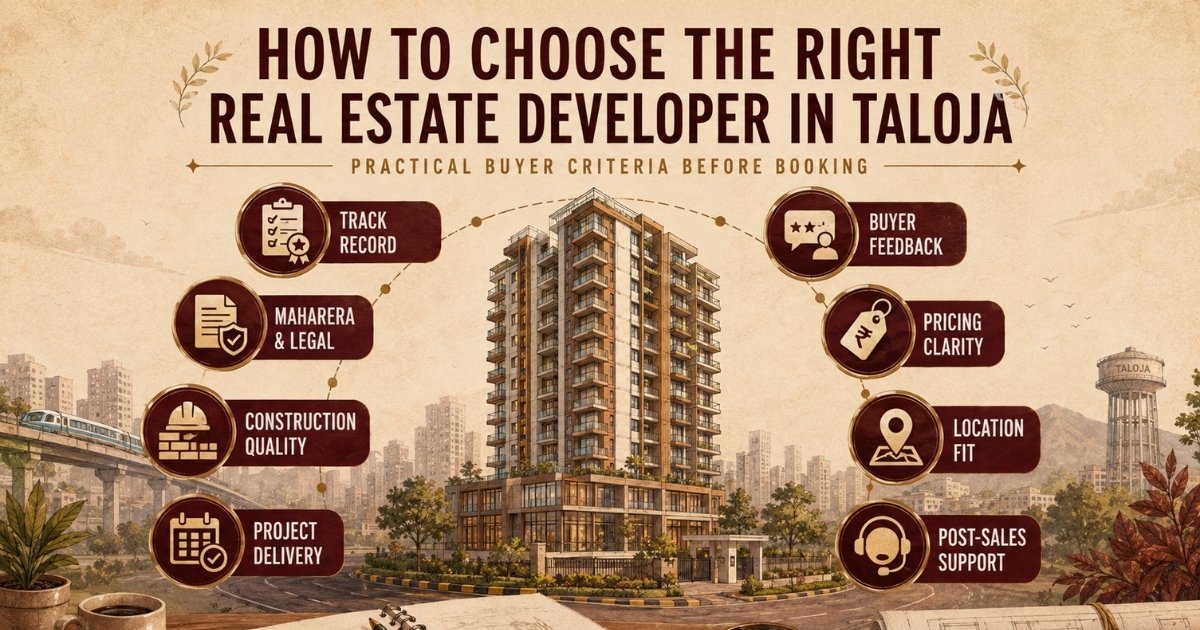
How to Choose the Right Real Estate Developer in Taloja | Buyer Guide

To choose the right real estate developer in Taloja, buyers should verify the developer’s past delivery record, MahaRERA details, CIDCO land documents, legal approvals, construction quality, pricing clarity, water planning, buyer feedback and OC-based possession before paying token money. In Taloja, this due diligence is especially important because the area has strong growth potential, but also real challenges such as water dependency, MIDC pollution influence, leasehold land complexity and under-construction project risk. Quick Summary: How to Choose the Right Real Estate Developer in Taloja Taloja is one of Navi Mumbai’s most affordable growth locations, especially for first-time homebuyers looking for 1 BHK and 2 BHK flats below the price levels of Kharghar, Nerul, Seawoods or Vashi. The operational Navi Mumbai Metro Line 1, airport-led growth expectations and improving connectivity have increased buyer interest in Taloja Phase 1, Taloja Phase 2, Ghot, Petali, Roadpali and nearby pockets. But affordability should not make buyers careless. A cheap flat in the wrong project can become expensive later through delay, leakage, tanker water cost, hidden charges, weak society handover or unclear CIDCO documentation. What to Check Why It Matters in Taloja Good Sign Red Flag MahaRERA details Confirms project registration, timelines and disclosures Clear registration, updated progress, no major litigation pattern Repeated extensions, poor disclosure, pending complaints CIDCO / land title Taloja has CIDCO leasehold and PAP / 12.5% plot-related risks Clear allotment, transfer and title documents Builder avoids sharing documents before token OC and CC Protects buyer from illegal possession and approval mismatch CC and OC status clearly explained in writing “Fit-out possession” offered without OC Water planning Taloja has known water supply stress in several societies Adequate storage, legal water connection, resident satisfaction Permanent tanker dependency in older projects Construction quality Monsoon leakage and maintenance issues can reduce livability Older buildings show good upkeep and no major seepage Damp walls, basement flooding, poor lift condition Pricing clarity Advertised base rates often exclude many charges All-inclusive cost sheet on letterhead Verbal discounts, hidden PLC, parking and maintenance charges Location fit Taloja Phase 1, Phase 2 and MIDC-side pockets differ Project suits daily commute, air quality and budget Good builder but weak micro-location The safest way to choose a real estate developer in Taloja is to verify legal documents, completed projects, pricing clarity and buyer feedback before paying token money. MahaRERA registration is important, but it should not be treated as the only proof of developer quality. Why Choosing the Right Real Estate Developer Matters in Taloja Choosing the right builder matters in every real estate market, but in Taloja it matters more because the buyer is not only buying a flat. The buyer is also accepting the developer’s ability to handle local approvals, CIDCO land conditions, water planning, construction quality, environmental realities and society handover. Taloja is no longer just an industrial periphery. It is now a metro-linked residential growth corridor with strong interest from first-time buyers, MIDC employees, investors and families priced out of Kharghar or Panvel. However, rapid development has also brought uneven project quality. Some developers have managed to deliver usable, well-planned homes, while others have struggled with delays, poor construction quality, weak maintenance planning or legal complications. A wrong developer choice in Taloja can create problems such as: EMI and rent burden due to delayed possession No proper OC at handover High monthly maintenance due to tanker water Leakage during monsoon Poor society formation and conveyance delays Hidden charges after booking Difficulty in resale because of weak project reputation This article is for general buyer awareness. Before booking or signing an agreement, buyers should verify documents with a qualified legal professional. Understand the Developer’s Past Track Record A developer’s past record is often more reliable than their sales presentation. In Taloja, where many buyers are attracted by affordable pricing and future appreciation hopes, checking older projects is one of the most practical ways to avoid a poor decision. A builder may show impressive brochures, sample flats and 3D renders, but the real test is how their completed buildings look after five to ten years. Check Completed Projects Before Trusting New Launches Before trusting a new launch in Taloja, ask the developer for a list of completed projects. Do not only ask for names. Ask for addresses, possession dates and whether the projects received OC. A completed project helps you check: Whether the developer delivered close to the promised timeline Whether the project received Occupancy Certificate Whether the society was formed properly Whether residents are satisfied with maintenance Whether there are leakage, lift or water issues If a developer has many under-construction projects but very few completed projects, buyers should be careful. It does not automatically mean the developer is bad, but it increases the need for stricter verification. Visit Older Buildings Developed by the Same Builder A five-year-old building tells the truth better than a new sales office. In Taloja, this is especially important because monsoon seepage, humidity, industrial dust and water stress can expose weak construction quickly. When visiting an older building by the same developer, check the basement, external walls, lobby, staircase, lift area, terrace and parking. Look for damp patches, peeling plaster, cracked tiles, rusted railings, poor drainage and waterlogging marks. Also observe whether the building feels properly maintained or abandoned after handover. A good developer does not disappear immediately after possession. Speak to Existing Residents and Buyers Existing residents can tell you what the sales team will not say clearly. Ask simple, direct questions: Was possession delayed? Was the final cost the same as promised? Is water supply regular? Does the building depend heavily on tankers? Was society formation completed smoothly? Are there leakage problems during monsoon? Does the builder respond after possession? In Taloja, buyers should specifically ask about water supply timing and tanker dependency. Some societies in the wider Taloja belt have faced very short municipal water windows and have relied on private tankers. If the developer’s older projects are still struggling badly for basic water, treat it as a serious warning

Read More