
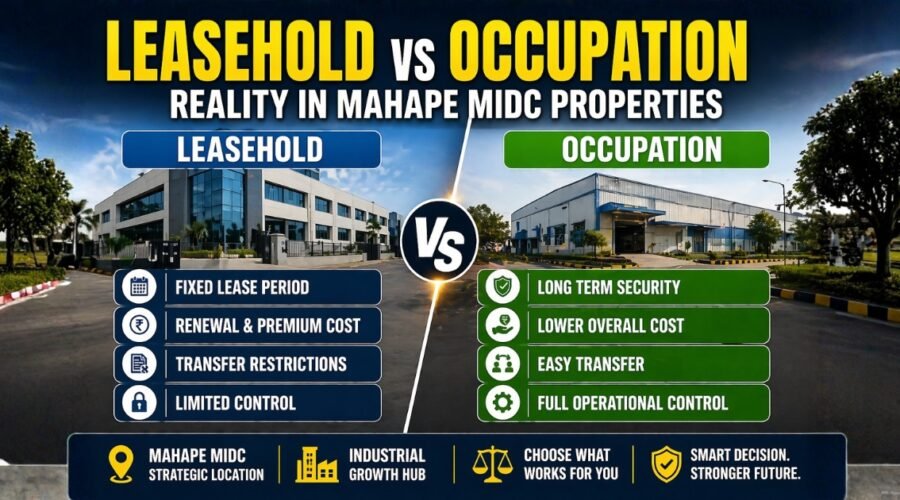
Leasehold vs Occupation Reality in Mahape MIDC Properties
Mahape MIDC properties are mostly leasehold industrial assets, so legal transfer and actual occupation are not the same thing. A buyer may get leasehold rights, transfer papers, or possession, but the property may still not be ready for the intended business use. Before paying token money, rent deposit, or transfer premium, the buyer or tenant must check MIDC permissions, sanctioned use, building approvals, OC or BCC status, fire safety, MPCB consent, power load, water, drainage, and road access.
This difference is where many Mahape industrial property decisions go wrong. On paper, a unit may look clean. The seller may say the MIDC transfer is possible. The broker may say, “Factory chalu ho jayega.” But in Mahape, especially inside the TTC Industrial Area, occupation depends on both documents and ground reality.
A property can be transferable but still difficult to occupy.
A property can have possession but still have compliance gaps.
A property can look useful but still fail for the exact business activity planned by the buyer or tenant.
This guide explains that difference clearly for Mahape MIDC buyers, tenants, industrial occupiers, warehouse users, investors, and business owners.
Quick Summary: Leasehold vs Occupation Reality in Mahape MIDC
| Point | What It Means in Mahape MIDC | Why It Matters |
|---|---|---|
| Leasehold right | Right to hold and use MIDC-allotted land or unit subject to lease terms | It does not mean absolute freehold ownership |
| MIDC transfer | Administrative transfer or assignment of leasehold rights | It does not automatically approve every structure or business activity |
| Occupation reality | Whether the property can legally and practically support the intended use | This decides whether the business can actually operate |
| Building approval | Sanctioned plans, BCC, OC, structural legality | Unauthorized changes can block safe occupation |
| Business activity approval | Permitted industrial use, MPCB category, fire safety, utilities | A warehouse, electronics unit, office, and chemical process have different requirements |
| Local operating reality | Power load, water, truck access, parking, drainage, station access | These decide daily business comfort and cost |
What Does Leasehold vs Occupation Reality Mean in Mahape MIDC?
Leasehold means the property holder has conditional rights over an MIDC-allotted industrial plot, shed, or unit for a defined lease period, subject to MIDC rules. In Mahape MIDC, this usually means the lessee is not an absolute freehold owner of the land. The person holds leasehold rights that can be used, transferred, assigned, developed, or occupied only within the conditions allowed by the authority.
Occupation reality is different. It asks a more practical question:
Can this exact business legally and safely operate from this exact property?
That answer depends on many layers. The lease deed may be in place, but the building may not match sanctioned plans. The MIDC transfer may be possible, but the buyer’s activity may need MPCB consent. The seller may have possession, but the structure may have an unapproved mezzanine or illegal side extension. The unit may be well-located near Ghansoli or Mahape, but the power load may not support machinery, cooling, or server equipment.
In simple words, leasehold is the paper right. Occupation reality is the usable business reality.
This is especially important in Mahape because the area has changed over time. It is no longer only a traditional industrial belt. It now supports electronics, IT/ITES, light assembly, back-end operations, warehouses, engineering units, and office-heavy activities around the wider TTC Industrial Area and Millennium Business Park side. Because of this mixed-use pressure, many older industrial properties need careful checking before they are treated as ready-to-use spaces.
Why Mahape MIDC Properties Cannot Be Judged Like Normal Freehold Property
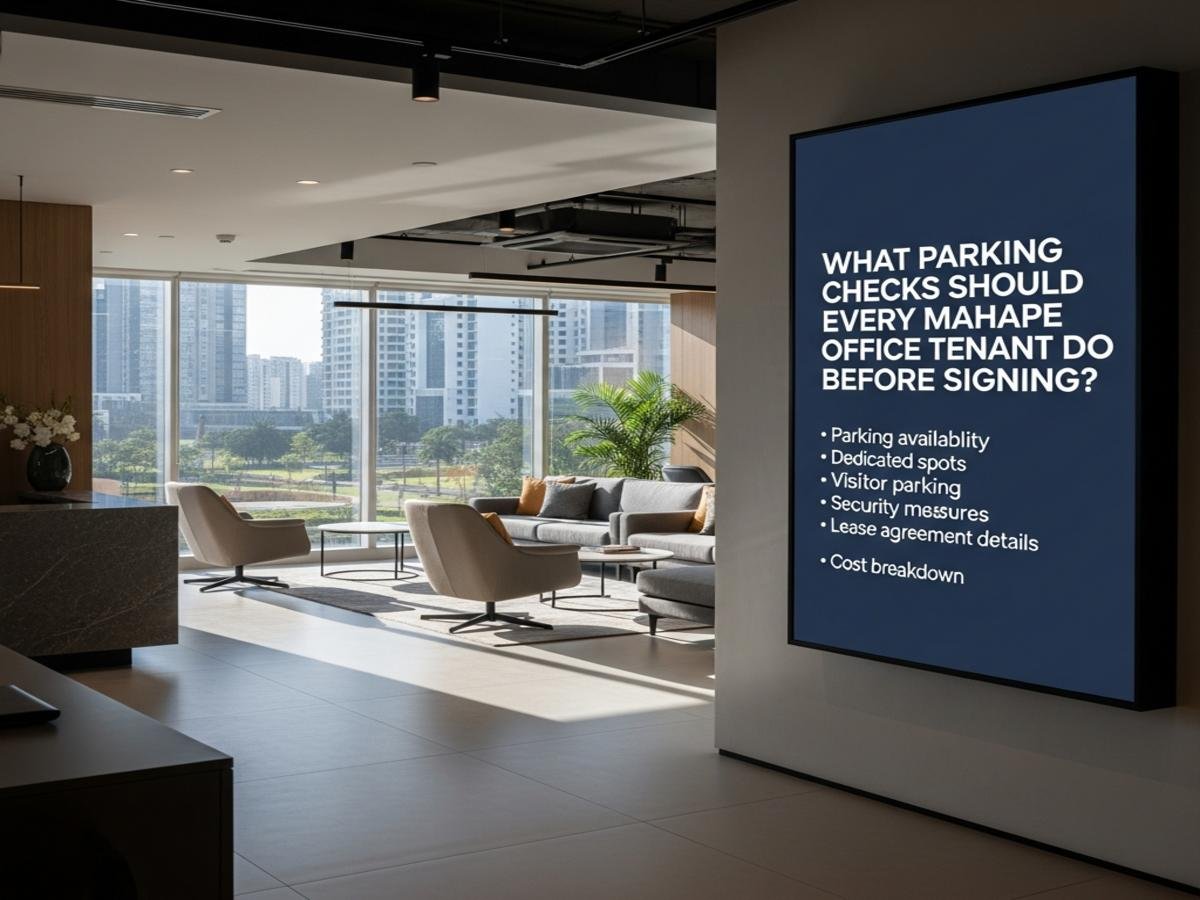
Mahape MIDC property should not be judged like a normal residential flat, private commercial shop, or freehold plot. MIDC land is allotted for planned industrial or commercial development under authority-controlled conditions. The buyer is usually taking over leasehold rights, not buying absolute land ownership in the usual freehold sense.
That changes the whole due diligence process.
In a normal residential resale, people mostly check title, society NOC, loan eligibility, registration, stamp duty, and possession. In a Mahape MIDC transaction, those checks are not enough. The buyer must also examine permitted use, MIDC transfer rules, lease conditions, building plan approval, FSI use, BCC or OC, fire safety, MPCB consent, utilities, and whether the property’s actual use matches the sanctioned use.
| Normal Property Thinking | Mahape MIDC Reality |
|---|---|
| “The seller owns the property.” | The seller usually holds leasehold rights subject to MIDC terms. |
| “Registration means the deal is safe.” | Registration is not the same as MIDC compliance or occupation readiness. |
| “Possession means we can start work.” | Occupation may need BCC/OC, fire approval, MPCB consent, power sanction, and permitted use match. |
| “Extra mezzanine means extra usable area.” | Unapproved mezzanine may consume FSI and create compliance risk. |
| “The same unit can be used for any business.” | MIDC permitted use and activity-specific compliance matter. |
| “Location is enough.” | Daily use depends on power, water, access, parking, drainage, loading, and truck movement. |
Mahape’s advantage is real. It has strong connectivity to Ghansoli, Koparkhairane, Rabale, Airoli, Thane-Belapur Road, and the wider Navi Mumbai-Thane business belt. But that advantage does not remove the need for authority-level verification.
A property can be in a good location and still be a bad fit for a specific occupier.
What Rights Does a Leasehold Holder Actually Have in a Mahape MIDC Property?
A leasehold holder in Mahape MIDC has useful rights, but those rights are conditional. They are not the same as unrestricted ownership. The exact rights depend on the lease deed, MIDC regulations, permitted use, transfer history, dues, building approvals, and any later permissions or violations.
Right to possess and use the plot or unit
The lessee generally has the right to possess and use the property for the purpose allowed under the MIDC allotment and lease conditions. If the plot or unit is meant for industrial activity, the actual use must normally remain within permitted industrial or approved commercial limits.
This is where many buyers make a mistake. They see a structure and assume any activity can be started there. But a unit used earlier for dry storage may not automatically suit electronics assembly, food processing, chemical handling, heavy fabrication, or high-density office use.
The intended activity must be checked against the permitted use.
Right to transfer or assign, subject to MIDC rules
A leasehold holder may have the right to transfer or assign the property, but this is usually subject to MIDC permission, payment of transfer charges, clearance of dues, and compliance with authority conditions.
The research dossier notes that MIDC transfer charges may be linked to the prevailing MIDC base rate and vary by use category, such as industrial, commercial, or other permitted use. These percentages and rules must always be verified from the latest MIDC records before a transaction.
The key point is simple: the seller cannot treat MIDC leasehold transfer like a normal freehold resale where private agreement alone completes the matter.
Right to construct, alter, or change use only with permission
Construction, alteration, expansion, mezzanine creation, demolition, change of use, or major layout modification generally cannot be done casually. The structure must match sanctioned plans and applicable development control rules.
This matters a lot in old Mahape industrial galas and sheds. Many units may have internal partitions, additional storage platforms, covered setbacks, loading extensions, or mezzanine floors created over time. Some may be practical for daily use, but not necessarily legal as per sanctioned records.
A buyer should not pay extra for illegal usable area without checking whether it can be regularized or whether it creates a future demolition, penalty, or BCC/OC problem.
When Can a Property Be Legally Transferable but Still Difficult to Occupy?
A Mahape MIDC property can be legally transferable but still difficult to occupy when the title chain is acceptable but the building, utilities, or intended business activity does not meet occupation requirements.
This is the biggest practical risk in such transactions.
For example, suppose a buyer wants to acquire a unit for electronics assembly. The seller has a clear allotment chain. The MIDC transfer appears possible. Dues are manageable. The location is good. On the surface, the deal looks safe.
But then the buyer discovers these issues:
- The mezzanine floor is not shown in approved plans.
- The earlier use was dry storage, not assembly.
- MPCB consent may need to be freshly applied based on the new activity.
- The sanctioned power load is lower than required.
- Fire access is weak because the setback is partly covered.
- The loading area is not suitable for regular material movement.
- Water supply is unreliable in peak summer, increasing tanker dependency.
In this situation, the leasehold transfer may still happen. But occupation will become expensive, delayed, or risky.
This is why the correct question is not only, “Can the property be transferred?” The better question is, “Can my exact business operate from this property without hidden legal, utility, or compliance problems?”
Caution Box: MIDC Transfer Is Not a Clean Chit for Occupation
MIDC transfer approval should not be treated as automatic confirmation that the building is fully legal, the use is approved, the fire systems are valid, or the future business activity is allowed. Transfer and occupation are connected, but they are not the same checkpoint.
Which Occupation Checks Matter Before Buying or Leasing in Mahape MIDC?

Before buying or leasing a Mahape MIDC property, the occupier should check the property in three layers: document legality, building legality, and operational usability.
If any one layer fails, the business can face delay, penalties, extra cost, or complete non-usability.
Permitted industrial use and activity match
The first check is whether the buyer’s or tenant’s actual activity is permitted in that property. A light assembly unit, electronics workshop, warehouse, IT back-end office, packaging operation, or chemical process cannot be treated in the same way.
Mahape works well for many cleaner and tech-adjacent uses, but not every activity is suitable for every unit. The user must verify whether the proposed activity fits the MIDC permitted use and whether any change-of-use permission is required.
Building approval, OC, BCC, and structural condition
The physical structure must be compared with the MIDC-approved sanctioned plan. This is not a formality. It is the only way to know whether the current building footprint, mezzanine, staircase, shed, setback, office block, loading bay, and extensions are legally acceptable.
In MIDC-related properties, Building Completion Certificate or Occupation Certificate status is an important occupation-readiness check. A unit without proper completion or occupation clarity may create issues for fire approval, bank funding, business licenses, insurance, and future resale.
Fire safety and emergency access
Fire safety is not only about keeping extinguishers inside the premises. Industrial and commercial occupation may require proper fire access, emergency exits, firefighting systems, safe storage, structural compliance, and valid fire approvals where applicable.
In Mahape, this becomes important because many older industrial units have been modified internally over time. If the side margins, access paths, or internal circulation are blocked, fire compliance can become difficult even when the property looks usable.
MPCB consent or pollution category requirement
MPCB consent depends on the actual business activity. Not every activity has the same pollution category or consent requirement. Electronics, assembly, light engineering, warehousing, chemical handling, food processing, metal treatment, or heavy manufacturing may all have different environmental requirements.
The buyer should not assume that the previous occupant’s consent will automatically suit the new activity. If the business activity changes, fresh Consent to Establish, Consent to Operate, or modification of consent may be required.
This is especially important when a property was earlier used for low-impact storage and the new buyer wants to use it for manufacturing or processing.
Power load, water, drainage, and waste disposal
Power load is one of the most practical checks in Mahape MIDC. A unit may have a connection, but the sanctioned load may not be enough for machinery, assembly lines, HVAC, server rooms, lifts, or heavy equipment.
Water and drainage should also be checked on-site. The dossier notes that parts of the TTC Industrial Area face water pressure and tanker-dependency issues, especially during peak summer periods. For some businesses, this may be a minor inconvenience. For others, it can affect production, sanitation, cooling, or processing.
Waste disposal and effluent handling must also match the activity. If the business generates industrial waste, chemical waste, or process discharge, the occupier must verify whether proper disposal routes and permissions are available.
Truck access, loading, parking, and internal movement
Mahape has good strategic connectivity, but daily logistics can be tricky for some users. The Thane-Belapur corridor is heavily commuter-oriented, and heavy commercial vehicle movement may face time restrictions during peak hours. This matters for warehouses, freight-heavy users, and just-in-time supply chain operations.
The occupier should check:
- Entry road width
- Internal turning radius
- Loading and unloading space
- Parking for staff and visitors
- Access during peak hours
- Suitability for container vehicles or tempo movement
- Whether loading areas are sanctioned or informal
A small electronics unit may manage these constraints. A high-volume warehouse may not.
How Do MIDC, NMMC, MPCB, Fire Department, and Utility Providers Affect Occupation?
Mahape MIDC occupation is not controlled by one single authority. Different authorities control different risks. A buyer or tenant should understand who controls what before depending on broker promises.
| Authority / Agency | What It Affects | What to Verify |
|---|---|---|
| MIDC | Leasehold title, transfer approval, permitted land use, building plans, FSI, BCC/OC-related approvals | Lease deed, allotment chain, transfer permission, sanctioned plans, BCC/OC status, dues |
| NMMC | Property tax and certain civic-side municipal issues within municipal limits | Updated property tax bills, arrears, no-dues position |
| MPCB | Environmental permission based on the actual activity | Consent to Establish, Consent to Operate, pollution category, waste handling |
| Fire authority / fire approval system | Life safety, fire access, firefighting systems, emergency readiness | Provisional or final fire approval where applicable |
| Utility providers | Power, water, drainage, and service continuity | Sanctioned load, recent bills, water connection, drainage arrangement |
| Professional consultants | Legal, technical, structural, environmental, and compliance interpretation | Lawyer report, architect report, structural audit, environmental review |
One common confusion is NMMC property tax. Many occupiers assume that because the property is inside an MIDC industrial area, only MIDC charges matter. But the dossier clearly points out that NMMC has had the legal right to levy property tax on units within its municipal limits, even where MIDC manages industrial infrastructure.
So before buying or leasing, unpaid NMMC property tax should not be ignored. It can become a financial burden and a negotiation point.
What Should Buyers Check in the Lease Deed, Transfer Papers, and MIDC Records?
Buyers should not stop at the sale agreement or registration draft. In a Mahape MIDC property, the deeper check is the MIDC record trail.
Original lease deed and allotment chain
The buyer should check the original lease deed, allotment order, assignment history, previous transfer permissions, and whether the current seller has a clear right to transfer. Any missing link in the allotment or transfer chain can create a problem later.
This is especially important in older industrial pockets where units may have changed hands, been subleased, mortgaged, modified, or occupied by different businesses over time.
Transfer permission, assignment, and dues
MIDC transfer permission and related dues must be checked carefully. Transfer charges, service charges, non-utilization penalties, and other authority dues may affect the transaction.
The dossier also highlights an important FSI-related point: under prevailing rules mentioned in the dossier, plot holders may need to achieve minimum FSI utilization through a BCC process by the applicable deadline, with non-utilization charges where relevant. Since these rules can change, buyers must verify the latest position directly through MIDC or a competent MIDC consultant.
Mortgage, encumbrance, and pending authority payments
A property may be mortgaged to a bank or financial institution. If so, the buyer should not proceed without a proper bank NOC, charge release, or transaction structure that protects payment.
Apart from bank mortgage, buyers should also check:
- MIDC dues
- NMMC property tax arrears
- Utility bill arrears
- Litigation or notices
- Breach notices
- Pending transfer objections
- Any illegal sublease or occupation issue
IGR Maharashtra registration records may help in transaction reference, but they should not be treated as proof of operational legality.
Permitted use and breach conditions
The lease deed may contain important use restrictions. If the buyer wants to run a business different from the original permitted use, this must be checked before payment.
For example, converting an industrial gala into a showroom, high-density office, storage depot, food processing unit, or chemical activity may need separate approvals. The seller’s past usage does not automatically become the buyer’s legal right.
What Should Tenants Check Before Taking a Mahape MIDC Unit on Rent?

Tenants also need due diligence. Just because the tenant is not buying the property does not mean the risk belongs only to the landlord.
A tenant should verify whether the landlord has the right to lease or sublease the property. If the lease deed restricts subletting or requires permission, the tenant should not rely only on a private rent agreement.
The tenant should also check whether the property can support the intended activity. A rent agreement will not help much if the business cannot get required power load, MPCB consent, fire approval, or business permission.
Before paying deposit, a tenant should ask for:
- Proof of landlord’s leasehold right
- Permission or eligibility to lease/sublease, where required
- Sanctioned plan and current layout match
- BCC/OC or completion status, where applicable
- NMMC property tax payment status
- MIDC service charge or dues position
- Sanctioned power load and recent electricity bills
- Water connection and tanker dependency, if any
- Fire safety status
- MPCB consent suitability for the tenant’s activity
- Clear repair, maintenance, and compliance responsibility in the agreement
For a small office or back-end unit, these checks may look excessive. But for a factory, assembly line, warehouse, or storage business, they can protect lakhs or even crores of working capital from getting stuck.
How Can Occupation Reality Differ for Factory, Warehouse, Office, and Back-End Ops Users?
Mahape does not behave the same way for every business. The same unit may be excellent for one occupier and unsuitable for another.
| Intended Use | Mahape Fit | Main Occupation Checks |
|---|---|---|
| Electronics and light assembly | Often suitable if permissions, power, ventilation, and MPCB category match | MPCB consent, sanctioned use, power load, fire safety, layout |
| IT/ITES and back-end operations | Strong in selected pockets, especially around tech and office-oriented areas | Parking, lift, HVAC, fire safety, employee commute, commercial-use limits |
| Warehousing and storage | Suitable for smaller or controlled movement needs, but not always ideal for heavy freight | Loading, road access, truck timing, ceiling height, fire storage norms |
| Heavy manufacturing | Selectively suitable, but can face more compliance and infrastructure pressure | Power, vibration, effluent, fire access, structural strength, MPCB category |
| Chemical or high-pollution activity | Needs very careful review; not every Mahape unit will support it | MPCB category, CETP linkage, waste disposal, ZLD or stricter conditions where applicable |
This is where local area logic matters.
Mahape is strong because of its position in the Navi Mumbai-Thane business belt. Ghansoli, Koparkhairane, Airoli, Rabale, and Thane-Belapur Road give it serious workforce and business access. For IT support, electronics, office-heavy back-end work, and light assembly, this can be a big advantage.
But for heavy logistics, the same commuter density can become a problem. Truck movement, parking, loading, and peak-hour restrictions can reduce daily efficiency. A location that is excellent for staff commuting may not be excellent for round-the-clock freight movement.
What Are the Red Flags in Mahape MIDC Properties That Buyers Often Miss?
The biggest red flags are usually not visible in the first site visit. They come out only when documents, sanctioned plans, authority dues, and actual use are checked together.
Common red flags include:
- Seller says “ownership,” but only leasehold rights exist and MIDC conditions are unclear.
- MIDC transfer is possible, but building plan approval does not match the current structure.
- Unauthorized mezzanine is shown as extra usable area.
- Setbacks or side margins are covered for storage or loading.
- BCC or OC status is unclear.
- NMMC property tax dues are pending or disputed.
- Existing power load is much lower than required.
- Previous activity and proposed activity fall into different MPCB categories.
- Fire access is blocked or too narrow.
- Water supply depends heavily on tankers.
- The seller says all approvals will be “managed later.”
- The price looks attractive only because compliance problems are hidden.
The Mezzanine Trap in Mahape Industrial Galas
A mezzanine can look like useful extra space, especially in high-ceiling industrial units. But an unapproved mezzanine may consume FSI and may not be shown in sanctioned plans. If it is illegal, it can affect BCC/OC, fire safety, insurance, and future transaction value.
Buyers should not treat mezzanine area as a bonus unless an architect verifies it against approved plans and applicable development control rules.
Practical Example: A Mahape MIDC Unit Looks Transferable, But Is It Occupation-Ready?

Consider a buyer planning to purchase a ground-floor industrial gala in Mahape for electronics assembly.
The seller has a clear-looking document file. The MIDC transfer appears possible. The location is near the right business belt. The price is acceptable. At first glance, the buyer feels the deal should move quickly.
But during occupation due diligence, the buyer finds five problems.
First, the mezzanine used for packaging is not shown in the sanctioned plan. Second, the earlier occupant used the space for dry storage, while the buyer’s electronics assembly may need a different MPCB consent position. Third, the sanctioned power load is not enough for assembly equipment and cooling. Fourth, the loading area is partly informal. Fifth, fire access needs review because internal storage has reduced movement space.
Now the deal is not automatically bad. But it is no longer a simple ready-to-occupy purchase.
The buyer has four options:
1. Ask the seller to regularize the structure before closing. 2. Renegotiate the price based on compliance cost. 3. Take expert reports before paying a large amount. 4. Walk away if the cost, time, or approval uncertainty is too high.
This is the real difference between leasehold transfer and occupation reality. The property can be transferable, but the business may still not be ready to operate from it.
Leasehold vs Occupation Reality: Quick Decision Table for Mahape MIDC Buyers and Tenants
| Due Diligence Result | What It Means | Practical Decision |
|---|---|---|
| Clean leasehold chain + valid sanctioned plans + clear dues + activity fit | Lower-risk property | Proceed after lawyer and technical verification |
| Clean title but unauthorized mezzanine or extension | Transfer may happen, but occupation risk remains | Pause, regularize, or renegotiate |
| Transfer possible but MPCB consent mismatch | Business activity may face approval delay | Consult environmental expert before payment |
| Good location but weak power load | Daily operations may suffer | Check upgrade feasibility and cost |
| Excellent structure but poor truck access | Not suitable for freight-heavy users | Consider Pawane, Taloja, or other logistics-friendly alternatives |
| Pending NMMC tax or MIDC dues | Hidden financial liability | Clear dues before agreement or adjust price |
| Seller avoids sanctioned plan or BCC/OC discussion | High caution signal | Do not proceed without document verification |
| Tenant gets private rent agreement without authority clarity | Occupation risk for tenant | Verify landlord’s right and use permission first |
FAQs on Leasehold and Occupation Reality in Mahape MIDC Properties
Is Mahape MIDC property freehold or leasehold?
Mahape MIDC properties are generally leasehold assets allotted under MIDC conditions. The lessee may have rights to possess, use, transfer, or develop the property, but these rights are subject to MIDC rules, lease terms, permitted use, and authority approvals.
Can I occupy a Mahape MIDC unit immediately after transfer?
Not always. Transfer of leasehold rights does not automatically mean the unit is occupation-ready. You must check BCC or OC status, sanctioned plan match, fire safety, MPCB requirement, utility readiness, and whether the intended activity is permitted.
Is MIDC transfer approval enough before buying?
MIDC transfer approval is important, but it is not enough by itself. It does not automatically prove that the building has no unauthorized changes, that the fire approval is valid, or that your business activity can legally operate there.
Do all Mahape MIDC businesses need MPCB consent?
Not all activities need the same level of MPCB approval. The requirement depends on the business activity and its pollution category. Warehousing, electronics assembly, fabrication, food processing, chemical handling, and heavy manufacturing may have different compliance needs.
What is more important: lease deed or occupation certificate?
Both matter, but they answer different questions. The lease deed helps prove leasehold rights and permitted terms. The occupation certificate or completion-related approval helps show whether the building is fit for legal occupation as per approved plans and applicable rules.
Can an office or back-end operation run from an MIDC industrial unit?
It depends on the permitted use, building approval, commercial-use limits, fire safety, parking, employee load, and authority rules. Some Mahape pockets are suitable for IT/ITES and back-end operations, but the exact property must be checked before use.
What should a tenant verify before renting in Mahape MIDC?
A tenant should verify the landlord’s right to lease, permitted use, sanctioned layout, utility capacity, fire safety, tax and dues status, and whether the tenant’s business activity is allowed from that premises.
Should I buy a Mahape MIDC property with pending dues or unclear usage?
Only after full verification and price adjustment. Pending dues, unclear permitted use, missing approvals, or illegal structural changes can create serious financial and occupation risk. In many cases, it is better to pause until the seller clears the issue.
Final Verdict: In Mahape MIDC, Buy the Usable Reality, Not Just the Paper Right
Leasehold rights are important, but they are only the first layer of safety in Mahape MIDC properties. The stronger question is whether the property can legally, safely, and practically support your exact business activity.
For buyers, that means checking MIDC lease records, transfer permission, dues, sanctioned plans, BCC or OC status, permitted use, fire safety, MPCB consent, power load, water, drainage, and access before paying serious money.
For tenants, it means not depending only on a rent agreement and broker assurance. The landlord’s title, authority permissions, utility capacity, and activity fit must be checked before moving machinery, staff, inventory, or operations into the unit.
Mahape is a valuable industrial and business location in Navi Mumbai, especially for electronics, light assembly, IT/ITES, back-end operations, and selected industrial users. But it rewards careful buyers and punishes casual assumptions.
The safest approach is simple: verify the leasehold paper trail and the occupation reality separately. If both are clean, the property may be worth proceeding with. If only the papers look clean but the ground reality is weak, the deal needs renegotiation, expert review, or a clear exit.
FAQs
Frequently Asked Questions