MIDC, MPCB, Fire and Utility Checks for Mahape Industrial Occupiers
Mahape industrial occupiers must check MIDC use and transfer permissions, MPCB consent requirements, fire safety, sanctioned power load, water, drainage, waste disposal, truck access, and building documents before signing or starting operations. A unit may look affordable and well-located, but it can become expensive if the permitted use, utility capacity, pollution category, fire access, or actual site condition does not match the business.
Mahape is one of the most active business pockets inside the TTC Industrial Area of Navi Mumbai. It sits close to Thane-Belapur Road, Ghansoli, Rabale, Kopar Khairane, Turbhe, Airoli, and Millennium Business Park. This makes it attractive for electronics assembly, light manufacturing, back-office operations, warehousing, service centres, and R&D-linked businesses.
But Mahape is not a simple plug-and-play industrial market. Many units are old. Some are modified. Some are suitable for office-type operations but not for machinery. Some may have clean ownership papers but weak utility support. Some may have road access but poor fire movement. This is why occupiers must judge the unit as an operating asset, not only as a property.
What Should a Mahape Industrial Occupier Check Before Signing or Starting Operations?
A Mahape unit should be checked across three layers: documents, physical site condition, and operational suitability. Ownership papers alone are not enough. The real question is whether your exact activity can legally and practically run from that unit.
| Check area | What to verify | Why it matters | Who should check it | Risk if ignored |
|---|---|---|---|---|
| MIDC use and transfer | Allotment, lease, transfer, subletting permission, permitted use | MIDC is central to industrial land use and transfer conditions in Mahape | Owner, buyer, tenant, lawyer | Unauthorized occupation, transfer delay, unexpected charges |
| MPCB requirement | Pollution category, consent need, self-declaration, waste type | Consent depends on actual activity, not only address | Occupier, compliance consultant | Delay in operations, penalty, shutdown risk |
| Fire safety | Fire NOC, exits, approach road, hydrants, extinguishers, storage material | Fire safety affects people, insurance, and continuity | Fire consultant, architect, occupier | Failed audit, unsafe workplace, claim rejection |
| Power load | Sanctioned load, connected load, transformer capacity, panel condition | Machinery, assembly, servers, and HVAC need stable power | Electrical contractor, occupier | Downtime, upgrade cost, unsafe wiring |
| Water and drainage | Water connection, bills, drainage slope, backflow signs, monsoon condition | Mahape has pockets where drainage and waterlogging can affect operations | Occupier, site inspector | Inventory damage, hygiene issue, operational stoppage |
| Waste disposal | Solid waste, process waste, e-waste, packaging waste, hazardous waste if any | Waste rules vary by activity | Occupier, MPCB consultant | Non-compliance and recurring operational issues |
| Physical access | Road width, truck turning, loading space, fire vehicle access | Good location is useless if vehicles cannot move properly | Occupier, logistics team | Delays, disputes, safety risk |
| Building condition | BCC/OC, approved plan, mezzanine, extensions, floor strength | Informal modifications are common in old industrial stock | Architect, structural consultant | Legal mismatch, structural risk, fire non-compliance |
The most important distinction is simple: a unit can be paper-safe but not operationally safe. Paper-safe means the basic property documents may look acceptable. Operationally safe means the unit’s permissions, power, drainage, fire access, structure, and activity fit your business.
Why Are Compliance and Utility Checks More Important in Mahape Than Just Rent or Location?
In Mahape, rent and location are only starting points. The real cost of occupation comes from compliance gaps, utility upgrades, fit-out corrections, fire safety work, power load enhancement, and monsoon-related disruptions.
Mahape is different from a purely heavy-industrial belt. It has a mixed working character. You will find IT and back-office operations around Millennium Business Park, electronics and light assembly units in industrial galas, warehouses on suitable access roads, and older manufacturing-style units in legacy pockets. This mix is useful, but it also creates confusion.
A unit that worked for a back-office team may not work for an assembly line. A warehouse may have good floor space but poor fire access. A legacy gala may look affordable but may have weak sanctioned power load. A building may have extra mezzanine space, but that space may not match approved plans or fire safety assumptions.
This is where many occupiers make mistakes. They compare rent per sq. ft., distance from Thane-Belapur Road, and carpet area. But they ignore power quality, fire passages, drainage history, loading movement, and whether the business activity matches the permitted industrial use.
Caution: A cheap Mahape unit is not always cheaper. If you later need power load enhancement, fire correction, drainage repair, legal regularisation, or major electrical rework, the saving in rent can disappear quickly.
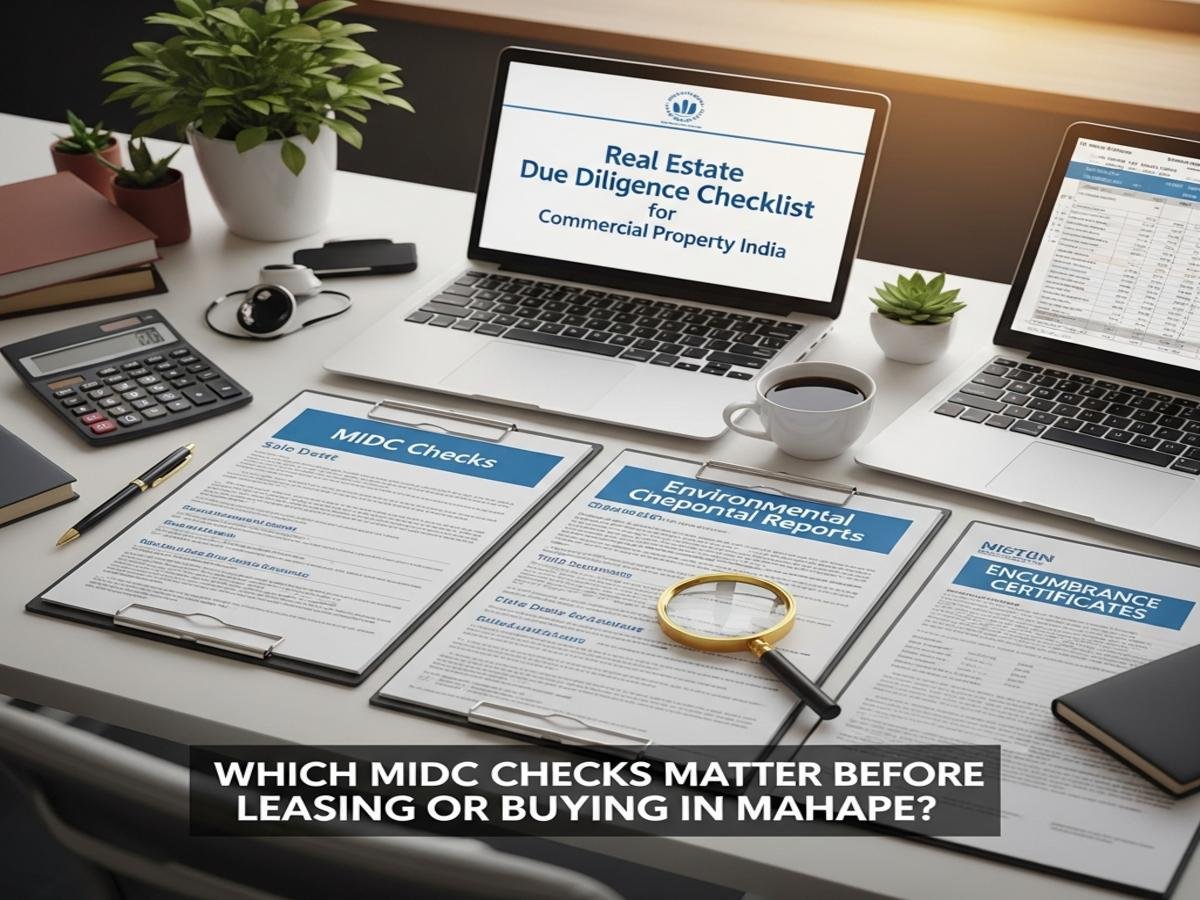
Which MIDC Checks Matter Before Leasing or Buying in Mahape?
MIDC checks matter because Mahape is part of the TTC Industrial Area, where industrial land use, transfers, and subletting conditions can affect occupation. A registered lease or sale agreement is not always enough if MIDC-related permissions and conditions are not clear.
Is the Industrial Use Allowed for the Actual Business Activity?
The first MIDC-side question is not “Is this an industrial unit?” The better question is: “Is my exact activity suitable for this unit and permitted use?”
For example, a software back-office, electronics assembly unit, packaging activity, light engineering setup, and process-heavy manufacturing operation do not carry the same risk. Even if all are loosely called industrial or commercial by brokers, their approval path and utility needs can differ.
The occupier should check whether the permitted use, building approval, and past usage support the new activity. A previous tenant’s business does not automatically prove that your activity is allowed.
Are Transfer, Lease, Occupation, or Subletting Conditions Clear?
For buyers, MIDC transfer conditions are important. In some cases, transfer of open plots or underutilised plots may involve differential premium based on consumed FSI, as mentioned in MIDC-related policy frameworks. These charges can be significant and should not be discovered after token payment.
For tenants, subletting is a major issue. A landlord cannot safely treat an MIDC industrial property exactly like a normal private commercial shop. If formal subletting permission or applicable charges are required, the tenant should understand that before signing.
The common mistake is depending only on an 11-month lease agreement without checking the authority-side position. It may feel simple, but it can create problems later if the occupation is treated as unauthorized.
Do Building Permissions and Actual Construction Match?
The physical building should match approved plans and completion-related documents. This is especially important in old Mahape units where mezzanines, sheds, partitions, extensions, or storage lofts may have been added over time.
Before leasing or buying, check:
- Original allotment or title-related papers available with the owner
- MIDC lease or transfer-related documents, where applicable
- Building Completion Certificate or occupation-related approval, where applicable
- Approved building plan versus actual construction
- Any mezzanine, shed, internal partition, or extension
- Owner’s right to lease, sublease, sell, or transfer
- Pending dues, notices, or authority-side objections
A unit should not be judged only by how much space the broker shows. The usable space and the legally supported space must be separately understood.
When Does an Occupier Need MPCB Consent in Mahape?
MPCB consent depends on the actual business activity, pollution category, waste generation, emissions, effluent, chemical use, and process type. Every Mahape occupier does not need the same environmental approval, but every occupier should verify the requirement before fit-out.
Which Business Activities Usually Need Environmental Scrutiny?
Office-style IT/ITES, data processing, light electronics assembly, and some low-pollution activities may fall under lighter compliance requirements under updated White Category-style frameworks. In such cases, the process may involve self-declaration rather than a long consent process, depending on the exact current category and activity.
Warehousing, non-chemical assembly, small mechanical workshops, or packaging-type operations may still need simplified or activity-specific environmental checks. Process industries, chemical-linked work, metal treatment, hazardous waste generation, or effluent-heavy operations need much deeper scrutiny.
| Business type | Likely MPCB relevance | Key question to ask | Risk if ignored |
|---|---|---|---|
| IT/ITES or back-office | Usually low, subject to current category | Is self-declaration or exemption applicable? | Wrong assumption, future notice |
| Electronics assembly | Often low to moderate depending on process | Is there soldering, e-waste, chemical cleaning, or hazardous waste? | Waste and compliance mismatch |
| Warehousing | Depends on stored goods | Are goods non-hazardous or regulated? | Fire and environmental risk |
| Packaging or light assembly | Depends on material and process | Is there dust, fumes, glue, solvent, or waste? | Consent or waste issue |
| Food processing | Activity-specific | Is water, waste, or effluent involved? | Drainage and consent problem |
| Chemical or process-led unit | High scrutiny | Is Consent to Establish/Operate required? | Shutdown and penalty risk |
Why Pollution Category and Waste Type Matter Before Fit-Out
The MPCB question should be settled before interior work, machine installation, or production planning. Once machines are installed, changing layout, waste systems, ventilation, or effluent handling becomes expensive.
A clean-looking unit does not mean the activity is clean. For example, electronics assembly may look simple, but if it involves chemical cleaning, soldering fumes, e-waste, battery handling, or process waste, the compliance requirement can change.
What Should Low-Pollution or Office-Type Users Still Verify?
Even if the activity is low-pollution, the occupier should not ignore MPCB completely. Keep proof of category, self-declaration, exemption, or consultant opinion wherever applicable. Also check how waste will be handled, especially e-waste, packaging waste, food waste from staff areas, and any activity-specific material.
Do not rely on the previous tenant’s consent. MPCB relevance follows the activity, not only the address.
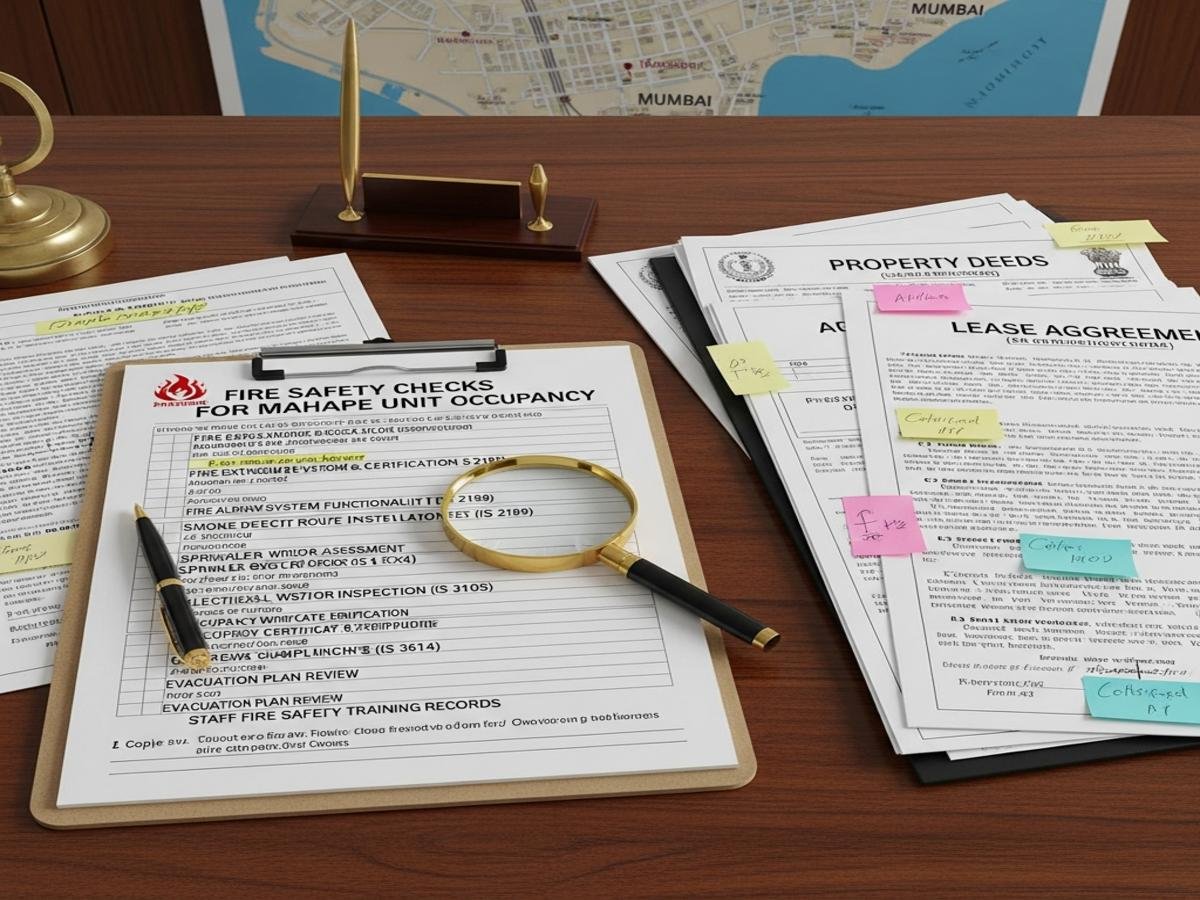
What Fire Safety Checks Should Be Done Before Occupying a Mahape Unit?
Fire safety should be checked before moving people, machines, stock, or inventory into the unit. In Mahape, many industrial buildings are shared, old, modified, or space-constrained. That makes physical fire safety as important as paperwork.
Does the Building Have Suitable Exits, Access, and Fire Systems?
The occupier should check whether the building has practical emergency exits, clear staircases, proper passage width, extinguishers, hydrants or sprinklers where required, emergency signage, and maintained electrical panels.
For industrial buildings and warehousing use, fire safety is strongly linked to occupancy type, storage material, building height, floor area, and access. Industrial occupancies are generally treated more seriously because they may involve machines, packaging, combustible material, electrical load, chemicals, or storage density.
Can Fire Vehicles Reach the Unit During an Emergency?
This is one of the most ignored checks in industrial areas. A fire NOC or fire system has limited value if fire vehicles cannot reach the premises.
In Mahape, check the internal road, parking condition, turning radius, loading area, gate width, and whether setback areas are blocked by parked vehicles, scrap, pallets, or unauthorized extensions. For larger industrial and warehouse operations, approach road strength and fire vehicle movement can become a serious compliance issue.
Are Internal Modifications Creating Safety Risk?
Unapproved mezzanines, lofts, partitions, storage racks, closed passages, or extra cabins can change the fire load and evacuation route. This is not a small interior matter. It can affect fire safety validity, insurance, and worker safety.
Before occupation, check:
- Are fire exits visible and usable?
- Are staircases and passages free from storage?
- Is there any unapproved mezzanine or extra floor-like structure?
- Are electrical panels accessible?
- Are extinguishers valid and suitable for the material stored?
- Is there proper ventilation for heat, fumes, or equipment?
- Can emergency vehicles enter without obstruction?
- Are combustible materials stored away from electrical points?
If the building depends on “adjustment” rather than proper access and safety, the occupier should pause.
How Should Occupiers Check Power Load, Backup, and Electrical Safety?
Power load is not a technical side issue in Mahape. It can decide whether your operation can run at all. A unit used earlier as a small office may not support machinery, assembly lines, air compressors, HVAC systems, servers, or testing equipment without load enhancement.
Is the Sanctioned Load Enough for the Actual Machines or Operations?
Ask for the sanctioned load, latest electricity bill, connected load details, meter category, and whether additional load can be obtained. Do not estimate based only on the previous tenant’s usage.
A practical example: a back-office setup may run with normal commercial load, computers, lighting, internet, and air-conditioning. An electronics assembly or machinery-led unit may need higher sanctioned load, stable voltage, UPS, earthing, and panel upgrades. If the unit has only a small sanctioned load and the local transformer is already stressed, the upgrade may take time and money.
Are Wiring, Panels, Earthing, and Backup Systems Safe?
Old industrial wiring is a real risk. During the site visit, check the panel room, cable routing, earthing, MCB/MCCB condition, heating marks, exposed wiring, and whether the load is being shared informally with another user.
Avoid relying on informal sub-meter arrangements where the landlord controls the main supply. If the main connection is disconnected because of owner default, your operation can stop even if you have paid your share.
For sensitive electronics, testing, IT servers, or equipment-heavy operations, UPS and voltage stabilisation should be planned from day one. Power quality issues such as dips or harmonics can damage equipment or create production errors.
What Water, Drainage, and Waste Disposal Checks Are Needed in Mahape?
Water, drainage, and waste disposal can directly affect daily operations. In Mahape, this is especially important for ground-floor units, warehouses, packaging businesses, food-related processes, and any activity storing expensive material.
Is the Unit Dependent on Shared Drainage or Internal Lines?
Many industrial buildings depend on shared drainage, common internal lines, or old storm-water systems. The unit may look fine during summer but behave differently during heavy rain.
Mahape and nearby TTC pockets have faced local drainage and waterlogging challenges in certain low-lying or poorly maintained areas. For any ground-floor industrial or warehouse operation, inspect the plinth height, slope of the compound, drain covers, backflow marks, water stains on walls, and road level outside the gate.
Can the Business Legally and Practically Handle Its Waste?
Waste is not only an environmental question. It is also a practical site-management question.
Check how the unit will handle:
- Packaging waste
- E-waste
- Scrap
- Food waste from staff areas
- Process waste, if any
- Hazardous material, if applicable
- Wastewater or effluent, if the activity generates it
A warehouse storing non-hazardous goods has a different waste profile from an electronics repair unit or a process-led workshop. The occupier should not assume that the building’s existing arrangement is enough.
What Happens During Heavy Rain or Drainage Backflow?
A serious occupier should inspect Mahape units during monsoon or speak to neighbouring occupiers about past waterlogging. This is not over-caution. For ground-floor stock, even a few inches of water can damage inventory, cartons, machines, electrical panels, and flooring.
Before finalising, ask:
- Has the internal road flooded before?
- Does water enter the compound?
- Is the unit’s plinth above road level?
- Are drainage lines cleaned before monsoon?
- Are there watermarks on walls or shutters?
- Does the landlord maintain common drains?
- Where will waste and scrap be stored during rains?
How Do Checks Differ for Electronics, Assembly, Warehouse, R&D, and Back-End Operations?
Every Mahape occupier should not use the same checklist. The exact risk depends on what the business does inside the unit.
| Occupier type | MIDC/use concern | MPCB concern | Fire concern | Utility concern | Mahape suitability note |
|---|---|---|---|---|---|
| IT/ITES and back-office | Check commercial/IT or permitted office-style use | Usually low, subject to current category and declaration | Staff density, AC, smoke detection, exits | Fiber, power stability, HVAC, parking | Mahape works well near MBP and better-access pockets |
| Electronics assembly | Check if assembly use fits the unit | Depends on soldering, e-waste, chemicals, cleaning process | Electrical panels, packaging material, ventilation | Stable power, UPS, earthing, load adequacy | Strong fit if power and fire safety are clean |
| Light assembly or packaging | Check industrial use and storage permissions | Depends on material, adhesive, fumes, dust, waste | Storage, exits, extinguishers, internal layout | Power, loading, ventilation | Works in many Mahape galas if space and access match |
| Warehousing and logistics | Check storage use and vehicle movement suitability | Depends on goods stored | High focus on access, sprinklers, storage load | Loading bays, floor strength, drainage | Suitable only where trucks can move properly |
| R&D or testing lab | Check whether activity is office-like or process-led | Depends on equipment, chemicals, samples, waste | Equipment safety, ventilation, emergency planning | Power quality, backup, water if needed | Selectively suitable, especially for electronics-linked R&D |
| Heavy process or chemical-linked work | Strict use and zoning checks needed | Often higher scrutiny | Special fire systems may be needed | Power, effluent, waste, safety systems | Mahape may not be ideal unless permissions and infrastructure are strong |
This table is important because Mahape’s strength is not the same for every business. It is generally better for clean industrial, tech-linked, electronics, service, back-office, and selected warehouse operations than for very heavy or high-pollution industrial use.
What Should Be Verified During the Physical Site Visit in Mahape?
The site visit should not be treated like a normal property inspection. For industrial occupation, the site visit is an operational audit.
Check the road first. Can your vehicle actually reach the unit? Can a tempo, container vehicle, or fire vehicle turn properly? Is there enough space for loading and unloading without blocking neighbours? Are there trucks already causing congestion in the lane?
Then check the building. Look for seepage, ceiling height, floor strength, ventilation, goods lift condition, staircase condition, electrical panel safety, common passage width, and fire access. If the unit has a mezzanine, ask whether it is approved and structurally safe.
For worker movement, Mahape has practical advantages because of its connection to Ghansoli, Rabale, Kopar Khairane, Turbhe, Airoli, and Thane-Belapur Road. But last-mile access still varies by pocket. A unit deep inside a poorly connected lane may create staff travel issues, especially for shift-based teams.
A good site visit should answer these questions:
- Can staff reach the unit comfortably?
- Can trucks and delivery vehicles enter without daily conflict?
- Is the building maintained or just patched up?
- Is there visible water damage?
- Are common areas clear?
- Are panels, wiring, and meters safe?
- Is the unit dependent on another tenant’s access or utilities?
- Can fire services reach the building in an emergency?
If the answer is unclear, do not pay token money just because the rent looks attractive.
Which Documents Should Be Checked Before Paying Token Money?
Token money should be paid only after basic due diligence. Once token is paid, negotiation power reduces. In Mahape industrial property, the document file should be wider than a normal rental or sale file.
| Document group | What to ask for | Why it matters |
|---|---|---|
| Owner/property documents | Ownership chain, allotment papers, lease deed, transfer papers where applicable | Confirms who has the right to deal |
| MIDC-related documents | Transfer permission, subletting permission, permitted use, pending dues if any | Confirms authority-side comfort |
| Building documents | Approved plan, BCC/OC where applicable, structural changes record | Confirms physical building matches documents |
| Fire documents | Fire NOC if applicable, equipment maintenance records, safety audit records | Reduces safety and insurance risk |
| Utility documents | Electricity bill, sanctioned load proof, water bill, meter details | Confirms running cost and capacity |
| MPCB documents | Consent, self-declaration, category proof, consultant opinion where needed | Confirms activity-specific environmental fit |
| Tax and dues documents | NMMC property tax clearance, maintenance dues, water dues, electricity dues | Avoids inherited liabilities |
| Agreement clauses | Use clause, lock-in, permission responsibility, utility upgrade cost, exit terms | Protects occupier after signing |
The NMMC property tax angle needs special attention in TTC areas because jurisdictional and tax recovery issues have been a recurring concern. A buyer should ask for a clear no-dues position before committing. Tenants should also understand whether the owner has pending dues that may affect the property.
What Are the Red Flags That a Mahape Industrial Unit Is Not Occupation-Ready?
A Mahape unit is not occupation-ready if the owner or broker cannot clearly prove that the property, use, utilities, and safety condition match your business.
Be careful if you see these warning signs:
- The owner says, “All permissions can be managed later.”
- The sanctioned use is unclear.
- The previous tenant’s activity was different from yours.
- The unit has an unapproved mezzanine or extension.
- The broker is counting illegal loft space as usable area.
- The sanctioned power load proof is not available.
- The electrical panel looks overheated or poorly maintained.
- Fire passages are blocked by storage or parked vehicles.
- Water marks are visible on walls or shutters.
- Drainage condition is not clear during monsoon.
- NMMC tax or utility dues are not clearly settled.
- MPCB documents are expired, irrelevant, or linked to a different activity.
- The owner avoids giving copies of key papers before token payment.
The biggest red flag is not one missing document. It is the attitude that documents and safety can be handled after move-in. In industrial occupation, that is exactly how small savings become large losses.
Should an Occupier Lease First or Buy After Checking Compliance?
For many Mahape businesses, leasing first is safer when the operation is new, changing, or dependent on future load expansion. Buying makes sense only when the business activity, title, MIDC condition, MPCB requirement, fire safety, power load, drainage, and access are already clear.
Leasing is better when:
- Your production process may change
- You are testing a new market or client base
- Your power or space requirement is not fixed
- You are unsure whether Mahape is the long-term location
- You want to avoid large upfront capital
Buying is better when:
- Your activity is stable
- You have verified MIDC and title-related documents
- Utility capacity matches long-term operations
- Fire and MPCB compliance are clear
- The unit can attract future tenants if you vacate
- The asset has proper road access and resale strength
Investors should be even more careful. A unit that cannot attract compliant tenants is not a strong investment, even if the location is Mahape. Rental demand depends on usability, not only address.
Practical Pre-Occupation Checklist for Mahape Industrial Occupiers
Before finalising any Mahape industrial unit, use this stage-wise checklist.
Before Shortlisting
Check whether the unit is suitable for your business type. Do not shortlist only by rent, size, and road distance. Decide your actual requirement first: office, assembly, storage, R&D, service centre, or process-led manufacturing.
Before Site Visit
Ask for basic details in advance:
- Carpet and built-up area
- Floor level
- Sanctioned power load
- Loading access
- Type of previous tenant
- Water and drainage condition
- Fire system availability
- Whether mezzanine or extra structure exists
- Whether the owner can provide documents before token
During Site Visit
Inspect road access, fire movement, parking, loading, electrical panels, seepage, plinth height, common passages, ventilation, floor strength, goods lift, water flow, drainage lines, and nearby occupier activity.
Speak to neighbouring units if possible. They often know more about waterlogging, power cuts, maintenance issues, and truck movement than the broker.
Before Token Payment
Ask for key documents. At minimum, check ownership rights, MIDC-related position, building approval status, electricity load proof, tax and utility dues, and whether your activity needs MPCB or fire-related approval.
Do not pay token money based only on verbal assurance.
Before Agreement
Make sure the lease or sale agreement clearly mentions permitted use, responsibility for permissions, utility upgrade cost, lock-in, maintenance, fire compliance, waste handling, repair responsibility, and exit terms.
Before Operations
Complete activity-specific compliance, fire safety setup, electrical safety work, waste disposal arrangements, insurance, staff safety planning, signage, and emergency access preparation before starting full operations.
FAQs on MIDC, MPCB, Fire, and Utility Checks in Mahape
Is MPCB consent required for every business in Mahape MIDC?
No. MPCB requirement depends on the business activity, pollution category, waste, emissions, effluent, and process type. Some low-impact activities may fall under lighter self-declaration or exemption-style frameworks, while process-led or higher-risk activities may need formal consent.
Can I start operations first and complete permissions later?
This is risky. Some permissions, declarations, fire safety corrections, and utility approvals should be handled before operations. Starting first may create problems with authorities, insurance, landlord disputes, and business continuity.
What is more important before leasing: rent or sanctioned use?
Sanctioned use is more important. Low rent is not useful if your business activity cannot legally or practically operate from the unit. Rent should be compared only after use, power, fire, access, and drainage checks are acceptable.
Who should check fire safety before occupying an industrial unit?
A fire consultant, architect, or qualified safety professional should inspect fire exits, approach road, internal layout, extinguishers, hydrants, electrical panels, storage material, and modifications. The occupier should not depend only on the broker’s statement.
Why is power load verification important in Mahape industrial units?
Because many businesses need more power than the previous tenant used. Machinery, assembly lines, testing equipment, servers, HVAC, and compressors can require higher sanctioned load and safer panels. If the load is insufficient, upgrades may be costly or delayed.
Is Mahape better for manufacturing or back-office operations?
Mahape is generally strong for back-office operations, IT/ITES, electronics-linked work, light assembly, service centres, and selected warehousing. Heavy process industries or high-pollution activities need much deeper checks and may not fit every Mahape pocket.
What should investors check before buying an industrial gala in Mahape?
Investors should check title, MIDC transfer position, sanctioned use, fire safety, power load, drainage, NMMC dues, building condition, and whether the unit can attract compliant tenants. A gala with weak utilities or unclear documents may struggle despite being in Mahape.
Conclusion
Mahape is a strong industrial and business location, but it rewards careful occupiers. The right unit can support electronics assembly, clean industrial work, R&D-linked operations, back-office teams, warehousing, and service businesses. The wrong unit can trap money in permissions, power upgrades, fire corrections, drainage problems, and legal confusion.
Before leasing or buying in Mahape, do not ask only, “What is the rent?” Ask, “Can my exact business operate here safely, legally, and without daily friction?”
That one question can save months of delay and lakhs of rupees in avoidable cost.
FAQs
Frequently Asked Questions