Mapping the TTC Industrial Area: Mahape Sector Layouts, Industrial Pockets and Property Guide
Mahape is one of the most important working pockets of the TTC Industrial Area in Navi Mumbai, but it is not one uniform industrial zone. Its real value depends on the exact pocket, road width, permitted use, power load, truck access, drainage condition, station connectivity, and compliance status. A Mahape address alone is not enough. The right sector layout must match the business activity.
Mahape sits inside the larger Trans Thane Creek industrial belt, commonly associated with MIDC-planned industrial land, manufacturing units, warehouses, electronics activity, IT/ITES offices, service businesses, and commercial buildings. On paper, it may look like a clean industrial grid. On the ground, it behaves like a hybrid micro-market.
One part of Mahape can suit an electronics assembly unit. Another can work better for an IT back office. A third may be practical for a small warehouse or service centre. A fourth may look attractive on a map but fail on truck turning, waterlogging, parking, fire compliance, or old municipal dues.
That is why Mahape should be studied through usability, not only through map boundaries.
Quick Summary: How to Read Mahape’s Sector Layout
| Reader Question | Practical Answer |
|---|---|
| Is Mahape part of the TTC Industrial Area? | Yes. Mahape is a key pocket within the TTC industrial belt of Navi Mumbai. |
| Is Mahape fully industrial? | No. It has industrial plots, electronics-oriented pockets, warehouses, galas, office buildings, service businesses, and IT/ITES spaces. |
| Is a Mahape address enough for property selection? | No. Exact road access, sanctioned use, building type, power load, and compliance matter more. |
| Best suited for | Electronics, precision work, small and medium manufacturing, service centres, IT/ITES offices, back offices, selected warehousing. |
| Main caution | Do not trust only map location or broker description. Verify MIDC use, NMMC tax dues, fire compliance, drainage, road width, and transfer conditions. |
| Key local access anchors | Thane-Belapur Road, Ghansoli station, Kopar Khairane station, Rabale, Turbhe, Airoli, Mahape-Shilphata corridor. |
Where Exactly Does Mahape Sit Inside the TTC Industrial Area?

Mahape is positioned in the central working belt of the Trans Thane Creek Industrial Area. In local business terms, it sits between the older, more rugged industrial character of Rabale and the more corporate, office-led movement seen around Airoli and Ghansoli.
This location gives Mahape a special role. It is neither only a heavy manufacturing belt nor only a polished office district. It works as a middle operating zone where manufacturing, electronics, IT support, warehousing, repairs, engineering, and commercial offices coexist.
The wider TTC industrial belt was developed as a major industrial corridor along the Thane-Belapur Road side of Navi Mumbai. The broader estate is spread across a large industrial area and houses thousands of micro, small, medium, and large businesses. Mahape is one of the pockets where this older industrial base has gradually adapted to newer types of demand.
In practical terms, Mahape connects with:
- Thane-Belapur Road for north-south industrial and office movement
- Ghansoli and Kopar Khairane railway stations for staff commute
- Rabale for older industrial depth
- Turbhe and Pawane for logistics and APMC-linked movement
- Airoli-Ghansoli for IT, business parks, and office-led demand
- Mahape-Shilphata side for movement toward Kalyan-Dombivli and wider freight routes
This is why Mahape cannot be judged like a normal city sector. It has to be read as a working industrial-commercial grid.
How Should Readers Understand Mahape’s Sector Layout Beyond a Simple Map?
A map can show roads, plots, and labels. It cannot show whether a 40-foot trailer can turn properly, whether the power load is enough, whether a lane gets waterlogged, or whether a building’s sanctioned use matches the business activity.
That is the real difference in Mahape.
Main-Road-Facing Pockets Versus Internal MIDC Lanes
Properties closer to main approach roads may offer better visibility and easier staff access. But for many industrial businesses, main-road visibility is not always the biggest advantage. Loading and unloading can become difficult if the site opens directly onto a busy traffic stretch.
Internal MIDC lanes can sometimes work better for factories, galas, and service units because they may offer calmer vehicle movement and more practical loading space. But this depends on the actual road width, turning space, parking pressure, and building entry.
A unit on a narrow internal lane may be cheaper, but it may create daily operational problems for trucks, vendors, staff, and emergency access.
Electronic Zone-Side Activity Versus Mixed Industrial-Commercial Pockets
Mahape has a strong electronics and cleaner industrial identity in some pockets. The Electronic Zone side is generally more relevant for low-emission, precision-oriented, assembly, hardware, electronics, repair, or technology-linked work.
This does not mean every vacant gala in the area can be used for any activity. A heavy chemical, noisy fabrication, or high-emission activity cannot be assumed to fit only because the rent looks attractive. The permitted use and pollution category must be checked properly with the relevant authorities.
Mixed pockets, on the other hand, may include service centres, small engineering firms, packaging businesses, office support units, and industrial-commercial buildings. These areas need closer due diligence because a property may look commercial from outside but may still have industrial-use restrictions.
Factory, Gala, Warehouse, and Office Clusters Are Not the Same
One of the biggest mistakes in Mahape is treating all built spaces as interchangeable. A factory shed, industrial gala, warehouse unit, back office, and commercial office do not require the same infrastructure.
A factory may need slab strength, ventilation, machine layout, power load, and loading access. A warehouse may need height, truck access, staging space, and dry storage. An office may need parking, lifts, fire safety, staff commute, washrooms, internet, and daily amenities.
The sector layout must be judged by use.
| Mahape Pocket Type | Usually Better For | What Must Be Checked |
|---|---|---|
| Electronic Zone-style pockets | Electronics, assembly, precision work, repair, hardware support | Sanctioned use, power quality, ESD-sensitive setup needs, fire safety, ventilation |
| General industrial lanes | Manufacturing, packaging, fabrication, engineering, service workshops | Road width, slab load, truck access, noise/emission permissions, drainage |
| MBP and office-led pockets | IT/ITES, BPOs, consulting, back offices, corporate teams | Parking, fit-out quality, power backup, lifts, staff commute, lease terms |
| Main approach-road pockets | Client-facing units, service centres, selected commercial use | Loading restrictions, traffic movement, frontage use, parking |
| Deeper internal pockets | Cost-sensitive industrial use, small units, workshops | Last-mile access, worker commute, waterlogging, road condition |
Which Mahape Pockets Are Better for Factories, Galas, and Production Units?
For factories, galas, and production units, the best Mahape pocket is not the one with the most impressive address. It is the one where the business can function daily without fighting the road, power, structure, loading space, or permissions.
A production unit must be selected like an operating site, not like a normal real estate asset.
What to Check Before Selecting an Industrial Shed or Gala
Before renting or acquiring an industrial space in Mahape, the user should inspect the property with a working checklist. This is especially important for businesses involving machinery, assembly lines, raw material movement, packaging, engineering, or repairs.
Key checks include:
- Width of the approach road and internal lane
- Turning radius for commercial vehicles
- Loading and unloading area
- Ground-floor slab load capacity
- Clear ceiling height, especially if cranes or tall storage are needed
- Power load availability and transformer capacity
- Ventilation, exhaust, fire access, and emergency exits
- Water supply and drainage
- Monsoon waterlogging history
- Sanctioned use and MIDC permission
- Fire NOC where applicable
- NMMC property tax status and old dues
- Lease transfer or sub-lease conditions
In Mahape, some industrial sheds may command better rent because they have usable height, better access, EOT crane compatibility, stable power, or a wide-road advantage. Others may look cheaper but become expensive after operational adjustments.
Why Road Width and Loading Access Matter More Than Address Prestige
A factory does not run on address prestige. It runs on movement.
If raw material vehicles cannot enter properly, if loading blocks the road, if staff vehicles create daily conflict, or if a truck has to reverse through a narrow lane, the business loses time every day. That loss does not always appear in the rent quote, but it appears in operations.
For industrial users, a slightly less visible unit with better loading and movement may be more useful than a “main road” property where trucks cannot stop safely.
This is especially relevant in Mahape because different internal lanes behave differently during working hours.
Which Parts of Mahape Work Better for Warehouses, Logistics Support, and Service Centres?
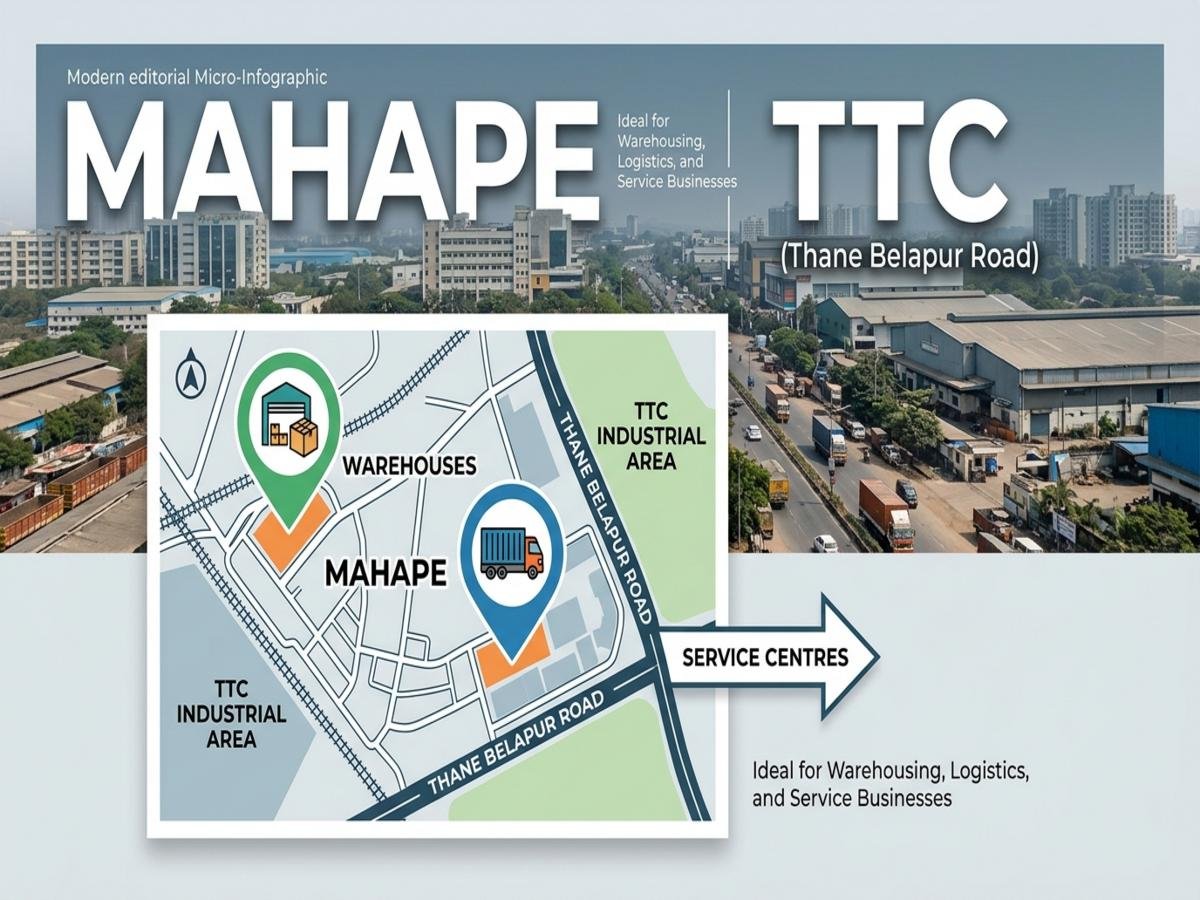
Mahape can work for warehouses and logistics support, but it is not always the best choice for every type of warehousing. It is more suitable for selected storage, service-linked logistics, electronics, spare parts, precision goods, and high-value lower-volume movement than for very heavy bulk logistics.
For large high-volume 3PL operations, users often need wider turning areas, flatter large-format movement, and faster trailer turnaround. In such cases, Turbhe, Pawane, or other logistics-heavy pockets may sometimes be more practical depending on the exact requirement.
Mahape makes more sense when the warehouse is connected to service, repair, electronics, industrial support, office operations, or nearby client servicing.
Truck Movement, Loading Bays, and Approach-Road Practicality
Truck movement is the first serious filter for warehousing in Mahape. A warehouse listing may look suitable online, but on-site movement can change the entire decision.
The user should check:
- Can a commercial vehicle enter without blocking the lane?
- Is there a separate loading bay or only roadside loading?
- Is the approach road busy during peak industrial hours?
- Is there waiting space for vehicles?
- Does the unit stay dry during heavy rain?
- Is there sufficient height for storage racks?
- Is the flooring suitable for material handling equipment?
- Is the location practical for vendors and delivery staff?
The Mahape-Shilphata side and surrounding freight corridors can face traffic pressure due to heavy commercial movement and infrastructure work. This does not make Mahape weak, but it means logistics timing must be planned properly.
When Mahape Works Better Than Turbhe or Rabale for Smaller Operations
Mahape can be a stronger fit for smaller operations that need a mix of industrial use, office support, stable power, staff access, and cleaner business surroundings.
For example, an electronics service business, spare-parts distributor, packaging support unit, or precision repair centre may find Mahape more balanced than a rougher industrial lane in an older pocket. But a heavy raw-material warehouse or large trailer-based operation may prefer a more movement-friendly logistics belt.
The right question is not “Is Mahape good for warehouses?” The better question is: “What type of warehouse activity are you running?”
Where Does Office and Commercial Demand Fit into Mahape’s Industrial Layout?
Office and commercial demand in Mahape is concentrated mainly around business-park-style and commercial pockets, especially the Millennium Business Park side and nearby office-led buildings. This demand is different from pure industrial demand.
Mahape’s office market is not the same as Vashi, Airoli, or Ghansoli. Vashi has stronger retail-commercial identity. Airoli and Ghansoli have stronger corporate and IT corridor pull. Mahape sits somewhere in between, with a stronger industrial-commercial mix.
Small Offices, IT-Support Firms, Consultants, and Back-Office Users
Mahape can work well for:
- IT support companies
- BPO and back-office teams
- Engineering consultants
- Facility management firms
- Industrial vendors
- Accounts and compliance firms serving factories
- Hardware and service-support businesses
- Training, testing, repair, and operational support teams
The advantage is that such firms can stay close to industrial clients while still operating from a more office-friendly environment. This is useful for companies that serve the TTC industrial belt but do not need a premium Vashi or Airoli address.
However, staff experience matters. If an office is inside a heavy industrial lane with poor food options, weak pedestrian access, parking problems, or poor public transport, employee retention can become difficult.
Why Mahape Is Not the Same as Vashi, Airoli, or Ghansoli Office Markets
A company choosing Mahape for office space should be clear about why it wants Mahape.
If the goal is brand visibility, client hospitality, and premium corporate image, some Airoli-Ghansoli or Vashi locations may feel stronger. If the goal is operational proximity to industrial clients, moderate cost, and access to the TTC belt, Mahape becomes more practical.
Office spaces in premium Mahape buildings or business-park pockets can attract higher rents than ordinary industrial office setups. As per the dossier, office and IT spaces in better commercial pockets such as MBP and premium standalone towers may be in the broad range of ₹100 to ₹140+ per sq. ft. per month, depending on fit-out, parking, building quality, and exact location. This should be treated as an indicative Q2 2026 estimate, not a fixed rate.
How Does Mahape’s Connectivity Change from One Sector or Pocket to Another?
Mahape’s connectivity changes sharply depending on the exact pocket. A unit close to Thane-Belapur Road is not the same as a deeper internal industrial unit toward the eastern side.
For workers and office staff, Ghansoli and Kopar Khairane railway stations are important access points. Rabale and Turbhe also matter depending on the pocket and travel route. But the last-mile journey from station to property can decide the daily comfort level.
Thane-Belapur Road Access
Thane-Belapur Road is the main movement spine for this belt. Properties closer to this road generally get better visibility, bus access, and easier recognition for clients and staff.
But this advantage comes with a trade-off. Heavy traffic, fast movement, parking pressure, and loading restrictions can make some front-facing properties less practical for industrial loading.
For office users, road visibility and bus access may matter more. For factories, internal movement and loading comfort may matter more.
Ghansoli, Kopar Khairane, Rabale, and Turbhe Station Access
For many employees, the Trans-Harbour railway line is the real daily lifeline. Ghansoli and Kopar Khairane stations are commonly used for Mahape access, depending on the exact sector. The commute from station to workplace may be manageable for some pockets and irritating for deeper internal locations.
This matters more for businesses with large staff strength. A small warehouse with 10 workers and company transport may manage easily. A 300-seat back office cannot ignore last-mile travel, autos, buses, shift timing, women employee safety, and late-evening movement.
Internal Road Movement During Working Hours
Mahape’s internal road movement can feel very different between morning, afternoon, monsoon days, and dispatch hours. A site that looks smooth during a Sunday visit may behave differently during weekday working hours.
For this reason, site visits should be done at least once during actual business timing. Check vehicle movement, illegal parking, loading queues, waterlogging marks, and how staff reach the property.
What Should a Buyer or Tenant Verify Before Trusting a Mahape Industrial Property Listing?

A Mahape listing is only the starting point. The real decision begins with documents, permissions, dues, access, and building condition.
This section is especially important because industrial and commercial properties in Mahape can involve leasehold rights, MIDC conditions, civic taxes, old liabilities, fire compliance, permitted use, and transfer approvals.
MIDC Use, Building Permissions, Fire Compliance, and Sanctioned Activity
A buyer or tenant should verify the permitted use before signing. A property suitable for electronics assembly may not automatically be suitable for chemical storage, heavy fabrication, food processing, or a dense BPO office.
Check the sanctioned use and building approval. If the business activity does not match the approval, future notices, operational stoppage, or compliance cost may arise.
Fire compliance also matters. Offices, warehouses, and industrial units may need different safety arrangements. Do not assume that an old building is automatically compliant because another business was operating there earlier.
Power Load, Water, Drainage, Parking, and Maintenance Control
Mahape has important industrial infrastructure, including high-capacity power support in the belt. But the practical availability of power load still depends on the building, connection, transformer capacity, and sanctioned usage.
A site visit should verify:
- Existing sanctioned power load
- Scope for load enhancement
- Water supply
- Drainage condition
- Flooding history
- Parking availability
- Lift and goods movement
- Maintenance responsibility
- Access for emergency vehicles
- Waste disposal system
Monsoon risk must not be ignored. Some Mahape-MIDC areas and junction-side stretches have faced waterlogging concerns, especially when heavy rainfall, drainage limitations, and local topography combine. A dry-season visit alone is not enough.
Leasehold, Transfer, and Documentation Checks
Most TTC/MIDC-style industrial assets are better understood as leasehold transfer rights rather than simple freehold land purchase. The exact legal position must be checked through documents.
The dossier highlights that NMMC property tax compliance has become a major issue after April 2026 legal developments and recovery action. Therefore, an updated no-dues position should be checked carefully before any transaction.
For buyers and long-term tenants, the verification should include:
| Verification Point | Why It Matters |
|---|---|
| MIDC allotment or lease documents | Confirms original rights and usage conditions |
| Permitted use | Ensures the planned business can legally operate |
| Building Completion Certificate or approval status | Helps verify whether construction is authorized |
| Fire NOC, where applicable | Critical for safety and operational permissions |
| NMMC property tax dues | Prevents inheritance of old liabilities |
| Transfer premium and charges | Affects real acquisition cost |
| ULC-related conditions, if any | May create extra cost or restrictions on transfer or use change |
| Electricity load documents | Prevents later power-capacity problems |
| Water and drainage status | Important for production, storage, and monsoon safety |
| Indemnity clauses in agreement | Protects buyer or tenant from past dues and hidden liabilities |
Mahape Versus Rabale, Ghansoli, Turbhe, and Kopar Khairane: Which Nearby TTC Pocket Suits Which User?
Mahape should not be selected only because it is centrally located. It should be selected because its operating character matches the business.
The nearby TTC and Navi Mumbai pockets each have a different personality.
| Area | Stronger Fit | Practical Difference |
|---|---|---|
| Mahape | Hybrid industrial-commercial activity, electronics, service units, back offices, selected warehousing | Balanced mix of industrial use and office ecosystem |
| Rabale | Heavy engineering, fabrication, rugged industrial work, older industrial setups | Stronger raw industrial identity but less polished for office users |
| Ghansoli | Corporate offices, IT/ITES, staff-heavy businesses | Better office pull but less suitable for heavy freight movement |
| Airoli | Premium corporate, IT parks, data and enterprise-linked office demand | Stronger commercial image, higher cost, more commuter pressure |
| Turbhe/Pawane | Logistics, APMC-linked movement, warehousing, movement-heavy businesses | Often more practical for goods movement and distribution |
| Kopar Khairane | Smaller businesses, residential-worker access, local service offices | Useful for staff convenience but not always suitable for heavy industrial operations |
Mahape is the hybrid option. That is its strength. But the same hybrid character can also confuse buyers and tenants. A heavy steel fabrication unit may find Rabale more practical. A premium corporate office may prefer Airoli or Ghansoli. A large logistics operator may prefer Turbhe or Pawane. A precision industrial business with office support may find Mahape very suitable.
What Type of Property Makes the Most Sense in Mahape for Different Users?
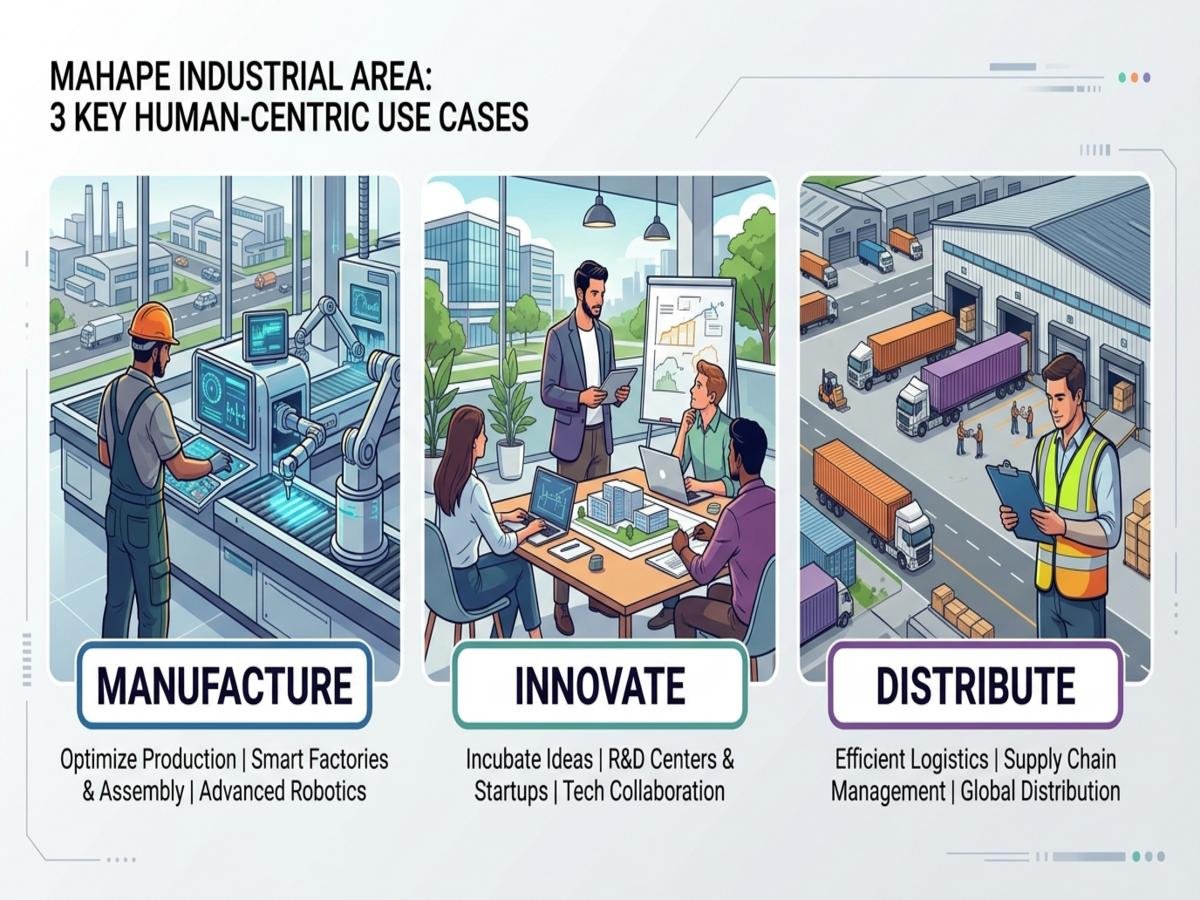
The right property in Mahape depends on the user profile. A small manufacturer, IT firm, warehouse operator, and investor should not use the same checklist.
A good Mahape property is not always the cheapest one. It is the one where the rent, permission, access, structure, and business use align.
Common Map-Reading Mistakes People Make While Judging Mahape
The biggest mistake is assuming that a pin on the map tells the full story. In Mahape, it does not.
A property may look close to Thane-Belapur Road but still be unsuitable for loading. Another may look deep inside the industrial grid but may have better road width and calmer movement. A third may appear office-friendly but may lack parking, fire systems, or staff convenience.
Common mistakes include:
- Assuming all Mahape sectors support the same type of business
- Choosing a property only because it is close to a main road
- Ignoring truck turning space and loading movement
- Visiting only during non-working hours
- Not checking monsoon waterlogging history
- Treating an industrial gala like a commercial office
- Assuming MBP-style office demand applies to all Mahape buildings
- Ignoring NMMC tax dues and MIDC transfer conditions
- Not checking actual sanctioned use
- Comparing rent without checking power load, height, and structure
The smarter approach is simple: read the map first, but trust the site visit, documents, and operational checks more.
Conclusion
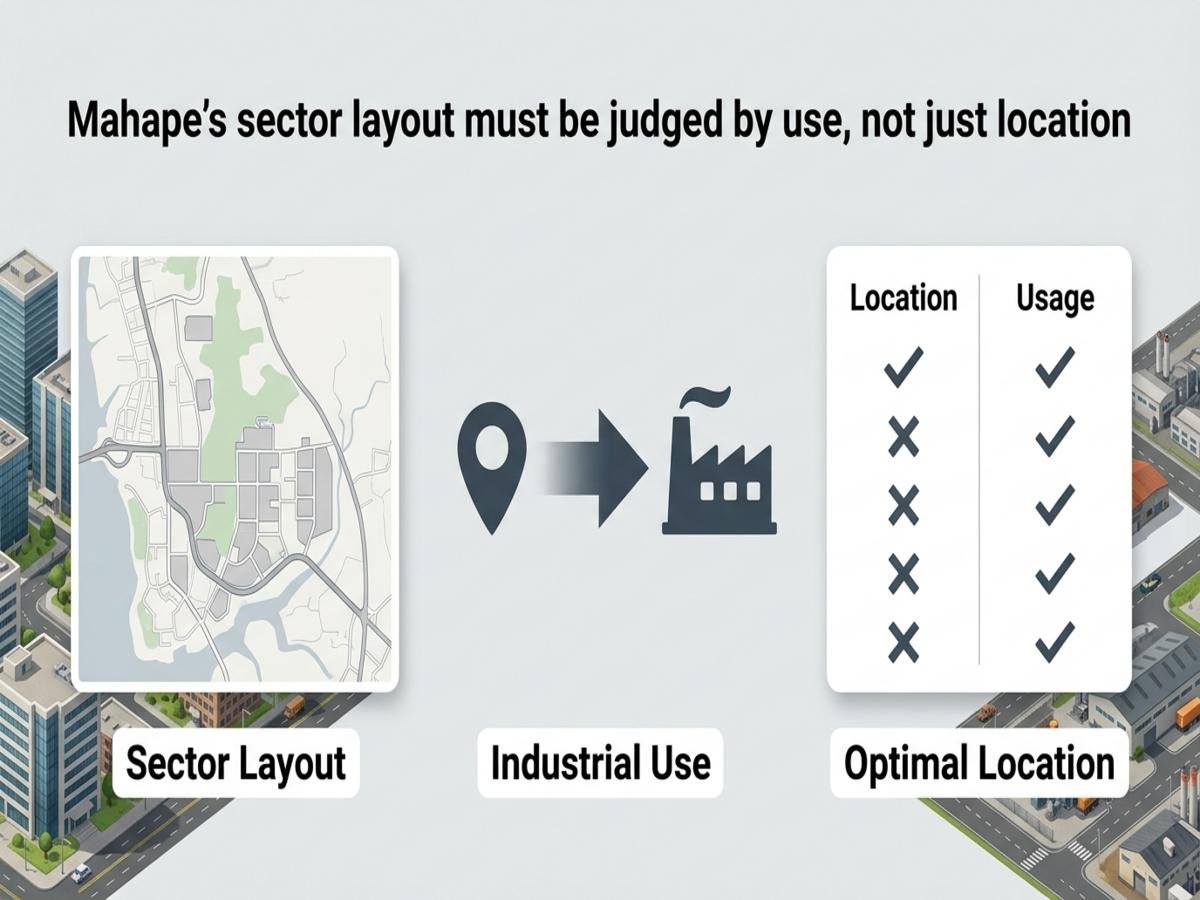
Mahape’s Sector Layout Must Be Judged by Use, Not Just Location
Mahape is one of the most strategically useful pockets in the TTC Industrial Area because it combines industrial activity, electronics, offices, service businesses, and selected warehousing within one working micro-market. But this strength also makes it easy to misread.
The right Mahape pocket depends on what the business actually needs. A factory needs road width, slab strength, power load, loading access, and permissions. A warehouse needs height, dry storage, truck movement, and dispatch timing. An office needs parking, commute comfort, fire safety, and building quality. An investor needs clean documents, tax clarity, transfer conditions, and realistic tenant demand.
Mahape is attractive when the exact pocket, sanctioned use, road access, drainage condition, power capacity, and building format match the business requirement. Without those checks, even a good-looking Mahape property can become an expensive operational mistake.
FAQ's
Frequently Asked Questions