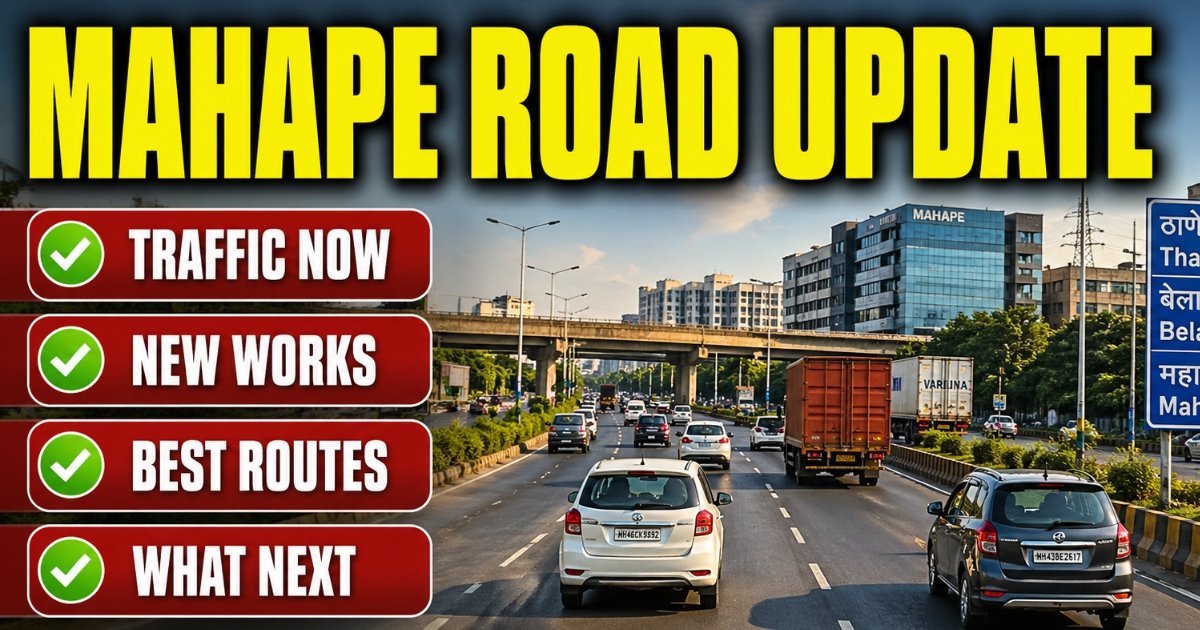
Thane Belapur Road Mahape: Complete Local Guide to Connectivity, Traffic and Property Impact
Thane Belapur Road Mahape is one of Navi Mumbai’s most important work corridors, connecting the TTC industrial belt with Mahape’s IT and corporate hub around Millennium Business Park. It gives strong road access toward Airoli, Ghansoli, Kopar Khairane, Turbhe and Thane, but the same stretch also faces heavy peak-hour traffic, truck movement, poor walkability, pollution concerns and rising real estate pressure in nearby residential nodes. Where exactly is Mahape on Thane-Belapur Road, and what areas does it cover? Thane Belapur Road is the main arterial road of the Trans-Thane Creek industrial and commercial belt. The full road is around 15.1 km long and connects the Sion-Panvel Highway side near Turbhe in the south with the Kalwa / Thane side in the north. Mahape is not the whole Thane Belapur Road. It is one important central stretch on this larger corridor. In practical local terms, the Mahape stretch sits between the Rabale-Ghansoli side and the Turbhe-Pawane side. It is strongly linked with Mahape MIDC, Millennium Business Park, corporate offices, IT parks, industrial units, warehouses, service businesses and daily office traffic. For a person searching “Thane Belapur Road Mahape”, the simplest way to understand it is this: Mahape is the point where Navi Mumbai’s older industrial belt and newer IT-office economy meet on the same road. Quick Summary: Thane Belapur Road Mahape Point Practical Details Location Type Major road stretch inside Navi Mumbai’s TTC industrial and IT corridor Main Identity IT, industrial, commercial and office connectivity belt Key Nearby Areas Ghansoli, Kopar Khairane, Rabale, Airoli, Pawane, Turbhe Main Work Hub Millennium Business Park, Mahape MIDC and nearby corporate offices Nearest Railway Access Ghansoli and Kopar Khairane on the Trans-Harbour line Best Use Case Office commute, commercial access, IT employment, industrial movement Main Problem Peak-hour traffic, truck movement, weak pedestrian comfort and pollution concerns Real Estate Impact Strong rental demand in nearby Ghansoli and Kopar Khairane because of office crowd From Mumbai or Thane side, many commuters enter this corridor through Airoli and move south towards Rabale and Mahape. From Panvel, Pune or Vashi side, traffic generally approaches through Turbhe or the Sion-Panvel Highway side and moves north. This is why Mahape behaves like a working junction, not just a road name. It carries office commuters in cars and buses, shared autos from railway stations, trucks serving industrial units, and regional vehicles moving toward bigger highway links. Why Is the Mahape Stretch So Important in Navi Mumbai? Mahape is important because it is one of Navi Mumbai’s strongest employment zones. It is not only an industrial area anymore. Over the years, the Mahape stretch has become a mix of IT offices, industrial plots, business parks, service companies, logistics activity and corporate support operations. The biggest anchor here is Millennium Business Park in Mahape MIDC. It is known for major technology and corporate offices, including companies such as Capgemini, TCS and LTIMindtree. For many employees from Thane, Airoli, Ghansoli, Kopar Khairane, Vashi and Panvel side, Mahape is a daily work destination. This is the main reason why the Thane Belapur Road Mahape stretch has a different character compared to many other industrial roads. It is not only about factories and goods movement. It is also about white-collar employment, IT teams, BPO staff, data operations, office parks, security staff, transport vendors and small service businesses that survive around corporate campuses. A simple road near a work hub can quietly change the economics of nearby areas. That is exactly what happened here. Ghansoli became more attractive for renters because it gives faster access to Mahape offices. Kopar Khairane remained useful because it offers older residential supply, markets and better everyday convenience. Airoli gained from its large IT and office ecosystem. Mahape sits in the middle of all this employment movement. The “frontage” reality many investors miss For IT companies and office buildings, Thane Belapur Road frontage is valuable because it gives visibility, easier employee access and stronger brand presence. But for heavy industrial or logistics users, road frontage is not always a simple advantage. Large trucks need turning radius, gate access, loading space, waiting area and predictable entry-exit timing. On a fast, busy road with traffic pressure and peak-hour restrictions, a property directly on the main road can become difficult to operate. So the same location can be excellent for an office but uncomfortable for a truck-heavy industrial unit. This is an important point for commercial buyers and tenants. What Is the Real Traffic Scene on Thane Belapur Road Mahape? Traffic on the Mahape stretch is serious during office hours because the road is shared by very different types of users. IT employees, private cars, company buses, NMMT buses, shared autos, delivery vehicles, industrial trucks and regional freight vehicles all use the same corridor. Morning and evening peak hours can become slow, especially around major junctions, office entry points and flyover approaches. In non-peak hours, the same route may feel manageable. But during peak time, a short distance can take much longer than expected. The main issue is not only vehicle count. The problem is vehicle mix. A car going to Millennium Business Park, a shared auto from Ghansoli station, a company bus dropping employees, and a heavy vehicle moving toward an industrial plot do not behave the same way on the road. Their speed, turning pattern and stopping behavior are different. This creates friction. Common traffic pressure points The Mahape-Rabale belt often sees congestion because of: office entry and exit timings heavy vehicle movement junction-level signal delays company bus stoppages autos slowing near pickup and drop points trucks struggling at turns or flyover climbs local cross-traffic from interior MIDC roads During severe congestion, traffic police may manually control movement instead of fully depending on automated signals. This usually helps main corridor flow, but it can delay vehicles trying to cross or enter from interior roads. Caution for daily commuters: Google Maps timing can be misleading during office hours on this stretch. A normal 10 to 15 minute movement can stretch sharply if there is
Read More